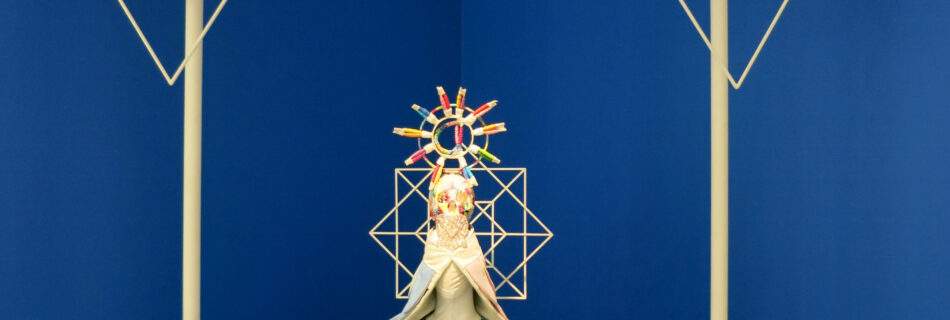
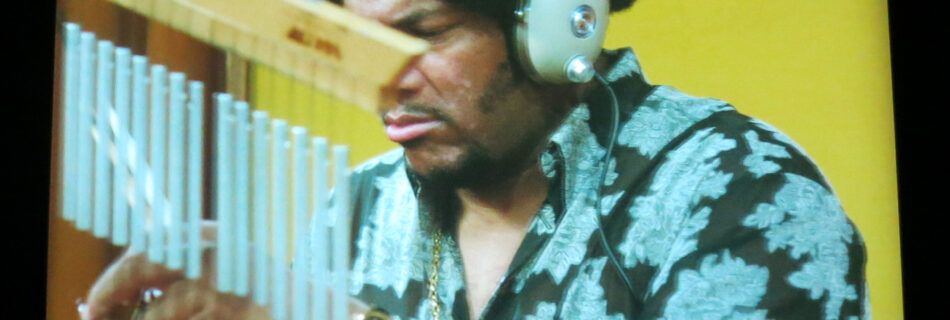
What is music when you can’t hear it? ‘Silent Disco,’ a new video work by British artist Sonia Boyce at Hauser and Wirth Gallery in Chelsea, features headphone-wearing people dancing to music that the audience can’t hear. In an added twist, the dancers are listening to two separate channels, dancing near others who may or may not be hearing what they are. The dancers’ interactions, movements and obvious enjoyment become subject matter, positioning dance in a new light and maybe even tempting gallery visitors to join in with their own moves. (On view in Chelsea through Oct 18th).
Sonia Boyce, Silent Disco, 3-channel colour video with sound, duration 9:42 min, 2025.
Groans of pain and the sound of encouraging voices greet visitors to Carolyn Lazard’s solo at Artists Space where two videos and an installation of linoleum flooring center on women’s medical experience. While most visitors will overlook the show’s soft institutional flooring, the drama of a birthing scene in ‘Fiction Contract’ grabs the attention immediately. Peering over the shoulder of a team of midwives in Elmhurst Hospital in Queens as they run into difficulty delivering a baby, our absorption little reduced by the fact that the patient and infant are mannequins. Part of a training exercise facilitated by the Maternal Mortality Reduction Program, the simulated scenario encourages audiences to consider the complexity of birthing situations, the professionalism of staff and the importance of funding to ensure equitable health care. (On view through May 10th in Tribeca.)
Carolyn Lazard, still from ‘Fiction Contract,’ single-channel video, color, sound, at Artist’s Space, April 2025.
Though twelve paper sculptures hang from the gallery ceiling, a grid of drawings covers one wall and a video projection takes over another in Gladstone Gallery’s cavernous 21st Street space, Joan Jonas’ new installation ‘Empty Rooms’ feels more subtly presented than many of her past multimedia works. Overhead, boxy forms dominate the gallery, floating like geometric clouds or 3-D kites and lit from within like lanterns. Made of wrinkled paper (along with lights and steel frames), the sculptures connect with a towering grid of similarly textured paper bearing drawings of leafless trees. Featuring the silhouette of a turbine and a young woman, a monochrome video adds a human actor to this enigmatic but intriguing view of the natural world. (On view in Chelsea through April 12th).
Joan Jonas, Empty Rooms (installation view) at Gladstone Gallery, March 2025.
In an interview accompanying her recent show at the Smithsonian American Art Museum, iconic photographer and artist Carrie Mae Weems said, “I know that I will be living with injustice for the rest of my life,” before going on to express her determination to advocate for change as it is currently needed. Her 7-part video ‘Cyclorama: The Shape of Things,’ now on view at Gladstone Gallery after several museum appearances, combines vintage film of circus acts, footage from Amy Cooper’s notorious 2020 Central Park phone call, and scenes from the January 6th insurrection with shots of methodically moving contemporary dancers and more in a collage of imagery that ranges from beautiful to horrifying. Projected on a circular screen like a 19th century narrative painting accompanied by changing lights and sound, Weems immerses us in the present moment, amplifying and clarifying the conversations and conflicts of the day. (On view at Gladstone Gallery through Nov 9th).
Carrie Mae Weems, installation view of Cyclorama: The Shape of Things, A Video in 7 Parts, 2021, 7 parts, duration: 40 min, Barbara Gladstone Gallery, September 2024.
Iconic Swiss video artist Pipilotti Rist is acutely attuned to the comfort of her audiences. Visitors to her atrium-filling video installation at MoMA in 2008 might have lounged on a low couch while another level of relaxation – beds – awaited at the artist’s New Museum retrospective in 2016. Rist’s current show at Hauser & Wirth Gallery in Chelsea offers both a bed and assorted furniture, enticing the public into the artwork itself to be bathed in constantly morphing patterns and images. Rist (seen in this photo conversing with visitors) conceived of Hauser & Wirth’s back gallery space as a living room; her simultaneous show at Luhring Augustine Gallery is a projection-filled back yard. (On view at Hauser & Wirth through Jan 13th and at Luhring Augustine through Feb 3rd).
Pipilotti Rist, (installation view) Welling Color Island West, video installation with projector skirt, projection on carpet, plants and furniture, silent, unique, dimensions variable, 2023.
20th century new media pioneer Nam June Paik integrated nature and technology in iconic artworks like his TV Garden (monitors set amid live plants) and robots that mimic the human figure. One of the robots is a standout in Gagosian Gallery’s current two-part exhibition of multi-media work from Paik’s career. Composed of radios – mass produced, found objects that spread information and culture globally – Paik’s late career robot sculptures don’t move, rather their bodies feature movement via circular inset monitors. Excited by the merger of technology, art and music and the advance of technology into daily life, Paik used TV sets like canvases and constructed cellos from stacked monitors. Both on display in the current show testifying to the artist’s hopeful and creative vision. (On view in Chelsea through July 22nd and at Gagosian’s uptown from July 19th – Aug 26th).
Nam June Paik, Bakelite Robot, single-channel video, LCD color monitors, electric lights, media player and permanent oil marker, 49 ½ x 58 x 7 inches, 2002.
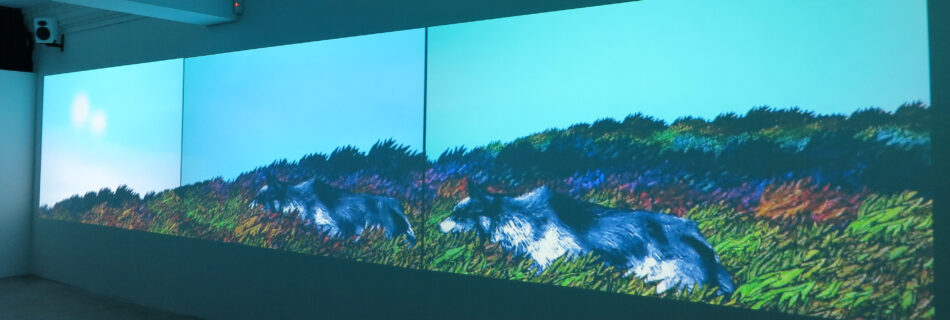
In his latest multi-screen video installation, ‘Wilderness’ at 303 Gallery, renowned artist Doug Aitken asks, “How far we will continue to evolve, and at what cost?” Aitken’s last major show in ‘18 at his Chelsea gallery featured communications expert and cell-phone pioneer Martin Cooper pondering how connected we actually need to be. Here, the artist takes this train of thought further, shooting footage on the beach near his Venice home to suggest land’s end as a kind of metaphorical end to pre-digital life. Beachgoers mouth phrases like ‘You sound so sweet and clear but you’re not really there,’ but the audio is from AI generated digital voices. Alluring and alarming, Aitken’s scenes give pause for thought as we witness hands photographing the sunset becoming hands that hail the new. (On view through May 27th).
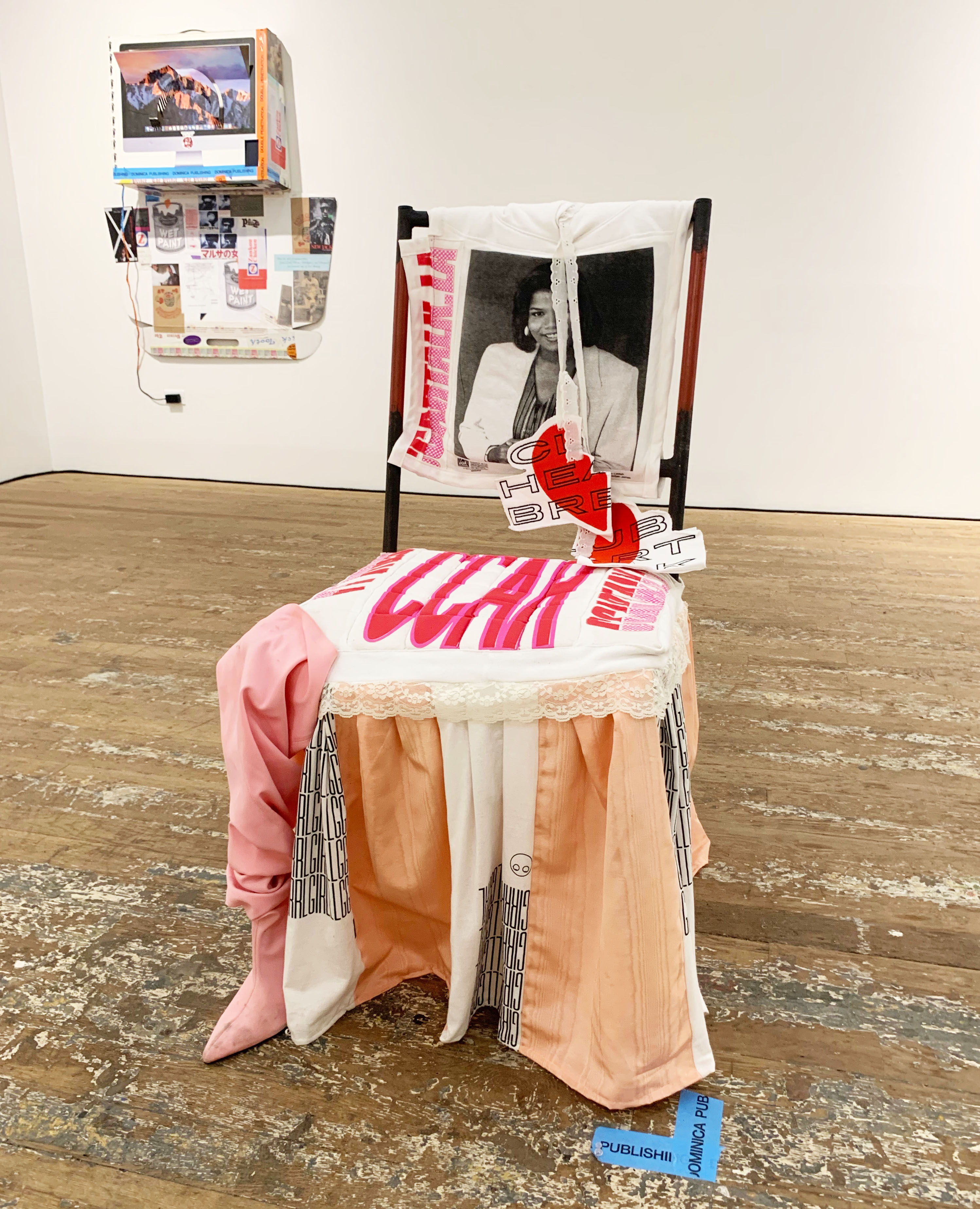
Martine Syms fans expect a stream-of-conscious outpouring of text and image (as in her recent diaristic book, ‘Shame Space’) and her latest solo at Bridget Donahue will not disappoint. Videos housed in custom, laser-cut cardboard boxes covered in fragments of commercial imagery or even inserted into a corner of a hanging dry cleaning bag run counter to typical sleek gallery video presentations. Positioned in front of one video wall, this chair titled ‘Bonnet Core’ sports frilly lace at the edges, abundant text and a high heeled pink boot next to one chair leg. Accompanied by a press release written by Alissa Bennett detailing enthusiastic engagement with an auction of Janet Jackson’s belongings earlier this year, the show speaks to our deeply personal yet shared experience of pop culture. (On view through Sept 25th on the Lower East Side).
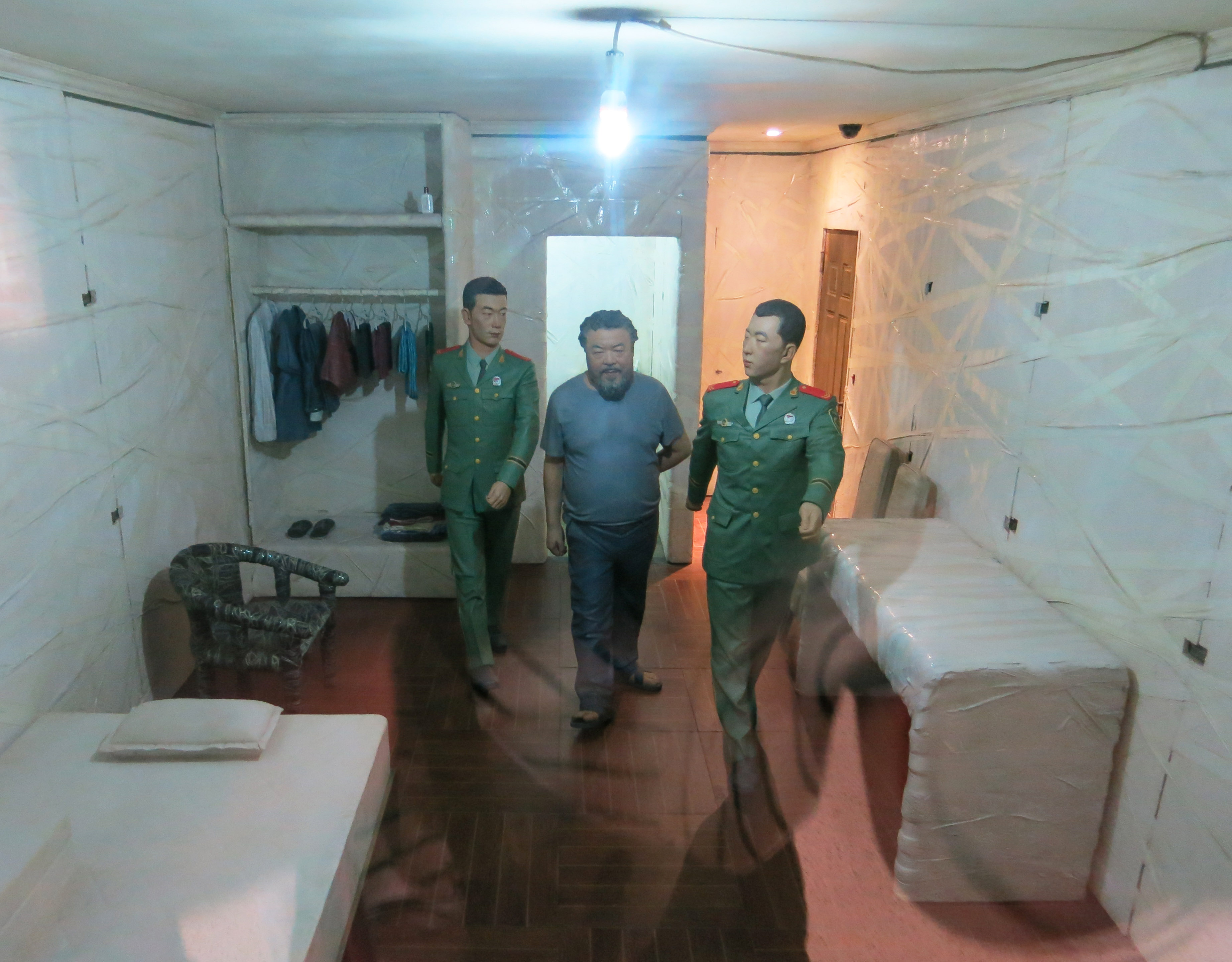
Arrested and held by the police for 81 days in Beijing in 2011, politically outspoken artist Ai Wei Wei was eventually accused of tax evasion, charges which he fought in court. Lisson Gallery is currently showcasing one of the several artistic responses Ai Wei Wei has made since, a nearly 7-hour long Henan Opera that recreates the court proceedings in language, “…couched in complex, obfuscating legalese and riven with dead ends.” (Lisson Gallery). Pictured here is an image from New York Art Tours’ archive of Ai Wei Wei’s first artwork in response to his detention, an installation recreating scenes from his prison life that was on view at the Brooklyn Museum in 2014. (‘Heaven and Earth’ is on view at lissongallery.com through June 15th).
S.A.C.R.E.D., six dioramas in oxidized metal, wood, fiberglass, polystyrene and sticky tape, 2013.
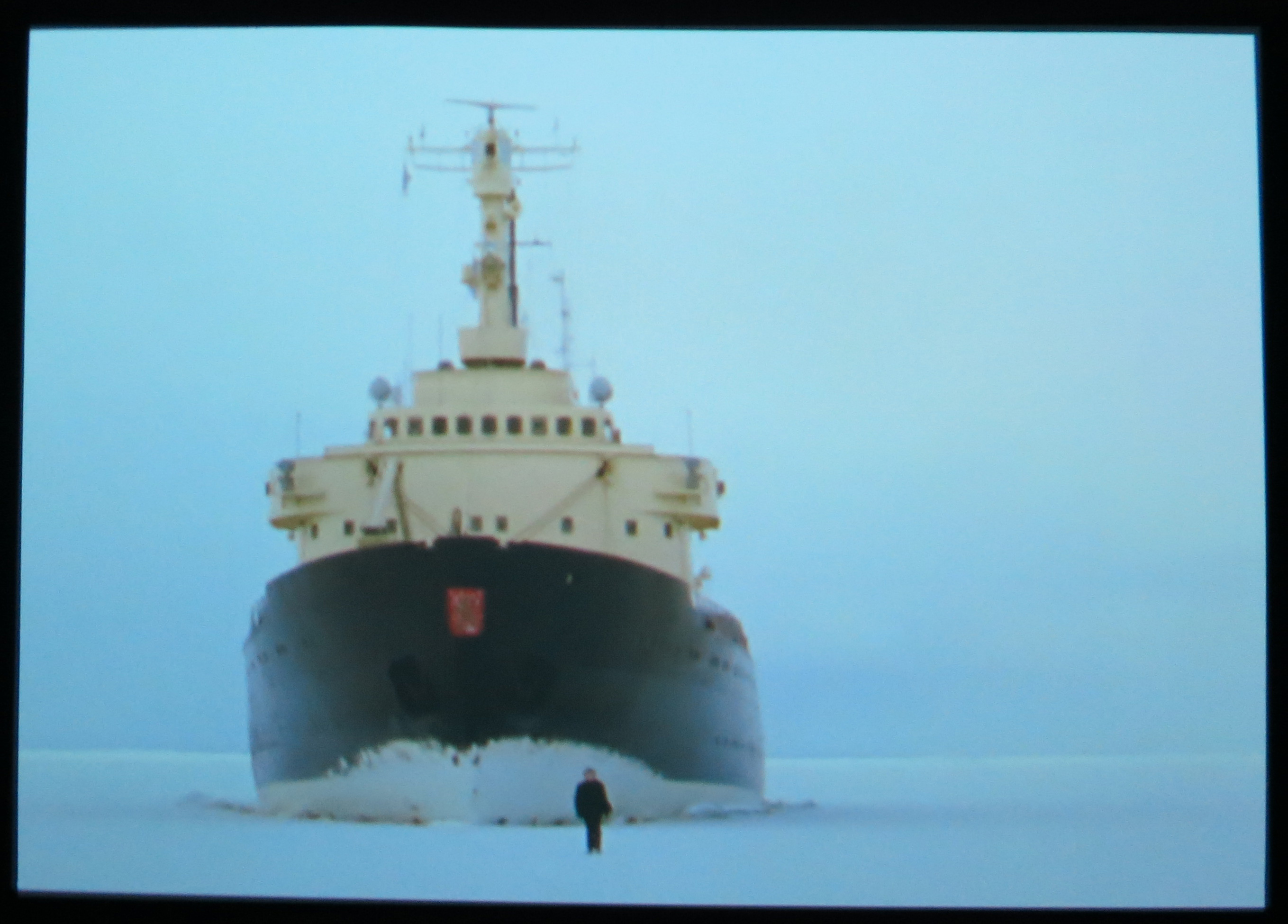
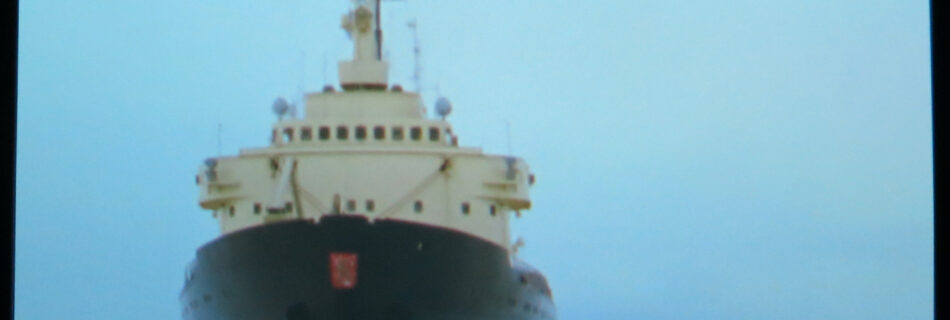
One of Dutch artist Guido van der Werve’s best known performances involved walking just 16 yards in front of an ice breaking ship in the Baltic sea, an example of the physical punishment and risk he’s willing to endure for his art. Now for a new on-line exhibition, Luhring Augustine Gallery, GRIMM Gallery and Monitor Gallery are teaming up to present still photographs from the artist’s mind-bending 2012 performance ‘Nummer Veertien, home,’ for which he swam, biked and ran 1,200 miles across Europe. Van der Werve’s journey began at the location of Chopin’s interred heart (Warsaw) and ended at the Pere Lachaise cemetery in Paris where the rest of the composer’s body is buried. In Paris, the artist delivered a small container of soil from outside Chopin’s childhood home, connecting the two places and creating a profound link between his own history and that of his favorite composer. (On view through June 19th).
Guido Van Der Werve, Nummer acht, Everything is going to be alright, 16mm to HD, 10 minutes, 10 seconds, 2007.
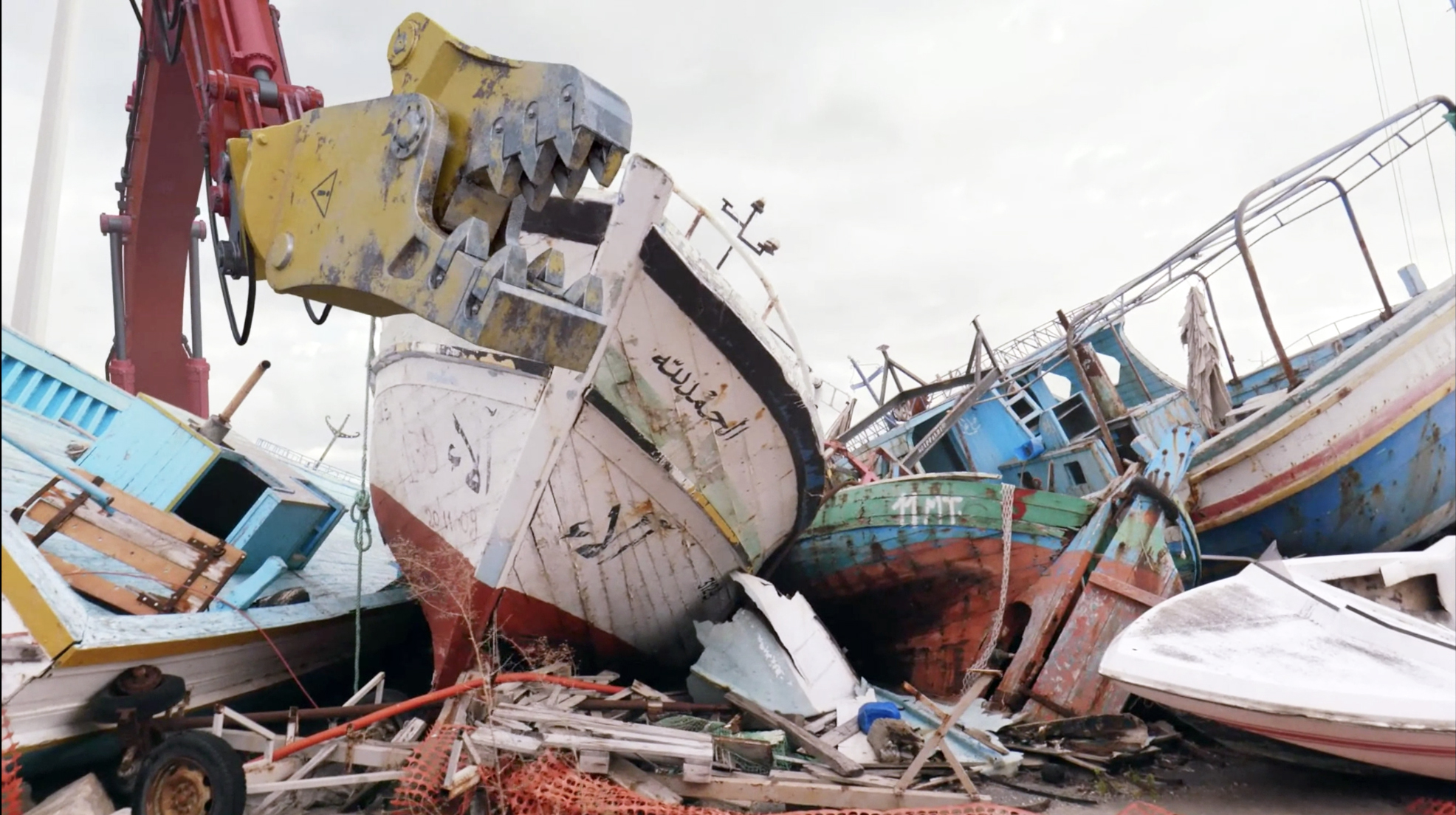
London and Berlin-based artists and photography professors Adam Broomberg & Oliver Chanarin’s short film, ‘The Bureaucracy of Angels’ grabs the imagination immediately with an unlikely casting choice; the star of the show – a mechanical wrecking arm – makes a riveting appearance as a soulful ballad singer lamenting the pain of migration. Currently available to watch via the Lower East Side gallery Signs & Symbols’ website, the piece’s premise is absurd but the effect is first mesmerizing, then moving. Part destroyer, part guardian, the machine keeps watch over migrants being intercepted by rescue agencies before eventually wrecking boats abandoned by travelers who made it to Sicily. (Available online at signsandsymbols.art through May 13th).
Broomberg & Chanarin, still from ‘The Bureaucracy of Angels,’ 2017.
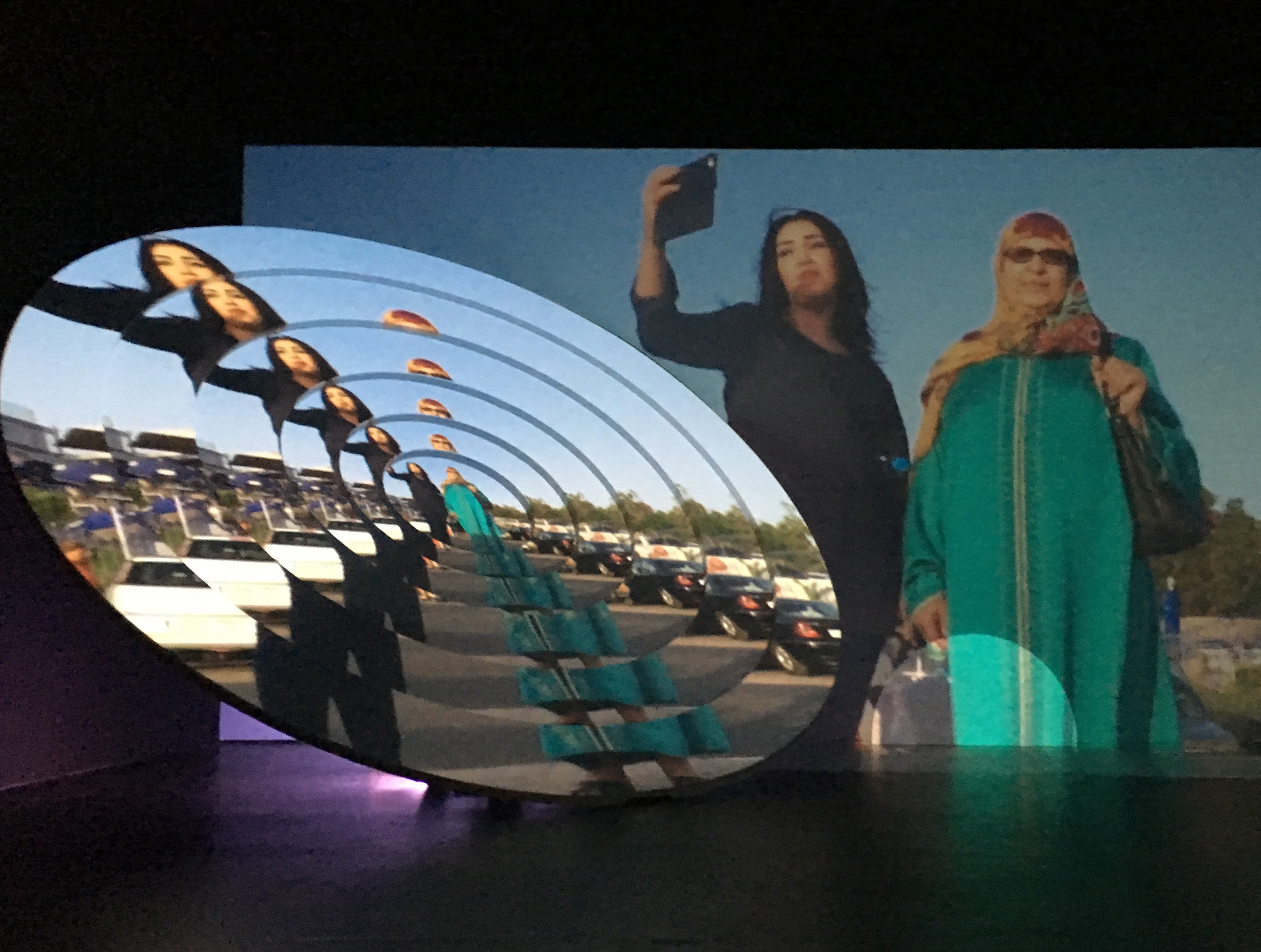
Two Moroccan women navigate the changing face of traditional Aita music in Meriem Bennani’s mesmerizing video ‘Siham & Hafida’ from ’17, seen here at The Kitchen in a photo from New York Art Tours’ archive. Two quite different characters – a pair of lizards in Brooklyn – navigate a separate set of challenges in Bennani’s new video series, launched with filmmaker friend Orian Barki in mid-March as a break from COVID-19 mandated isolation. Entertaining and short, the videos speak to the surreal quality of life during the pandemic. (Episode One. Episode Two).
Meriem Bennani, still from the video installation Siham & Hafida, The Kitchen, 2017.
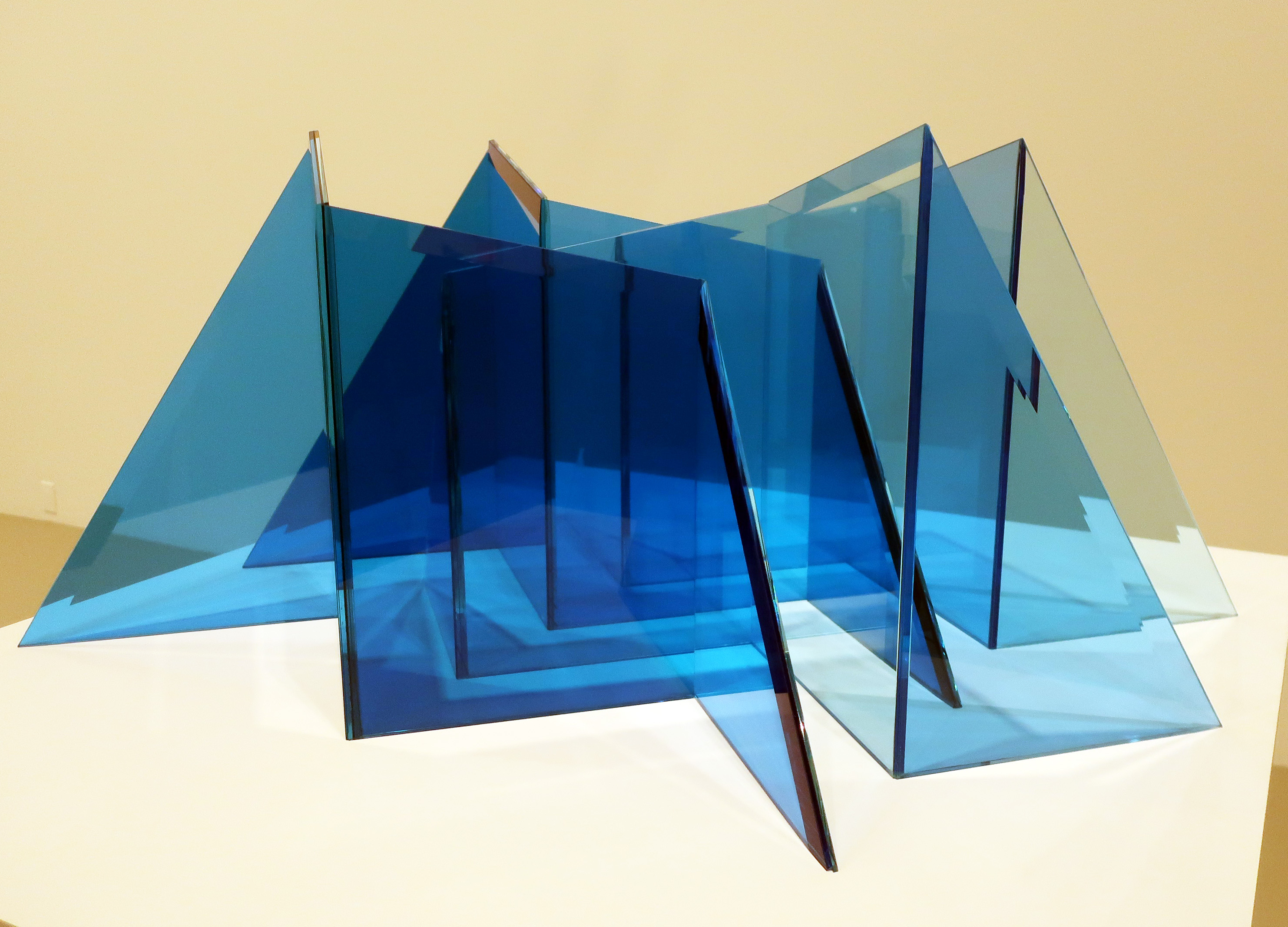
Operating under the premise that, “Art makes a positive difference at all times and in all circumstances” Hauser & Wirth Gallery has reverted to on-line exhibitions and other Internet-accessible strategies to make art available. The gallery’s recently released exhibition walk-through with Light and Space artist Larry Bell wonderfully conveys Bell’s exploration of how glass ‘reflects, absorbs and transmits light.’ We can’t visit the artist’s reflective glass panels right now (seen here in a smaller sculpture), but the next best thing is watching him activate his ‘Standing Wall’ installations to shift the space around him.
Larry Bell, Iceberg SS, French Blue, Capri Blue, Periwinkle, and Turquoise laminated glass, 4 parts, unique, dimensions variable, 2020.
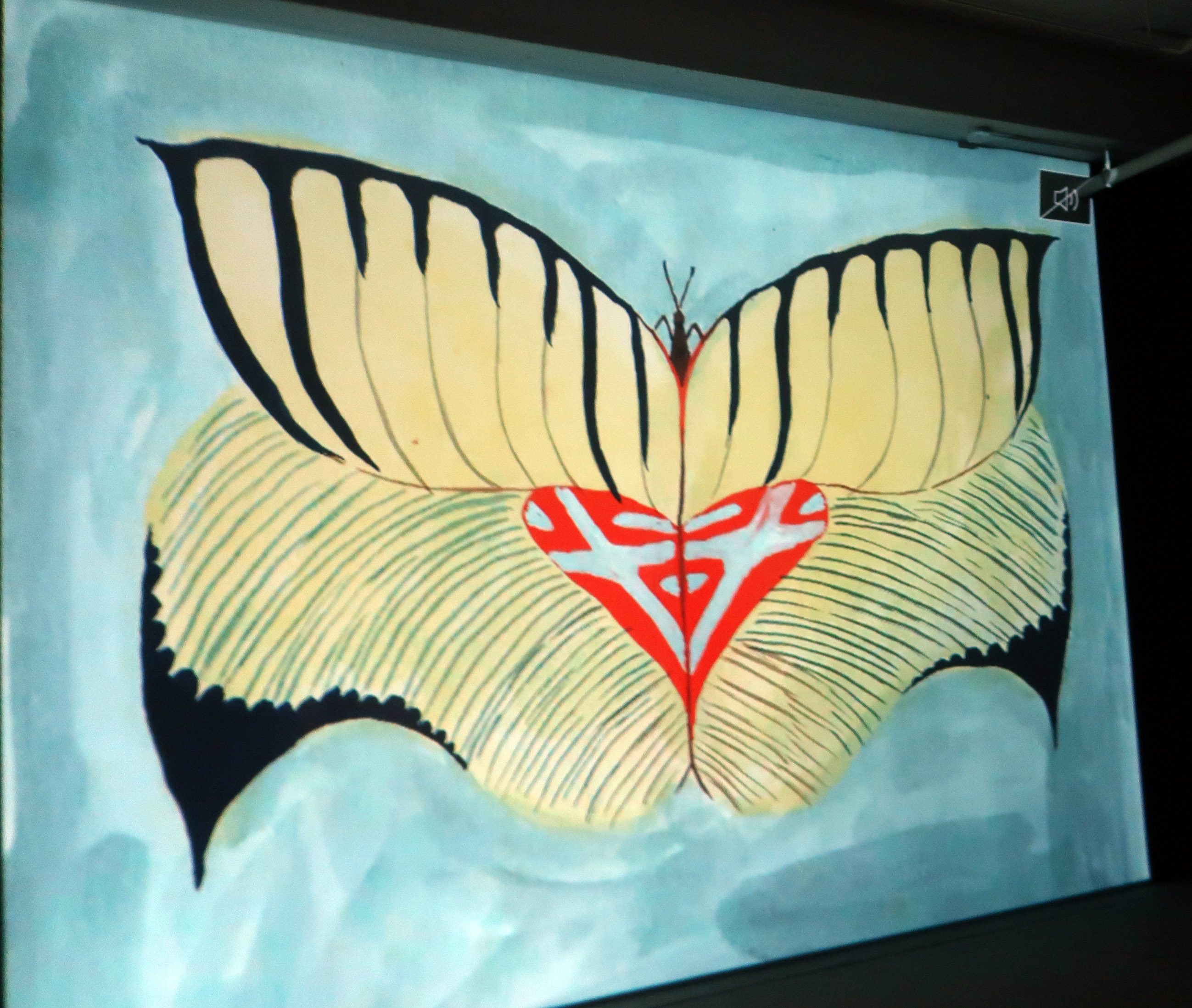
‘Moth,’ a 3-minute stop motion animation by Allison Schulnik was a highlight of her PPOW Gallery show in Chelsea and is also available on Vimeo. Over 14 months, Schulnik painted gouache on paper frames for the piece, following a moth’s unconventional metamorphosis into a variety of creatures. Created after a move from LA to the desert landscapes of Sky Valley, CA, and while becoming a mother, Schulnik’s personal transformation inspired an engrossing mediation on change. (Chelsea’s PPOW Gallery is closed to the public to help stop the spread of COVID-19, but Moth can be seen on Vimeo).
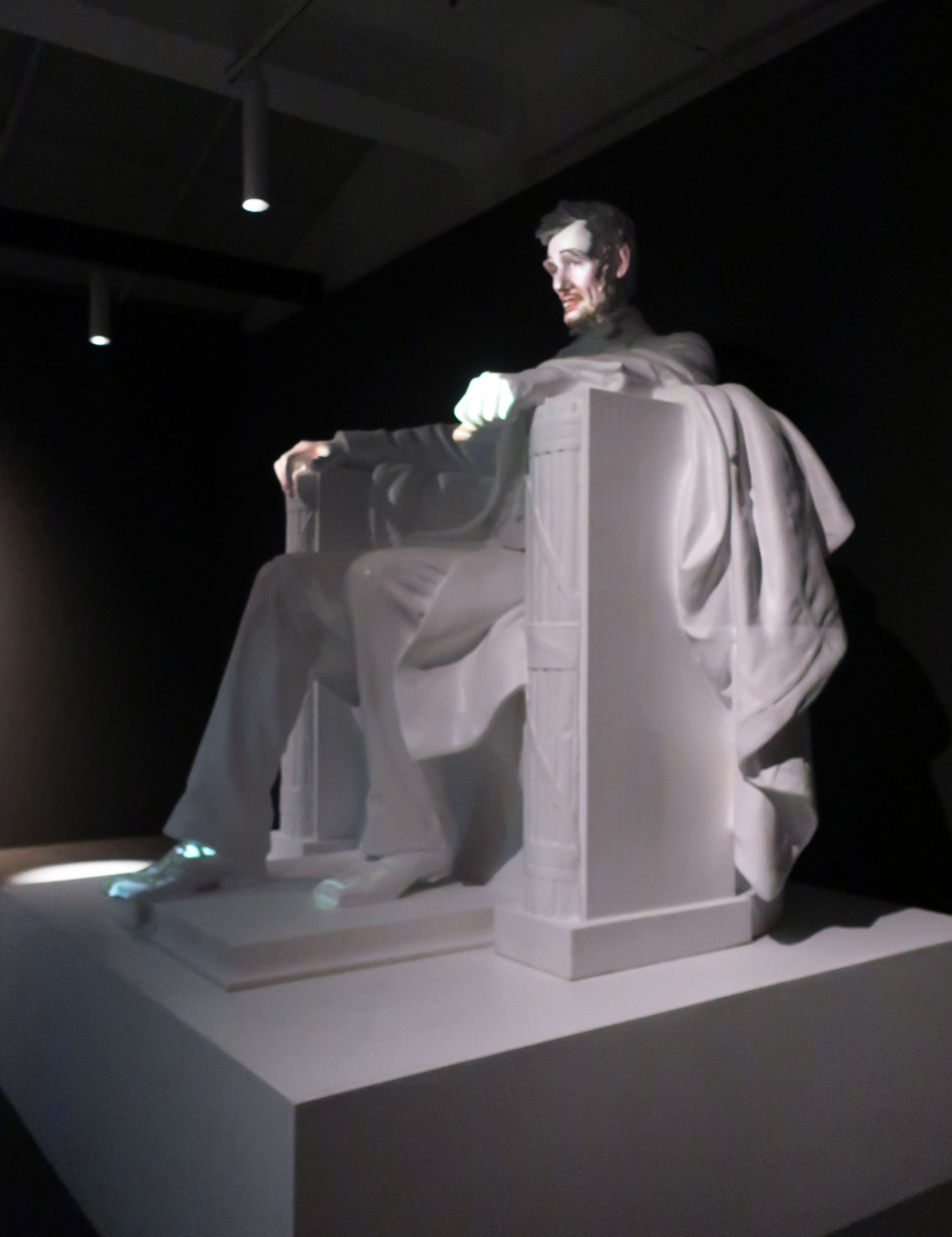
Abraham Lincoln morphs into a teenager, a senior, a woman in glasses and other characters in Krzysztof Wodiczko’s ‘A House Divided…’, as interviews shot with a variety of Staten Island citizens with varying political views are projected onto two replica of the Lincoln Memorial at Chelsea’s Galerie Lelong. In some exchanges, friends acknowledge their differences while respecting each other; in other conversations, barriers remain high. Wodiczko’s goal is to encourage the exchange regardless, making dialogue the goal of his art production. (On view through March 7th).
Krzysztof Wodiczko, A House Divided…, 4K video projection on sculpture, figure height: 98.4 inches, 2019.
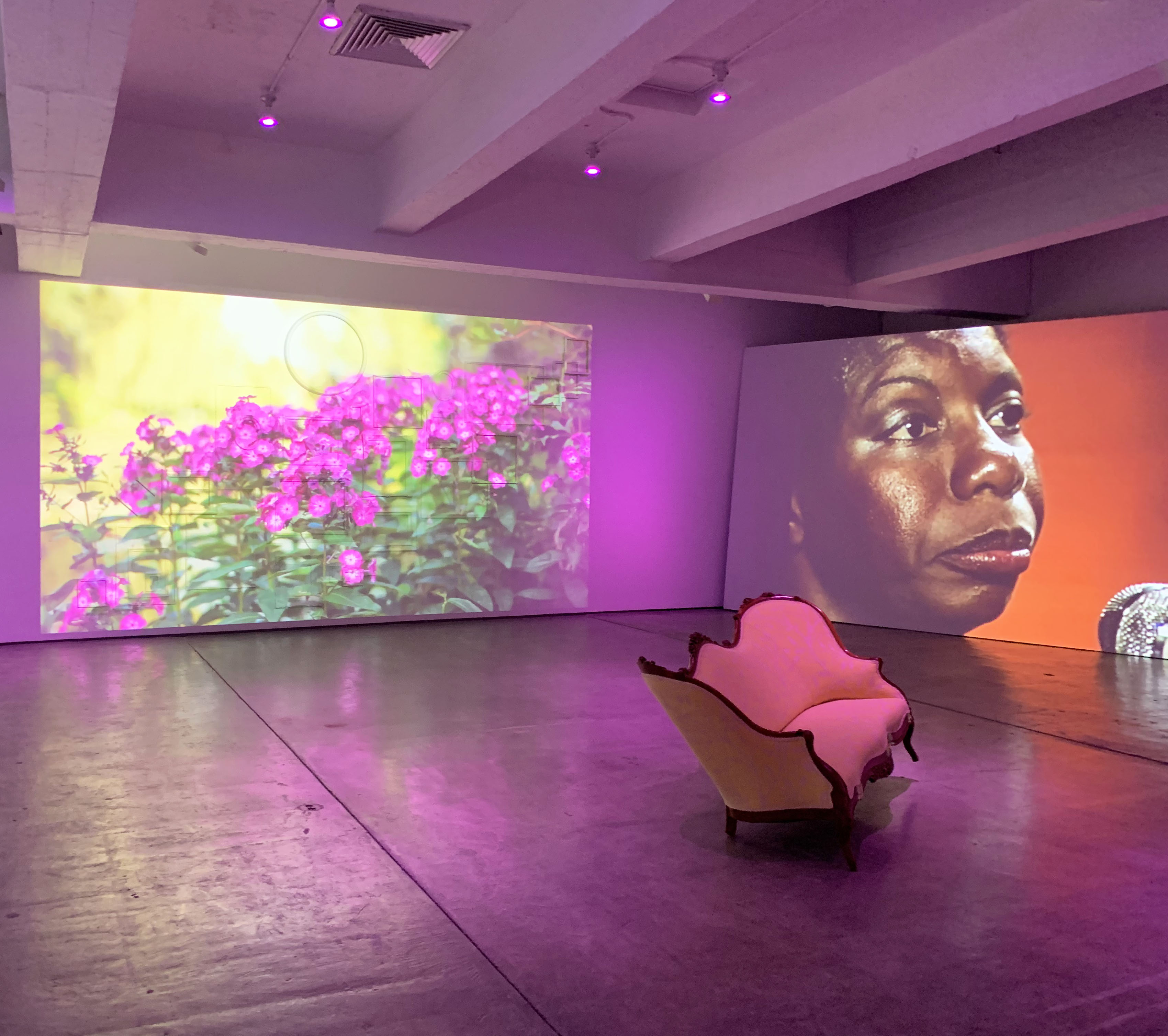
Ja’Tovia Gary pictures the variety in Black womanhood in her new three-channel video installation at Paula Cooper Gallery with footage shot of the artist in Monet’s garden at Giverny intercut with video of Nina Simone’s 1976 performance at the Montreux Festival and street corner interviews with women of African descent in Harlem. Through direct animation on archival film, internet footage and her own images as well as montage, Gary employs a variety of techniques to present a complex view of Black interiority. (On view in Chelsea through March 21st).
Ja’ Tovia Gary, installation view from THE GIVERNY SUITE, three-channel film installation, 2019.
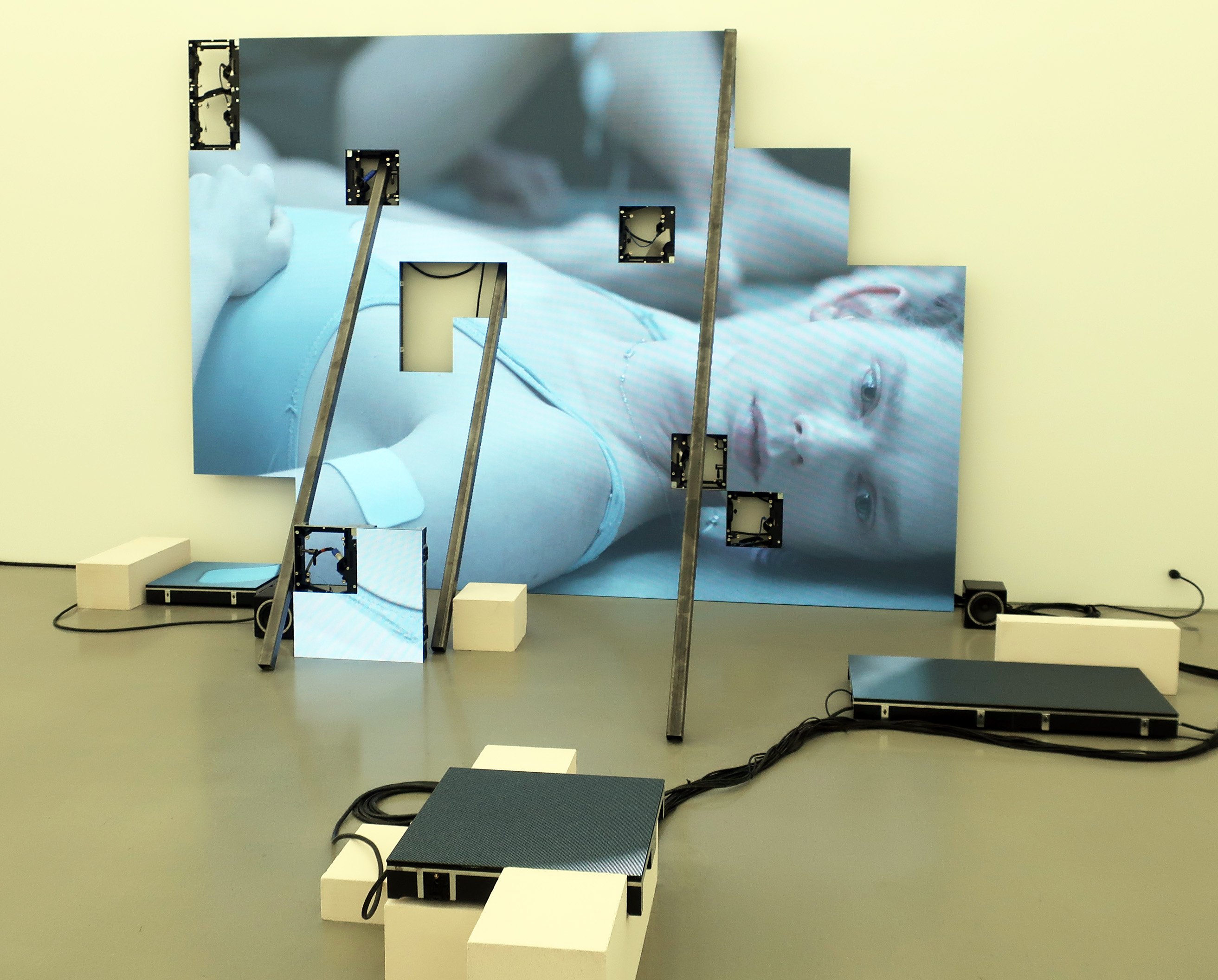
Emotion and vulnerability continue to be strong themes in Jesper Just’s latest body of work at Perrotin Gallery on the Lower East Side. American Ballet Theater dancers lie and sit on the floor while receiving muscle therapy via patches applied to their skin. Though nearly motionless, this individual’s alert state and a single tear suggest powerful goings on beneath a calm exterior. Panels separated from the main display join blocks of concrete on the gallery floor in order to engage viewers more personally by forcing us to consider our own bodies in the gallery space and our own efforts at constructing meaning. (On view through Feb 15th).
Jesper Just, Corporealities – 1, LED panels, multi-channel video, sound, steel, and cement, 98 7/16 x 137 13/16 x 143 inches, 2020.
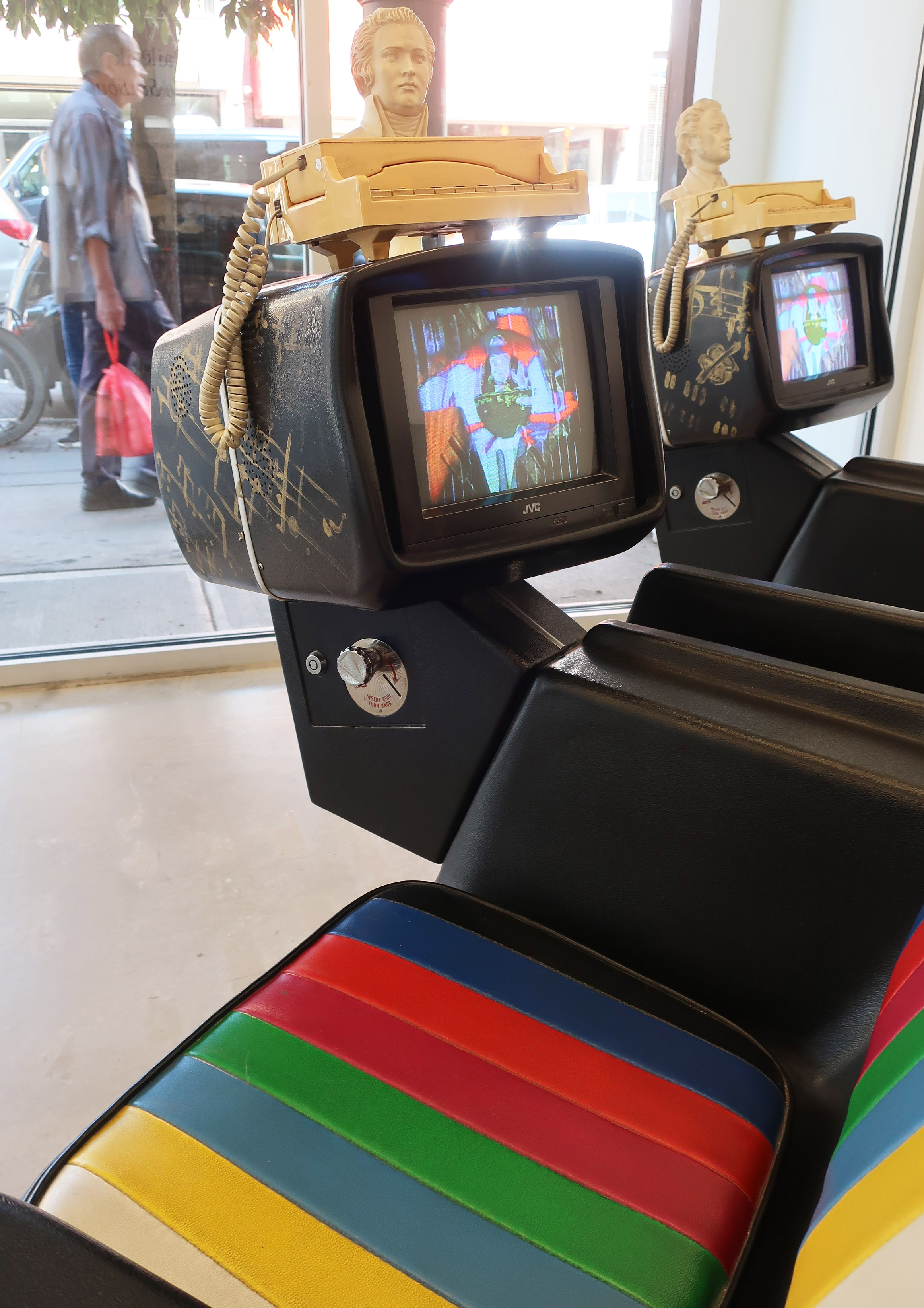
Despite their tiny size, monitors on twin coin-operated chairs from 1988 by Nam June Paik in the entryway of James Cohan Gallery’s Lower East Side location blast a stream of media content at visitors who can simultaneously watch the world go by on the busy street outside. Resembling test patterns, the chairs’ upholstery invites viewers to submit themselves to media overload. (On view through Oct 20th).
Nam June Paik, Music is Not Sound, video system, chairs, statuettes, other objects, 46 x 41 x 72 inches, 1988.
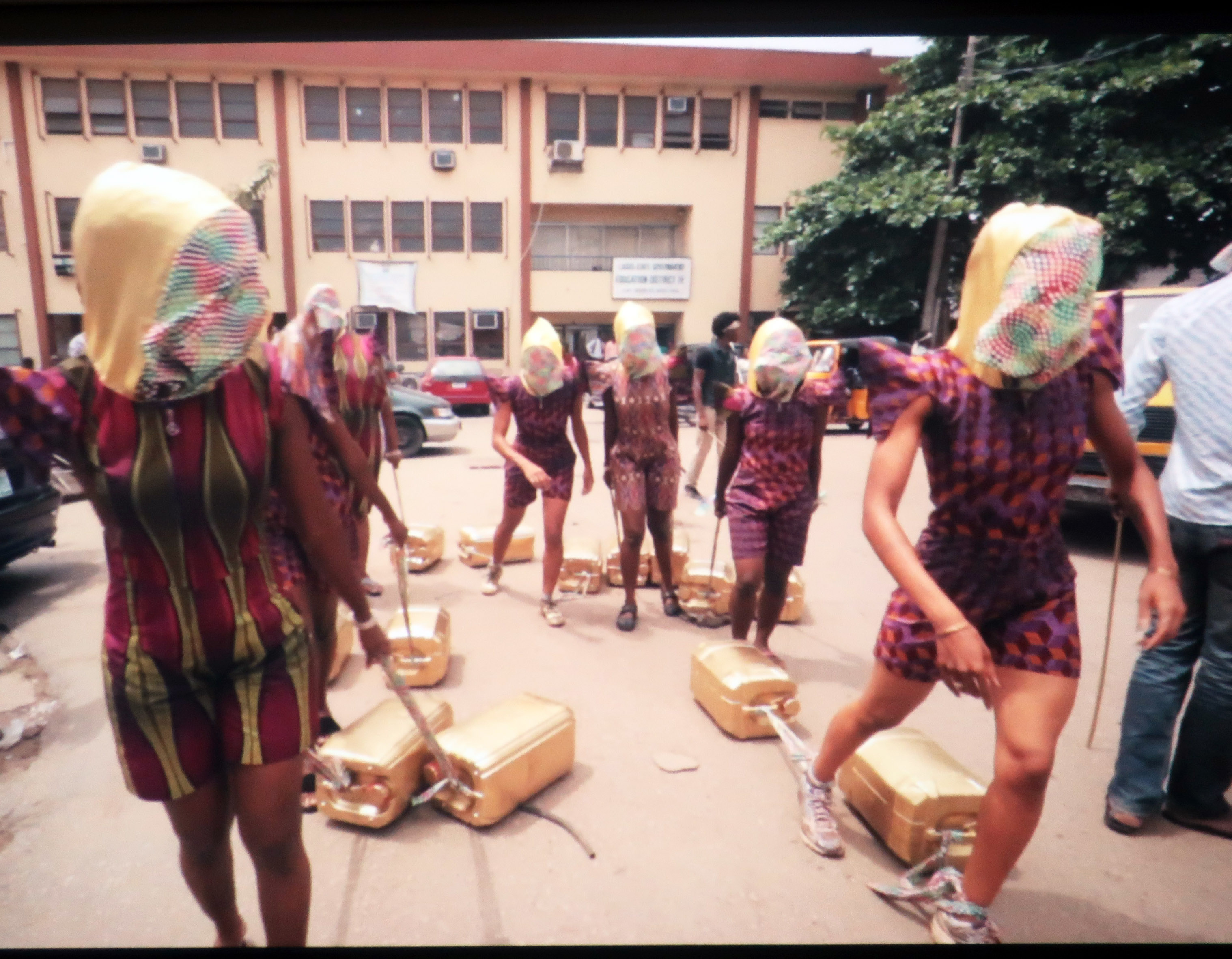
Inspired by women’s lives in her parent’s native Nigeria, US born artist Wuru-Natasha Ogunji’s considers the daily task of carrying water in her video, ‘Will I still carry water when I am a dead woman?’ Featuring several masked women walking the residential streets of Lagos dragging gold-colored water containers, viewers witness the toll exacted on the bodies of the exhausted and drenched participants. (On view at Fridman Gallery through Oct 12th).
Wuru-Natasha Ogunji, still from ‘Will I still carry water when I am a dead woman?, single-channel digital video, 11 min, 57sec, 2013.
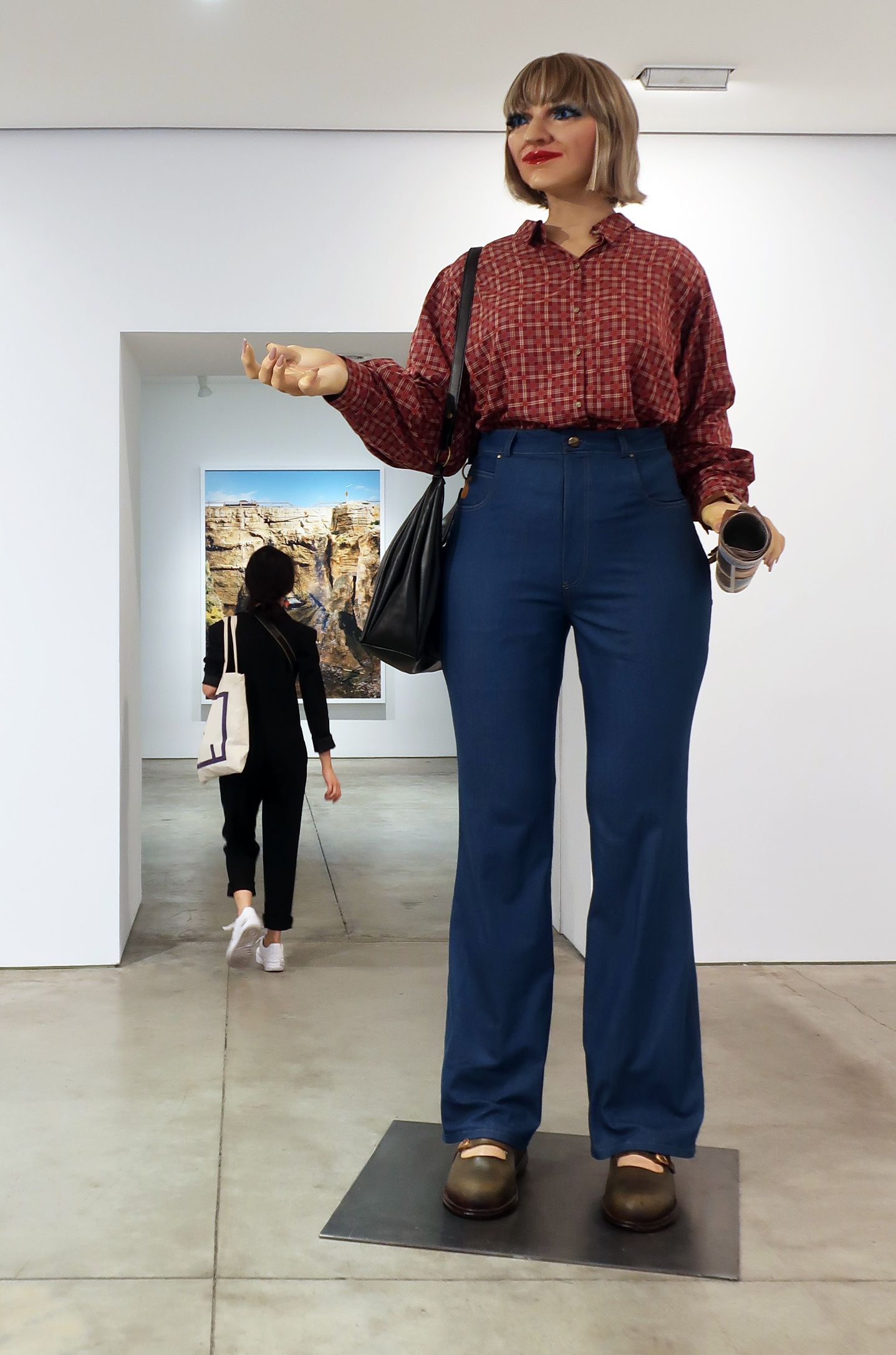
“Driving through Los Angeles, you see all kinds of things out your window, and they go by so quickly,” Alex Prager told the New Yorker as she explained the bizarre scenarios and eccentric characters in her latest photos and video at Lehmann Maupin Gallery. This towering, nine-foot-tall sculpture dominates the gallery and appears in an even larger version in Prager’s short film ‘Play the Wind,’ an homage to the unexpected and strange on the streets of Prager’s hometown. (On view in Chelsea through Oct 26th).
Alex Prager, Big West, foam, plastic, fabric and aluminum on metal base, 112 x 50 x 23 inches, 2019.
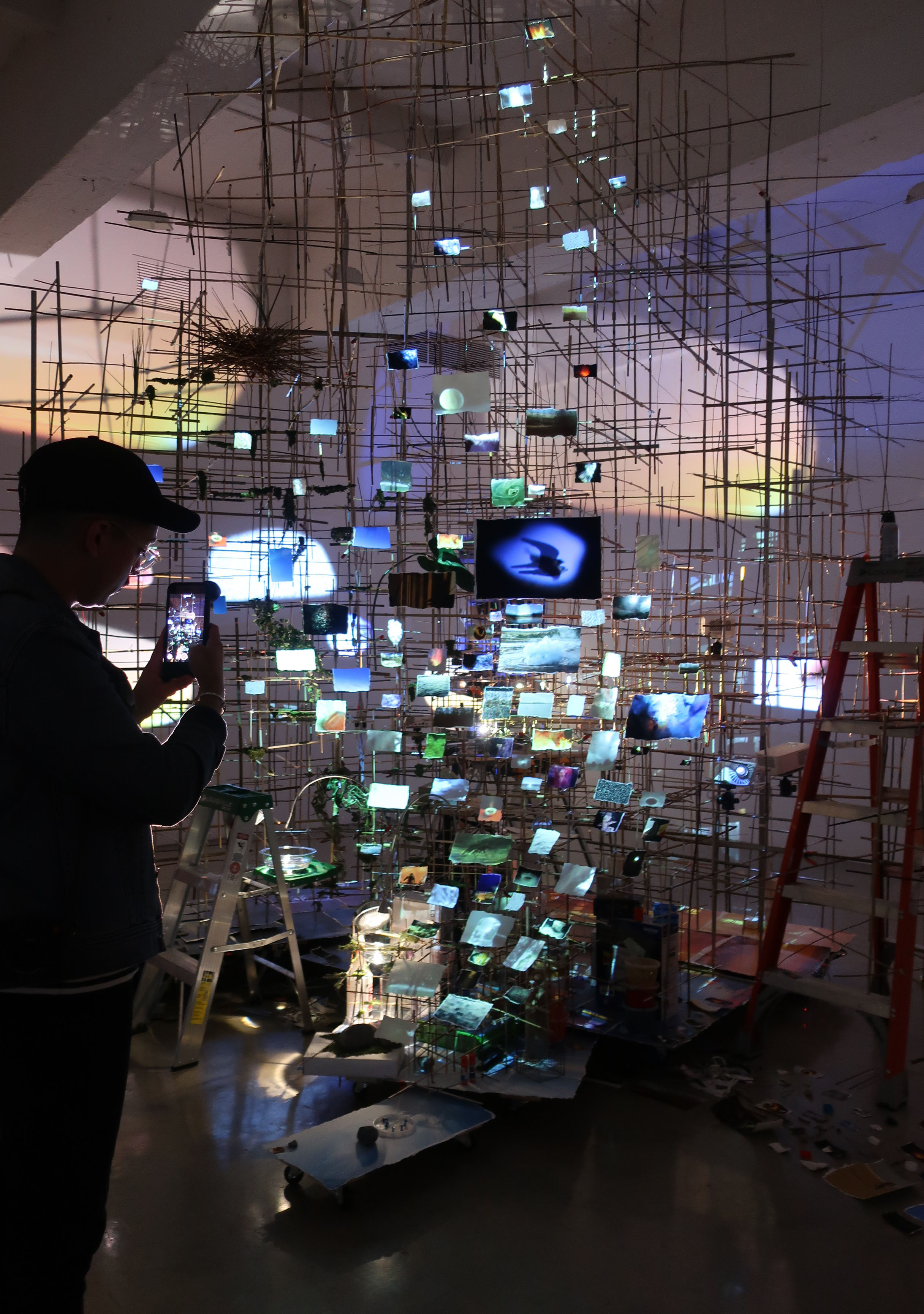
Ever aware of the evolving role of images as stand-ins for real objects in the digital era, Sarah Sze creates a wave in the form of photos, video and rotating projections at Tanya Bonakdar Gallery. Titled ‘Crescent (Timekeeper),’ the installation displays fragmentary glimpses of the natural world on a rickety but orderly wooden frame. Visitors who step close to explore a coyote crossing a road, a raging flame or a bird in flight experience a dynamic and evolving sculpture that offers an immersive experience in real time. (On view in Chelsea through Oct 19th).
Sarah Sze, Crescent (Timekeeper), mixed media, wood, stainless steel, acrylic, video projectors, archival pigment prints, ceramic and tape, dimensions variable, 2019.
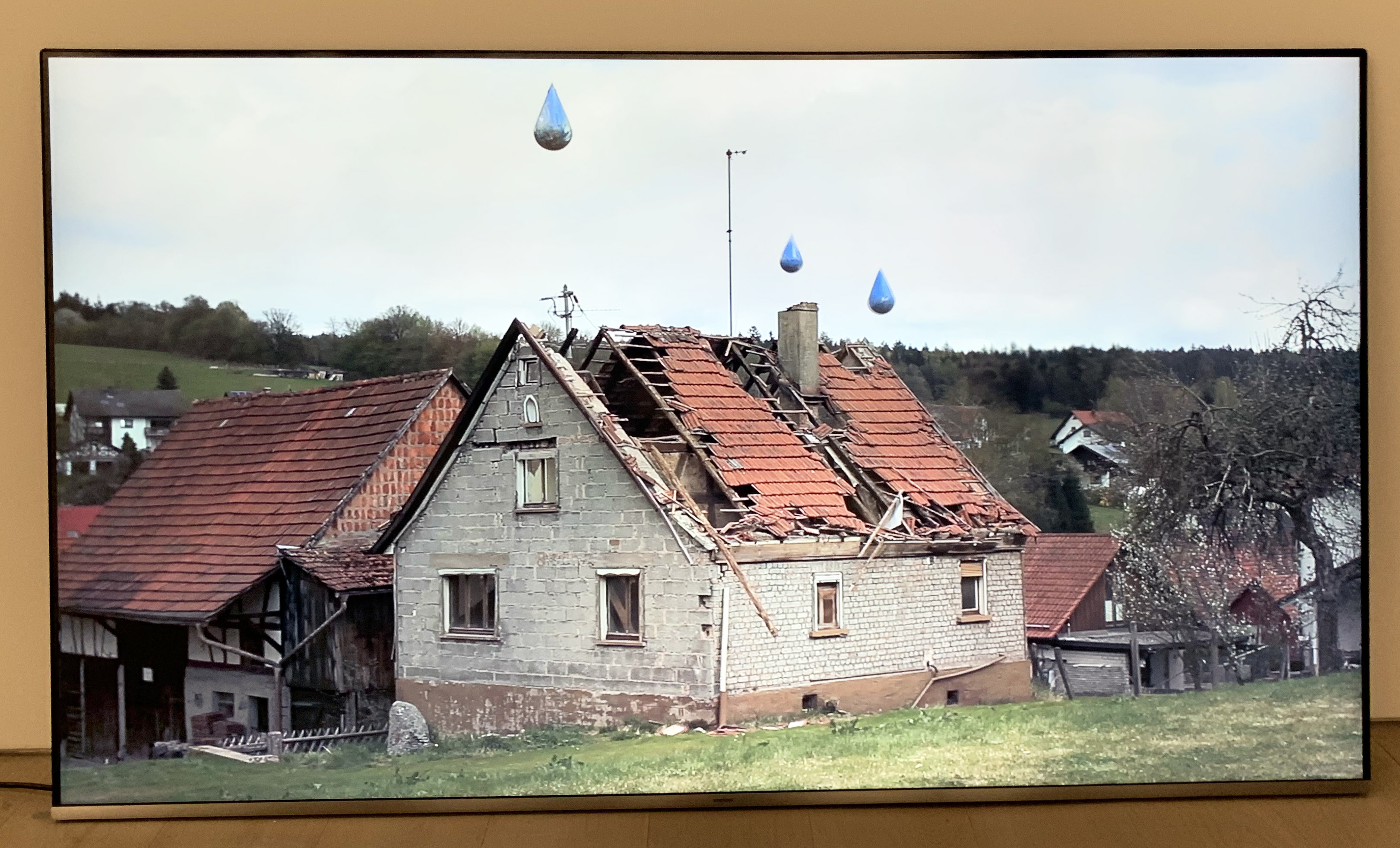
Berlin-based artist Michael Sailstorfer’s tear-themed show at Galerie Perrotin aims to convert sadness to fun. Here, a rickety farm building is destroyed by wrecking balls in the shape of teardrops (cables were removed post-production). Elsewhere, the artist prepares tear-shaped lumps of coal for burning and morphed Bavarian beer bottles into tear-shapes with the help of a glass-blower. (On view on the Lower East Side through April 13th).
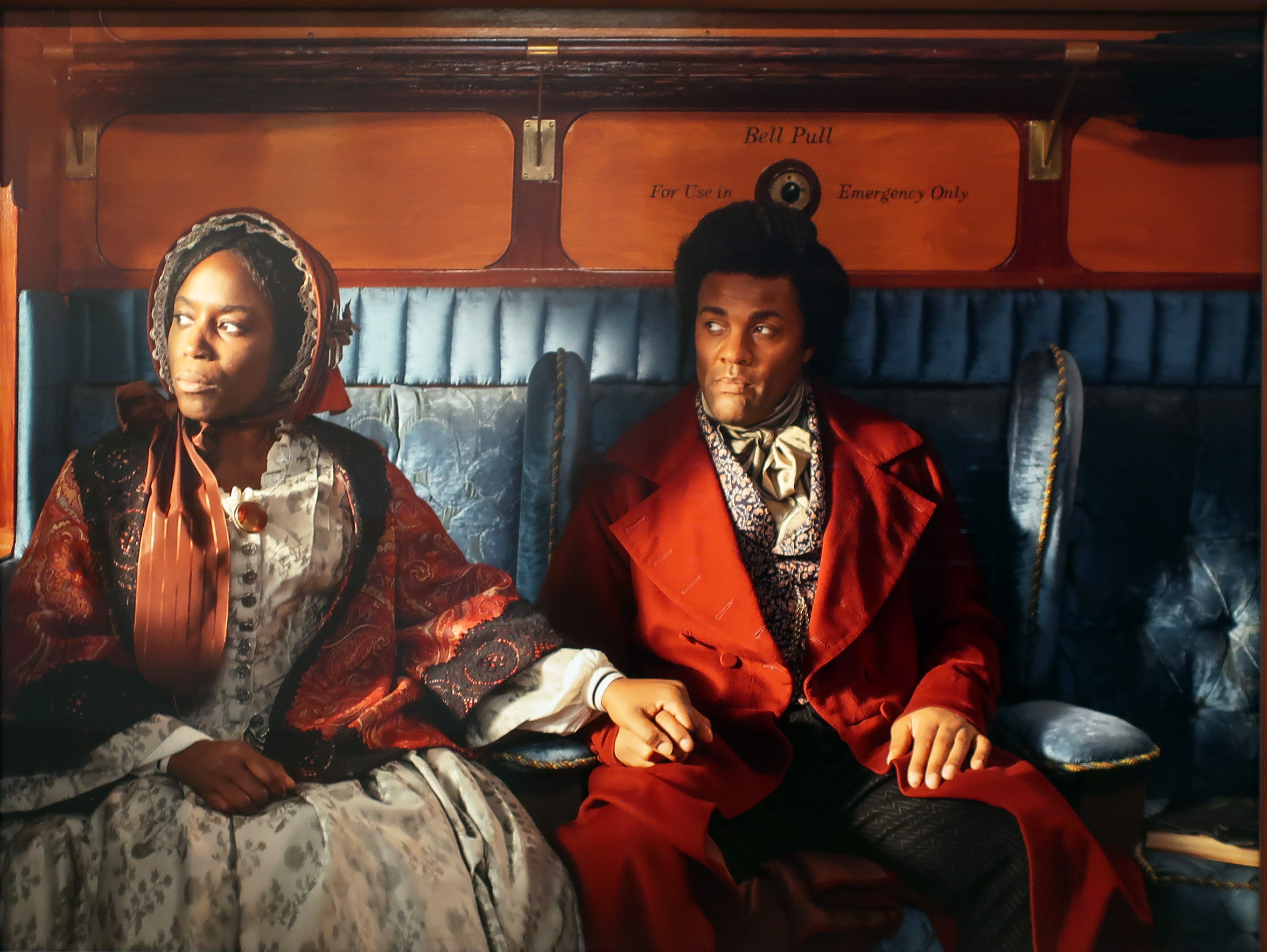
Based on the life of Frederick Douglass, the most photographed American man of the 19th century, British filmmaker Isaac Julien’s new ten-screen installation ‘Lessons of the Hour’ brings Douglass’ remarkable life and oratory talents into focus at Metro Pictures Gallery. Here, actors play the role of Douglass and his wife traveling by rail, echoing and contrasting his escape via train as a young man to freedom in New York. (On view in Chelsea through April 13th).
Isaac Julien, The North Star (Lessons of the Hour), glass inkjet paper mounted on aluminum, 63 x 84 inches, 2019.
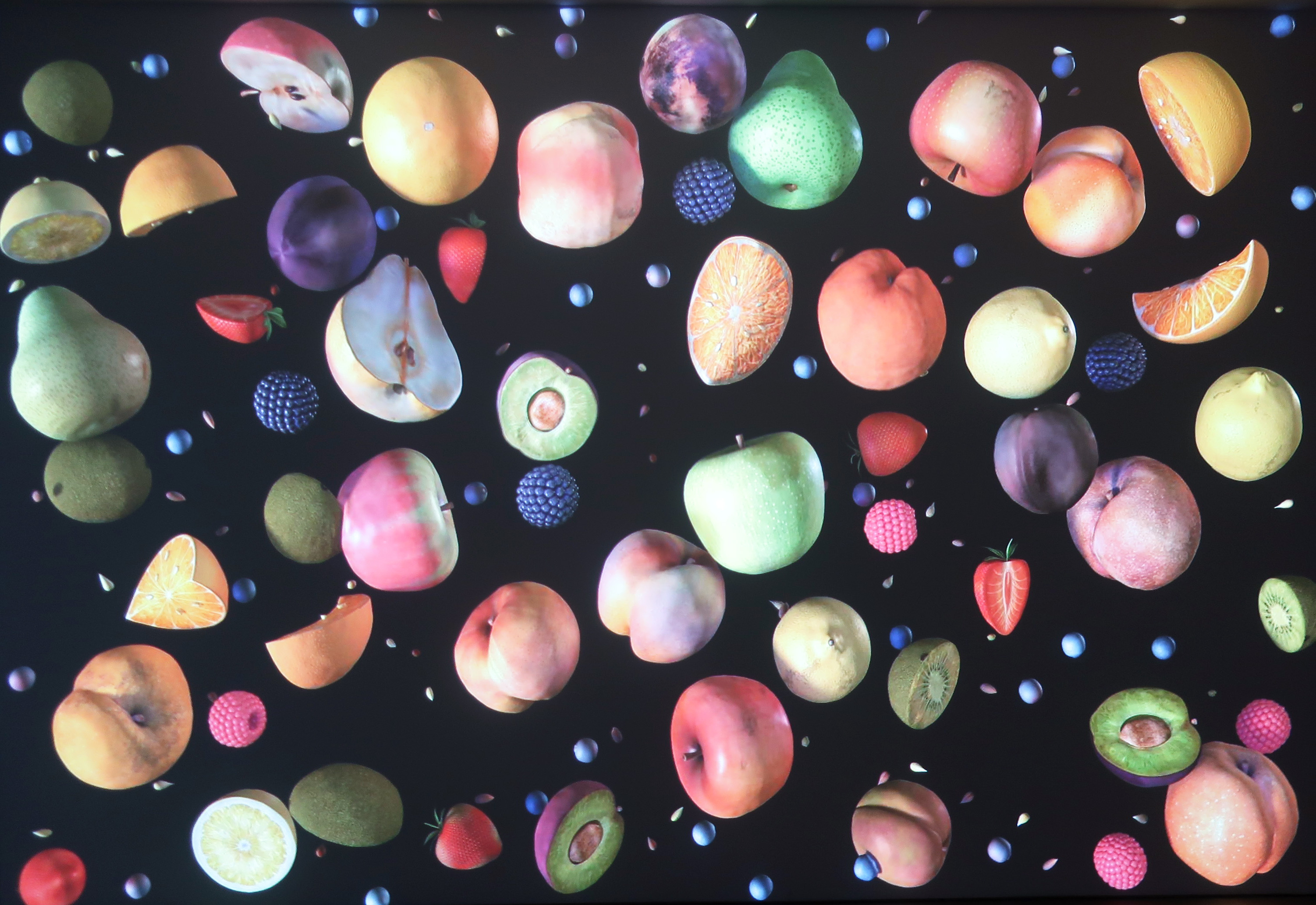
A field of fruit appears perfect until it begins to move and collide, revealing soft surfaces that bespeak rot below a flawless exterior. Titled Impeach I, this animation by Jennifer Steinkamp began life as an LA billboard and now exists as a selection of constantly moving, morphing and reforming fruit. (On view at Lehmann Maupin Gallery’s 22nd Street Chelsea location through April 13th).
Jennifer Steinkamp, Impeach 1, video installation, dimensions variable, 2019.
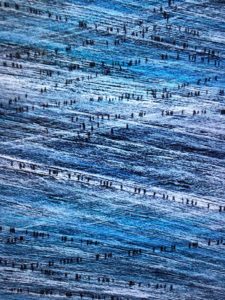
Lines of moving silhouettes endlessly crisscross rugged terrain in ‘Blue Hills,’ an arresting video at the entrance to Michal Rovner’s latest solo show at Pace Gallery. Suggesting constant migration across inhospitable land, the piece’s calm colors belie more overt alarm in several of the show’s other works, in which bodies with flashing red lights for heads or constantly waving arms sound a warning. Reflecting on the role of technology in our daily lives, Rovner muses that we are becoming ‘bar codes with DNA.’ (On view at Pace Gallery’s 25th Street location through June 29th).
Michal Rovner, Blue Hills, LCD screen and video, 57 1/8 x 32 5/8 x 3 3/8 inches, 2018.
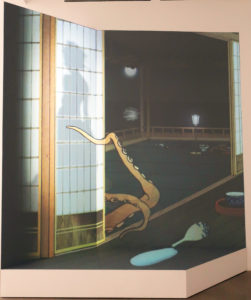
Inspired by a woodblock print from Hiroshige’s ‘100 Famous Views of Edo,’ Tabaimo extends the life of the 19th century artwork in an animation that gives life to a mysterious female figure behind the balcony screen. Despite a spilled vessel and briefly flailing octopus tentacles, the scene retains its sense of tranquility and intrigue. (On view at James Cohan Gallery’s Lower East Side location through Feb 25th).
Tabaimo, still from Obscuring Moon, single channel video, 2016.
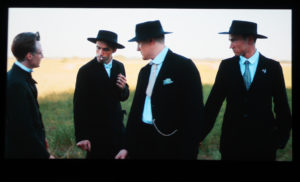
August Sander’s iconic ‘People of the 20th Century,’ a photographic project documenting the German people in the early 20th century is the starting point for Omer Fast’s ‘August,’ a captivating video imagining Sander’s haunted later years. Here, Fast restages Sander’s oft-reproduced image of young farmers as an opportunity to consider the photographer’s stagecraft. (On view at James Cohan Gallery through Oct 29th).
Omer Fast, still from August, stereoscopic film in 3D, 5.1 surround sound, duration 15:30 minutes, 2016.
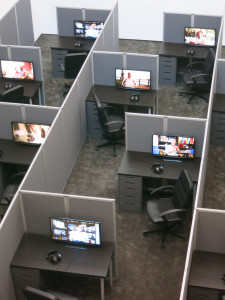
In an eighteen-screen installation set in a warren of cubicles at Lehmann Maupin Gallery, French-Algerian artist Kader Attia explores western vs non-western approaches to mental health in a series of monologues by European and African health professionals. The dehumanizing office environment contrasts the intimacy of each screening space, resulting in an unsettling experience that invites new discoveries. (At Lehmann Maupin’s Lower East Side location through March 4th).
Kader Attia, Reason’s Oxymorons, 18 films and installation of cubicles, duration variable, 13-25 minutes, 2015.
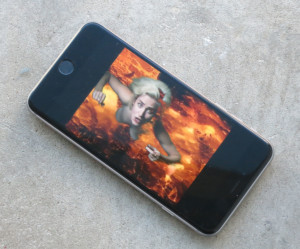
Swiss video artist Pipilotti Rist shouts for help in several languages, adding, ‘I am a worm and you are a flower!’ as she reaches up from a burning pit of lava in this 1994 video at the New Museum. Part of Rist’s retrospective exhibition, it’s a tiny but powerful appeal to our empathic natures. (On the Lower East Side through Jan 15th).
Pipilotti Rist, Selbstlos im Lavabad (Selfless in The Bath of Lava)(Bastard Version), single-channel video and sound installation, color, on mobile phone; 6:20 min, 1994.
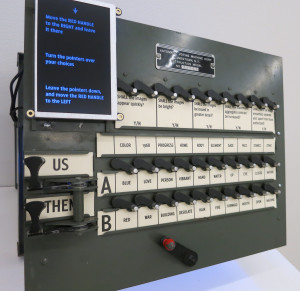
Using voter machines from the 40s, 50s and 60s, Luke DuBois presents gallery-goers with some more esoteric choices than the U.S. public faces in today’s election (us vs them, water vs fire, nature vs machine). Once visitors have locked in their votes, a unique video response interprets the data. (At Bitforms Gallery through Dec 23rd).
R. Luke DuBois, Learning Machine #2: Image, AVM voting machine (instruction model, blue, ca. 1955), voting booth, computer, camera, lights, screen, 11.75 x 13.5 x 13 inches, 2016.
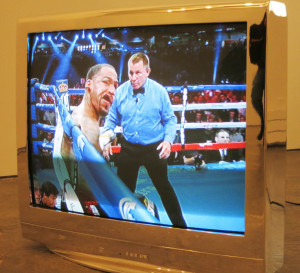
An unseen opponent batters James Kirkland with blows that literally make the flesh on his face shake in Paul Pfeiffer’s powerful video at Paula Cooper Gallery. By collaging together short clips that feature direct hits to the head and body and digitally removing Kirkland’s adversary, Pfeiffer focuses attention on the violence of boxing and turns fighter into victim. (In Chelsea through Nov 12th).
Paul Pfeiffer, Caryatid (Kirkland), digital video loop, chromed 32” color television with embedded media player, 27 x 30 x 19 inches, unique, 2016.
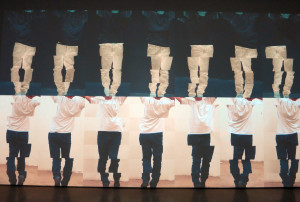
In 1968, Bruce Nauman videoed himself slowly pacing down a narrow corridor, swinging his hips with each step into a pose reminiscent of Donatello’s bronze David sculpture. Once again, Nauman posits the human body – now older and fragmented by a screen with multiple splits – as subject for art in a new series of videos at Sperone Westwater Gallery, also on view at the Philadelphia Museum of Art. (On the Lower East Side through Oct 29th).
Bruce Nauman, installation view of ‘Contrapposto Studies, i through vii at Sperone Westwater Gallery, Sept 2016.
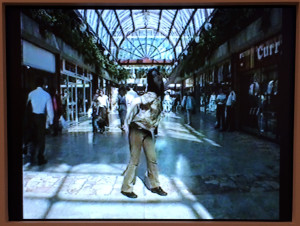
Gillian Wearing’s now classic video of herself dancing uninhibitedly in a London shopping arcade in 1994 – causing discomfort with the idea of turning public into private space – is precedent setting in the International Center of Photography’s group show ‘Public, Private, Secret,’ which considers how identity is created both openly and in secret. (Through Jan 8, 2017).
Gillian Wearing, Dancing in Peckham, video, 25 min, 1994.
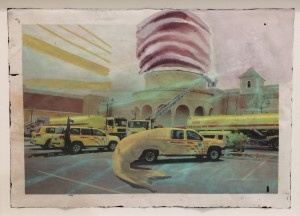
Painting over You Tube video stills, Iranian artist Rokni Haerizadeh morphs familiar imagery into a setting for mythological creatures inspired by Persian tradition. Here, a building echoes the Guggenheim’s spiraling form but is surrounded by emergency vehicles, one of which has partially changed into a fish. (At the Guggenheim, in ‘A Storm is Blowing from Paradise: Contemporary Art of the Middle East and North Africa’ through Oct 5th).
Rokni Haerizadeh, one piece from the 24-part work ‘But a Storm is Blowing from Paradise,’ gesso, watercolor and ink on inkjet prints, 2014.
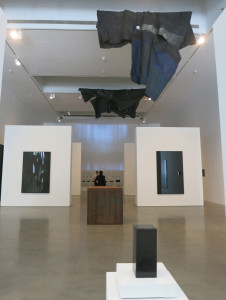
From a 1962 painted black rectangle by Sol LeWitt to a series of canvases hung from the ceiling by Oscar Murillo, Pace Gallery’s ‘Blackness in Abstraction’ discusses varieties of blackness, touching on race, the life of the spirit and simplicity of form. (On 25th Street in Chelsea through Aug 19th).
Installation view of ‘Blackness in Abstraction’ at Pace Gallery, June, 2016.
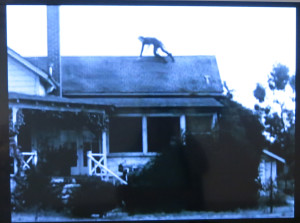
At the start of Dutch artist Bas Jan Ader’s 19 second video, Fall 1, the artist perches on a chair on a roof. As we watch with increasing unease, he leans over until he causes himself to tumble to the ground below. Absurd yet emotionally jolting, Ader’s video portrays the artist as dare devil willing to take risks and foretells his eventual disappearance at sea during the creation of another event-as-artwork. (At Metro Pictures in Chelsea through Aug 5th).
Bas Jan Ader, Fall 1, Los Angeles, 16mm black and white film, 1970.
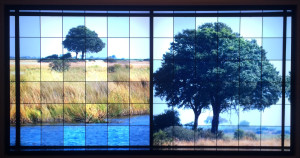
Shot around the world from Peru to Greece, Yorgo Alexopoulos’ videos of the natural world are a low-key sublime, prompting appreciation of beautiful landscapes unblemished by mankind. (At Chelsea’s Bryce Wolkowitz Gallery through June 11th.)
Yorgo Alexopoulos, Tree with River, digital animation on two synchronized High Resolution square LCD displays, 4K video, CGI, custom playback system, painted aluminum, polished stainless steel, glass, 12 minute infinite loop, 17 ¾ x 33 ¼ x 7 ¾ inches, 2015-16.
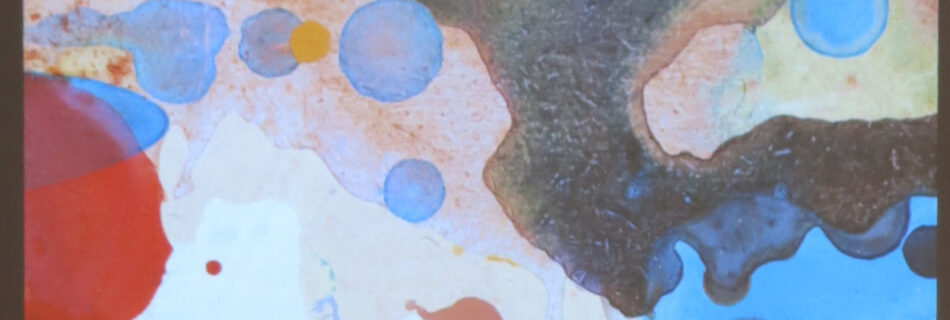
Known for videos made from photos taking during his painting process, Dutch artist Jacco Olivier embraces abstraction in his latest projections at Marianne Boesky’s Lower East Side space. Without the narrative found in his previous painted videos, the recent work becomes meditative; it’s not so much watching paint dry as watching it drift slowly across the canvas. (Through Feb 14th).
Jacco Olivier, Equilibrium II, HD Animation, 3 min, 20 seconds, projection size: 37 3/8 x 33 ½ inches, 2015.
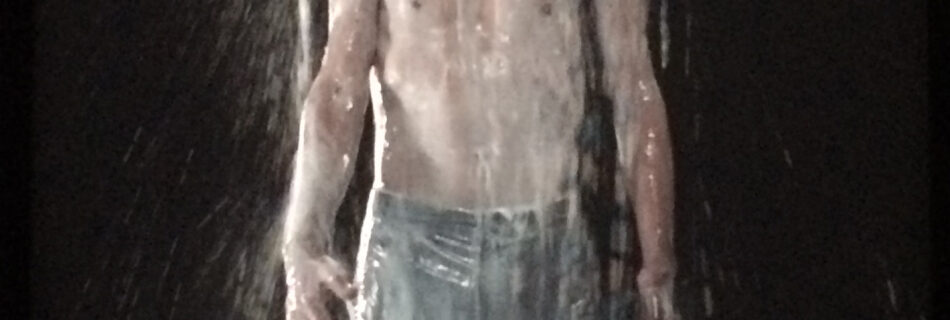
Bill Viola explores his signature themes of rebirth, endurance and physical/spiritual transformation in ‘Inverted Birth,’ a large-scale video at Chelsea’s James Cohan Gallery. Here, black, red, white and clear liquids, perhaps symbolizing elemental materials of earth, blood, milk and water, pour away from the subject (as the video runs backwards) suggesting a reversal of time. (Through Jan 30th).
Bill Viola, installation view of ‘Inverted Birth’ at James Cohan Gallery, through Jan 30th.
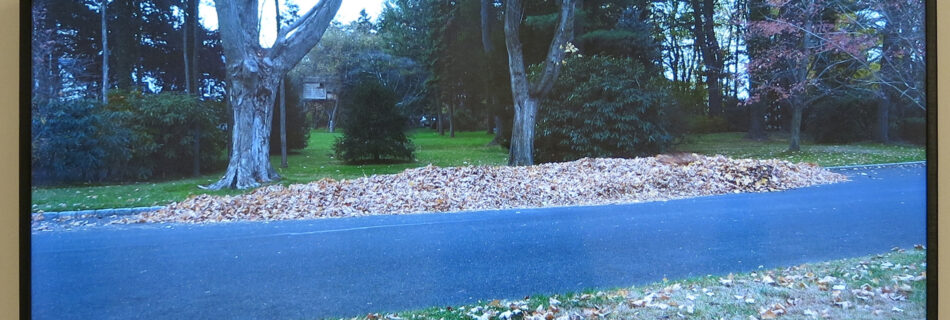
Renowned for his interventions in nature, British artist Andy Goldsworthy has recently documented himself walking up a waterfall, throwing kelp into the sky and crawling precariously across a long hedge. Here, he participates in an autumn ritual usually enjoyed a younger demographic – burrowing through a massive pile of fallen leaves. Each gesture reads as a charmingly quixotic quest to engage with nature. (At Chelsea’s Galerie Lelong through Dec 5th).
Andy Goldsworthy, Burrowing through a pile of leaves, Greenwich, CT, 15 Nov, 2013, time lapse video, running time 4:27 minutes, ed of 6.
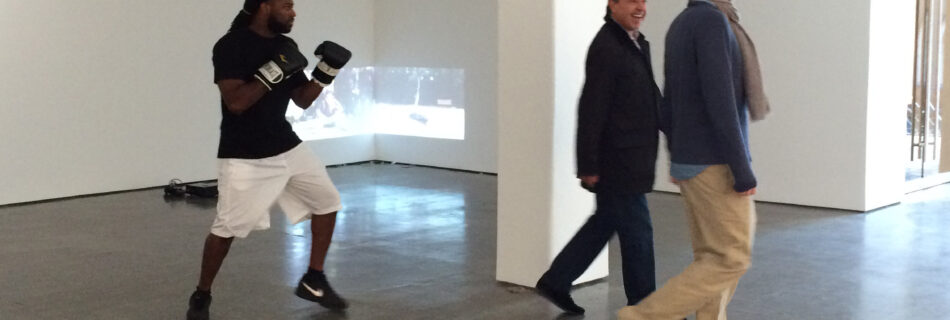
Visitors who stray too far into Klein Sun Gallery get more than they bargained for with Chinese video and performance artist Li Liao’s performance piece, ‘Attacking the Boxer from Behind is Forbidden.’ Each afternoon, a boxer occupies half of the gallery, sparring with anyone who gets close and giving visitors the chance to consider how they’ll react to an unexpected situation that defies conventional gallery behavior. (In Chelsea through Nov 14th).
Li Liao, performance view of ‘Attacking the Boxer From Behind is Forbidden’ at Klein Sun Gallery, October 2015.
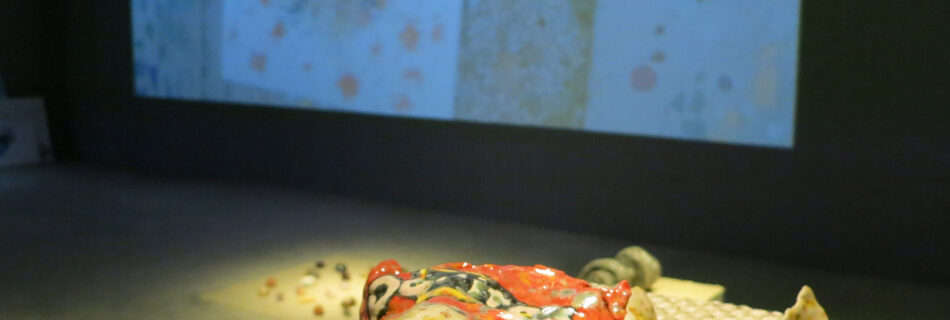
It’s post-apocalypse in Trisha Baga’s imagination – Florida has mostly sunk into the sea and the array of artifacts left behind, including this Doritos bag and chips, have been rendered in ceramic and put on display. In the video at rear, peacocks pick at a seed portrait of Rosie O’Donnell. Baga’s rich imagination makes an unknown world all the stranger. (At Greene Naftali Gallery in Chelsea through October 3rd).
Trisha Baga, Doritos bag with 4 doritos, glazed ceramic, 2 ¾ x 9 x 6 inches, 2015. Background: Peacock Museum. The Department of Education, video installation, 4 mirrors with fava beans, 18 min, 44 sec, each 23 ½ x 19 1/8 inches, 2015.
Christian Marclay’s 24-hour video of collaged clock-related film clips from 2010 was so engaging that his subsequent photo projects and onomatopoeia paintings have sometimes seemed bland by comparison. The standout piece in his latest solo show at Chelsea’s Paula Cooper Gallery corrects that trend, however, by animating words from cartoons in an eye-popping immersive installation that, though soundless, communicates loudly. (Through Oct 17th).
Installation view of Christian Marclay’s ‘Surround Sounds,’ at Paula Cooper Gallery, September 2015.
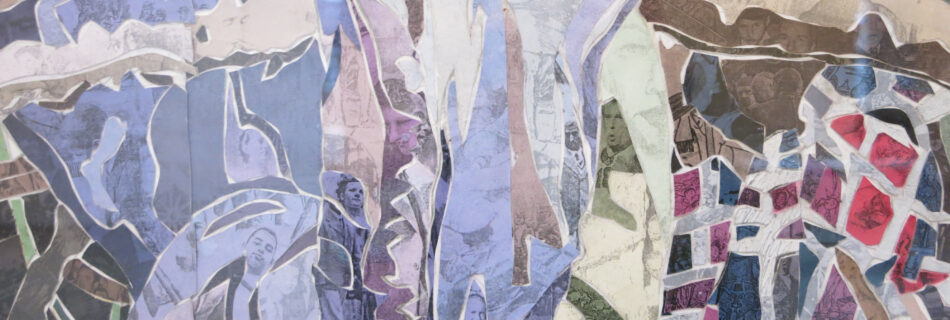
For his latest solo show, German video and collage artist Marcel Odenbach produces collaged images of what he calls ‘Green Zones,’ or marginal spaces in which nature and unexplained human activity meet. Seen here in detail, a scarf tied around a tree branch suggests a memorial, composed of clipped and copied press images referring to “…religious delusion, racism and murder…’ explains the gallery. (At Anton Kern Gallery in Chelsea through July 3rd).
Marcel Odenbach, Grunflache 3 (Green Zone 3), ink and collage on paper, 81 x 108 inches (framed), 2014/15.
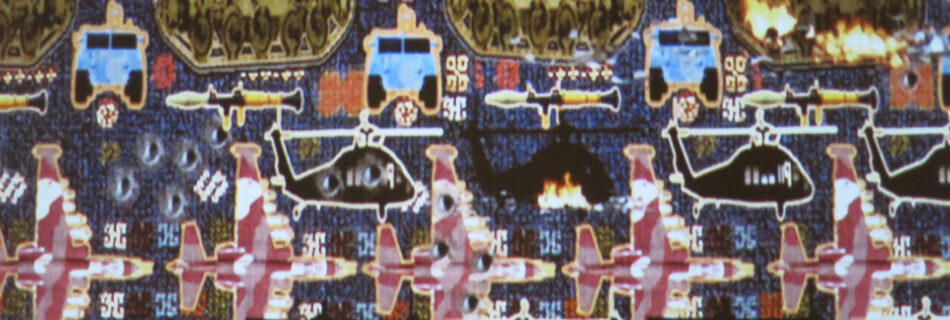
Inspired by Afghan women who modified traditional rug patterns to include weapons and war vehicles after the 1979 Soviet invasion of Afghanistan, Israeli artist Nevet Yitzhak creates digital war rugs featuring tanks, airplanes, and helicopters. Here (seen in detail), helicopters direct missiles at each other, causing explosions and devastation that belies any idea of weaving (even digitally) as a peaceful art. (At Yossi Milo Gallery through July 10th).
Nevet Yitzhak, detail from the series WarCraft, War Rug #2, projection of FHD video and animation, 8:00 min loop, stereo sound, 2014.
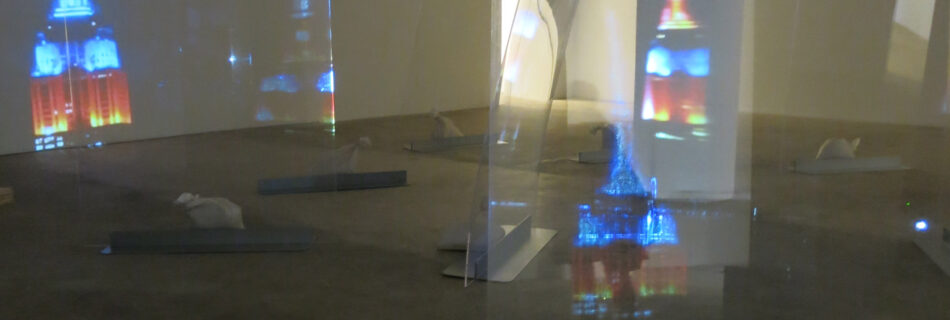
In contrast to Andy Warhol’s 1964 film ‘Empire,’ Lutz Bacher’s installation by the same name features a multitude of Empire State Building spires in full color, reflecting off of sheets of Plexi arranged around GreeneNaftali Gallery. While the piece feels like a celebration of the fact that there’s no ‘one New York,’ sandbags holding down the panels add a note of caution. (In Chelsea through May 9th).
Lutz Bacher, Empire, two channel digital video, color/sound, Plexiglas, sand, 43 min, 1 second, 2014.
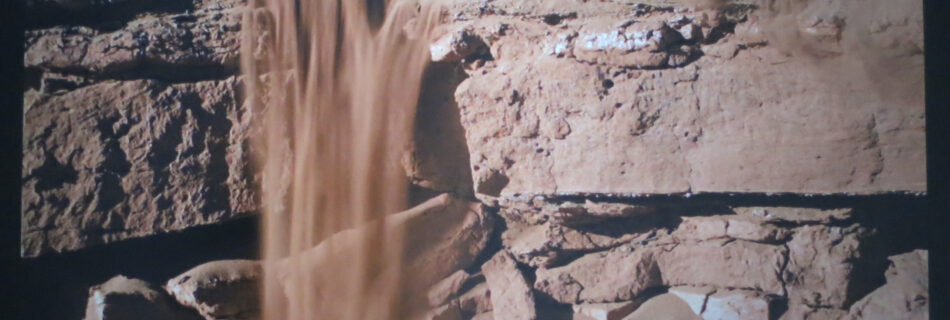
Brazilian artist Thiago Rocha Pitta’s new videos track minute, artist-introduced changes to tiny segments of the landscape in Argentina. Here, a cascade of sand runs like a never-ending hourglass. (At Marianne Boesky Gallery on the Lower East Side through March 22nd.)
Thiago Rocha Pitta, Temporal maps of a non sedimented land #1, video, 2.33 min, 2015.
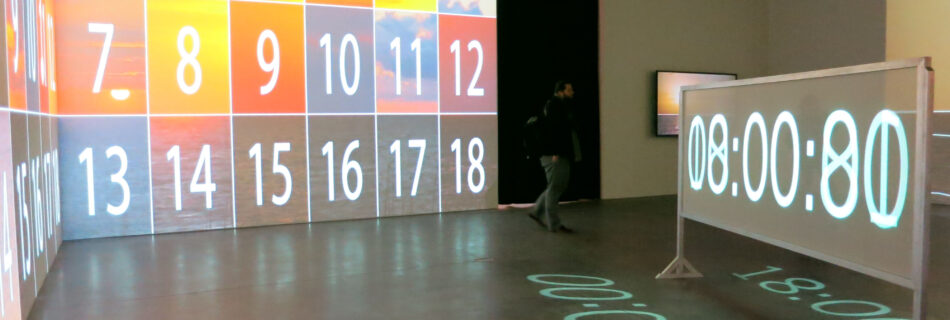
Against video of sunsets shot on a Rauschenberg residency in Florida, numbers flash in anticipation of the 18 minutes prior to sunset in veteran video-artist Charles Atlas’ latest solo show at Chelsea’s Luhring Augustine Gallery. Titled ‘The Waning of Justice,’ the show decries the current political state of the country with help in the back gallery from legendary drag performer Lady Bunny. (Through March 14th).
Charles Atlas, installation view of ‘The Waning of Justice,’ at Luhring Augustine, Feb 2015.
Saya Woolfalk continues to imagine life in a utopic community of culturally hybridized beings with her new series of colorful sculpture, video and collage at Chelsea’s Leslie Tonkonow Artworks & Projects. In this lush corner installation, a meditating figure in fantastical priestly garb holds minerals that supposedly release the power of greater empathy. (Through Feb 28th).
Saya Woolfalk, ChimaTEK: Virtual Reality Station, mixed media installation with video, 108 x 91 x 19 ½, 2015.
Inspired by James Turrell sculptures, in which the audience looks upward through a ceiling aperture to view the sky as art, LA artist Diana Thater devised this projection on the ceiling of David Zwirner Gallery as an homage to the dung beetle, a creature which looks to the stars to guide its ecologically critical activity. (In Chelsea through Feb 21st).
Diana Thater, Science, Fiction, installation for two video projectors, media player, and lights, overall dimensions vary with installation, 2014.
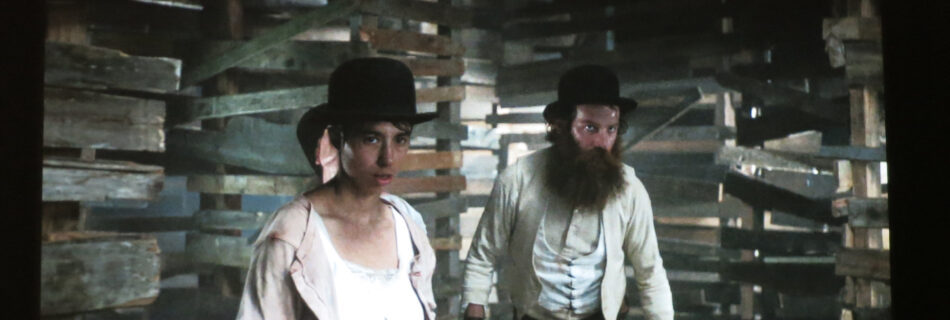
Brooklyn-based Danish artist Joachim Koester channels the wild west in a distinctly avant-garde way in his absorbing video installation, The Place of Dead Roads, in which dancers dressed as grubby gunslingers move around an eerie boarded-up space as if locked in a tense shootout, all without weapons or an obvious enemy. (At Chelsea’s GreenNaftali through Feb 14th).
Joachim Koester, The Place of Dead Roads, HD video installation, color, sound, 33:30 min, 2013.
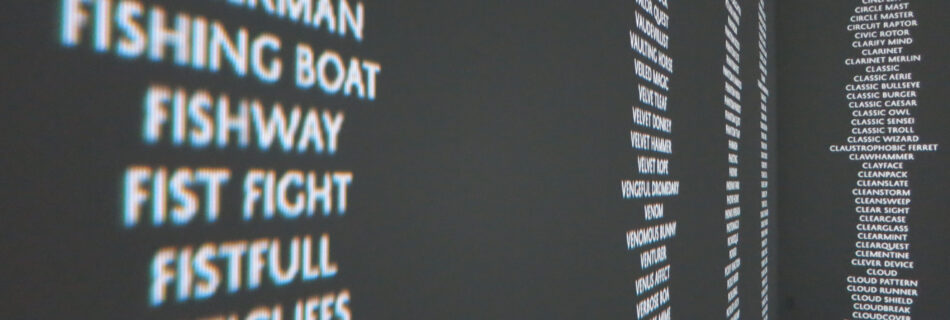
A never-ending scroll of words runs on all four walls of Metro Pictures‘ upstairs gallery, naming National Security Agency and Government Communications Headquarters surveillance program code names, gathered and presented by New York artist Trevor Paglen. Minimal and in black and white, the piece resembles a memorial, perhaps to freedom from observation. (In Chelsea through Dec 20th).
Trevor Paglen, installation view of ‘Code Names of the Surveillance State,’ November, 2014 at Metro Pictures.
In a futuristic city inhabited by robots, stories of two dogs and a married couple loosely intertwine as one character tries to disentangle real from false memories. As could be expected, the protagonist never separates one from the other, but the process of watching is mesmerizing. (At Eleven Rivington’s 195 Chrystie Street location through October 5th).
Adam Shecter, installation view of ‘New Year’ at Eleven Rivington Gallery, September 2014.
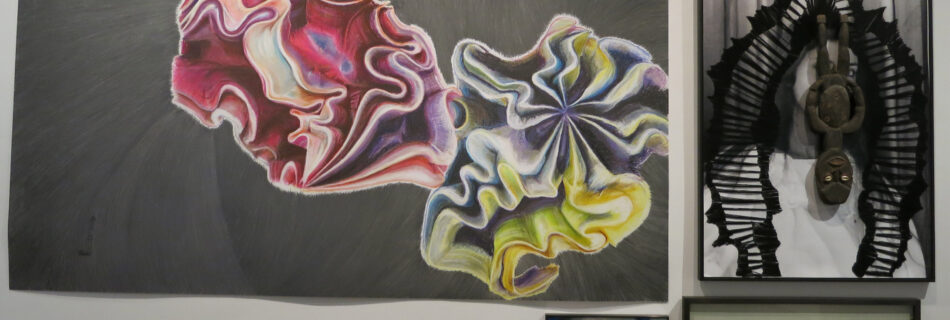
Beautiful organic forms, a trace of violence in a smear of blood, a mysteriously hazy landscape and a young woman crowned with a wig of wool and hidden by a totemic mask by Zipora Fried create an atmosphere of enticing mystery at her impressive solo show at On Stellar Rays on the Lower East Side (through October 12th).
Zipora Fried, Installation view of ‘I Hope the Moon Explodes,’ at On Stellar Rays, September, 2014.
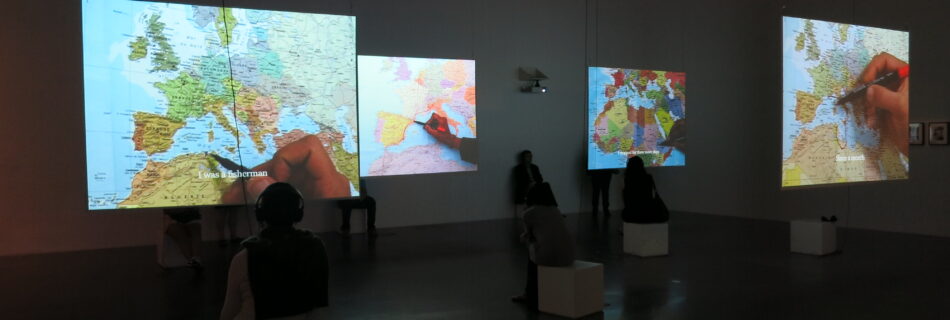
Bouchra Khalili’s video installation in the New Museum’s Arab art exhibition movingly documents the travels and travails of immigrants coming to Europe without papers. The tales of their setbacks and successes are mesmerizing. (Through Sept 28th).
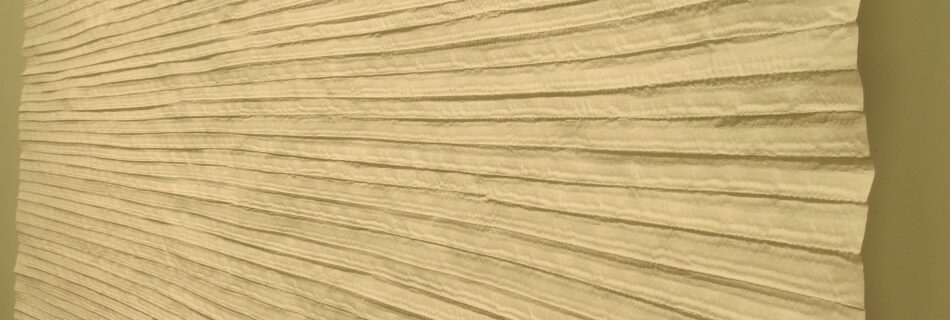
Dancer and visual artist Tony Orrico spent eight hours at PPOW Gallery in Chelsea creating this minimal work on paper – a record of his physical interaction with a vast sheet of paper made by chewing on each fold to leave a personal imprint on his material. (Through June 28th).
Tony Orrico, prepare the plane (P.P.O.W., New York, NY) 2014/2012, dental occlusion on archival bright white Neenah paper, 8:15:22 hours, 96 x 96 inches.
Just inside the front door of Chelsea’s Andrea Rosen Gallery, the drip from an air conditioner hits a hotplate, creating a arresting sound that sets the tone for a show full of magical occurrences and mysterious processes…(Through June 14th).
Mika Rottenberg, installation view of Tsss Tsss Tsss, air conditioner, plant, hotplate, frying pan, water, 2014.
Guido van der Werve’s 2007 video ‘Nummer acht’ is a standout in Marlborough Gallery’s excellent ‘Lone Tree,’ a show dedicated to artists inspired by 19th century painter of the sublime landscape, Caspar David Friedrich. The Dutch artist walked about 10 meters in front of a towering ice-breaker off the frozen coast of Finland, suggesting bravery and folly in equal measure in one lone individual. (In Chelsea through May 3rd.)
Guido Van Der Werve, Nummer acht, Everything is going to be alright, 16mm to HD, 10 minutes, 10 seconds, 2007.
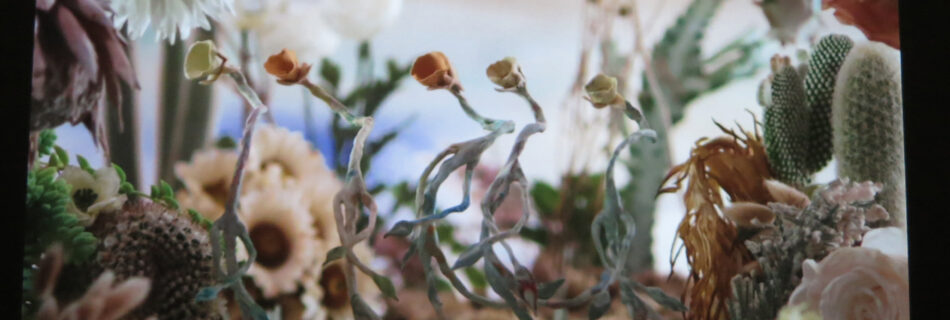
‘Eager,’ Allison Schulnik’s new stop-motion animation starts with restrained dancing figures and quickly ups the pace as nature itself joins in the dance with flowers bursting forth in bloom and swaying with exuberant fecundity. (At Chelsea’s ZieherSmith through Feb 22nd.)
Allison Schulnik, still from ‘Eager,’ clay-animated, stop-motion video, 8 min, 30 sec, ed of 5, 2014.
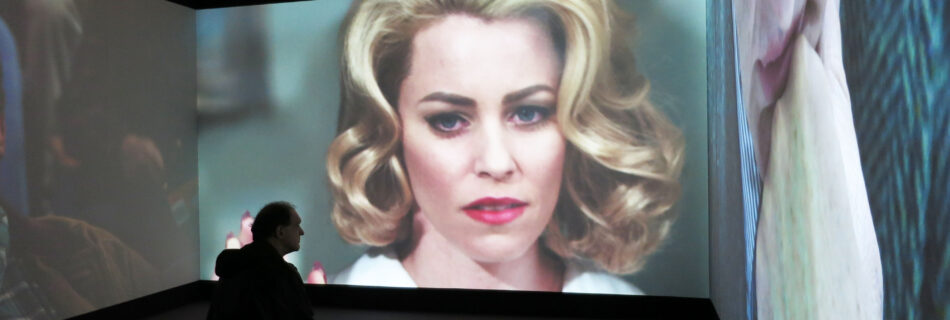
Alex Prager has explained that living in LA, she doesn’t have a lot of experience with crowds. Her latest body of photos and her film ‘Face in the Crowd,’ makes a break with the norm though as Prager directs actor Elizabeth Banks and hundreds of other actors on constructed sets as they play out scenes of crowd dynamics from the thrilling to the terrifying. (At Chelsea’s Lehmann Maupin Gallery through Feb 22nd).
Alex Prager, still from ‘Face in the Crowd’ at Lehmann Maupin Gallery, January, 2013.
Vancouver photographer and filmmaker Stan Douglas continues a theme from his last show – the influence of Afrobeat on the NY music scene of the 70s – with his latest film ‘Luanda-Kinshasa,’ on view at Chelsea’s David Zwirner Gallery. Watching the video in its entirety – and music lovers may want to – could take six hours as the scenes run in non-sequential loops. (Through Feb 22nd).
Stan Douglas, still from Luanda-Kinshasa, Jan 2013, David Zwirner Gallery.
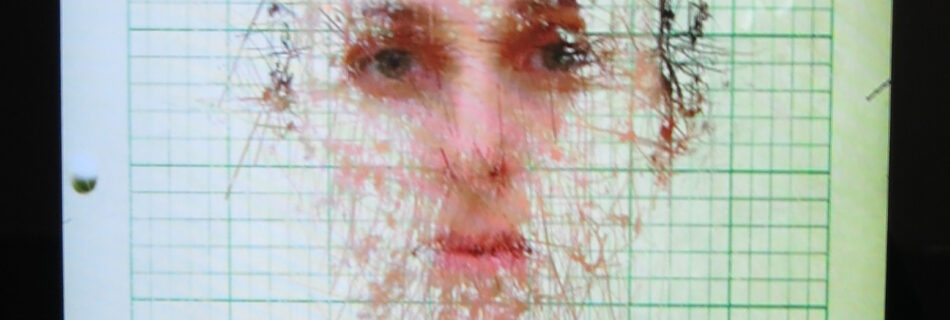
Mariano Sardon not only gives us portraits, he tells us how we look at them. The Buenos Aires-based Argentinian artist shows a picture of a face to viewers while a camera records their eye movements. The information from many viewers is then mapped onto the face, which is drawn before our eyes following the sequences of the gazes. (At Bryce Wolkowitz Gallery in Chelsea through Dec 21st).
Mariano Sardon, from the series ‘150 Gazes looking around them,’ digital video, 2012.
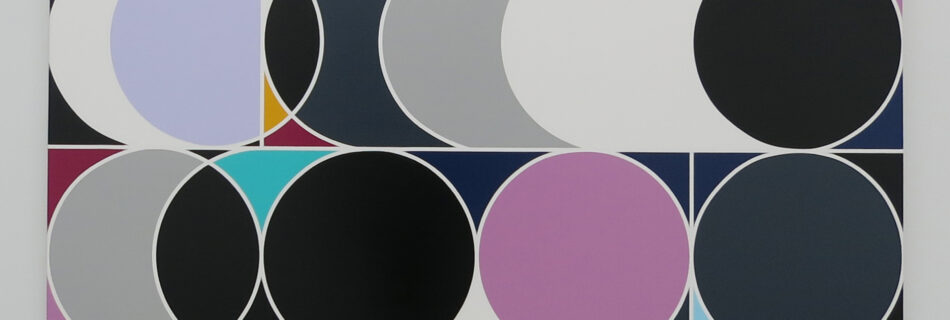
Part of an exhibition by British artist Sarah Morris inspired by Rio de Janeiro, this graphically slick painting evokes the iPhone’s sliding on/off switches, an active game board or abstracted commuters moving rapidly through the city grid, all of which make for an urban landscape painting that evokes a city on the move. (At Petzel Gallery through Dec 21st).
Sarah Morris, Hybrid Solar Eclipse (Rio), household gloss paint on canvas, 2013.
Hands down one of the best shows on in New York at the moment, Josh Kline’s latest solo show at 47 Canal on the Lower East Side includes this video, which maps Whitney Houston’s face onto an actress who brings the singer back from the grave to discuss a life shaped and destroyed by stardom. Cynical but utterly absorbing, Kline lambastes our society’s love of celebrity and youth. (Through Oct 13th).
Josh Kline, Forever 48 (installation), sculpture with video: plexiglass, LED lights, MDF, plywood, HD television, media player, SD card, 16 min HD video, 2013.
Berlin-based artist Simon Fujiwara created this gender-reversing picture as part of a meandering investigation into a now-lost photo of his globe trotting, show-girl mother in the arms of a stranger on a beach in Beirut. With very little information to go on, Fujiwara goes on, casting actors to reconstruct the old photo while musing on family history. (At Chelsea’s Andrea Rosen Gallery through Aug 9th).
Detail from Simon Fujiwara’s exhibition ‘Studio Pieta (King Kong Komplex),’ at Andrea Rosen Gallery, July 2013.
‘You get to have your cake and eat it, too,’ explains experimental film and video artist Leslie Thornton in respect to her three-channel video, ‘Luna.’ Digital effects morph her subject, Coney Island’s historic Parachute Jump, into vibrant, kaleidoscopic forms that evoke different 20th century time periods, prompting us to question what it is that conjures the mood of a particular era. (At Chelsea’s Winkleman Gallery through June 22nd).
Leslie Thornton, Luna, three-channel HD video, 12 minutes, 2013.
Contrary to its title, there’s nothing particularly subversive about ‘Spies in the House of Art,’ the Metropolitan Museum’s enticingly titled exhibition of its contemporary photography collection, which opened yesterday. Photos, films and videos take museum display and visitor responses as subject matter, but the mood of the best pieces is more fond criticism than biting institutional critique. Still, by bringing the myriad ways we navigate the museum experience to our conscious mind, the show counteracts purely passive viewing pleasure.
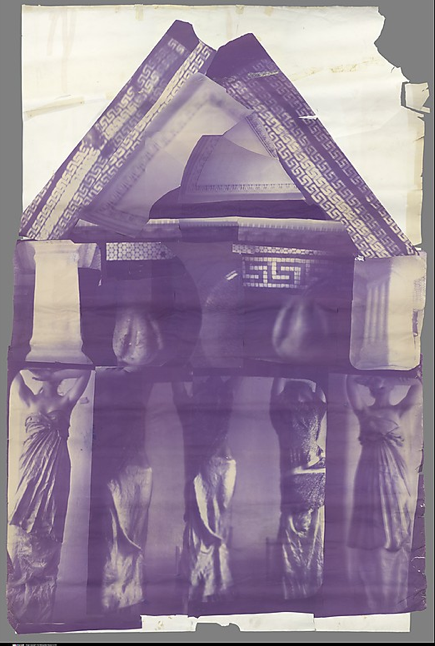
A standout is Francesca Woodman’s 1980 ‘Blueprint for a Temple.’ Completed a year before her untimely death and marking a major shift from her small scale photos, this 15 foot high photo collage of a Greek temple supported by her friends dressed as caryatids and printed on blue architectural blueprint paper playfully remakes ancient culture while forces a connection between past and present that resonates with the Met’s newly crafted Moroccan court.
The show’s second major highlight, Rosalind Nashashibi’s and Lucy Skaer’s 16mm film ‘Flash in the Metropolitan Museum’ from 2006 was shot at night with a flash strobe as the artists moved through the museum, momentarily illuminating Greek ceramics one minute, African or Medieval European sculpture the next. Unclear images, seen for a moment in varying scales and unflattering angles turn usual museum display on its head while creating an alluringly mysterious anthropological study that is equal parts ‘Blair Witch Project’ and ‘Mixed Up File of Mrs Basil E. Frankweiler.’
Less familiar work comes across as amusing and fresh, like Laura Larson’s photograph of a display in the Telfair Museum in Savannah, Georgia which delights in pointing out the tasteless clash of style in a Regency settee, a wallpapered landscape and patterned marble floor. Sophie Calle’s text and image of a gender-ambiguous blind person describing the ‘terrific ass’ of a sculpture in Paris’ Rodin museum invites reflection on our own ideas about beauty.
By comparison, a photo of a shelf of stored artworks by Louise Lawler, an image of a painting by Tim Davis with his flash blotting out the subject’s face and a video by Lutz Bacher following a young adolescent through the Picasso Museum in Paris look at art stored, reproduced or visited in unexpected if not particularly compelling ways. In a sense, the Met itself undermines the less nuanced work in the show – the stunning artwork and displays encountered on the way to the 2nd floor photo galleries are a tough act to follow.
Tris Vonna-Michell, installation view at Metro Pictures, 2011.
In his New York gallery debut, British artist Tris Vonna-Michell explores the stories of little-known historical figures (an East German border guard, a forgotten concrete poet) in a group of distinct but linked installations that collect, sift and reconfigure information to create intriguing, and charmingly quixotic, alternative histories. Despite deliberately low-tech, low-key visuals—slide shows of bleak urban scenes, displays of texts on tables and shelves—the artist’s soundtrack of urgently delivered word streams provides an irresistible hook.
In the darkened front gallery, a voice speaks pressingly about magnetic tapes, tanks and Russians, while a projector slowly flashes images of the former no-man’s-land near the Berlin Wall. Texts spell out the story of a young soldier canonized by the East German state for being shot by defectors escaping west in 1962, but the actual details are left untold because, as the piece suggests, truth was subsumed by official legend long ago.
Elsewhere, Vonna-Michell tells of his not entirely successful attempt to track down an obscure French avant-garde poet, Henri Chopin (a former neighbor), and also recalls the 1989 mass demonstrations around Stasi headquarters in Leipzig, as nervous authorities shredded incriminating files inside. Seamlessly segueing from their frantic efforts to destroy records to Kurt Schwitters’s collage technique, Vonna-Michell demonstrates that while none of us may ever completely know the past, it can be engaged, at least, on one’s own terms.
Originally published in Time Out New York, issue 832, October 13-19, 2011.
Patricia Esquivias, "Natures at the Hand." Photograph courtesy of Murray Guy, New York.
Patricia Esquivias’s immediately likable narrator voice is the hook in her major new video,Folklore III, keeping us engaged through dull, repetitive images and the creeping suspicion that there is less to the historical connections she weaves between two lands—Galicia, Spain; and Nueva Galicia, Mexico—than her deadpan delivery suggests. Unsupported by video evidence, the details Esquivias describes—childlike decorations on the houses, a vast unfinished monument—gradually come to seem more fanciful than believable, and thus, wonderfully entertaining.
Old Galicia represents endings—we see scenes of the coastline and hear about the rituals enacted there—while new Galicia presumably offers a fresh start to immigrants. Yet it’s the Old World that hosts a peculiar and inherently hopeful architectural custom, whereby homeowners build successively larger floors onto their buildings, creating edifices shaped like inverted Aztec pyramids. Such optimism in the future contrasts with the stasis of Nueva Galicia, where newcomers never really find their feet, subtly upending the assumption that newer is always better.
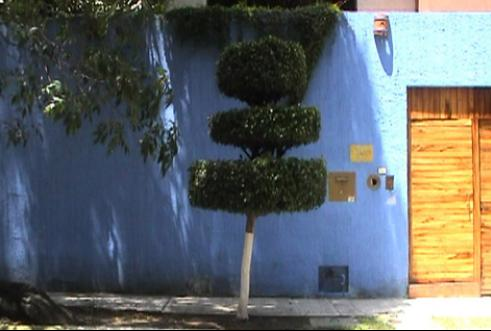
The show’s second major piece, Natures at the Hand, (from 2006) reverses tactics by favoring visuals over story, though it continues to forge similarly tenuous historical or thematic connections—comparing topiary in European castles with that in Guadalajara’s front yards, for example. Collaging disparate images together to create new narratives is a common strategy these days (Fischli and Weiss and Fia Backström come to mind), but Esquivias makes the approach her own by delighting in the simple absurdities of life, and evoking a cross-border culture in which the fluidity of facts meets the charms of quirkiness.
Originally published in Time Out New York, issue 768, June 17-23, 2010.
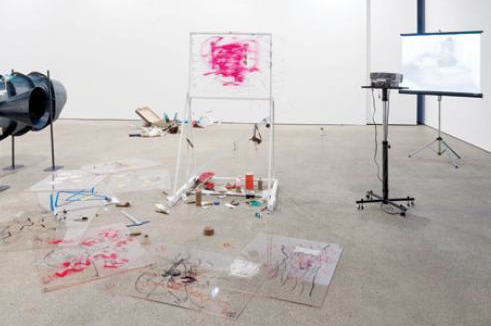
John Bock, installation view, 2010. Photograph courtesy of Anton Kern Gallery, New York.
The remnants of John Bock’s current performance at Anton Kern Gallery—a floor littered with Plexiglas sheets covered in marker drawings, smiley-face stickers and sausage slices; a suitcase full of handmade, low-tech mechanisms—speak to the artist’s willingness to mine the ridiculous, grotesque and nonsensical in order to build fantastical, alternative realities. The new work, including two videos shot in Korea and a series of wall sculptures, offsets confusion with absurdity, striking an appealing balance between eccentricity and humor.
Bock’s videos feature an assortment of antiheroes who use a revolving lineup of devices to navigate unfamiliar terrain. The live performance distills this same sort of activity, via a hired dancer who tests a series of contraptions cobbled together from wood, stuffing and masking tape, as Bock diagrams his actions in rapid-fire sketches on Plexi. Like an artistic MacGyver, Bock’s resourcefulness in crafting, say, a sandbag-like weapon out of a pair of tights enables his characters to meet the challenges of an illogical world.
Just as performance partially decodes Bock’s frenetic, abstract diagrams, a mini horror movie, Büsche (Box), pokes fun at the psychological drama of a longer video titled Para-Schizo, ensnarled, in which two muttering loners employ totems and devices to walk, eat and engage in a destructive love affair. Their tools don’t fix anything: One character meets an abject death, the other finds a secluded peace, suggesting that while life may present us with obstacles, our efforts to overcome them—reasonably or not—are still valiant.
Originally published in Time Out New York, issue 756, March 25 – 31, 2010.