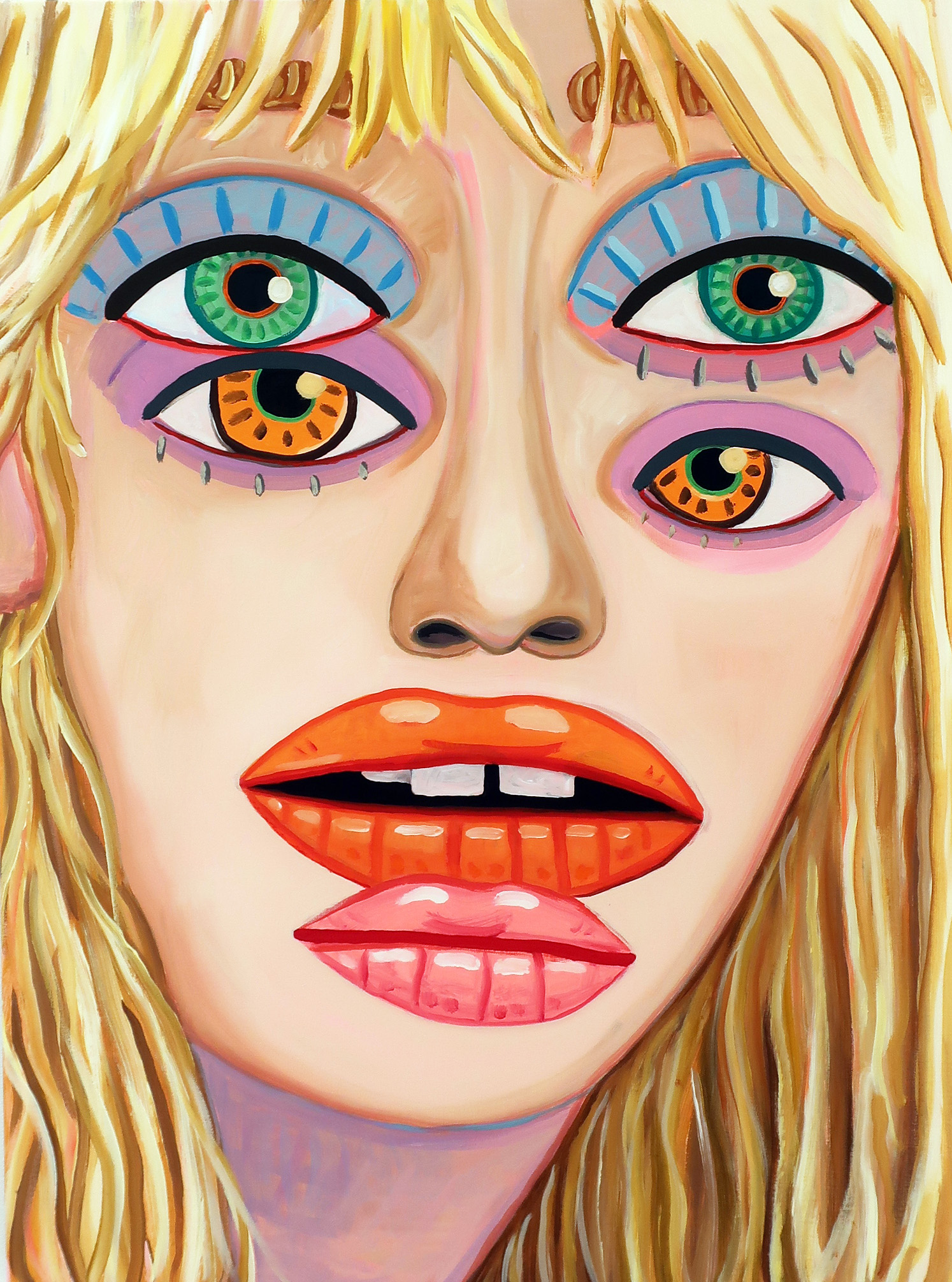
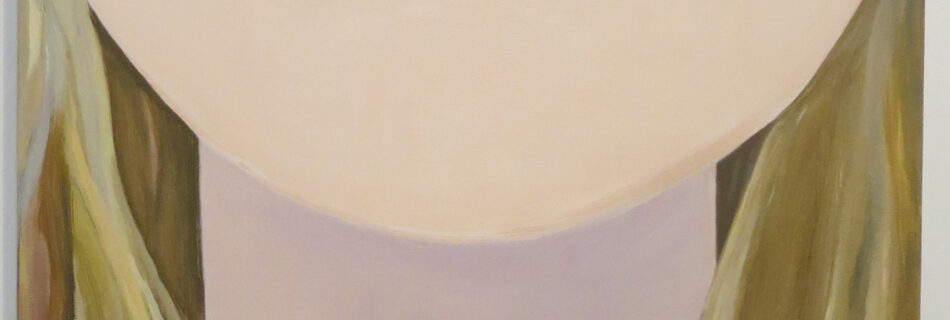
As artists continue to present bodies of work created during the pandemic, Californian painter Brian Calvin’s best new paintings at Anton Kern Gallery stand out for concisely capturing a feeling of disorientation. Here, a female figure’s parted lips convey cluelessness or surprise and a sense of vulnerability, yet at the same time, her other mouth – lips firmly pressed together – suggest composure. Trying to separate the faces (and emotions) can literally hurt. (On view in midtown through Dec 5th. Masks and social distancing required).
Brian Calvin, Composite Sketch, acrylic on linen, 40 x 30 inches, 2020.
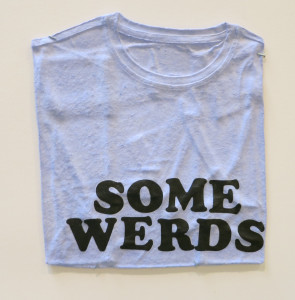
British artist Richard Hughes makes his own t-shirts…out of paper pulp in the case of this low-key garment. Deliberate misspellings on the shirts, and here, a disregard for even including a message, take a whatever attitude to a new level. (At Anton Kern Gallery in Chelsea through Dec 22nd).
Richard Hughes, Some Werds, paper pulp, 13 x 12 inches, 2016.
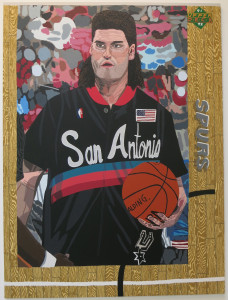
Jonas Woods’ monumental painting of late basketball player Dwayne Schintzius offers a tragic figure for contemplation. After a promising start in college basketball, health problems thwarted Schintzius’ career before he died due to complications of leukemia in his early 40s. At over seven feet tall, with a mullet hairstyle as renowned as his sports skills, Schintzius was a particular type of American hero; Woods prompts us to ask what kind with his over nine-feet-tall canvas. (At Chelsea’s Anton Kern Gallery through Oct 22nd).
Jonas Woods, Dwayne Schintzius, oil and acrylic on canvas, 110 x 82 inches, 2016.
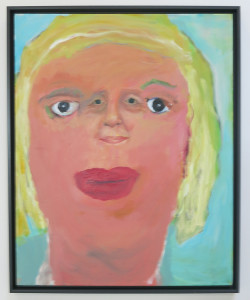
Chicago-based octogenarian Margot Bergman makes her New York solo debut with highly emotive, expressionist portraits created on canvases found in thrift stores and flea markets and reworked into double portraits. Here, a kindly, elderly face peers out from the forehead of a pouty-lipped blond, perhaps foretelling the younger woman’s future or portraying her internal voice. (At Chelsea’s Anton Kern Gallery through Aug 19th).
Margot Bergman, Wilma Rose, acrylic on found canvas, 30 x 24 inches, 2012.
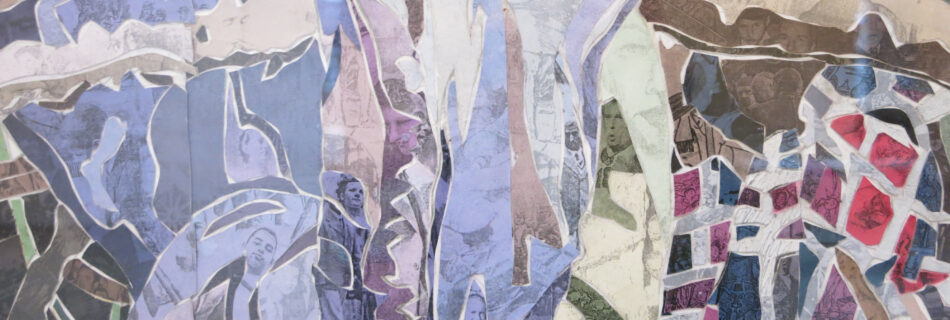
For his latest solo show, German video and collage artist Marcel Odenbach produces collaged images of what he calls ‘Green Zones,’ or marginal spaces in which nature and unexplained human activity meet. Seen here in detail, a scarf tied around a tree branch suggests a memorial, composed of clipped and copied press images referring to “…religious delusion, racism and murder…’ explains the gallery. (At Anton Kern Gallery in Chelsea through July 3rd).
Marcel Odenbach, Grunflache 3 (Green Zone 3), ink and collage on paper, 81 x 108 inches (framed), 2014/15.
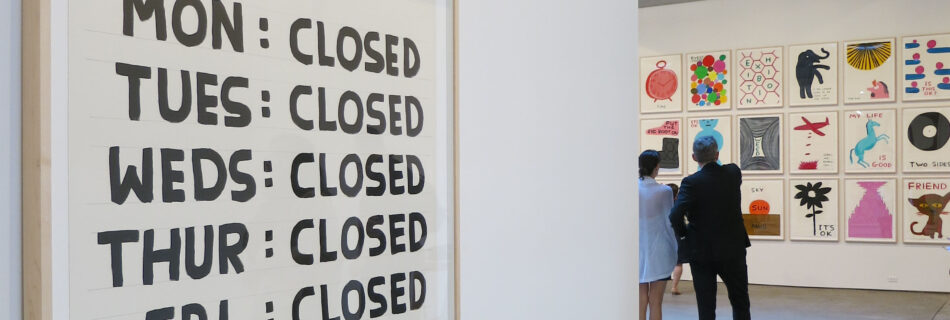
Traditionally, Chelsea galleries are closed today – the Saturday of Memorial Day weekend but a sea-change may be coming; it’s the last day to catch David Shrigley’s show at Anton Kern Gallery, which contrary to the tongue-in-cheek signage, will be open today. (Through May 23rd).
David Shrigley, installation view at Anton Kern Gallery, May 2015.
Looking like someone’s giant selfie gone wrong, this painting by LA artist Brian Calvin depicts a carefully dressed figure in the blush of youth, whose crooked teeth take center stage to suggest a momentary lapse in managed self-presentation. (At Anton Kern Gallery through Oct 4th).
Brian Calvin, Ha, acrylic and flashe on canvas, 72 x 48 inches, 2014.
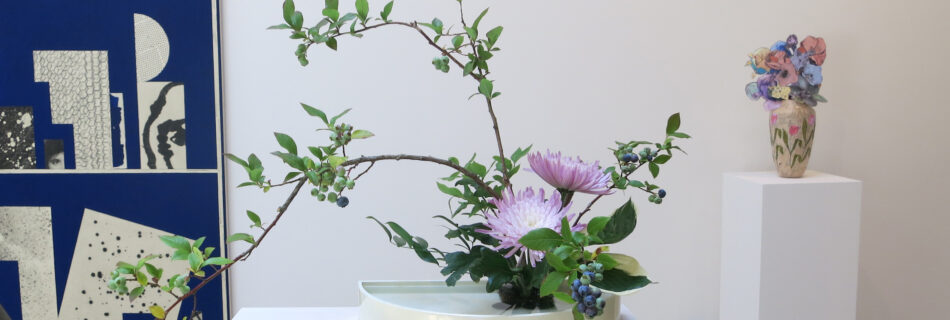
Traditional Japanese Ikebana becomes art in the hands of New York artist Carissa Rodriguez (who memorably showed a Cartier clock owned by FDR at the Whitney Biennial this spring). In Anton Kern Gallery’s treasure-chest of a summer group exhibition, she saddles this gorgeous arrangement with the title ‘I Will Cook Myself Tomorrow,’ making it a kind of pre-memorial. (In Chelsea through August 22nd).
Center: Carissa Rodriquez, I Will Cook Myself Tomorrow,’ unique seasonal Ikebana arrangement, Sogetsu suiban vessel and custom pedestal, variable dimensions, 2012. To the left: ‘Blue Shelf’ by David Korty. To the right: ‘Vase (prototype) and paper bouquet,’ Marc Camille Chaimowicz.
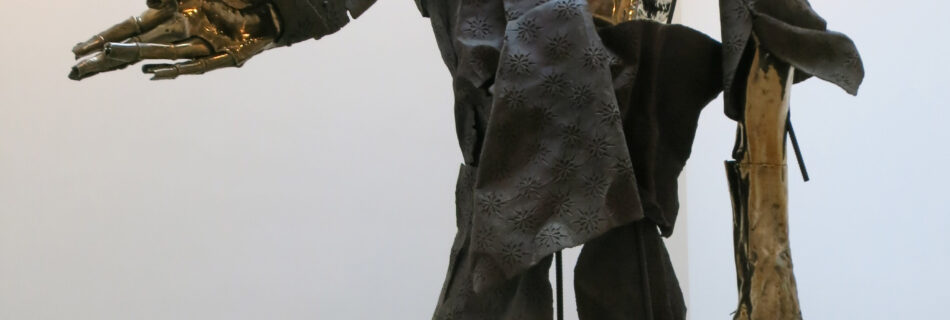
Named Hephaestus, after the god of fire and blacksmiths, this towering, skeletal sculpture by LA artist Matthew Monahan suggests that its power lies not in massive proportions but the ability to assemble an arresting totem from scrap. (At Anton Kern Gallery through June 28th).
Matthew Monahan, Hephaestus, patinated bronze, stainless steel, patinated rebar, 144 1/8 x 114 ¼ x 82 ¾ inches, 2013.
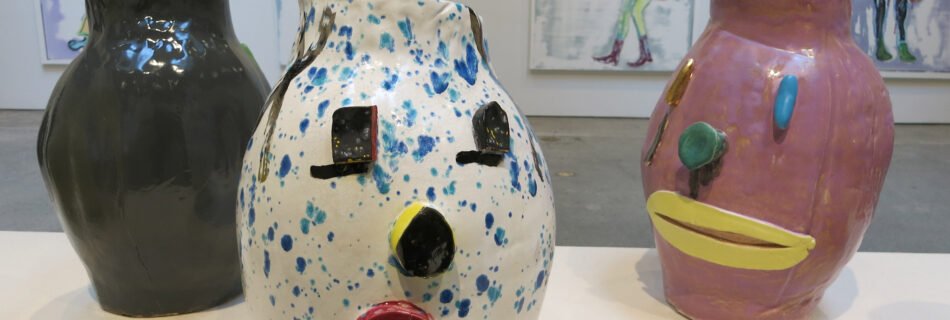
In one of Chelsea’s more cheerful shows of the moment, New York-based artist Dan McCarthy presents paintings of happy musicians accompanied by birds and ‘Facepots,’ one of which smiles through its tears. (At Anton Kern Gallery through March 22nd).
Dan McCarthy, installation view at Anton Kern Gallery, February 2014.
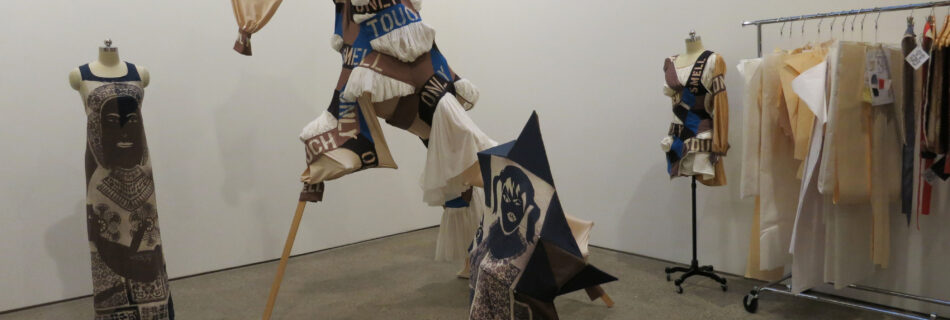
Known for fabric sculptures like those pictured here, LA-based artist Lara Schnitger is now allowing fans a more intimate appreciation of her work with a couture line – Sister of Arp. The clothes will, she says, “play with themes of motherhood, feminism, fashion and sculpture.” (At Anton Kern Gallery, Chelsea, through Feb 15th.)
Lara Schnitzer, installation view of ‘Sister of Arp’ couture clothing at Anton Kern Gallery, January 2014.
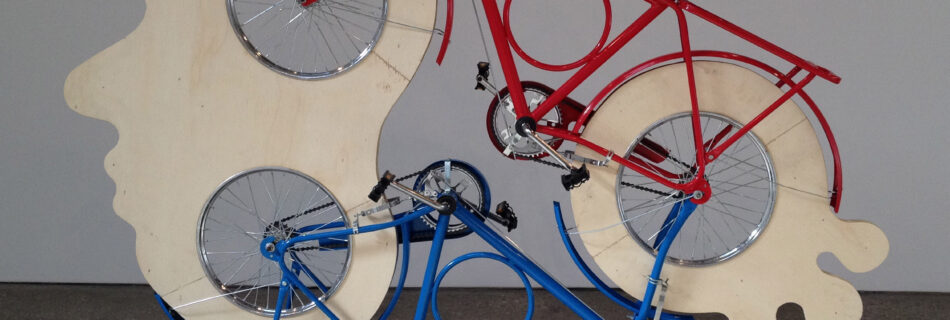
Brazilian artist Marepe continues to use everyday materials, simply transformed to achieve big effects. In his latest solo show at Chelsea’s Anton Kern Gallery, he transforms two bikes into a stationary creature with human head and fish-like tail, a hybrid that suggests literal and figurative possibilities for forward movement. (Through Dec 14th).
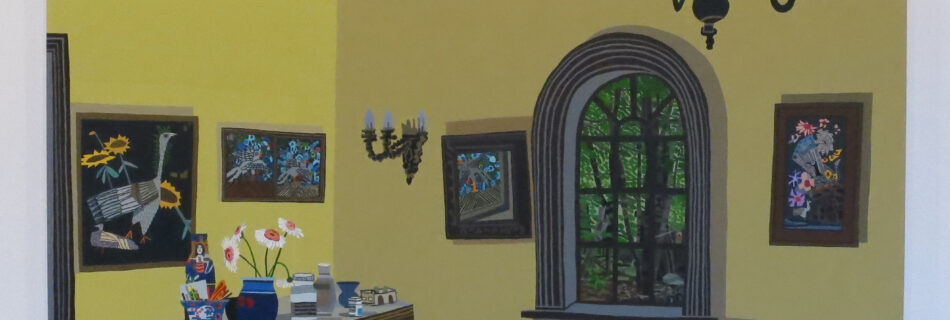
LA-based artist Jonas Wood builds his paintings from photos, sourcing them in the digital. At the same time, his memories supply more details as in this painting of his father’s house in Boston in which the bird and flower paintings are depicted as Wood remembered them from childhood rather than how they actually are. (At Chelesa’s Anton Kern Gallery through Oct 19th).
Jonas Wood, Yellow Front Hall, oil and acrylic on canvas, 2013.
Francis Upritchard’s medieval-looking characters ride, run, lunge and more as they engage in slightly ludicrous one-sided combat. Their expressions read as aloof, nauseous or perhaps both, which seems fitting for such convincingly-executed weedy warriors. (At Chelsea’s Anton Kern Gallery through August 9th)
Francis Upritchard, installation view at Anton Kern Gallery featuring ‘Rider,’ modeling material, wire, fabric, leather and shell buttons, 2012.
In his latest New York solo show, British artist Richard Hughes turns drabness into whimsy by appearing to transform light posts into a pair of jauntily high-stepping legs. They’re actually meticulously created to look like the real thing, but that fact’s almost irrelevant to their enjoyment. (At Chelsea’s Anton Kern Gallery through May 18th).
Richard Hughes, Pedestrian (Hot Ste P), architectural grey board, fiberglass, stone resin, steel and paint, 2013.
Painting gets the last laugh in Polish artist Wilhelm Sasnal’s new body of work which focuses on Kodak, its products, logos and marketing of the ‘Kodak moment.’ Now, the former photographic giant’s film products are reduced to memories and arresting color contrasts rendered in oils. (At Anton Kern Gallery through April 6th.)
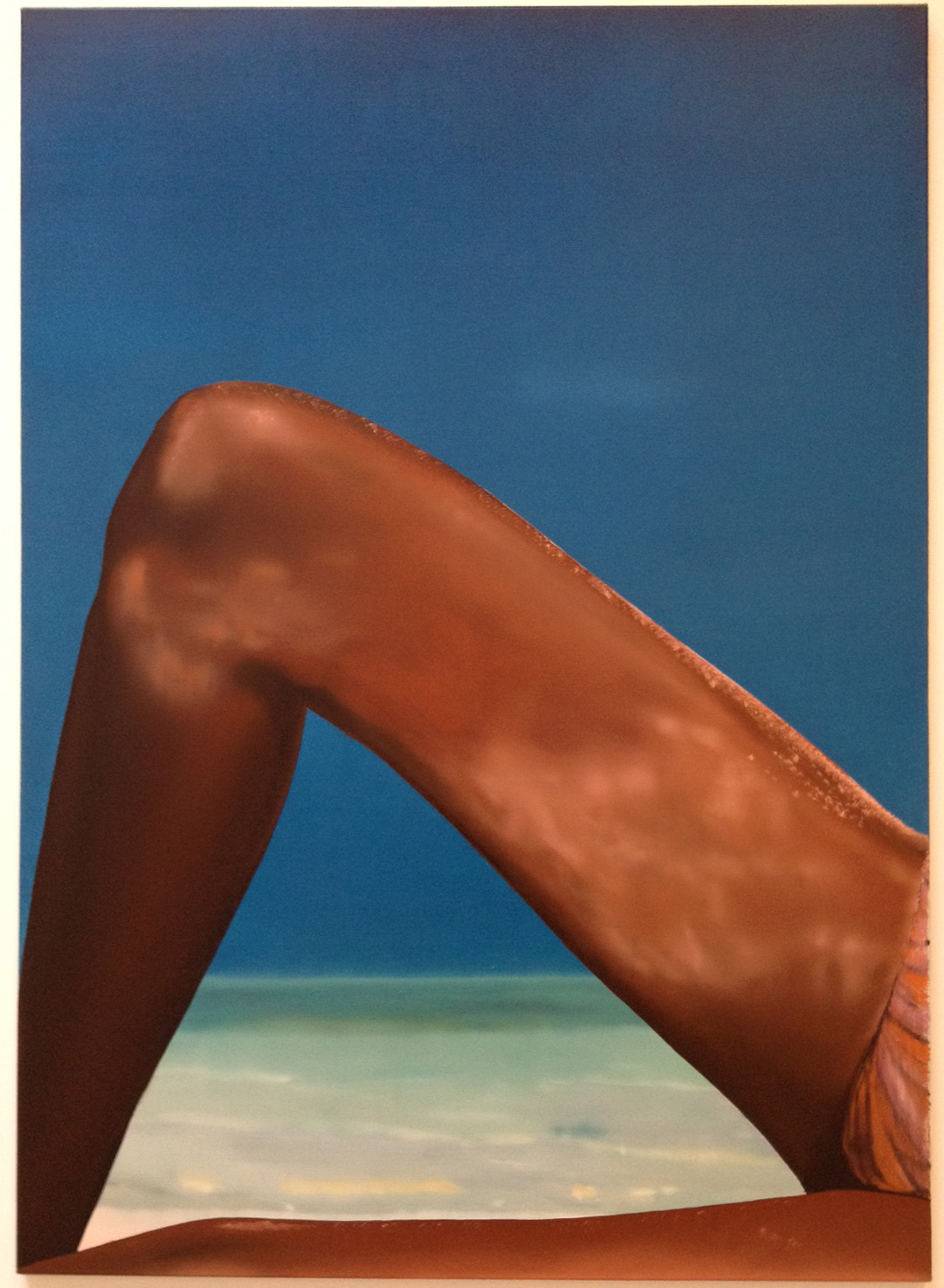
Eberhard Havekost’s painting ‘Ocean’ is once again on display as Chelsea’s Anton Kern Gallery reopened today, post-Sandy. It’s a standout in a show about Havekost as artist and consumer, who transforms an enviable body (sourced from a German ad) into a mottled obstacle to the paradisiacal scene behind. (Through Dec 15th).
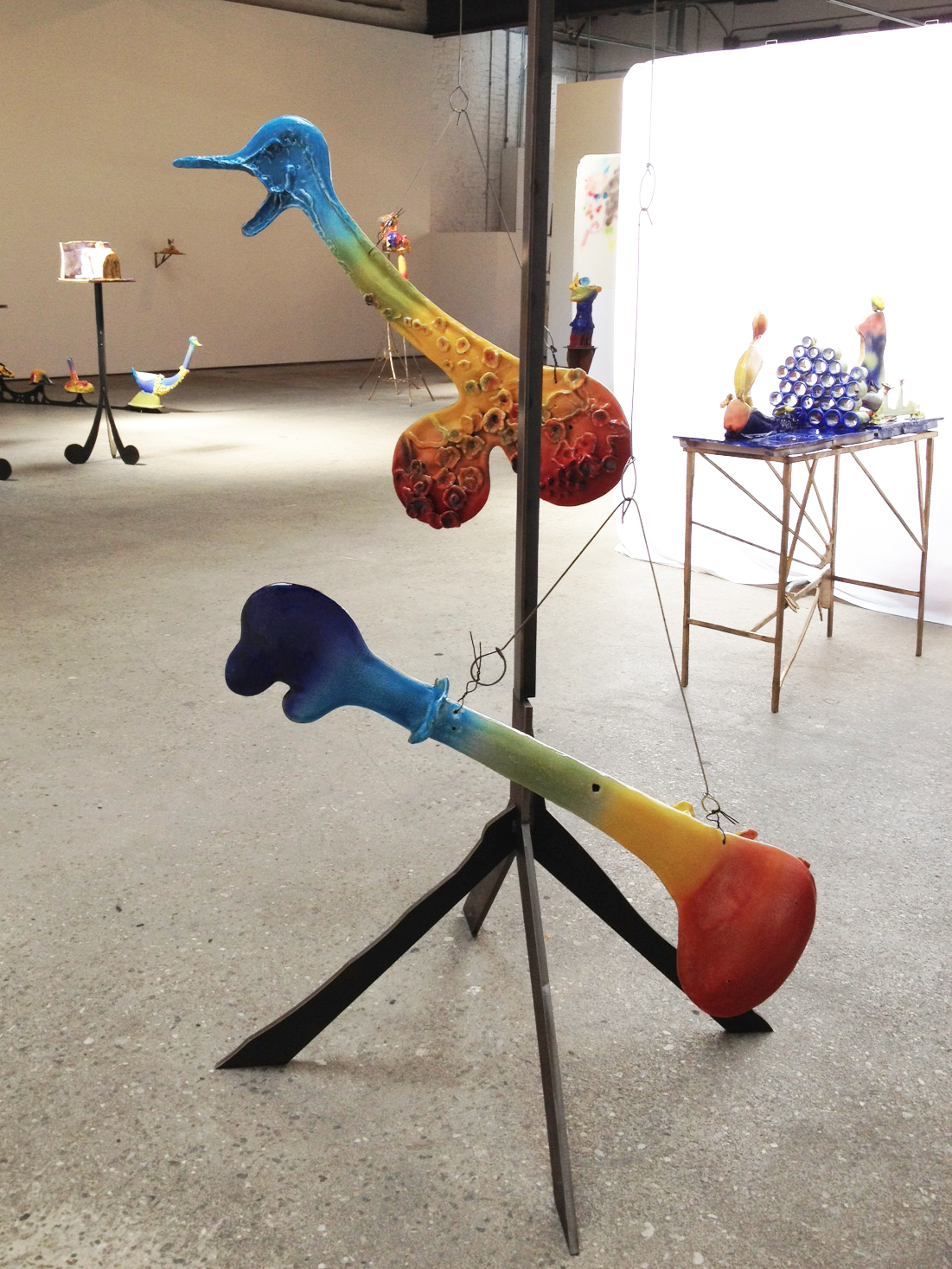
Alessandro Pessoli’s painted figures usually look like they’ve emerged from a dream or hallucination; these absurdly phallic Maiolica ceramic sculptures, fittingly titled Sancho Panza & Don Chiscotte, lack the typical atmospheric surroundings of Pessoli’s paintings, but their lighthearted vibrant colors and mobile-like hanging lend them an amusing whimsy. (At Chelsea’s Anton Kern Gallery through Oct 20th.)
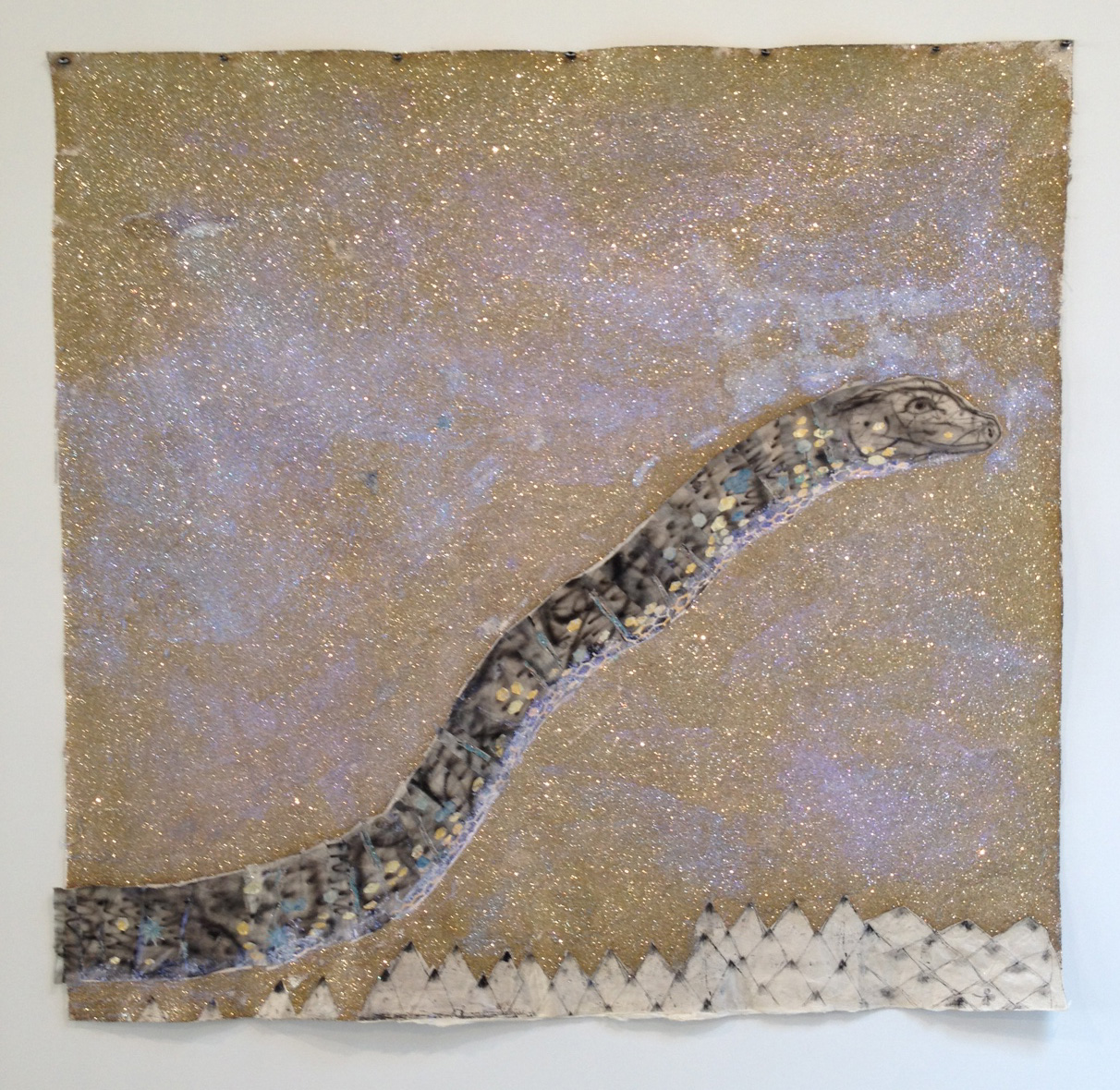
Kiki Smith, Milky Way, murrini with push pin, glass and plastic glitter, gold leaf and ink on Nepalese paper mounted on canvas, 2011.
Kiki Smith’s ‘Milky Way’ brings to mind a more benevolent Edenic serpent hovering over a field of pointed breasts (a fertile Eve? multi-breasted Greek goddess Artemis?). Murrini glass, plastic glitter, and gold leaf amongst other materials create a dazzling backdrop and light up the snake from beneath. The piece could read as an exhuberant celebration of fertility or its opposite, as sharp breasts threaten. (In ‘It’s Always Summer on the Inside’ at Anton Kern Gallery, Chelsea, through August 24th).
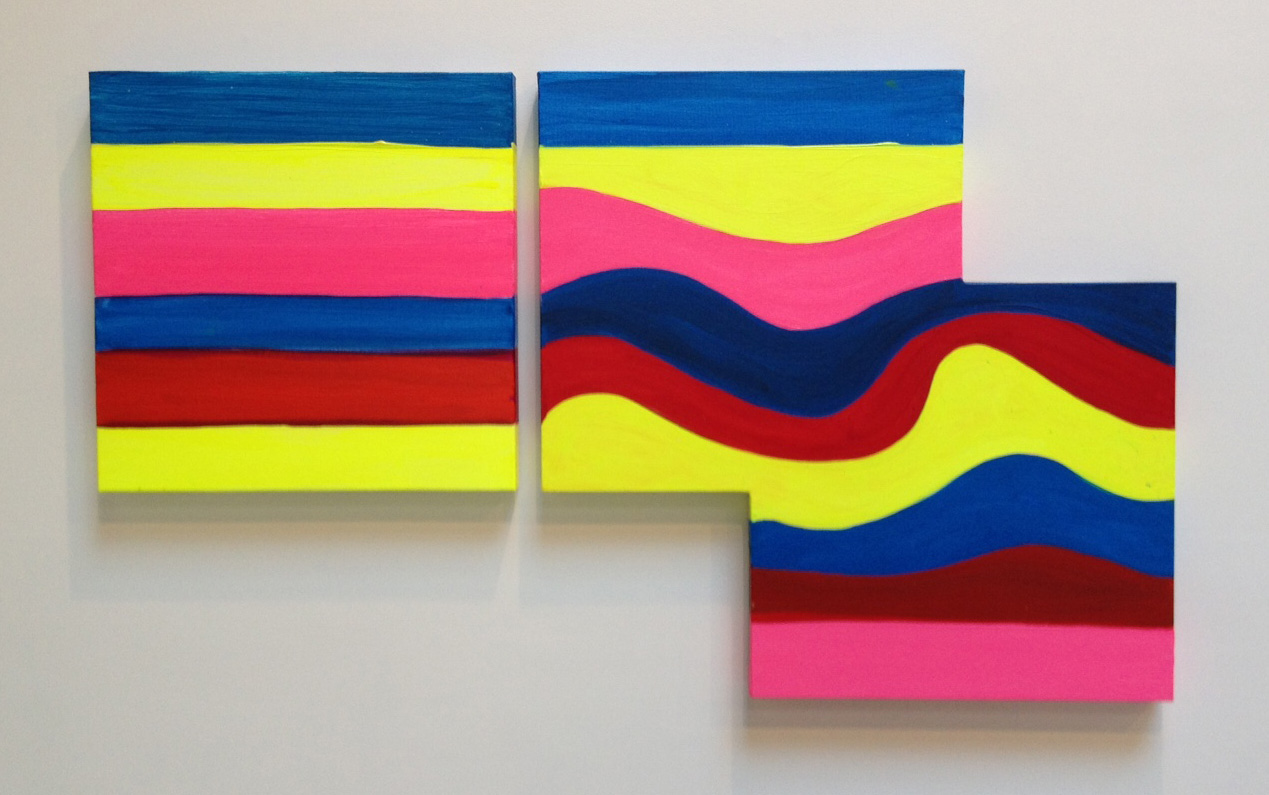
Mary Heilmann, Mojave Mirage, oil on canvas, 2012.
‘It’s Always Summer on the Inside’ at Anton Kern Gallery features some pretty dark fare, from the Coke logo emblazoned with the word ‘blood’ to one of Joyce Pensato’s sinister Batman paintings, making Mary Heilmann’s ‘Mojave Mirage,’ a blessed burst of candy-colored happiness. Her signature technique of adding extra canvas to the conventional rectangular shape works a treat as the sands of a flat desertscape suddenly swoop and swirl. (Through Aug 17th.)
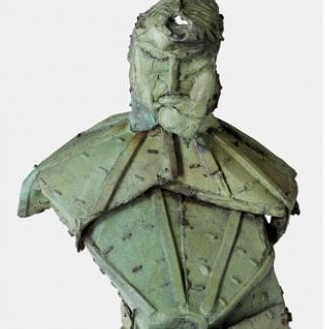
Matthew Monahan, “Seppuku.” Photograph courtesy of Anton Kern Gallery, New York.
For a card-carrying member of the “Unmonumental” generation of sculptors (he was actually in the New Museum show of that name), Matthew Monahan’s latest freestanding bronze sculptures are both reactionary and a logical next step. His previous work consisted of installational displays crowded with objects and figures, idiosyncratic minimuseums chockablock with visual allusions to art history—a Greco-Indian eye here, a Northern Renaissance visage there. At Anton Kern, Monahan distills archetypal characters from a jumble of references, creating a fascinating group that looks like archaeological finds from an alternative art history.
One slender nude’s wire-bound body recalls photographer Nobuyoshi Araki’s soft-core titillations, but her quizzical expression is more provocative, suggesting spiritual superiority and/or mental disability. Another character’s cruciform pose begs explaining, but his craggy and practically concave face closes in as if guarding secrets. Nearby, a motionless, gold-leafed droid version of Umberto Boccioni’s Unique Forms of Continuity in Spacestands stiffly by.
While Monahan’s sculptures pique our curiosity with their mix of vague familiarity and uncertain identity, a series of oil-on-board images resembling tantric diagrams fairly exudes esoteric mystery. Collectively titled “Body Electric,” they summon Walt Whitman’s passionate appreciation of the human form but feature a fairly unnuanced, everyman element: a simplified kind of line drawing made by scraping black-painted paper to reveal the white below. The sculptures, on the other hand, turn appropriation into creation with their affecting cast and enjoyable synthesis of history, pop culture and sheer invention.
Originally published in Time Out New York, issue 793, December 9 – 15, 2010.