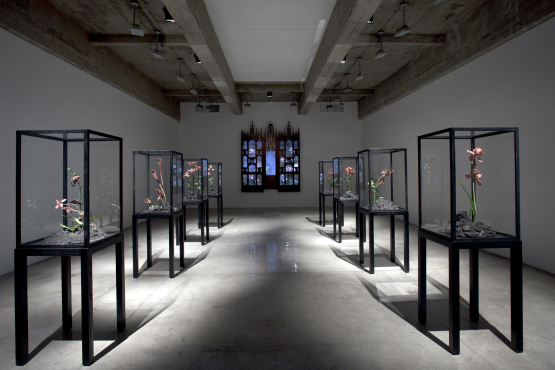
Matt Collishaw ‘Vitacide,’ at Tanya Bonakdar Gallery

Matt Collishaw, installation view.  Photo courtesy of the artist and Tanya Bonakdar Gallery, New York.
Matt Collishaw, installation view. Photo courtesy of the artist and Tanya Bonakdar Gallery, New York.

Photos of Texas death-row prisoners’ last meals, giant prints of dead insects and sculptures of diseased flowers (titled, for instance, after a poem from Baudelaire’s Fleurs du Mal or a U.K. waste-management company) confirm that original Young British Artist Mat Collishaw still traffics in sensation. Surprisingly, the most gratuitous subject—the last meals—proves to be the most thought-provoking, despite the fact that it, too, reflects Collishaw’s fondness for grotesquery.

Collishaw rightly calculates that our morbid fascination will attract us to these photos of french fries, steak, cinnamon rolls and other repasts, dimly lit to recall Dutch still-life painting, but mainly looking gray and unappetizing. Still, evoking this last moment of pleasure does create twinges of sympathy for the condemned, whose orders range from a dish of yogurt to a heaving pile of food.

Vitrines of waxy-looking, boil-covered, meat-pink amaryllis, lilies and other flora growing in toxic soil are so blatantly gross that they kill any such nuance of feeling. A video animating decaying flowers buzzing with flies in a comically misty dead forest does a bit more than the sculptures to suggest the dark enchantment hinted at in Baudelaire’s title, but setting the flatscreen behind an 18th-century altarpiece seems like a mere ploy to stir the pot with a tangential religious reference. Collishaw gets it right when he mines the contradictions in humanity’s capacity for base thoughts and actions. But when he simply represents it, he produces more of the same.

Don’t Miss: On Kawara at David Zwirner


For an artwork with such potential to bore its audience silly, On Kawara’s One Million Years at David Zwirner Gallery is surprisingly seductive. To try to better understand this landmark conceptual art project, consisting of several volumes of type-written numbers counting one million years into the past and one million years into the future, I volunteered to take part in a public reading one Saturday afternoon.

Half expecting to emerge from my two-hour stint hoarse and semi-deranged after such a mind-numbing chore, I was relieved to survive relatively intact. I’d thought that my mind would wander to all kinds of interesting places while my lips went on autopilot. No such luck.

Plowing through the centuries at a steady clip (my male counterpart and I covered a millennium in about an hour), I had to stay focused despite the temptation to meet the gazes of staring gallery visitors or gawk at one knoodling couple. To my chagrin, the piece brought out my inner nerd, so preoccupied by speaking up and not making mistakes that I couldn’t begin to get my head around the idea of the numbers representing meaningful dates. Instead, my thrills came from configurations like 48,888AD and the turn of the millennium.

Later in the day, though, I found myself thinking about the progression of ‘our’ numbers – 48,625 A.D. – 49,678 A.D. Something about the repetition was soothing – maybe the idea of time marching inevitably and quickly on, regardless of what may or may not happen all those years in the future. I can’t say my immediate perception of time has been effected, but the idea of a human lifespan passing in a flash while barely a dent was made in the tally of dates is still awe inspiring.

Catch On Kawara’s One Million Years before it closes on February 14th, or watch my exhibition review .

Don’t Miss: Elizabeth Peyton and Mary Heilmann at The New Museum

Several museum shows are timed to close at the end of the holiday season; don’t let your chance to see Elizabeth Peyton’s and Mary Heilmann’s solo shows at the New Museum slip away.  To much publicity, Peyton added a portrait of Michele Obama to her exhibition after November 4th, but the artist’s best work comes when she indulges her obsession with wan and pretty men.  Plenty of female artists have depicted men in feminizing ways to in order to critique conventional portrayals of women, but Peyton doesn’t demean her subjects, instead giving them their own aura of exquisiteness.  Downstairs, forty years of painting, ceramics and furniture by Mary Heilmann refreshingly demonstrate this much admired artist’s ability to conjure a range of moods –  – electrifying, humorous, or serene – through her abstract canvases.  Highlights include ‘Lovejoy, Jr.,’ a day-glo grid inspired by the stained glass windows in the church on The Simpsons and a row of blue and white paintings in the lobby gallery, which riff on the meeting of land and sea.

Don’t Miss: ‘The Voting Booth Project’

Obama-mania has swept the art world this fall with myriad auctions and other fundraising events. At David Zwirner Gallery, you can do more than buy art or hobnob with politically like-minded art lovers. you can take home a piece of history from ‘The Voting Booth Project,’ an exhibition of artwork made from actual voting booths used in the 2000 election in Florida. If the memory of the faulty booths
makes you a little queasy, at least the lineup of participating artists promises to sex up the symbols of disenfranchisement by including the campy, carnivalesque assume astro vivid focus, Mickalene Thomas,
liberal user of rhinestones in her images, and Fred Tomaselli of drugs-as-collage-materials fame.

The Rema Hort Mann Foundation presents The Voting Booth Project at David Zwirner Gallery, 525 West 19th Street, Oct 14 – 25 and at Lehmann Maupin Gallery, 540 West 26th Street, November 7-8.

Don’t Miss: Kara Walker

“If Ms Walker retired today she would leave behind one of the most trenchant and historically erudite bodies of art produced by any American in the last 15 years, only a portion of which is in the Whitney show,” wrote New York Times critic Holland Cotter of Kara Walker’s powerful survey show at the Whitney Museum. Pilloried by some prominent African American artists in the late 90s for trafficking in negative black imagery, Walker’s signature installations of black-paper silhouettes on white walls, drawings, projections and texts mine America’s past and present race relations in all their ugly complexity. For viewers unafraid to confront controversial issues head on, this is the show not to miss. (On through Feb 3rd).

For more information, visit the Whitney Museum’s website or read Holland Cotter’s review in the New York Times.

Don’t Miss: Chris Ofili

For many New Yorkers, Chris Ofili’s name will bring to mind the brou-ha-ha around his painting of the Virgin Mary supported by two clods of dried elephant dung, exhibited at the Brooklyn Museum in 1999. Ofili’s choice of materials aimed to beg the question of what kind of art he should make as a Caribbean-British artist, a topic that he revisits in a show of new work at David Zwirner Gallery. A recent move to Trinidad appears to have influenced the subject matter and style of his recent paintings, with languid characters, intense colors and tropical landscapes making references to European masters like Gauguin and Matisse, who ventured abroad in search of the exotic. With several standout paintings and sculptures, Ofili peels back another layer of his complicated identity, making this the ‘don’t miss’ show of the moment.

For more information on Chris Ofili’s ‘Devil’s Pie’ exhibition, visit David Zwirner Gallery.

Don’t Miss: ‘Global Feminisms’

Feminism is dead? Think again. Touted as, ‘The first international exhibition exclusively dedicated to feminist art from 1990 to the present,’ ‘Global Feminisms’ at the Brooklyn Museum proves that women around the world (with quite a few art stars among them) are making artwork about specifically female experience. The show opens the Elizabeth A. Sackler Center for Feminist Art, implying not only that feminism is here to stay, but that the artwork identified under that title will be continually worthy of a significant swathe of Brooklyn Museum real estate. Judge for yourself if this controversial investment is truly groundbreaking or ‘a false idea wrapped in confusion,’ as New York Times critic Roberta Smith recently put it. (Show closes July 1st.)

For more information on Global Feminisms and the Elizabeth A Sackler Center for Feminist Art, visit The Brooklyn Museum’s website.

Don’t Miss: Mitch Epstein, Justine Kurland, Karel Funk

Attention all photo enthusiasts, don’t miss three shows set to close April 7th. Selections from Mitch Epstein’s series, ‘American Power’ may feel a little disjointed – images representing family and romantic power relations are shuffled in with photos depicting refineries, fuel processing plants and the wreckage of Hurricane Katrina – but are still a sobering visual essay on the cost exacted by American energy consumption. Justine Kurland’s subject matter is likewise tied to the American landscape, but her photos of mothers and their children posing nude in the wilds are idyllic scenarios suggesting a thwarted yearning for prelapsarian perfection. Meanwhile, over at 303 gallery, Karel Funk’s photorealist paintings (OK, it only looks like photography) prove it’s not just God who can count every hair on your head. Check out the lavish attention paid to the minutest detail of his male subjects, including the wispy locks on one magnificent hipster in the back gallery.

For more information on Mitch Epstein, see Sikkema Jenkins & Co, for Justine Kurland, see Mitchell-Innes & Nash and for Karel Funk, visit 303 Gallery’s website.

Don’t Miss: Stan Douglas, Dike Blair, Charles Long

Exhibition closings come in waves; the next set is due to break on February 10th. Don’t miss Stan Douglas’s video ‘Klatsassin,’ a murder and revenge story set during a gold rush in 19th century British Columbia, at David Zwirner Gallery. Presented in Douglas’ characteristic looping format, with 850 possible permutations, the entire effort runs over 70 hours, both teasing and enticing viewers with an elusively juicy plot. Though their subject matter is decidedly less dramatic, at least two other shows merit a last minute trip to Chelsea. Dike Blair’s tiny, mundane, but mysterious still life paintings at D’Amelio Terras Gallery muster a murky noir feeling, while Charles Long’s elegant, white sculptures at Tanya Bonakdar Gallery recall Giacometti but were actually modeled on bird droppings, giving them pedigree in an art world long obsessed with bodily function.

Don’t Miss: Andy Warhol, John Currin, Martha Camarillo

Christmas is just around the corner, but amid the shopping and festivities, don’t forget that many gallery shows are slated to close right before the holidays. The most obvious must-see is John Currin’s racy, exquisitely rendered portraits at Gagosian Gallery’s uptown location. Meanwhile, don’t miss the huge show of late Warhols at the gallery’s two downtown spaces, where self-portraits in fright wigs butt heads with Mao and Jesus makes an appearance in monumental Last Suppers. For something out of the ordinary, catch Martha Camarillo’s photographs of horse-riding culture in the heart of inner city Philadelphia (as in, hanging out on the street on a horse), at the Jack Shainman Gallery. (All shows close December 22nd.)

Don’t Miss: Evan Holloway, Jennifer Bornstein, Dieter Roth

A trio of shows south of the border (e.g. just beyond the Meatpacking District!) are a cinch to draw visitors below 14th Street this month with excellent offerings by young West Coast artists Evan Holloway and Jennifer Bornstein and Swiss legend Dieter Roth. Holloway at long last presents his first New York solo show after attracting attention in the 2002 Whitney Biennial for his abstract sculptures, while Bornstein departs from her usual photo and film-based work to present intimate portraits created by copperplate etching. Meanwhile Carolina Nitsch Contemporary Art shows editioned graphics and objects by the master of odd art materials (including chocolate and sausage) as part of a two-gallery show also at Josee Bienvenu Gallery in Chelsea. (Evan Holloway’s and Jennifer Bornstein’s shows are open until Nov 18th, Dieter Roth’s is open until Nov 25.)

Don’t Miss: ‘Helter Swelter’ Justin Lowe

It’s no wonder ‘Helter Swelter,’ Justin Lowe’s first New York solo show attracted reviews in The New York Times, the Village Voice and Time Out. This young collage artist turned the gallery itself into an artwork by creating a convincing, full scale corner store in the front room, parking an ice cream van in the hall, and covering the floor of the back room in fabulous psychedelic swirls of fabric. This meeting of life and art may not explain the mysteries of the universe, but the experience is unique enough for a visit. (Through July 28th)

Find out more at: 5be Gallery

Don’t Miss: Asian Contemporary Art Week

For one week only, New York hosts an extravaganza of Asian art made here and abroad in a series of non-stop lectures, exhibition openings and events. Highlights include an array of video works presented at art venues across the city, sculptures by legendary Indian outsider artist Nek Chand, and even an intergenerational showdown between two action painters on a blocked off street in Tribeca. With so many events happening in so many venues, it ’s a sure bet that something good with be happening near you.

For more information and schedules, visit Asian Contemporary Art Week’s website.