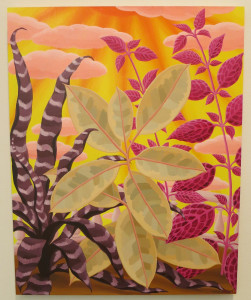
New York artist Amy Lincoln carefully studies particular plants, then incorporates them in paintings of the natural world so crisp and vibrantly colored, they’re almost hallucinogenic. (At Morgan Lehman Gallery in Chelsea through May 7th).

New York artist Amy Lincoln carefully studies particular plants, then incorporates them in paintings of the natural world so crisp and vibrantly colored, they’re almost hallucinogenic. (At Morgan Lehman Gallery in Chelsea through May 7th).

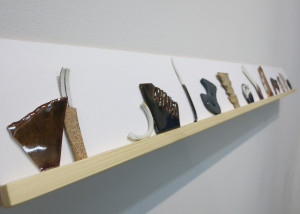
Arranged in vitrines or along this long shelf, Katy Fischer’s ceramic objects look like archaeological finds. They’re a humorous take on the notion that ceramics must have use-value and yet provocative in prompting consideration of what those uses might be. (At Lower East Side gallery Louis B. James through May 1st).

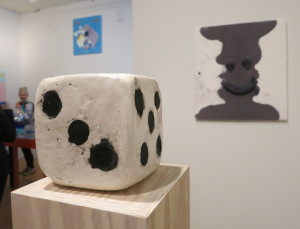
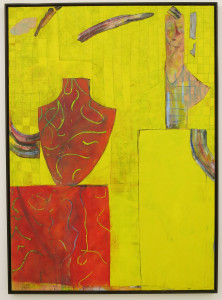
Painter and sculptor Volker Hueller is known for mining art history, remixing styles and associations from yesteryear into a contemporary visual vocabulary. In this recent painting, on view at Lower East Side gallery 11R, he turns one of his signature, geometric characters into art object, suggestively equating face and vase. (Through April 24th).

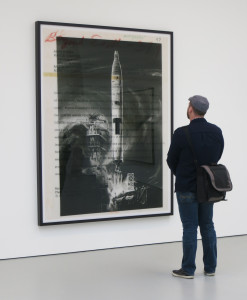
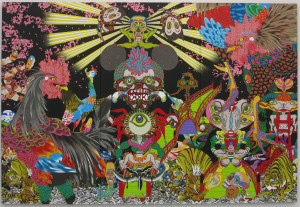
Above a barely noticeable landscape of frothing waves and neon-colored bridges, a strange assortment of alien characters array themselves like a contemporary, psychedelic thangka in Keiichi Tanaami’s ‘Vision in the Womb.’ The Japanese icon blends eroticism and the lingering terror of Tokyo’s firebombing in a hallucinatory scene that stuns in its creative profusion. (At Chelsea’s Sikkema Jenkins & Co through April 23rd).

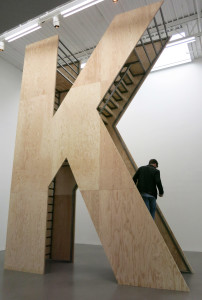
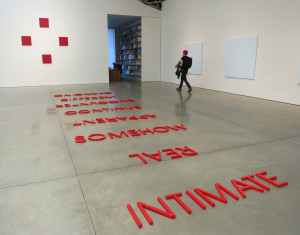
Conceptual art pioneer Robert Barry uses language to transport viewers; in this handsome installation, cast resin letters painted a vibrant red form words like ‘intimate,’ ‘apparent’ that evoke strong associations. (At Chelsea’s Mary Boone Gallery through April 23rd).

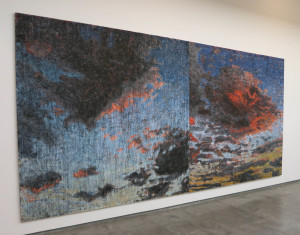
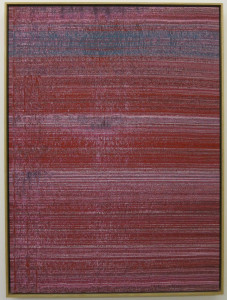
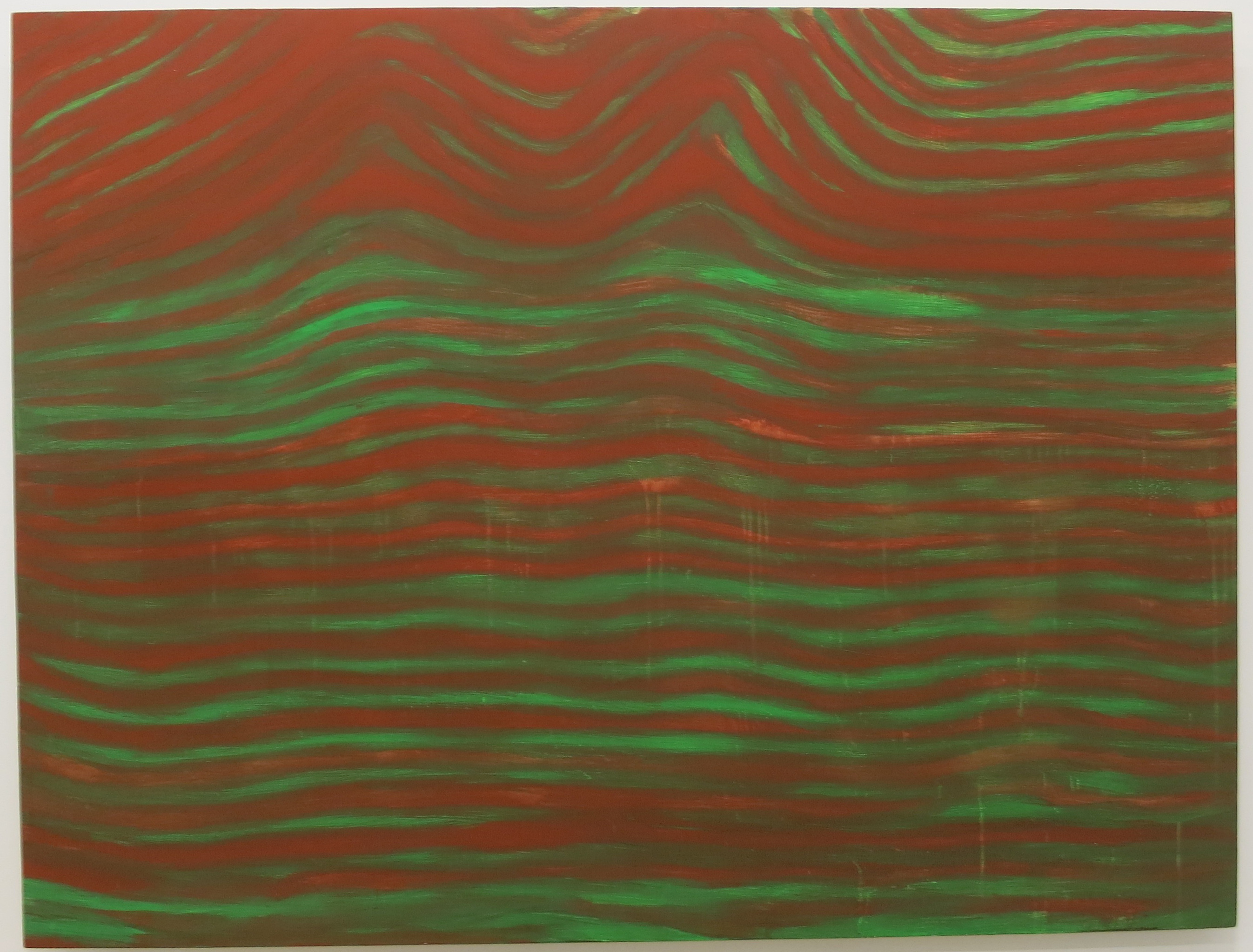
Using her home and the surrounding landscape in Amagansett as subject matter, Jennifer Bartlett offers two versions of the same view. Both have been constructed with a graining brush, a tool that allows her to paint in parallel lines, taking her longstanding relationship with the grid to new directions. (At Paula Cooper Gallery through April 23rd).

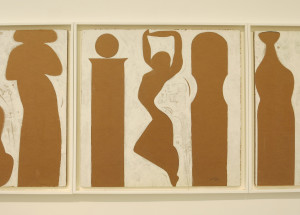
A visit to the Alhambra in Spain inspired Oxford, England-based Sudanese artist Ibrahim El-Salahi to begin his ‘Flamenco’ series, in which he celebrates the music and dance of Andalusia in his signature, modernist style. (At Salon94 on the Lower East Side through April 18th).
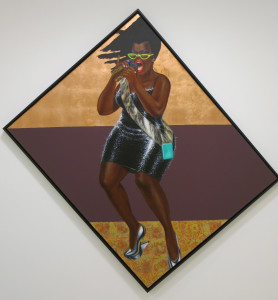
Though they’re both solitary women illuminated by glowing backgrounds, the subject of Barkley L. Hendrick’s 2015 painting, Anthem, couldn’t be further in character from the measured cool of his iconic 1969 ‘Lawdy Mama.’ This singer is holding nothing back as she takes the stage with a double mike and unrestrained self-confidence. (At Jack Shainman Gallery through April 23rd.)

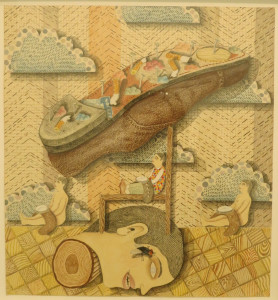
You won’t find wholesome fantasies of life in the American heartland in Iowan artist Timothy Wehrle’s surreal pencil drawings at Chelsea’s P.P.O.W. Gallery. Under rain clouds, a severed head acts as momento mori, while an upside down shoe studded with nails suggests a painful journey. (Through April 16th).

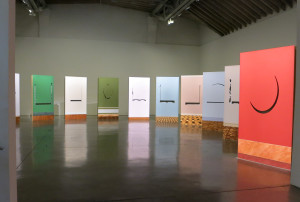
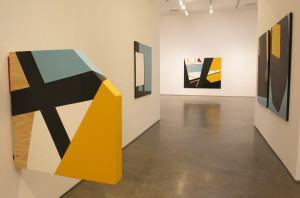
Young Johannesburg artist Serge Alain Nitegeka pushes abstraction off the wall at Marianne Boesky Gallery in Chelsea, altering the gallery with paintings that project into the room while simultaneously acting as portals into 2D illusionary spaces. (Through April 23rd).

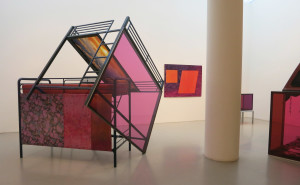
Evocative sculpture by New York artist Sarah Braman creates a nexus between mass produced furniture and the unique art object, coldly minimal forms and a potentially cozy bedroom, a mined metal and unexploited nature in the form of a gorgeous sunset. (At Chelsea’s Mitchell-Innes & Nash through April 16th).

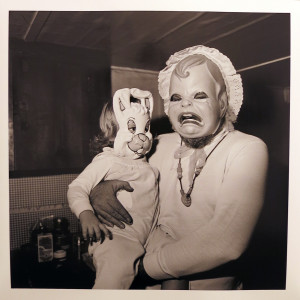
This shot by Rosalind Fox Solomon comes across as simple enough at first…until you register that the caregiver is a crybaby, caring for a bunny and wearing a beard, defying expectations at every turn. The unexpected and odd dominate Fox Solomon’s selection of images from her archive, shot over three decades and around the world, now on view at Bruce Silverstein Gallery in Chelsea. (Through April 16th).

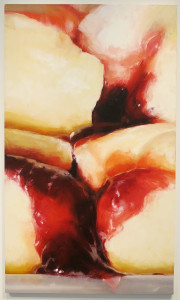
Fruity filling oozes from cracked dough like blood seeping from a wound in this painting of two stacked donuts by Emily Eveleth. The painting’s title ‘Façade,’ suggests we’re only getting half of the story and backs up the impression that these donuts can be read as stand-ins for much more. (At Danese Corey Gallery in Chelsea through April 16th).

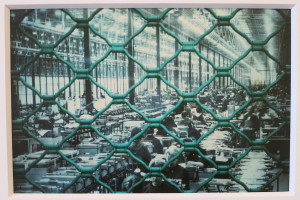
A series of charming vintage color photos from the 70s and 80s by the late Italian photographer Luigi Ghirri, currently on view in Chelsea at Matthew Marks Gallery, use framing and balance to tell stories. This photo – cropped or layered to hide how a fancifully colored turquoise grate came to stand between us and a huge factory floor – both keeps us out and the workers in. (Through April 30th).

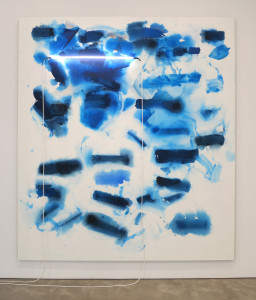
Mary Weatherford’s Casa Reef is a standout in Skarstedt Gallery’s excellent painting show in Chelsea, bringing to mind Yves Klein’s body prints, but in geometric blocks that suggest an underwater structure emerging from swirling white foam pushed by a (literal, neon) current. (In Chelsea through April 16th).

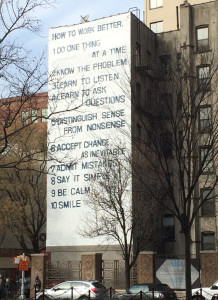
Since lifting it from the bulletin board of a Thai ceramic factory 30 years ago, Swiss artists Fischli and Weiss have reproduced this motivational list in different locations and formats over the years, most recently installing it on Houston Street in Manhattan. From the simple instruction to ‘do one thing at a time’ to the more profound challenge to ‘distinguish sense from nonsense,’ the advice encapsulates the artists’ credo to ask questions and embrace the absurd. (On Houston St at Mott Street through May 1st. For more info, see Public Art Fund or visit the artists’ retrospective at the Guggenheim.)

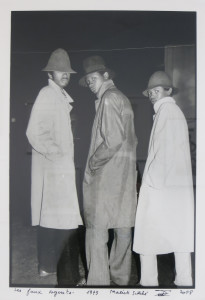
Iconic photographer Malick Sidibe – who will be 80 this year – pulls out more joie de vivre from his famous archives of Malian night-life with images shot at parties over the decades. Here, three young men dressed as secret agents let us in on the fun of their masquerade. (At Chelsea’s Jack Shainman Gallery through April 23rd).

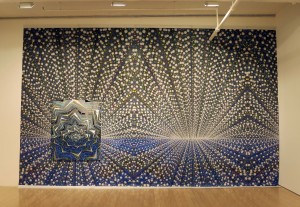
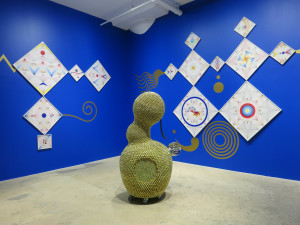
Haegue Yang continues her ‘Trustworthy’ series – made from the patterned interiors of security envelopes – with this installation of abstract diagrams set against deeply soothing Yves Klein blue walls at Greene Naftali Gallery. Just as Klein offered a portal into the sublime, Yang points to the mystical with her eye-like shapes and totemic figure covered in bells. (In Chelsea through April 16th).

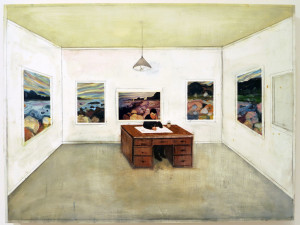
A moody beach scene by Norwegian expressionist icon Edvard Munch inspires this painting by William Wegman at Sperone Westwater Gallery, which incorporates and builds on a postcard at center. Wegman both adds psychological intensity and humor to Munch’s angsty scene by making the main character a creative type alone in his Spartan room. Come see this painting and more on Saturday’s Lower East Side Gallery Tour, 1 – 3pm. (Click here for tickets. On view through April 23rd).

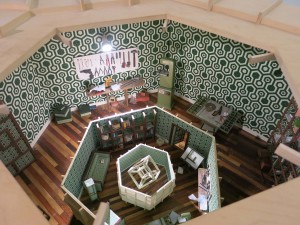
Fractal patterns on the walls of meticulously constructed dioramas by French artist Laetitia Soulier at Claire Oliver Gallery transform each space into a fantastical realm. The dominant cube pattern in this construction leaps off the walls and into the ever-decreasing form of this Lilliputian set of nesting rooms. (In Chelsea through April 9th).

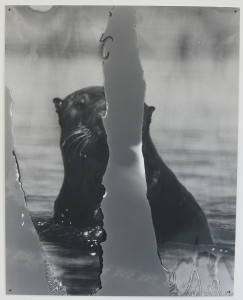
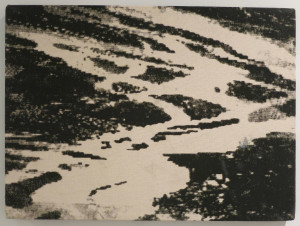
Her own nature photography and images downloaded from the Internet are the basis for several new photos by Eileen Quinlan at Miguel Abreu Gallery, including this interrupted shot of an otter. A strip from the center of the image looks like both a rip and a pool of water, while streams of photo chemicals toward the bottom of the image contrast liquids used in photo processing with the otter’s natural habitat. (On the Lower East Side through April 17th).

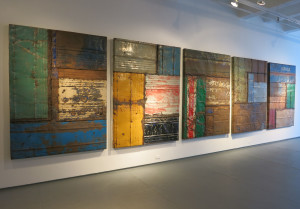
Celebrated Cuban artist Roberto Diago presents wall-mounted works in corrugated sheet metal that look like weather-beaten modernist abstractions with a distinctly Cuban twist revealed in the title, ‘Variaciones de Oggun,’ a nod to the Latin American deity Oggun, who is associated with metal work. (At Magnan Metz in Chelsea through April 9th).

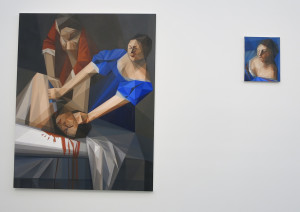
Inspired by Artemisia Gentileschi’s famous early 17th century painting of the Biblical heroine Judith slaying the Assyrian army general Holofernes, Anna Ostoya’s quasi-cubist rendition of the scene pits Judith against herself. Now that beheadings have become current events, Ostoya asks to what extent this is self-definition and self-harm. (At Bortolami Gallery in Chelsea through April 23rd.)

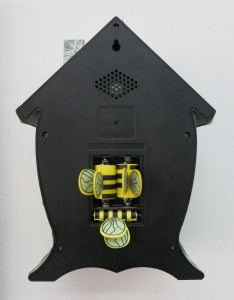
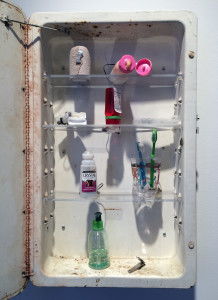
Tim Hawkinson offers visitors to Pace Gallery the chance to snoop through his medicine cabinet, in the process giving us the time around the globe with what’s actually a world clock in disguise. The unassuming bathroom fixture includes a bandage representing the time in Los Angeles and a soap pump acting as a clock for Tokyo. The biggest delight is New York’s timepiece – a lotion bottle with a cap that rotates as an hour hand and a drip of lotion (plastic) that acts as the minute hand. (At Chelsea’s Pace Gallery through April 23rd).

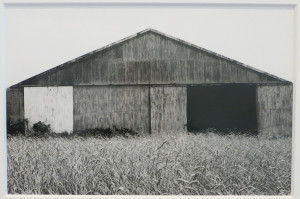
Strong shadows and angular forms in photos of barns and rural architecture shot between the 50s and early 80s by Ellsworth Kelly bear a striking resemblance to the abstract shapes of the artist’s paintings, offering what feels like a peek at the artist’s real-world inspirations. (At Matthew Marks Gallery in Chelsea through April 30th).

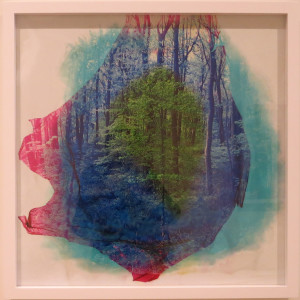
Doug Fogelson’s ‘Ceaseless’ series comprises beautiful but damaged nature photos, for which the Chicago-based artist shot traditional landscape photos, which he printed and partially destroyed by applying common industrial chemicals to the surface. Ironically, the results are gorgeous. Here, a verdant forest hovers like an apparition surrounded by peeling layers of emulsion. (At Sasha Wolf Gallery on the Lower East Side through April 16th).

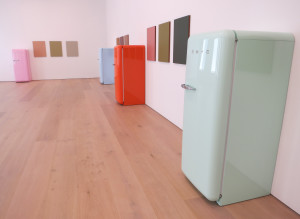
Iconic appropriation artist Sherrie Levine pairs monochrome paintings replicating colors found in Renoir’s nudes with colorful SMEG refrigerators in groupings that might serve to remind or warn snacking art collectors of Renoir’s voluptuous figures. (At David Zwirner Gallery in Chelsea through April 2nd).

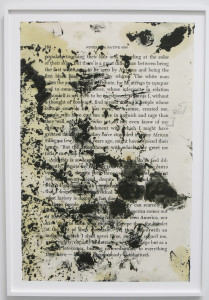
Glenn Ligon turns his well-worn copy of James Baldwin’s 1953 essay, ‘Stranger in the Village,’ into a suite of prints, each more or less obscured by paint and fingerprints left behind by years of reference use in Ligon’s studio. Ligon’s marks testify to the personal importance of Baldwin’s text, while the parts that remain visible leap out as a kind of charged concrete poetry. (At Luhring Augustine through April 2nd).

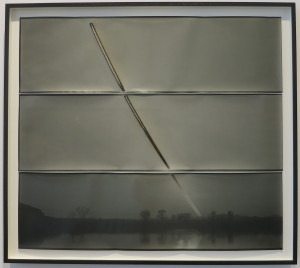
It would trouble some, but the smell of burning paper is the norm in Chris McCaw’s photographic practice. Using powerful lenses, McCaw magnifies the intensity of the sun to the extent that it burns holes in the light sensitive paper he places in his homemade cameras. The effect is ethereal, as the sun literally carves a path through the sky over shadowy landscapes. (At Yossi Milo Gallery in Chelsea through April 9th).

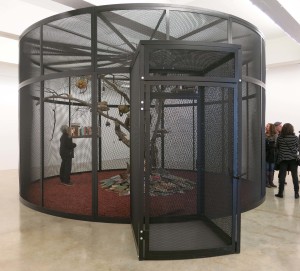
Mark Dion’s latest show is for the birds, which is to say that the centerpiece, a huge cage housing a selection of books related to birds and their predators along with several zebra finch and canaries, is intended as a gift to our feathered friends. The birds seem to be more concerned about nest building and communicating with each other than in reading, leaving the literature to humans and reinforcing Dion’s point that it’s always about us. (At Tanya Bonakdar Gallery through April 16th).

“It’s not about being a commodity, it’s about the pleasurable experience of looking,” explained Carrie Moyer to an interviewer recently, elaborating on how her once overtly political art practice has morphed into a subtle advocacy for enjoyment. (At DC Moore Gallery through March 26th).

In Walid Raad’s tongue in cheek narratives about the emergence of a booming new Arab art world, he’s hunted for refugee color and fonts that have gone into hiding and reflections that are missing; here at Paula Cooper Gallery, a wall text explains that the shadows normally cast by the artwork have run away, no longer interested in being part of the art infrastructure. The artist hopefully builds a series of walls with fake shadows to entice the real ones to return, all the while ostensibly failing to notice that the art itself is missing. (In Chelsea through March 26th).

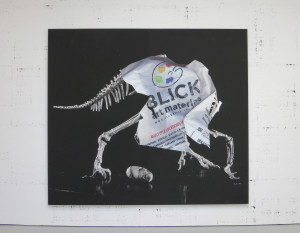
David Zwirner Gallery’s normally pristine white walls look as though they’ve been damaged by scraping; a closer look reveals that black markings are text fragments, printed onto posters that cover the walls of Michael Riedel’s latest solo show. Known for recycling text and image from his previous shows, Riedel takes the metaphor a step further by picturing animated dinosaur skeletons, creatures whose lives have been extended, in a sense, by being exhumed and put into the public realm again. (In Chelsea through March 25th).

Inventive use of materials is everything in Karla Black’s huge installation, ‘Includes Use’ at David Zwirner Gallery. Mixing powder paint and plaster, Black covers the gallery floor with a beach of cocoa-like powder separated into curving organic shapes by frilly tucks of toilet paper. The artist resists the term ‘feminine’ to describe her work, but with glitter as the finishing touch, the effect is decidedly pretty. (In Chelsea through March 26th).

Colorful lumps of squeezed clay, or the pattern on a checked shirt are inspiration to Houston-based artist Jeremy Deprez; here, he presents visitors to Feuer/Mesler Gallery with a five foot high bar of hotel soap. Unlike pop predecessors who supersized everything from hamburgers (Oldenberg) to soup cans (Warhol), Deprez pays painterly attention to his flecked monochrome. (On the Lower East Side through March 27th).

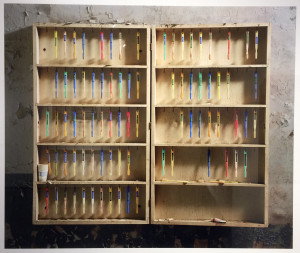
Toothbrushes hang in neat rows, labeled with the names of patients at a now-closed psychiatric hospital in Poughkeepsie in this arresting photograph by Christopher Payne. Payne traveled to hospitals around the country over several years, creating a moving document of life in a bygone era. (At Chelsea’s Benrubi Gallery through March 26th).

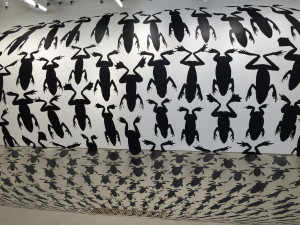
A flood of frogs (vinyl silhouttes adhered to walls and floor) escape down a fake drain in Brazilian artist Regina Silveira’s space-bending installation at Alexander Gray Associates. Referencing Biblical plagues and unexpected, underground activity, the frogs suggest that above-ground life is only half of the story. (In Chelsea through March 26th.)

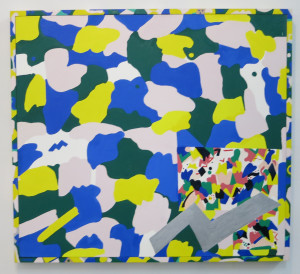
A painting is set into a painting, set into a painted frame in Nora Griffin’s ‘Painting Culture,’ a nestled presentation of homey organic shapes, cheery color and unselfconsciously handmade marks that conjures 80s design and a kind of youthful freedom exemplified by a zany silver zigzag. (At Louis B. James on the Lower East Side through March 20th).

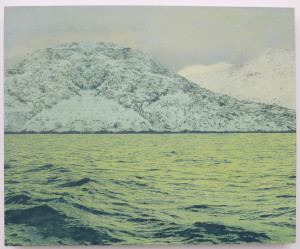
A trip to the Arctic inspired Saul Becker’s uncanny landscapes, in which mirrored hills present a Rorschach for those wishing to ponder lesser known regions and toxic colors bear witness the changing climate. (At Zieher Smith and Horton in Chelsea through March 19th).

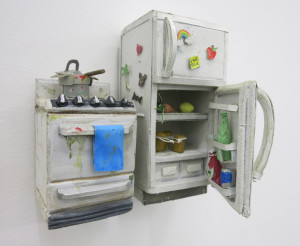
The bar below his apartment, the 99 Cent Pizza place, the Laundromat and apartment furnishings inspired New York artist Nicholas Buffon’s latest paper sculptures, what the New Yorker called, ‘elegies to a vanishing downtown.’ Here, even his stove and cheerily decorated fridge bespeak the well worn and well loved. (At Callicoon Fine Arts on the Lower East Side through March 20th).

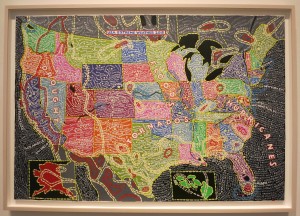
Paula Scher, principle at renowned design firm Pentagram, invites us to understand the country through its airline routes, geography, climate and here, its weather. Her painted maps of the USA emphasize how we see places through frameworks of information. (At Chelsea’s Bryce Wolkowitz Gallery through March 26th).

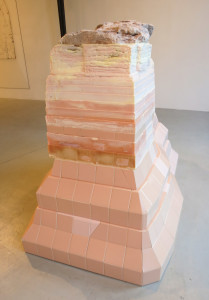
A 300 lb piece of talc was the basis of this large sculpture by Larry Bamburg, who bridged the natural and manmade by adding a similarly colored soap, then bathroom tiles to the stone, creating a conversation between materials whose properties converge yet remain distinct. (At Simone Subal on the Lower East Side through March 20th).

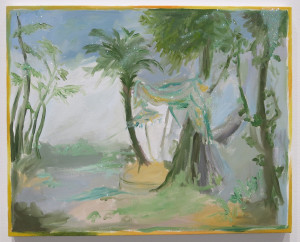
Inspired by late Renaissance and Baroque landscape painting, tapestry and stage scenery, Karen Kilimnik’s latest body of work showcases interiors with canopied beds and manicured landscapes, stage-like in their perfection. The exception is this expressionist tropical landscape with its sumptuous, glittery tent, as lush as the greenery. (At 303 Gallery in Chelsea through March 26th).

David Kennedy Cutler continues to turn photographed or scanned images into provocative sculpture with a cluster of heads representing Bacchus – the god of wine and related merrymaking – grouped together like giant grapes. Paired with slices of bread, however, does the reference turns toward the Eucharist? (At Lyles and King on the Lower East Side through March 13th).

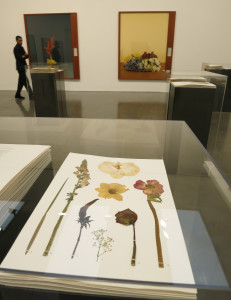
Innocuous floral arrangements in archival photos of historically important business and political meetings inspired New York artist Tayrn Simon’s latest project, ‘Paperwork and the Will of Capital.’ With a botanist’s help, she recreated bouquets present at shady dealings – when Mozambique agreed with South African not to support the ANC in the 80s, or when business owners purchased citizenship in St Kitts in return for supporting economic development there. She then entombed photos, texts and specimens in a concrete press, which acts here as a pedestal. (At Gagosian Gallery, through March 26th).

Casey Ruble’s meticulous cut paper images of former safe houses on the Underground Railway and locations of Civil Rights era riots confer a potent stillness on historical scenes that are fading from memory, largely unmarked by signage or physical markers. Here, she focuses on the epicenter of the 1967 Newark riot, where police mistreatment of an African American cab driver sparked a devastating protest. (At Foley Gallery on the Lower East Side through March 20th).

Under a darkening sky, a classic car speeds along an elevated city highway under a dollar sign and two maps of the US in this painting by Matt Blackwell. In the car, a bearded man with gritted teeth (succinctly crafted from a scrap of plaid fabric) grips the steering wheel, seemingly on a lone mission of intense urgency. (At Edward Thorp Gallery in Chelsea through March 19th).
Matt Blackwell, Going Out West, oil on canvas with collage, 44 x 64.5 inches, 2015.

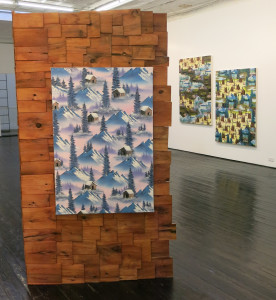
Using techniques from ‘how to’ TV shows on painting, British artist Neil Raitt makes odd juxtapositions of cabins and mountains, cacti and palm trees in repeating patterns that are like digital wallpaper but carefully hand-rendered. (At Nicelle Beauchene Gallery on the Lower East Side through March 13th).

Titled ‘Trips I’ve Never Been On,’ Shara Hughes’ solo show at Marlborough Gallery includes slightly surreal scenarios like this one, a juxtaposition of landscapes that seems both dream-like and real. (In Chelsea through March 12th).

From sounds recorded at a textile factory in Bally, PA and computer data sites, Mika Tajima and a textile designer worked to translate sound waves into visual patterns. Old technology – the mill uses jacquard looms (a punch-card system invented in the early 1800s) – meets new in a beautiful abstract textile that looks like a screen interrupted by interference. (At 11R Gallery on the Lower East Side through March 13th).

Since 1993, Richard Dupont has made silkscreens from photos of TV screens with scrambled signals. The results look like paintings of lassos of paint, actual paint skeins, abstract expressionism or a capture of paranormal activity. (At Tracy Williams, Ltd. through March 6th).

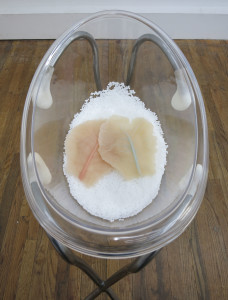
Flesh-color, cabbage-like leaves nestle in a container that recalls an incubator in Hannah Levy’s alluringly odd sculpture at 247365 Gallery. Waxy fingers that hold the tub and leaves made of something resembling skin recall Keith Edmier’s resin renderings of his mother or Matthew Barney’s plastics and petroleum jelly, making for fascinating but unnerving sculpture.

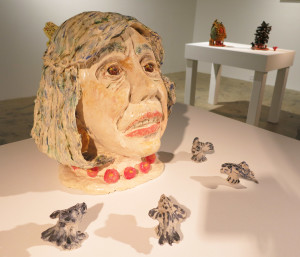
Sally Saul’s arresting ceramic self-portrait portrays her as if in mid-sentence, her eyes looking into the distance as if trying to phrase something just so. Surrounded by tiny attentive birds, what she says has caused nature to stop and listen. (At LaunchF18 on the Lower East Side through March 6th).

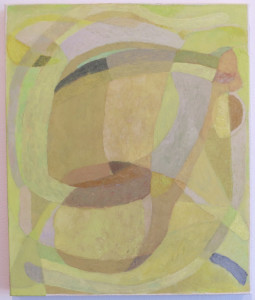
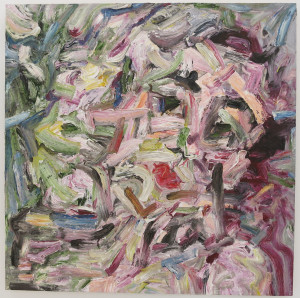
This small painting by New York artist Clare Grill is a standout in a group show at Lower East Side gallery Steven Harvey Fine Art Projects for its lively color and suggestion of a sympathetic face framed by lighter color, curving bands. (Through March 13th).

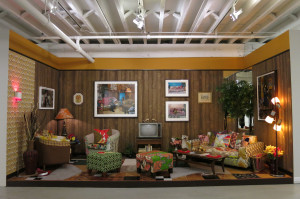
Like Freud, Mickalene Thomas’ couch has made her famous. Normally appearing as a colorful, patchworked backdrop in Thomas’ photos and paintings of lounging African-American beauties (seen on the back wall), it’s a character of its own in this retro living room, transplanted to Chelsea’s Aperture Foundation. (Through March 17th).

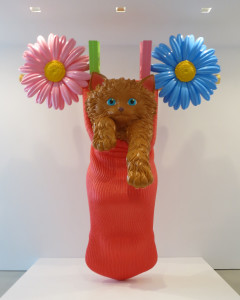
At over ten feet tall, this polyethylene sculpture by Jeff Koons magnifies kitsch to its limits. Whether it’s a contemporary crucifixion, as Koons has said, a phallic symbol, as others have pointed out, or something else entirely, there’s more than meets the eye. (At Chelsea’s Flag Foundation through May 14th).

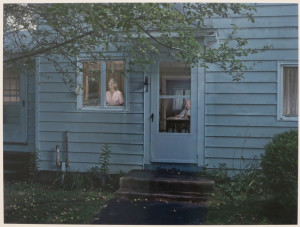
The color and lighting of Gregory Crewdson’s new photos can be traced to his interest in how painters of the 19th century and prior drew viewers into their paintings with detail and tones that could be appreciated from both near and far. The photos’ suspenseful and melancholy mood might be attributable to major life changes, which have included a new gallery, a divorce and a move out of New York. (At Gagosian Gallery’s 21st Street location through March 5th).

In person, the subjects of LA painter Vanessa Prager’s heavily painted portraits only faintly emerge from their textured backgrounds; in photos, they materialize more readily. The implications of being more visible on a screen aren’t lost on Prager, who has installed peep-holes through out the gallery to carry on a conversation about the absence and presence of images today. (At The Hole NYC on the Lower East Side through Feb 29th).

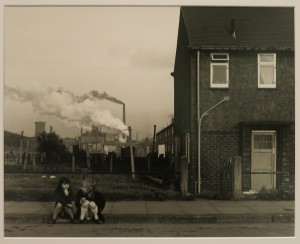
Photographer Chris Killip’s iconic images of the North of England, shot between 1973 and 1985, give meaning to the stereotype, ‘It’s grim up north.’ How will these two young girls survive their grey surroundings? (At Yossi Milo Gallery in Chelsea, through Feb 27th).

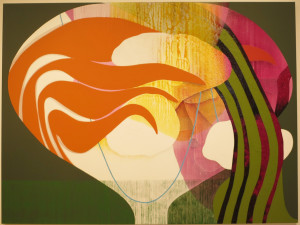
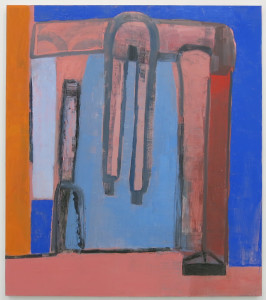
“I don’t care about beauty at all,” New York painter Amy Sillman has declared about the imperfect figures and heavily worked canvas of her paintings. Recent works at Sikkema Jenkins & Co are titled after the German word for metabolism, a nod to the process of changing paint into images that land provocatively between abstraction and figuration, suggesting both bodies and furniture in a color palette that simultaneously soothes and excites. (In Chelsea through March 12th).

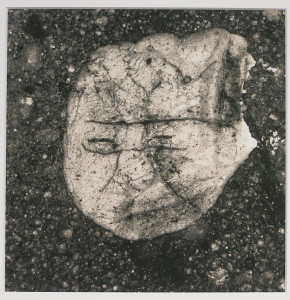
From the 1940s onward, the fashion world embraced the elegance of iconic photographer Irving Penn’s highly visible commercial work, but it sometimes took longer for his personal projects to gain traction. In the iPhone era, his investigation of the wonderful in the banal seems prescient, especially in this particularly charming shot of an eerily face-like wad of chewing gum found on the city street. (At Chelsea’s Pace Gallery through March 5th).

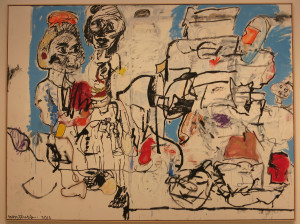
Eddie Martinez continues to mine art history in increasingly abstract paintings now on view in Chelsea at Mitchell-Innes and Nash. Tapping into diverse sources of inspiration – from Basquiat’s jittery line to de Kooning’s boldly outlined bodily forms – Martinez creates strangely familiar paintings to ponder. (Through March 5th).

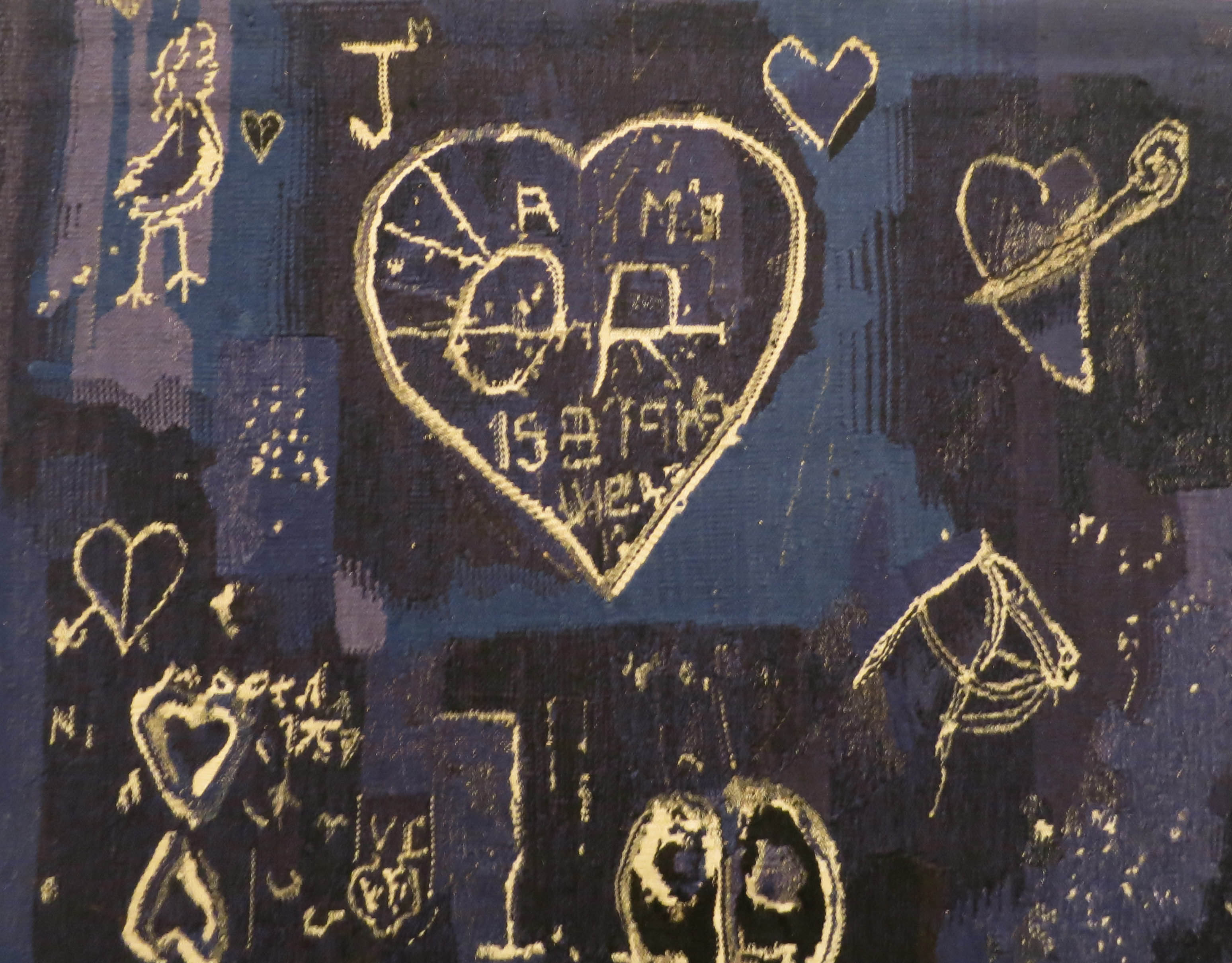
Photos of Paris graffiti, shot by Brassai in the 1930s onward, are subject matter for tapestries the artist created in collaboration with Atelier Yvette Cauquil-Prince in 1968. Currently on view at Higher Pictures, Nocturne (seen here) and ‘Graffiti I’ further immortalize sentiments first carved in the stone of Paris buildings. (On the Upper East Side through March 5th). Brassai, (detail) Nocturne, flat-weave wool tapestry, 110 x 54 inches, 1968.
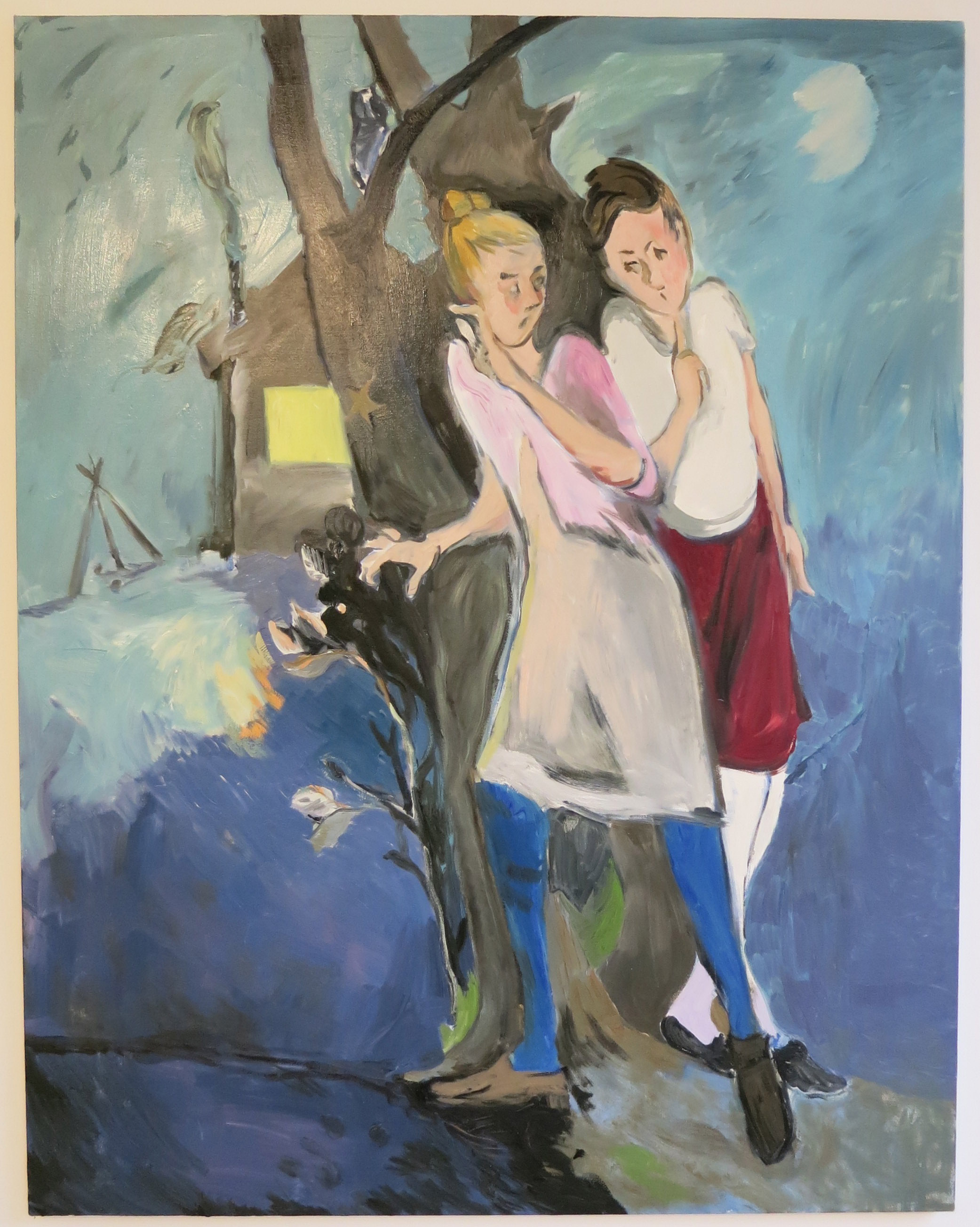
Like protagonists in a young adults detective novel, Jane Corrigan’s svelte sleuths ooze intrigue as they receive covert messages, investigate strange noises and meet secretively at night. The hook is strong. What are they up to? (At Feuer Mesler through Feb 14th).
Jane Corrigan, Spies, oil on canvas, 70 x 55 inches, 2015.
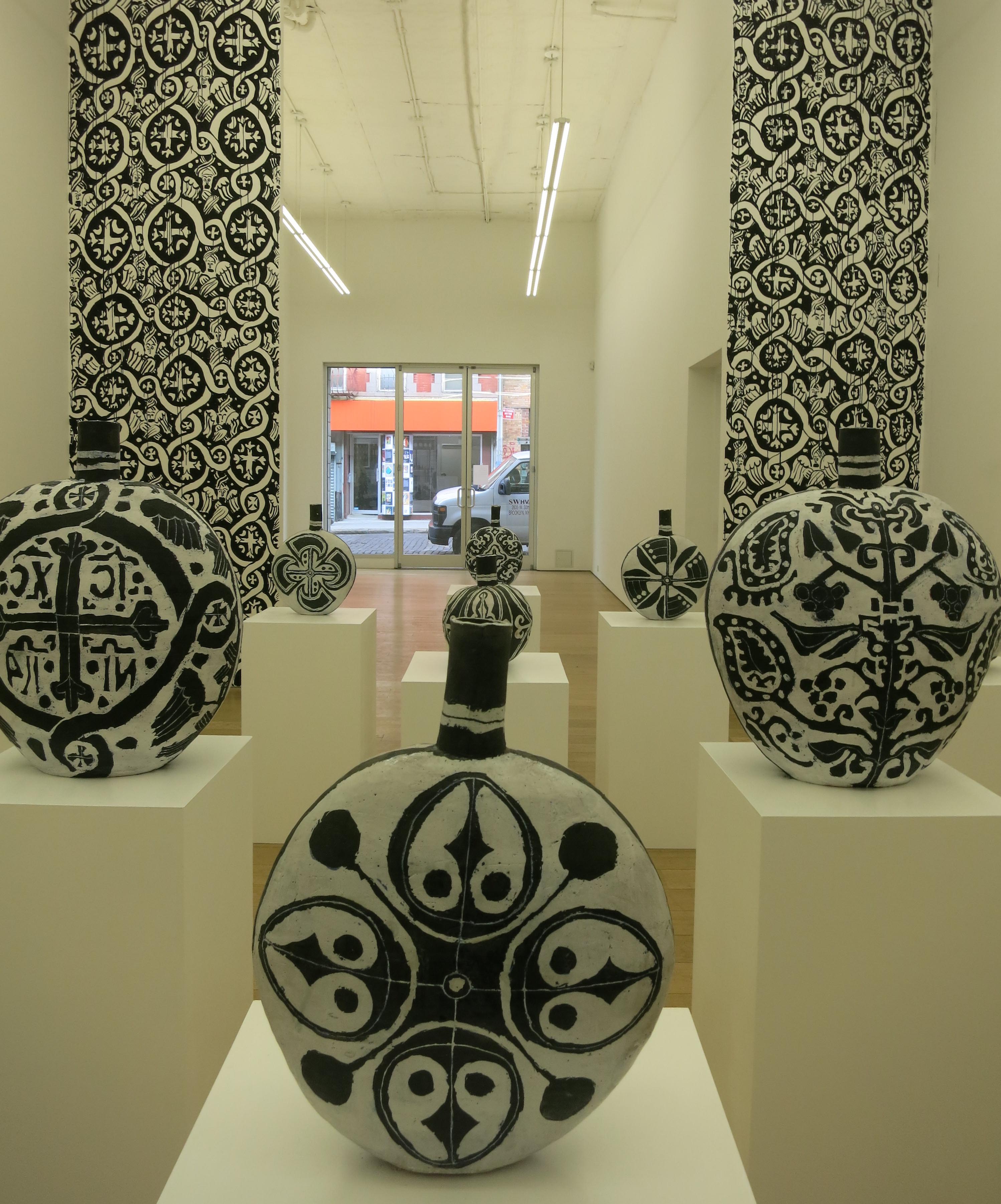
Inspired by Islamic, Byzantine and Asian historical ornaments, New York artist Elizabeth Kley’s ceramics celebrate and overwhelm with pattern. (At Canada New York, through Feb 14th).
Elisabeth Kley, Flask with Eyes, glazed earthenware, 15.25 x 11.75 x 4.75 inches, 2015.
It’s telling that young New York artist Jeni Spota C.’s heavily textured paintings of individuals grouped around mother-figures are included in the Jewish Museum’s current group show of ‘outsider’ art. Inspired by early Renaissance painting as well as a psychic’s assertion that the artist is constantly surrounded by departed relatives, Spota’s work invites speculation on the spiritual realm. (At Brennan and Griffin on the Lower East Side through Feb 14th)
Jeni Spota C., Bird Woman (detail), oil on canvas, 36 x 42 inches, 2015.
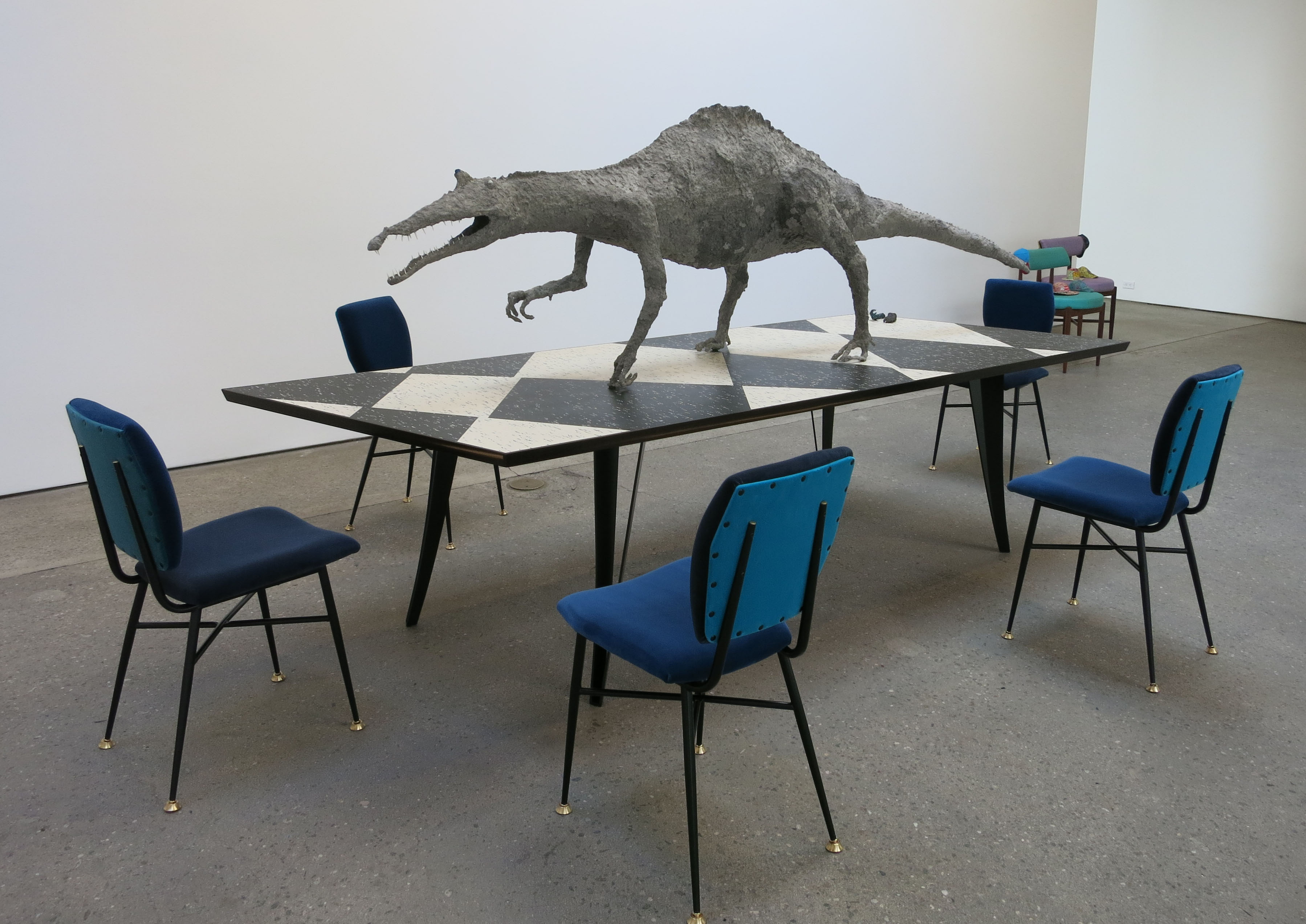
Sculptor Francis Upritchard and her designer husband Martino Gamper ask in a collaborative installation of their respective work, just what you’d do if a scrawny spinosaurus were to run across your dining table? Gamper’s playful patterning and richly colored fabrics and Upritchard’s quirky dinosaur cast the scenario in whimsy and pull out a chair for us to join in. (At Anton Kern Gallerythrough Feb 20th).
Francis Upritchard, Paper Spinosaurous, papier-mache, metal armature and modeling, 30 x 101 9/16 x 18 1/8 inches, 2014. Martino Gamper, Black and White Table, linoleum, blockboard, walnut, 107 x ¾ x 39 2/3 inches, 2015. Ice Cream Chairs, steel structure and upholstery, 19 ½ x 15 ¾ x 32 ½ inches, 2015.
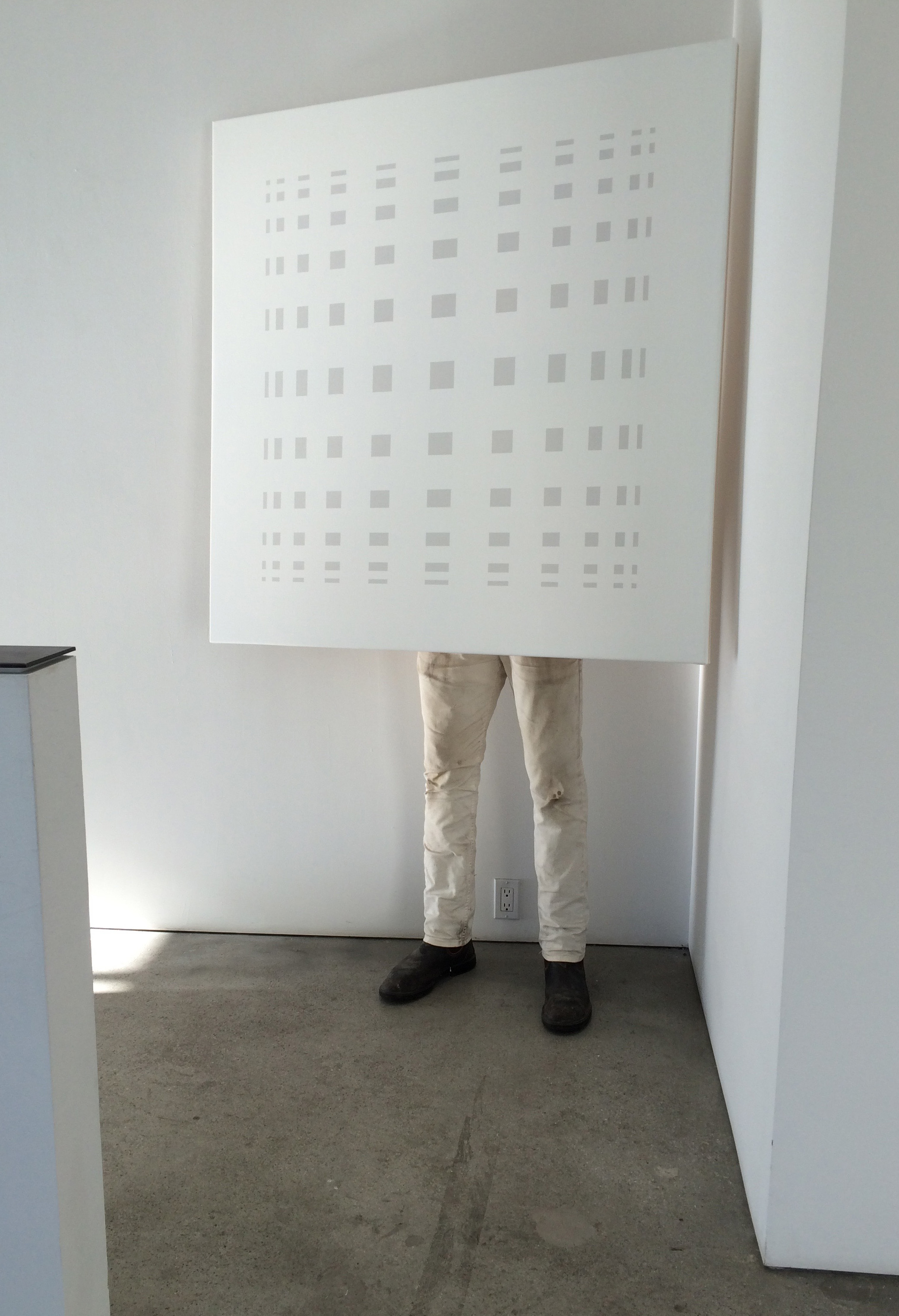
How can an artist pay homage to his/her influencers? John Riepenhoff’s ‘Group Show’ walks the line between flattery and offense by recreating artworks in the style of his contemporaries and predecessors. At the show’s entrance, legs make a stand for a space-bending geometric abstraction (actually painted) by Susie Rosmarin. (At Chelsea’s Marlborough Gallery through Feb 6th).
John Riepenhoff, Art Stand (legs), wood, wire, cloth, shoes, fiberglass and clamp, 50 x 14 x 26 inches, 2014. Susie Rosmarin, Grey and White (painting), acrylic on canvas, 48 x 48 inches, 2015.
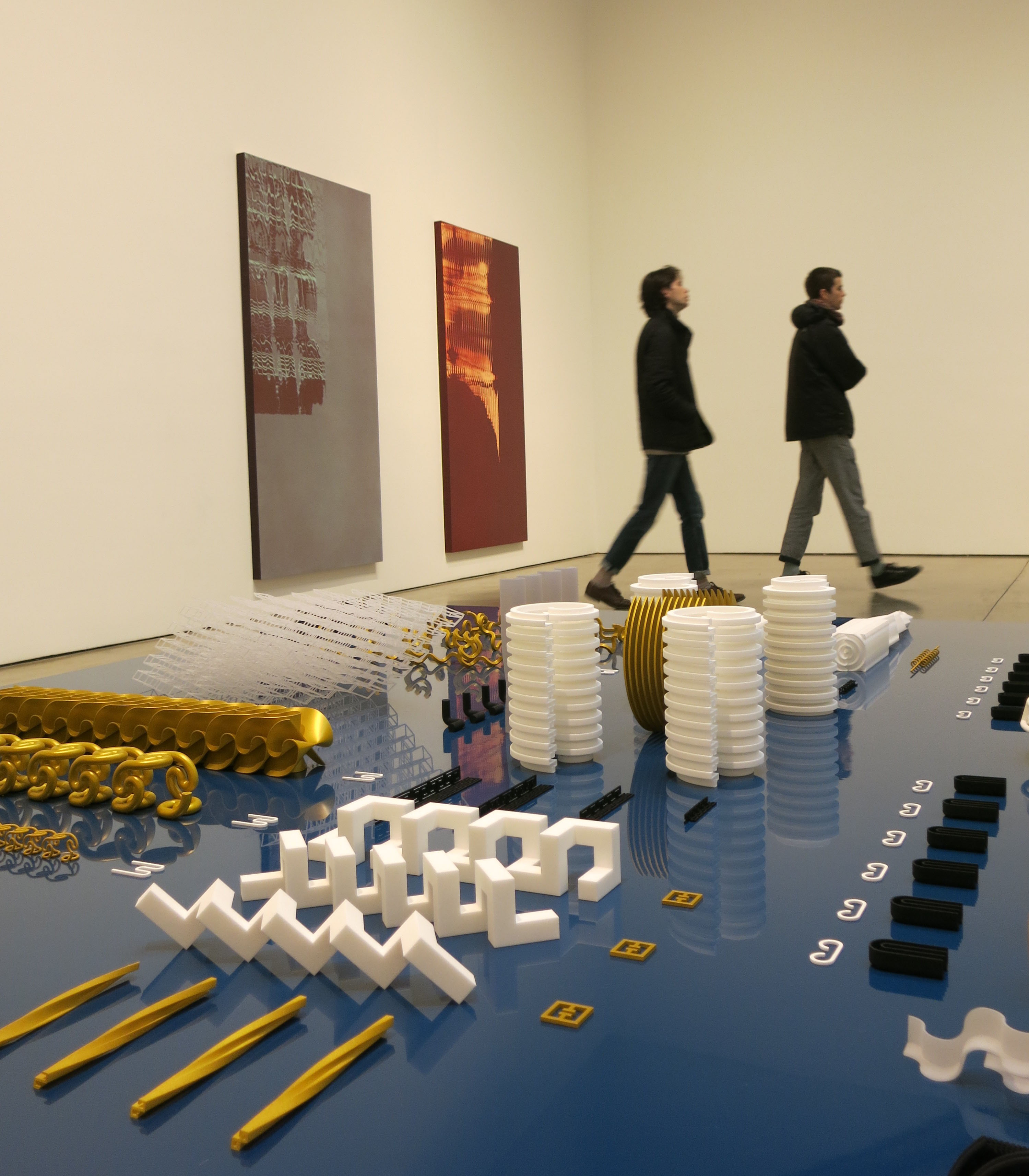
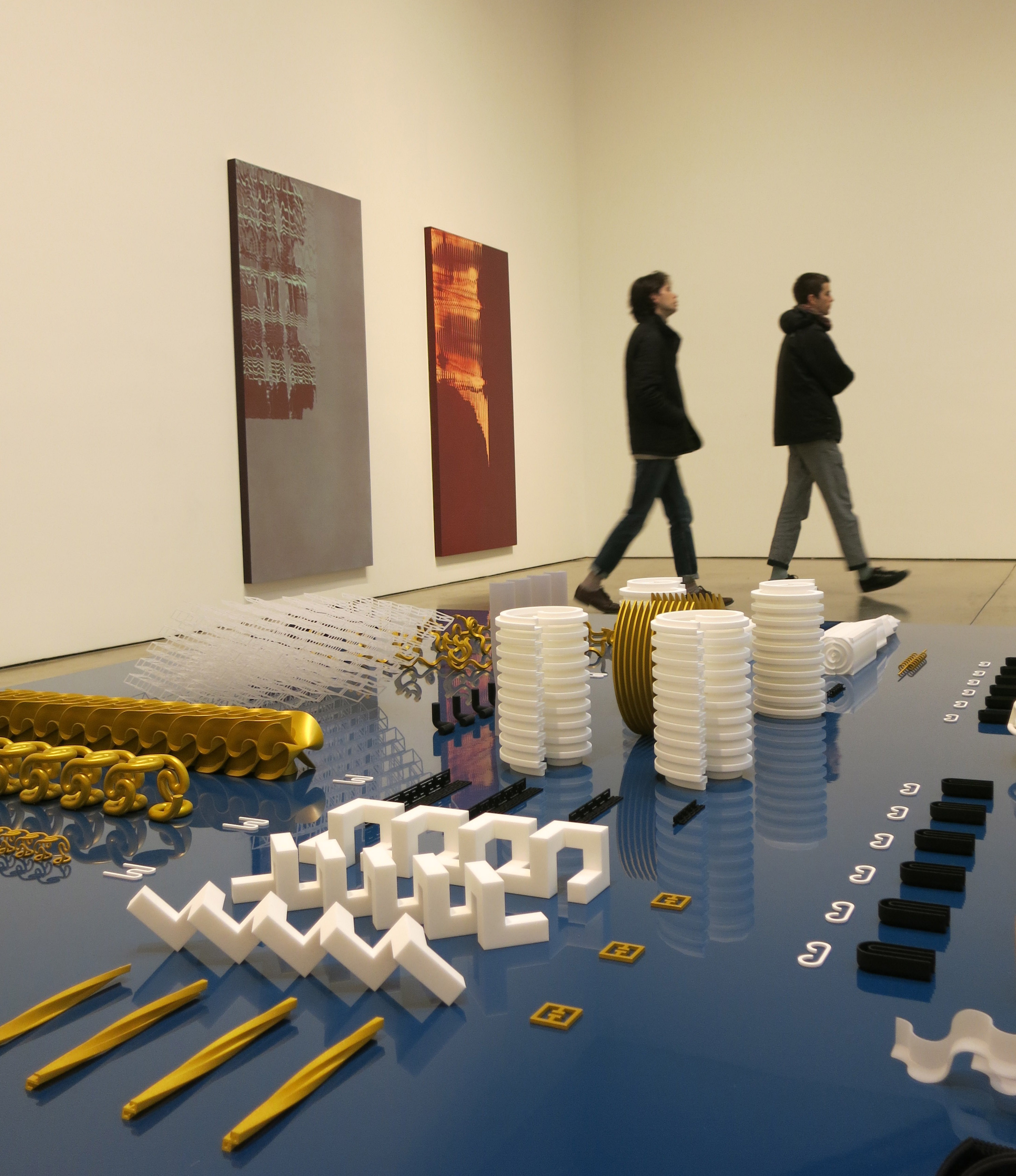
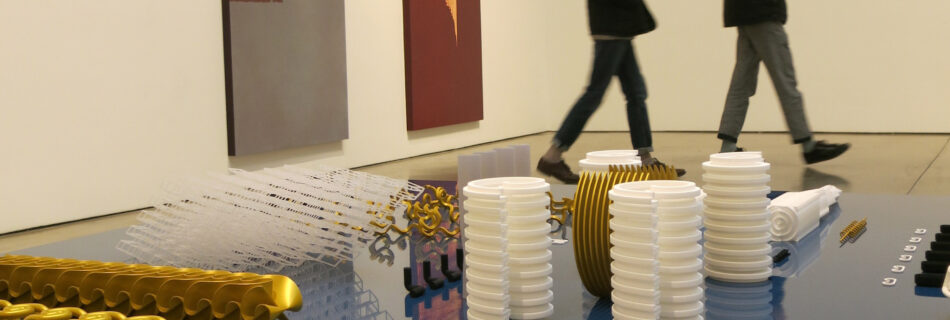
Certain ornamental patterns – waves, helices – appear across cultures, perhaps pointing to fundamental structures of our universe. New York artist Tauba Auerbach delves into these forms in a display of sculptures with rotating shapes titled ‘Altar/Engine.’ Like a display of sacred objects or an explosion diagram of an engine, these 3D printed shapes relate to twisting wave forms inscribed in the paintings behind. (At Chelsea’s Paula Cooper Gallerythrough Feb 13th).
Tauba Auerbach, Altar/Engine (foreground), 3D printed nylon and plastic, an array of several dozen parts ranging from 18 x 18 x 10 inches, 2015.
Certain ornamental patterns (waves, helices) appear across cultures, perhaps pointing to fundamental structures of our universe. New York artist Tauba Auerbach delves into these forms in a display of sculptures with rotating shapes titled ‘Altar/Engine.’ Like a display of sacred objects or an explosion diagram of an engine, these 3D printed shapes relate to twisting wave forms inscribed in the paintings behind. (At Chelsea’s Paula Cooper Gallery through Feb 13th).
Tauba Auerbach, Altar/Engine (foreground), 3D printed nylon and plastic, an array of several dozen parts ranging from 18 x 18 x 10 inches, 2015.
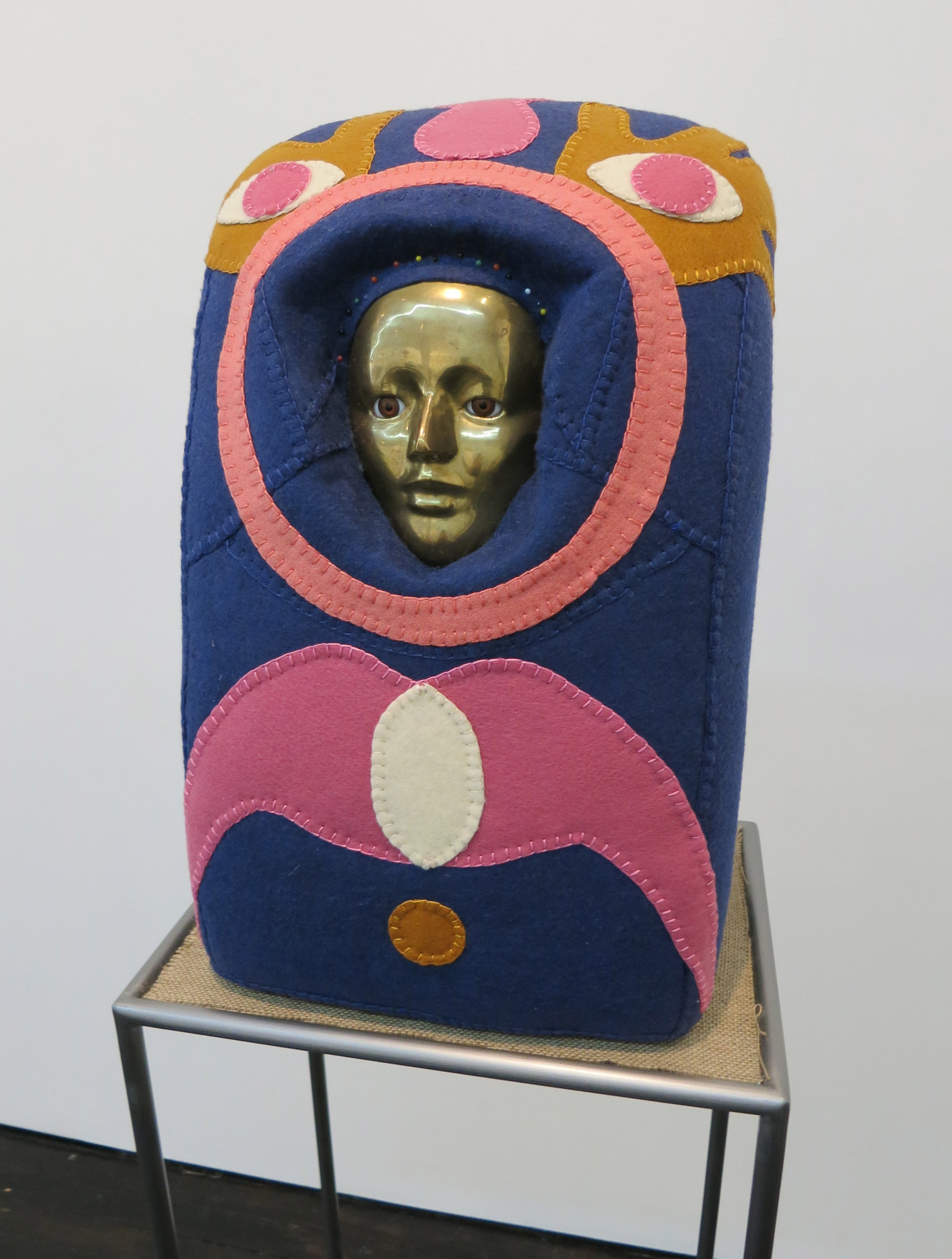
British artist Jonathan Baldock’s soft sculptures channel both Louise Bourgeois’ use of soft fabric to create unnerving characters and Barbara Hepworth’s rounded, organic sculptural forms to create cheery yet creepy totemic forms. (At Nicelle Beauchene Gallery through Feb 7th).
Mutter, steel, hessian, felt, thread, polystyrene, dolls eyes, brass, 65 ½ x 15 ¾ x 11 ½ inches, 2015.
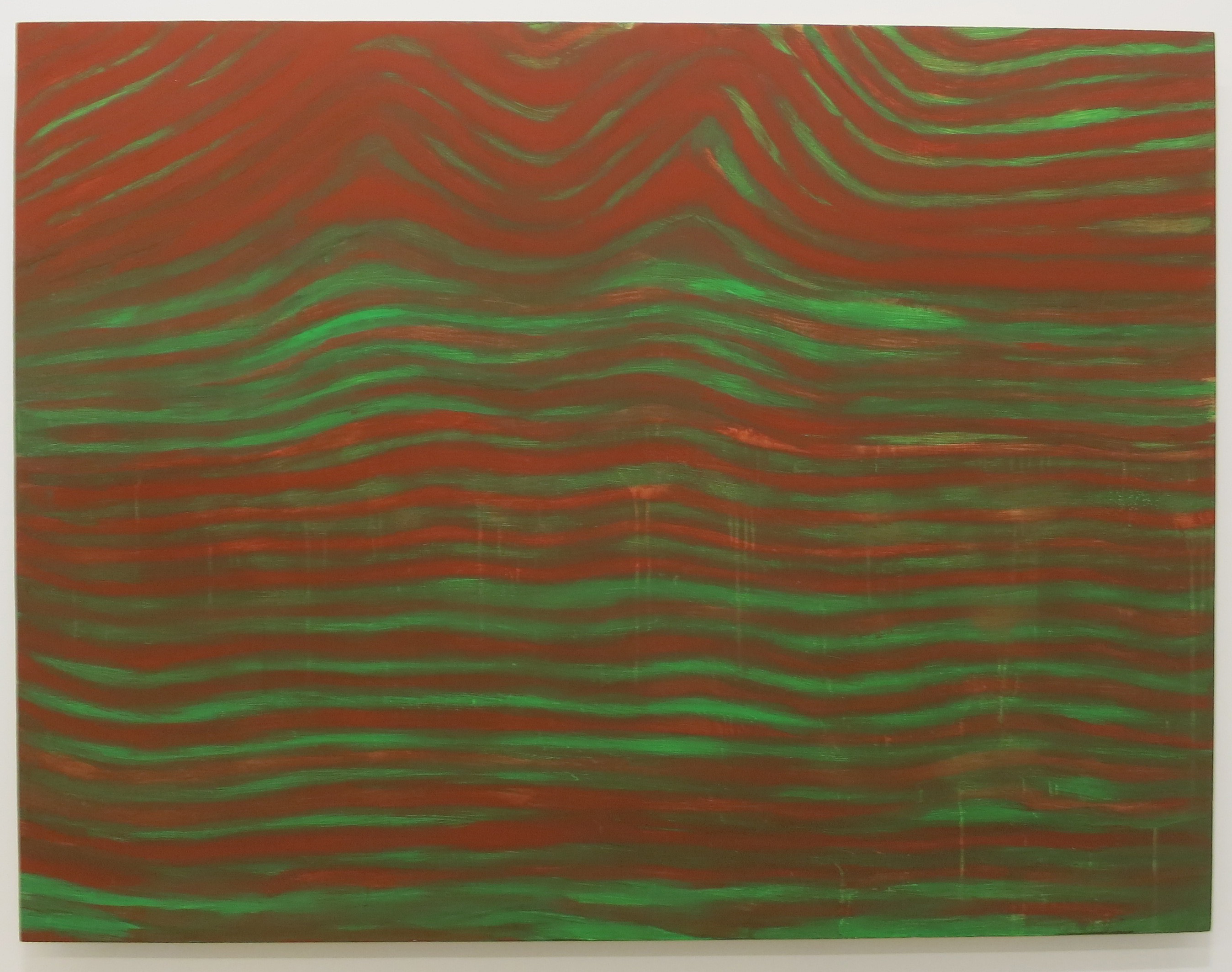
Late painter Moira Dryer’s career is in a revival as 11R gallery explores how the artist worked within the framework of minimalism to both create an emotional impact via color and convey personality via references to representation (a fingerprint, in this case). (On the Lower East Side through Feb 7th).
Moira Dryer, Untitled, casein on wood, 48 x 63 inches, 1987.
Late painter Moira Dryer’s career is in a revival as 11R gallery explores how the artist worked within the framework of minimalism to both create an emotional impact via color and convey personality via references to representation (a fingerprint, in this case). (On the Lower East Side through Feb 7th).
Moira Dryer, Untitled, casein on wood, 48 x 63 inches, 1987.
Corinne May Botz’s photos of medical actors, simulating illness in trainings for medical students are simultaneously moving and not-quite-believable. Though they don’t depict real scenarios, Botz’s photos nevertheless strongly tap a sense of dread and helplessness when our bodies fail to function as they should. (At Benrubi Gallery through Feb 6th).
Corinne May Botz, “Louise” from Bedside Manner, archival pigment print, 30 x 24 inches, 2013.
1980s interior décor inspires Brooklyn artist Leah Guadagnoli’s huge new wall sculptures, perfectly conjuring the colors and fabrics of the decade and turning them into objects of contemplation. (At 247365 on the Lower East Side through Feb 7th.)
Leah Guadagnoli, Slow Dance in My Underpants, oil, acrylic, fabric, pumice stone, canvas, wood and polyurethane foam on insulation board, 72 x 58 x 7 inches, 2015.
Palm tree paintings made in LA artist Yutaka Sone’s garden and rattan palm trees created by craftspeople in Mexico point to the artist’s exploration of Aztec history in Michoacan, Mexico, the subject of Sone’s upcoming film. (At David Zwirner Gallery through Feb 20th).
Yutaka Sone, Sky and Palm Tree Head #5, (on the wall), acrylic on canvas, 85 x 102 ½ inches, 2013. In foreground, two ‘Tropical Compositions’ in rattan, metal and paint, 2011 and 2012.
Austrian Pop artist Kiki Kogelnik lays out bodies for view in ‘Cold Passage,’ an oil painting that offers and denies access to its subjects by abstracting heads into round emoji-like circles (though the painting is from 1964) and silhouetted bodies as if they’re flat cutouts or crime scene chalk outlines. (At Simone Subal Gallery through Feb 7th).
Kiki Kogelnik, Cold Passage, oil and acrylic on canvas, 59 ¾ x 48 inches, 1964.
The rhythmic concentric rings in calming cool colors in this painting by Cuban artist Luis Martinez Pedro might bring to mind drops of water falling on the surface of the water, but don’t be too sure. The work features in a group show of art by ‘The Ten,’ a group formed in the late 50s of concrete artists in Cuba who resisted depicting forms from nature. (At David Zwirner Gallery through Feb 20th).
Luis Martinez Pedro, Aguas territorials (Territorial Waters), oil on canvas, 39 9/16 x 30 ½ inches, 1964.
Known for videos made from photos taking during his painting process, Dutch artist Jacco Olivier embraces abstraction in his latest projections at Marianne Boesky’s Lower East Side space. Without the narrative found in his previous painted videos, the recent work becomes meditative; it’s not so much watching paint dry as watching it drift slowly across the canvas. (Through Feb 14th).
Jacco Olivier, Equilibrium II, HD Animation, 3 min, 20 seconds, projection size: 37 3/8 x 33 ½ inches, 2015.
It’s important to know but hard to guess how New York artist Lisa Oppenheim sources the materials she uses to make her images – in this case, swirling clouds or monstrous faces that emerge from book matched wood. Using a thin sheet of veneer from Eastern Red Cedar, the artist created a camera-less photogram, which she then framed in Eastern Red Cedar and in birch, a wood used to imitate cedar. (At Tanya Bonakdar Gallery through Feb 20th).
Lisa Oppenheim, Landscape Portraits (Eastern Red Cedar)(Version I), set of four silver gelatin photograms in Eastern Red Cedar and Birch frames, 51 5/8 x 55 inches, 2015.
Molly Zuckerman-Hartung made a splash in the last Whitney Biennial with a huge painting on drop cloth that had been spray painted, pierced with a dremmel and stitched together with an industrial sewing machine. ‘Fruited Void,’ a standout in a two-person show at Lower East Side gallery Lyles & King, likewise is roughly handmade – fabrics with seeping stains meet in uneven tucks – but a warm palette and curving colors convey a softer sensibility. (Through Feb 7th).
Molly Zuckerman-Hartung, Fruited Void, acrylic and oil on sewn silk, cotton, linen, 55.125 x 65.125 inches, 2014.
Nigerian American artist Odili Donald Odita aims to make paintings that ‘exist before language,’ a strategy that works immediately in his high-impact wall mural at Jack Shainman Gallery’s 24th Street space in Chelsea. (Through Jan 30th).
Odili Donald Odita, Installation view of ‘The Velocity of Change,’ at Jack Shainman Gallery, Dec 2015. On view through Jan 30th, 2016.
Titled ‘Quaint Abstractions,’ new ball-point and Gelly roll pen drawings by pseudonymous New York artist Butt Johnson are mind bogglingly precise. Now that deskilling has become an art world buzzword, is meticulously rendered artwork quaint? (At CRG Gallery on the Lower East Side through Feb 21st).
Butt Johnson, Study for Regression Towards the Mean, ballpoint ink on metallic foil paper, 8.5 x 11,” 2013.
Pleasure starts to look like panic in Katherine Bradford’s large painting of beach-goers frolicking in turquoise waters when you learn its title, ‘Fear of Waves.’ Themed on swimmers and water, the show’s paintings entice as they demonstrate a range of moods from the ominous to the magical. (At Canada New York on the Lower East Side through Feb 14th).
Katherine Bradford, Fear of Waves, oil on canvas, 84 x 72 inches, 2015.
In 11R’s serendipitous pairing of ceramics by Jennie Jieun Lee and multiple exposure photograms by Mariah Robertson, each artist creates visual interest by defying convention. Robertson punctuates gorgeously-hued abstractions by cutting her photo paper into a rough, tapering point. Lee crafts vessels from glaze-splashed curls of clay. (At 11R on the Lower East Side through Feb 7th.)
Installation of ceramic by Jennie Jieun Lee and Mariah Robertson, 11R, January 2016.
In the 60s, New York painter Janet Fish reveled in painting reflections she observed on everyday objects and packaged foods. Here, a package of plantains turns mundane supermarket fare into a canvas demonstrating light at play. (At Chelsea’s DC Moore Gallery through Feb 13th).
Janet Fish, Plantains in a Box, oil on canvas, 44 x 44 inches, 1969.
Beijing-based artist Li Hongbo’s installation at Klein Sun Gallery creates a powerful creature from prosaic materials, if you interpret a snaking line of giant binder clips as a dragon. Textbooks flap like birds in the air above, pave a pathway below, and are carved into the shape of students at desks in the back of the gallery, all begging the question of how education might have the power to shape a society. (In Chelsea through Feb 13th).
Li Hongbo, installation view of ‘Textbooks’ at Klein Sun Gallery, January 2016.
Penelope Umbrico continues to mine Flickr’s vast on-line archive of images for collage-like assemblages that gently and beautifully point out the homogeneity of our camera-driven visual culture. Her latest show – and first at Chelsea’s Bruce Silverstein Gallery – zeros in on photos that have been copyrighted by amateur photographers against the back wall. In the foreground, screen shots of images tagged ‘full moon’ run on a scroll on and on along the gallery floor. (Through Feb 20th).
Installation view of ‘Penelope Umbrico: Silvery Light,’ at Bruce Silverstein Gallery, January 2016.
An Artforum critic recently identified a central quality of young New York painter Jennifer Packer’s style by explaining that her paintings capture a ‘state of perpetual becoming.’ In this painting dedicated to the artist’s late college painting instructor, flowers emerge explosively from a shadowy yet brilliant mass, existing as suggestions of color and form. (At Chelsea’s Sikkema Jenkins & Co through Jan 23rd).
Jennifer Packer, Breathing Room, Flowers for Frank Bramblett, oil on canvas, 48 x 29 inches, 2015.
Sixteen years before his solo debut at LA’s Ferus Gallery, Andy Warhol was just another art student at Carnegie Tech. Here, the whimsical character, if not the elegantly wavering line of his later commercial illustrations is prefigured in a student assignment from 1946. (At Betty Cunningham Gallery on the Lower East Side through Feb 13th).
Andy Warhol, Kids on Swings, tempera on board, 31 x 26 7/8 inches, 1946.
Chinese landscape painting meets Monet’s haystacks in clever cultural hybrids by Queens-based Chinese artist Zhang Hongtu at the Queens Museum. (Through Feb 28th).
Zhang Hongtu, Monet, Study of Pi Ma Ts’un and Jie So Ts’un, oil on canvas, 2007.
Conveyor belts of alien-like creatures, tropical landscapes in day-glo colors, and a high-wire act define the turbulent interior life of this person by New York artist Erik Parker. A silhouette of a lone shepherd towards the bottom of the painting remains like a suppressed hope for simpler times. (At Paul Kasmin Gallery’s 297 Tenth Ave space through Jan 23rd).
Erik Parker, Tastemaker, acrylic on canvas, 90 x 80 inches, 2015.
New York artist Juan Fontanive conjures the delightful flickering motion of butterflies and hummingbirds in motorized frames that act as flipbooks for 72 screen printed images at Chelsea’s Danese Corey. (Through Feb 6th).
Juan Fontanive, Ornithology P, four-color screen print on Bristol paper, stainless steel, motor and electronics, 5 x 4.25 x 3/75 inches, 2014.
LA-based experimental film maker Pat O’Neill’s first New York solo gallery show includes film and sculptures like this surreal, suggestive assemblage. (At Chelsea’s Mitchell-Innes & Nash through Jan 23rd).
Pat O’Neill, Safer than Springtime, fiberglass, aluminum, steel, paint, 48 x 39 x 30 inches, 1964.
Ilya and Emilia Kabakov’s new paintings include several that look like illustrations from a children’s storybook (recalling Ilya Kabakov’s former profession as an illustrator when he lived in the Soviet Union). Here, circular patterns layered over this painting’s surface look like snow, obscuring the cheery scenes beneath and suggesting a gradually advancing loss of sight. (At Chelsea’s Pace Gallery through Jan 23rd).
Ilya and Emilia Kabakov, The Six Paintings about the Temporary Loss of Eyesight (In the Room), oil on canvas, 44 x 77 inches, 2015.
Bill Viola explores his signature themes of rebirth, endurance and physical/spiritual transformation in ‘Inverted Birth,’ a large-scale video at Chelsea’s James Cohan Gallery. Here, black, red, white and clear liquids, perhaps symbolizing elemental materials of earth, blood, milk and water, pour away from the subject (as the video runs backwards) suggesting a reversal of time. (Through Jan 30th).
Bill Viola, installation view of ‘Inverted Birth’ at James Cohan Gallery, through Jan 30th.
Dutch artist Rachel de Joode creates a striking optical illusion at The Hole NYC with two flat photographic images mounted to PVC that momentarily appear to be 3-D. Part of The Hole’s excellent exhibition of art indebted to photographic processes, de Joode’s images of man-handled clay exist in a dimension of their own. (On the Lower East Side through Jan 16th).
Rachel de Joode, ‘Here I am and things that exist. Ow! XIV (foreground), archival inkjet print on PVC with pedestal, 60 x 34 x 14 inches, 2015.
Greg Smith’s handmade camera, crafted from linoleum, canvas,
digital camera parts and more is a standout in Yossi Milo Gallery’s exhibition
of camera related art. Mixing the
haphazard with digital know-how and a craft-oriented look, this tool is one of
a kind. (In Chelsea through Jan 23rd).
Greg Smith, Linoleum Camera, linoleum, canvas, gesso,
thread, paper, graphite, pushpin, lens, copper, epoxy, digital camera parts,
wood, hardware, 2014.
Nigerian American artist Toyin Ojih Odutola’s meticulous, patterned rendering of human skin both attracts admiration and repels understanding of her subjects. In her latest show at Chelsea’s Jack Shainman Gallery, Odutola blocks an easy read on a wall of celebrity portraits by darkening the skin of Caucasian subjects. Here, she treats the skin of two nudes as a decorative surface for a dappled pattern of light and dark color. (Through January 30th).
Toyin Ojih Odutola, Quality Control, marker and pencil on paper, 64 ¾ x 41 15/16 inches, 2015.