Using silicone and metal beads, sculptor Eva LeWitt creates a series of hanging spheres in Luhring Augustine’s Chelsea space that shape-shift as light passes through them. The artist has explained that for her, spheres are ‘a beginning and an end…a period, a punctuation.’ Hung in a ring around the middle of the gallery at varying lengths, they seem gathered as if for conversation or play. (On view in Chelsea through April 30th).
Eva LeWitt, installation view at Luhring Augustine Gallery, March 2022.
Known for his portraits of stylish Black people painted from the ‘60s onward, Barkley L. Hendricks’ lesser-known body of work merging minimalism and basketball is now on view at Chelsea’s Jack Shainman Gallery. Between attending the Pennsylvania Academy of Art and Yale, Hendricks worked for the Philadelphia Department of Recreation as an artist with access to the courts and games that inspired pieces like ‘Two!’ Though the ball is in motion here, a sense of stillness pervades, as if the artist is savoring a moment in a game. Though circular and rectangular forms dominate and bring to mind hard-edge abstraction, Hendricks evokes the flat stillness of a momentous scene in an early Renaissance painting. (On view in Chelsea through April 30th).
Barkley L. Hendricks, Two!, oil on linen, 44” diameter, 1966-67.
Norway-based American artist Camille Norment conceives of social relationships past and present in terms of sound in two new commissions at the Dia Art Foundation in Chelsea. For this untitled piece, microphones in the gallery pick up ambient sound and send it down the stem and into the bell below. As sound creates more sound and feeds back into the loop, auditory events in the room become, in Norment’s words, “an exponential saturation of voice, existing and experienced as a negotiation of control.” (On view through Jan 2023).
Camille Norment, Untitled, brass, sine waves, autonomous feedback system, and archival radio static, 2022.
Describing his new stoneware vessels at Nicelle Beauchene Gallery as ‘imperfect reliquaries,’ London-based artist Jonathan Baldock imprints the cylindrical forms with evidence of his own hand and adds cast body parts and funereal herbs. In additional sewn works, 3-D heads emerge from flat felt and hessian textile backgrounds, staging a miraculous entrance from the picture into real space. Likewise, the uncanny ceramic forms suggest an unknowable quality to the human body and its manifestations. (On view in Tribeca through April 2nd).
Jonathan Baldock, Scuffle, stoneware and glaze filled with rosemary, 22 x 14 x 13 inches, 2022.
Betrayal and concealment are words applied to Mika Horibuchi’s deceptively masterful paintings at 55 Walker, which replicate her grandmother’s amateur watercolors. At first glance, triangular tabs appear to be adhered to the surface to hold up a printed photo. A closer look reveals that they, like the ‘photo,’ are meticulously painted. The cat image is a rendition of a printed snapshot sent to the artist in Chicago by her grandmother in Japan, who has taken up painting later in life. A nearby display case shows the original snapshots along with other photos, drawings, and more. Here, the professional mimics the hobbyist, but the work conveys respect and consideration. (On view in Tribeca through March 26th).
Mika Horibuchi, Watercolor of Pi-ko, oil on linen, 42 x 55 x 1 ¾ inches, 2021.
What carries the idea of rocks as artwork? ‘Massive weight,’ replies Michael Heizer in a gallery statement announcing his current exhibition of new stone and steel sculpture at Chelsea’s Gagosian Gallery. Sheer size, heaviness, and a certain kind of audacity in relocating huge pieces of nature blasted out of place and trucked into art-related settings are the hallmark of Heizer’s practice. In the recent sculpture, rocks seem to almost perch on thick planes of rusted steel in geometric shapes, setting up a dynamic interplay between manmade and natural forms that suggests both symbiosis and antagonistic struggle. (On view on 21st Street through April 16th).
Michael Heizer, installation view of Rock/Steel at Gagosian Gallery, March 2022.
Kay WalkingStick’s paintings at Chelsea’s Hales Gallery traverse and glory in the North American landscape, from mountain peaks, to eroded canyons to windy shorelines. Each is overlaid with a pattern derived from imagery created by Native American peoples who have lived in the areas depicted. Together, the patterns and scenery speak to the deep connectedness of Native histories and culture and the land. (On view through April 16th.)
Kay WalkingStick, (detail from) The San Francisco Peaks Seen from Point Imperiale, oil on panel in three parts, 31 ¾ x 95 ¼ x 2 inches, 2021.
Christopher Myers’ applique textiles at James Cohan Gallery picture dramatic moments in history; here, a star-shape on the head of 19th century Xhosa leader Mlanjeni speaks to his vision of resistance to British colonialism in South Africa, specifically his prophesy that the Xhosa would be impervious to British bullets. Created from a patchwork of patterned textiles, each hanging work speaks to an individual creator employing material with its own histories and associations into a larger, conceptually layered image. Likewise, Myers’ subjects, who range from Paiute Ghost Dance advocate Wovoka to Hong Xiuquan, who fought the Qing Dynasty leaders to create an earthly Heavenly Kingdom, crafted diverse and complex ideologies of resistance. (On view in Tribeca through April 2nd).
Christopher Myers, Star of the Morning placed itself on his forehead, applique textile, 80 ½ x 58 5/8 inches, 2022.
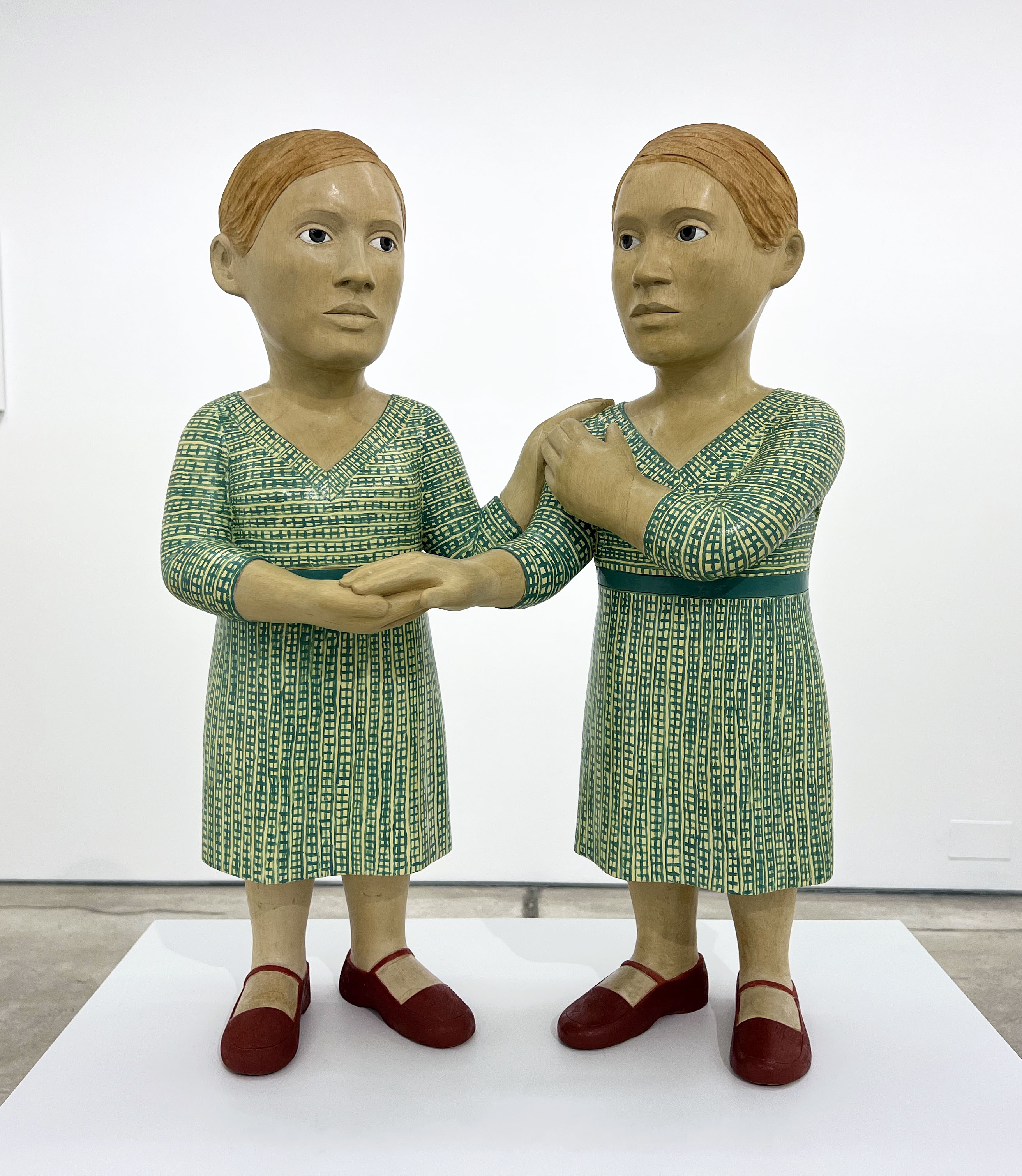
Known for medium-sized, uncannily still wooden figures, South African sculptor Claudette Schreuders explores the notion of doubling with new work at Chelsea’s Jack Shainman Gallery. In response to the experience of social isolation over the last two years, Schreuders has been picturing the self as constant presence and company. Titled Accomplice, this piece considers how a lack of communication can lead to polarization and extreme thinking; however, at the same time, the hand gestures were inspired by a tender moment in a 14th century medieval church sculpture of Christ’s mother Mary greeting her relative, Elizabeth. (On view through April 2nd).
Claudette Schreuders, Accomplice, Jelutong wood, enamel and oil paint, 27 ¾ x 20 x 11 inches, 2021.
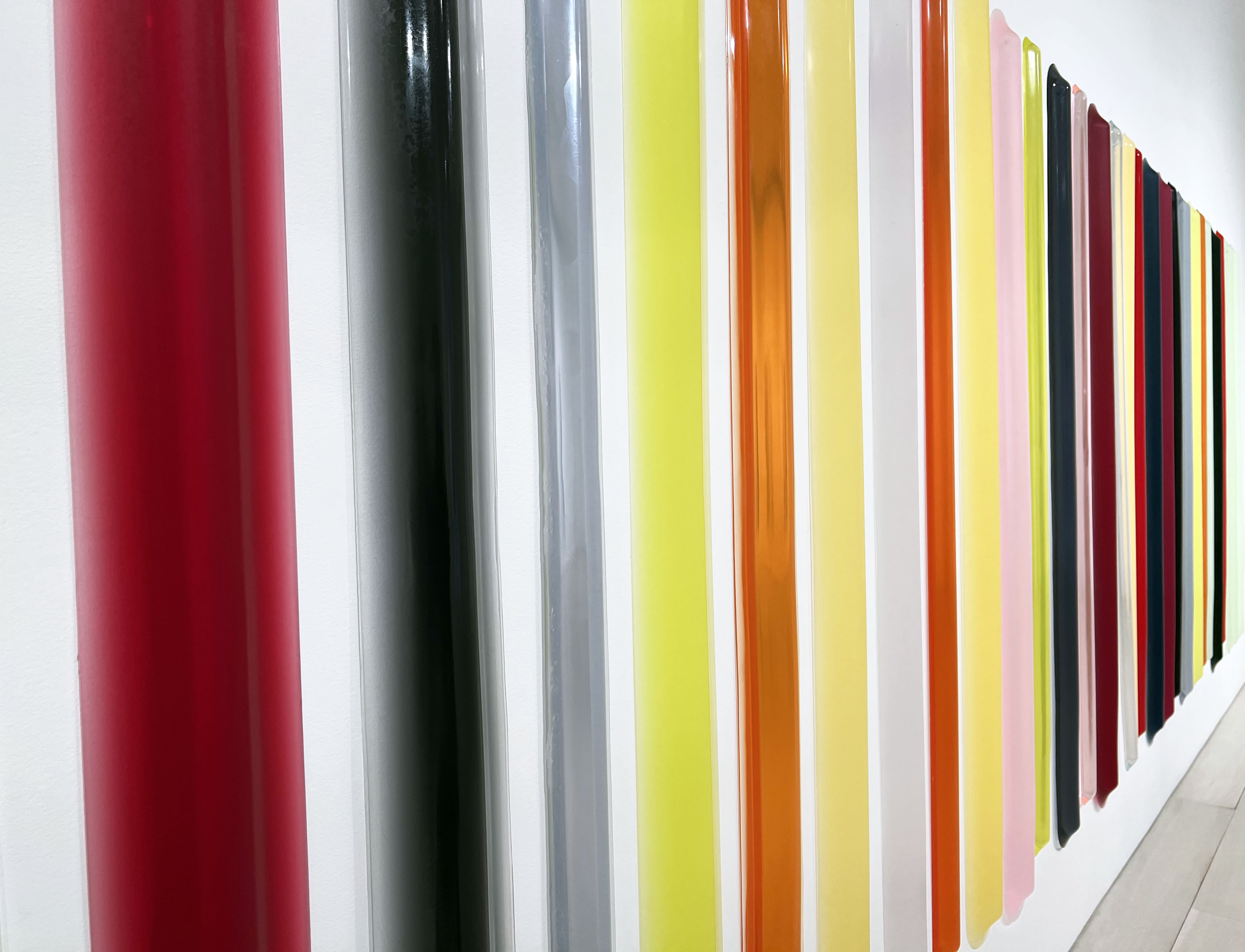
After an over two-decade hiatus from sculpture-making, late west coast Light and Space artist Peter Alexander came back strong, creating cast forms that appear to glow. Pace Gallery’s current show of these works from ’11 to ’20 features this eighteen-foot-long installation of urethane strips. Varying in width and color, the parallel pieces create an irregular rhythm that excites the senses. (On view through March 19th).
Peter Alexander, Heard it Through the Grapevine, urethane, 77 x 18’ 1” overall installed, 2019.
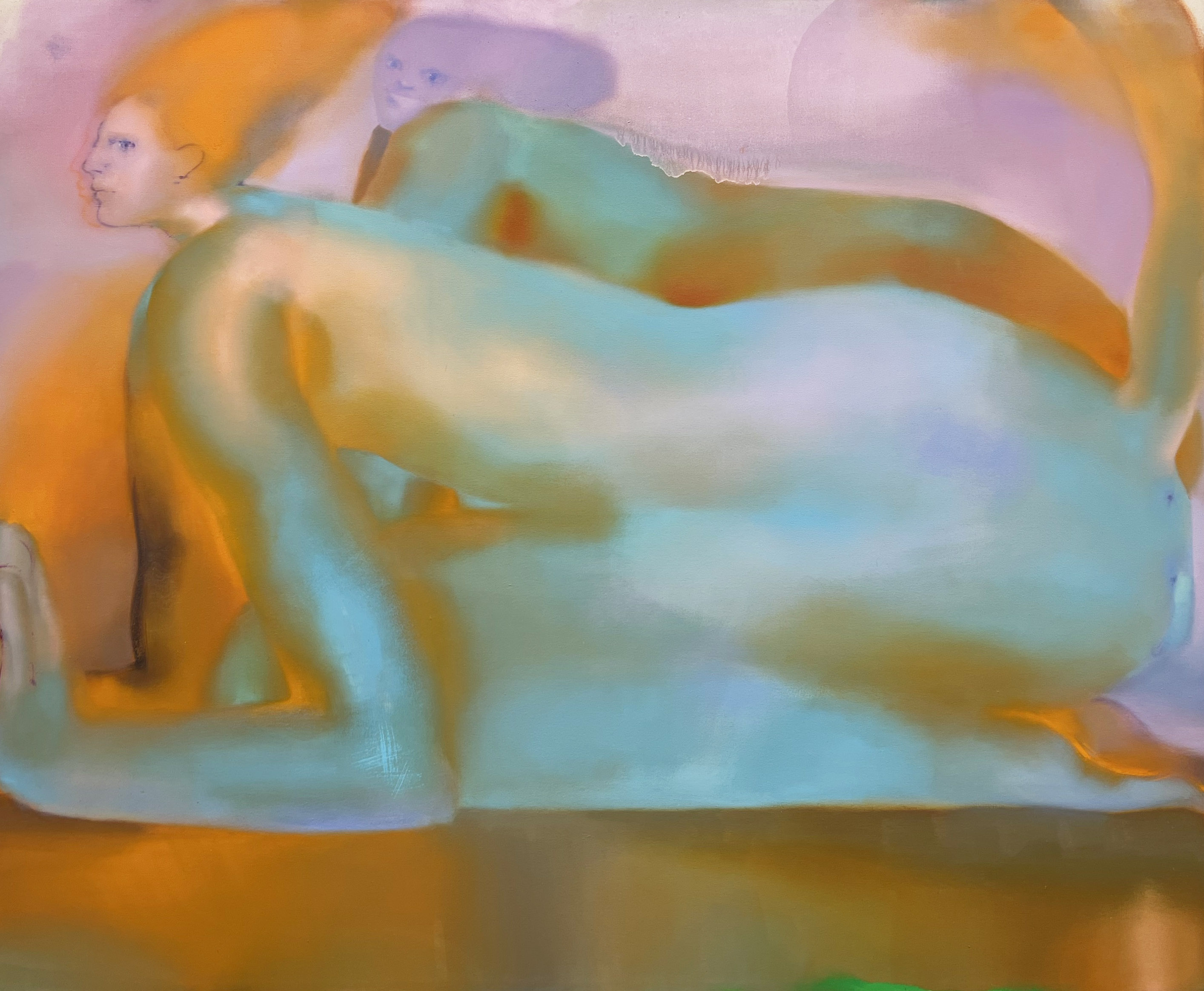
Titled ‘Phantom Tail,’ Elizabeth Glaessner’s show of new painting at PPOW Gallery in Tribeca dissolves distinct separation between human and animal bodies in order to probe possible forgotten connections to nature. Searching for what the gallery identifies as “collective primordial knowledge,” Glaessner imagines creatures with long horse-like or spider-like legs and here, sphinxes with tails curling to meet their flying hair. Created using poured pigment and solvent, the washy figures elude definition, as if perceived in a fever-dream. (On view through March 19th).
Elizabeth Glaessner, Two Sphinxes, oil on canvas, 70 x 85 inches, 2022.
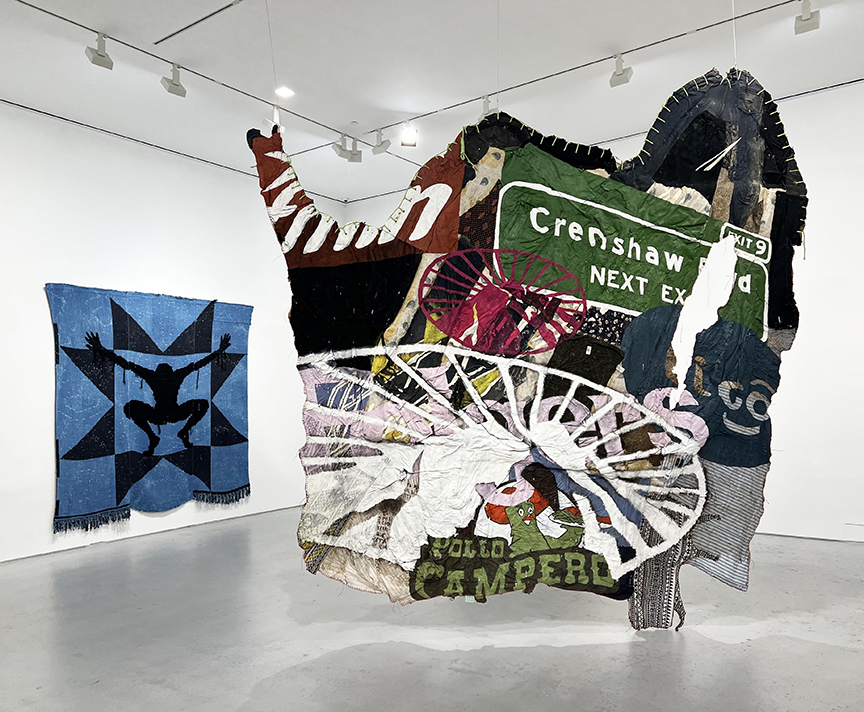
Eddie Rodolfo Aparicio’s ‘Holbein En Crenshaw,’ a rubber cast of a tree on a LA street dominates ‘The New Bend,’ a standout show of textile-related work curated by Legacy Russell at Chelsea’s Hauser & Wirth Gallery. Layered imagery including a highway exit sign, distorted wheel-like shapes, and advertisements crowd together on one side of this hanging piece, recreating the bombardment of information pedestrians and motorists experience on city streets. On the other side, the rough texture of the cast tree with its burls and imperfections suggests the difficulties of urban life, even for plants. Aparicio explains that his intention is to connect beleaguered, non-native trees to the reception of migrant workers in California while also recognizing the rootedness of both in LA life. (On view through April 2nd.)
Eddie Rodolfo Aparicio, Holbein En Crenshaw (Washington Blvd and Crenshaw Blvd., LA, CA), rubber, sulfur, tree and plant residue, wood glue, latex paint, acrylic paint, strings and found cloth quilt, 138 x 150 x 5 inches, 2018.
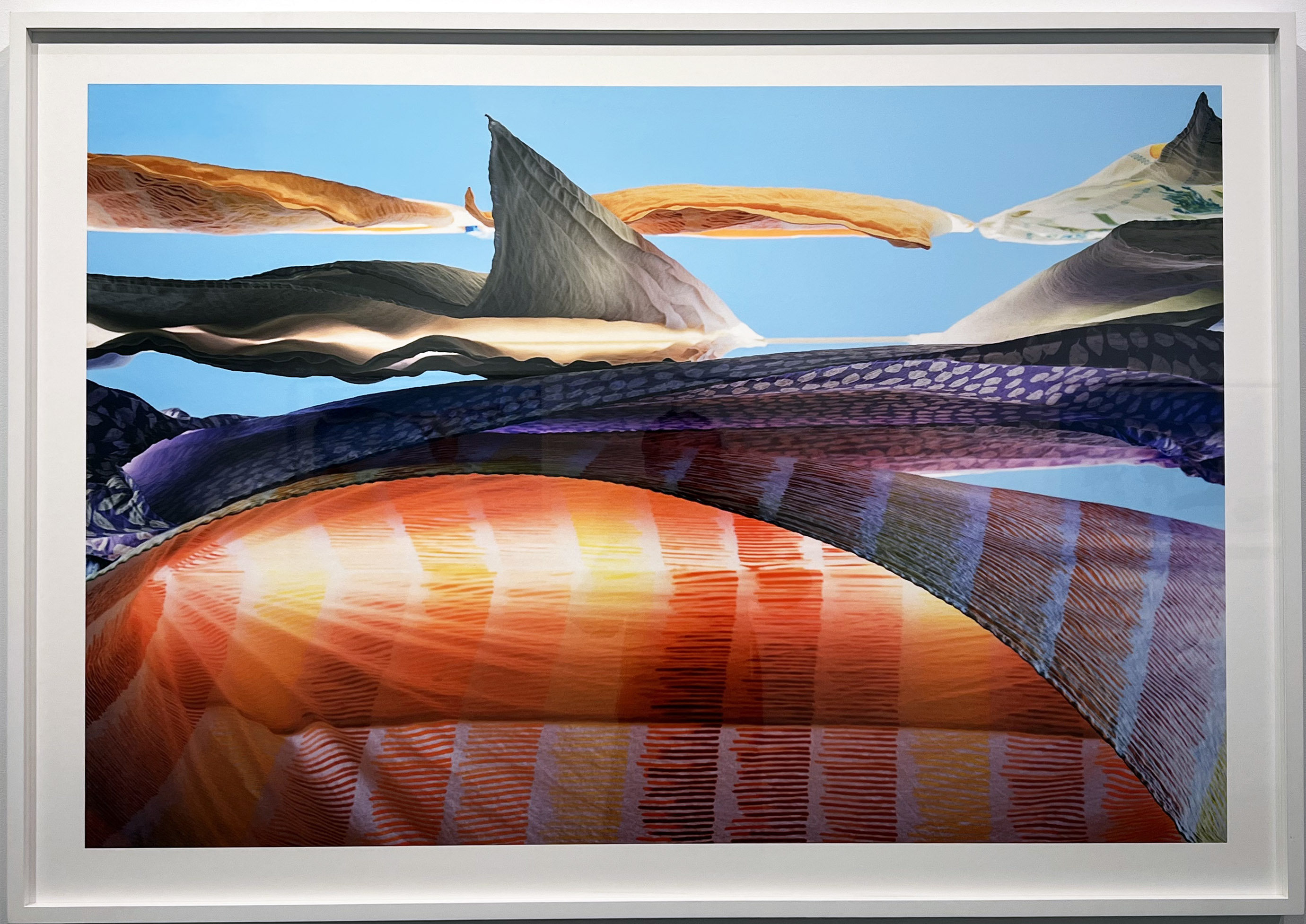
At first glance, photos from Sally Gall’s Aerial series at Chelsea’s Winston Wachter Gallery create happy confusion; abstract shapes and vibrant colors lure us into trying to understand what’s being represented. After a longer look, what appeared to be sea life or flowers resolves into items seen from below on a clothes-line. Even after the ‘ah-ha’ moment of identification, Gall’s images continue to entice as colorful and complex abstractions. (On view in Chelsea through March 5th).
Sally Gall, Composition #1, archival pigment print, various image and edition sizes available, 2015.
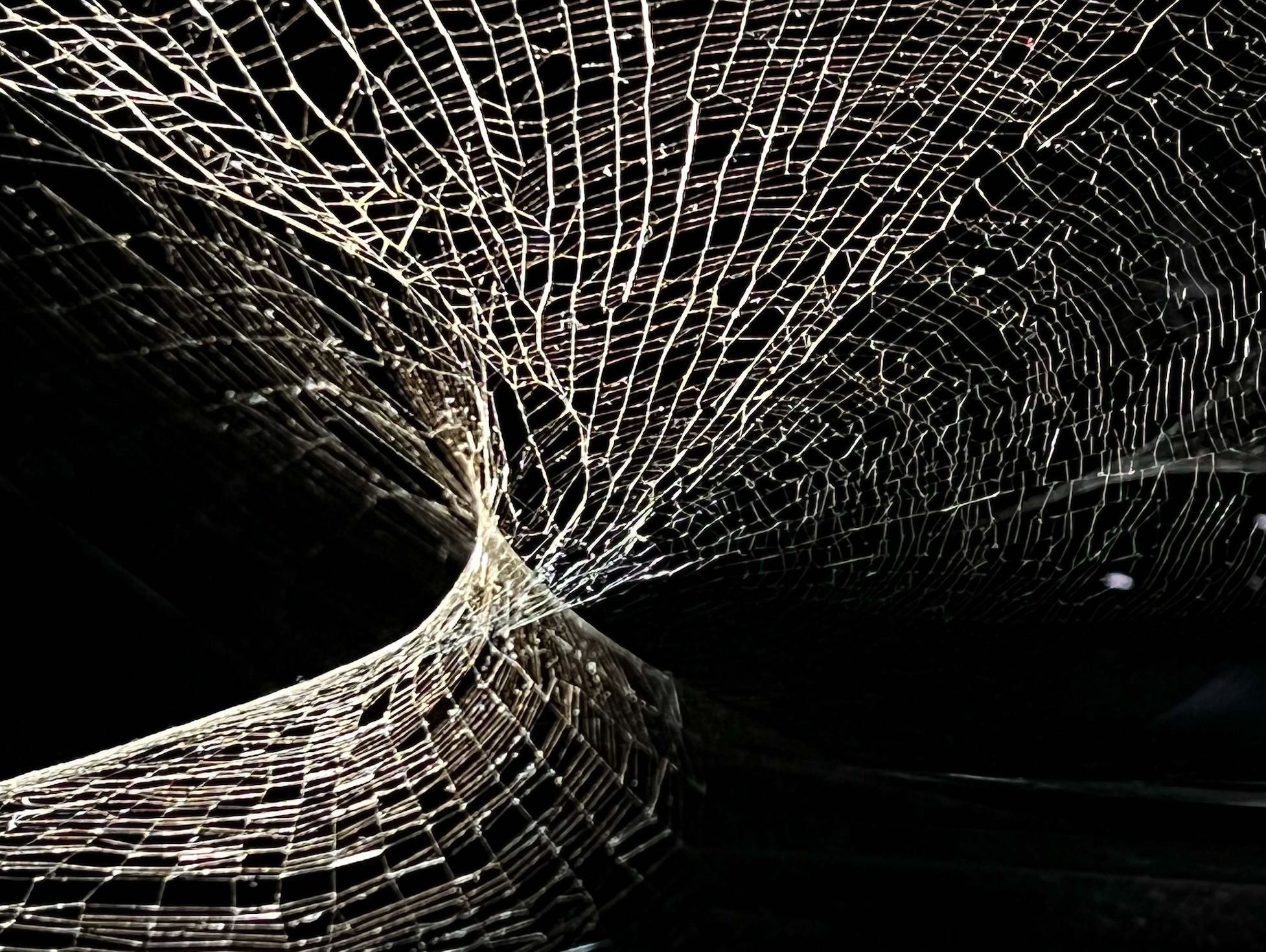
This web is a tiny part of Tomas Saraceno’s current show at The Shed in Hudson Yards, but like the rest of the exhibition, it elicits wonder at the natural world, prompting greater respect for the web of interspecies relationships around us. Housed behind glass and spot lit from below, webs created by various species of spiders in Saraceno’s Berlin studio demonstrate the arthropods’ ability to communicate and understand the world around them through motion perceived via webs. Elsewhere in the show, visitors are invited to physically enter a version of a web in the immersive installation ‘Free the Air: How to hear the universe in a spider/web’ by settling on a web of wire mesh netting to listen to a soundtrack that translates spider movements into sound. (On view at The Shed through April 17th).
Tomas Saraceno, installation view (detail) of ‘Webs of At-tent(s)ion,’ spider frames, spider silk, carbon fibers, lights, 2020.