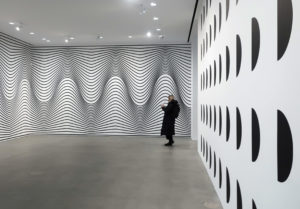
Swiss artist Claudia Comte makes walls the focus of her latest solo show at Chelsea’s Barbara Gladstone Gallery, nodding to US politics, cave paintings and installations like Sol LeWitt’s rule-based wall drawings. Destined to be popular on Instagram as selfie-backdrops, the show reinforces Comte’s wish to make art not just for the art world elite but for everyone. (On view on 24th Street through Feb 16th).
Claudia Comte, back wall: The Morphing Scallops (black on white) and right wall: Half Circles in a Grid (black on white) acrylic wall painting, dimensions variable, 2019.
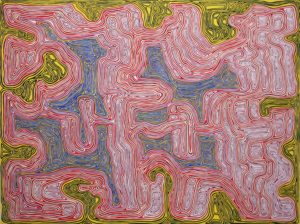
Fans of James Siena’s rule-driven abstract paintings have new lines of enquiry to follow as the artist experiments with a canvas support (vs enamel on aluminum) and expands his normally intimate scale to sizable new works at Pace Gallery. (On view through Feb 9th in Chelsea).
James Siena, Spoolstone, acrylic and graphite on canvas, 36 x 48 inches, 2017.
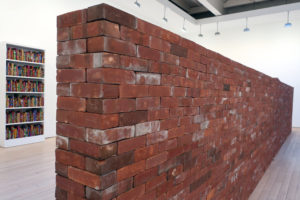
Borders are front and center in U.S. politics and at James Cohan Gallery where Jorge Mendez Blake’s ‘Amerika’ bisects the main exhibition space, arresting both visitors’ thoughts and physical progress through the show. Mid-way along the base of the wall, Mendez Blake has placed a copy of Kafka’s ‘Amerika,’ the troubled tale of a European immigrant to New York, intimating that migration is a fraught undertaking from start to finish. (On view at James Cohan Gallery’s Chelsea and Lower East Side spaces through Feb 23rd).
Jorge Mendez Blake, Amerika, bricks, edition of ’Amerika’ by Franz Kafka, 72 7/8 x 11 7/8 x 400 inches, 2019.
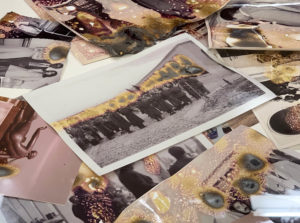
Iranian-born artist Fatemeh Baigmoradi’s burnt photographs recall her father’s attempt to avoid arrest by burning his photos of events that tied him to an oppressed political minority after the Islamic Revolution in Iran. The artist connects the resulting images – characterized by beautiful halos of color – to a Persian painting tradition that painted a glow around the heads of featureless holy figures. Her installation, seen here in detail, is a standout in Laurence Miller Gallery’s ‘GRACE’ exhibition, a multi-faceted and fascinating exploration of gender, race and identity. (On view in Chelsea through Feb 22nd).
Fatemeh Baigmoradi, installation view of selected works from the series ‘It’s Hard to Kill,’ 2017 at Laurence Miller Gallery, January, 2019.
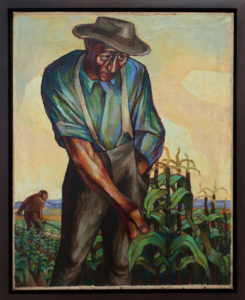
Charles White called painting his weapon in fighting racism and poverty in the United States. His painting of a sharecropper from 1947-48 demonstrates the difficulty of that life and the resilience of the farmers. Part of an exhibition highlighting White’s last mural – a celebration of the achievements of educator and activist Mary McLeod Bethune – the work exhibits White’s commitment to representational art (when abstraction was becoming the new norm) in service of social change. (On view at David Zwirner Gallery through Feb 16th).
Charles White, Sharecropper, oil on canvas, 30 x 24 inches, 1947-1948.
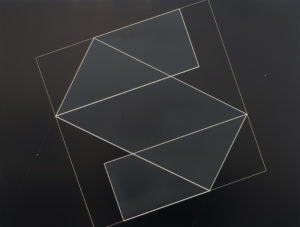
Just months before color theorist, abstract art pioneer and teacher Josef Albers passed away, a book titled ‘Sonic Design’ paid homage to his mid-century abstractions that could be discussed in musical terms. In particular, his series of shapes outlined against a dark background appeared simple but, like music, shift over time in how they might be read, with planes receding at one moment and coming forward the next. The book delighted Albers and inspired David Zwirner Gallery’s current show, which brings together select pieces of glass work from Albers’ time at the Bauhaus in Germany, paintings from his iconic ‘Homage to the Square’ series and more, to consider how color, shape and sound might relate. (On view through Feb 16th).
Josef Albers, Structural Constellation, machine-engraved plastic laminate mounted on wood, 17 x 22 ½ x 7/8 inches, c. 1950.
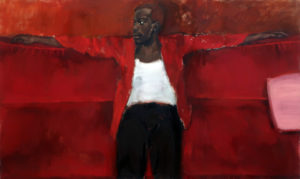
British artist Lynette Yiadom-Boakye converses with John Singer Sargent’s 19th century portrait of a doctor in a red dressing gown standing before red drapes in this vivid painting of an imagined young man in a red jacket lounging on a red sofa. Is he mimicking the crucifixion or expressing total relaxation in the comfort of this womb-red environment? Titled ‘The Ventricular,’ matters of the heart and health come to mind. (On view at Jack Shainman Gallery’s Chelsea locations through Feb 16th).
Lynette Yidaom-Boakye, The Ventricular, oil on linen, 47 ½ x 78 7/8 x 1 ½ inches, 2018.
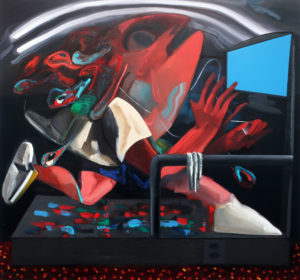
A fish-headed creature with legs runs desperately on a treadmill in this painting by Dana Schutz, epitomizing the pervasive anxiety and grotesque shape-shifting that energize her huge new paintings at Petzel Gallery. In one of the show’s largest paintings, Schutz depicts a mountaintop crowded with oddball characters with competing interests (from a landscape artist to a yogi), none of whom look enlightened. Elsewhere, a worried man in a business suit carefully washes a monster he can’t escape. Malaise abounds in Schutz’s portrayal of a dangerous and uncertain world. (On view at Petzel Gallery through Feb 23rd).
Dana Schutz, Treadmill, oil on canvas, 90 x 96 inches, 2018.
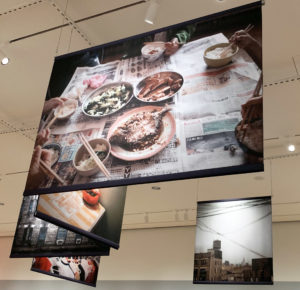
Despite the pressures of a busy life, whether she was at home, at work or at her mother’s house, Shirley Lam always put a meal on the table for her family. Thomas Holton’s documentary photos of the Lam family’s life in their 350 sq ft apartment on Ludlow Street is one of three remarkable photo series now on view at the Museum of the City of New York that elaborate on capability and sacrifice in New York’s Chinese communities. (on view through March 24th).
Thomas Holton, Dinner for Seven, 2011, installation view of ‘Interior Lives’ at the Museum of the City of New York, January 2019.
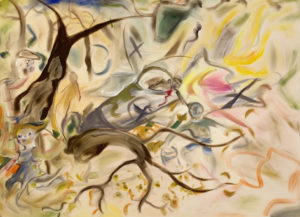
Though inspired by the local history and landscape of the countryside near her studio in Kent, England, Sophie von Hellerman’s latest paintings are anything but tranquil. Scenes of ecstatic dancing and energetically soaring birds join paintings like this one – depicting a WWII soldier’s plane crash in the woods – to offer unexpected rural drama. (On view at Greene Naftali Gallery in Chelsea through Feb 2nd).
Sophie von Hellerman, Ileden Woods, acrylic on canvas, 9 ½ x 124 7/8 inches, 2018.
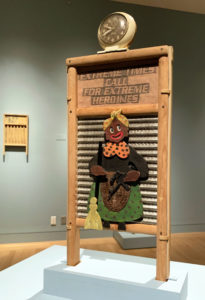
In response to recent shootings of African Americans, Betye Saar has revived her iconic Aunt Jemima imagery to create new work that continues to undermine racist stereotypes from U.S. culture. Mounted on a washboard signifying a history of labor performed by African American women, this Aunt Jemima character totes a broom and a gun under the slogan ‘Extreme Times Call for Extreme Heroines.’ (On view in ‘Betye Saar: Keepin’ it Clean’ at the New York Historical Society through May 27th).
Betye Saar, Extreme Times Call for Extreme Heroines, mixed media and wood figure on vintage washboard, clock, 2017.
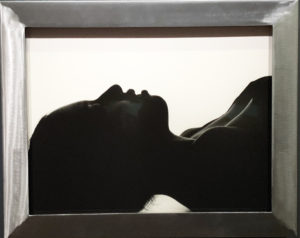
Inspired by a 2018 lie-in by high school students in Washington D.C. to protest gun violence, and ghostly profile portraits by Benjamin Tappan in the New York Historical Society’s collection, London-based artist Bettina von Zwehl created portraits of 17 New York high school students intended to recall death masks. The result is a sobering and beautiful memorial to those killed by guns and a powerful plea to stop the violence. (On view at the New York Historical Society on the Upper West Side through April 28th).
Bettina von Zwehl, Meditations in an Emergency, #1-17, series of 17 photographs, gelatin silver prints, handprinted, 2018.
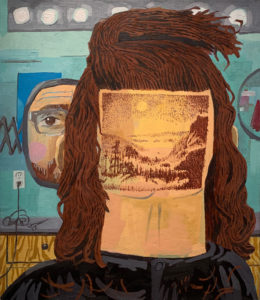
Brooklyn painter Paul Gagner takes personal care to a new and hilarious extreme with this image of an intricate landscape created via shaved hair. Gagner’s self-conscious art practice sends up the quest for originality and artistic greatness in paintings of self-help books for struggling artists and pictures like one featuring a giant meteorite that has crashed through a studio window and crushed an easel. ‘Hairscaping’ continues the self-questioning with its tongue-in-cheek pondering of what a truly dedicated artist will do for an art-led life. (On view at Freight and Volume on the Lower East Side through Jan 13th).
Paul Gagner, Hairscaping, oil on canvas, 26 h x 30 w, 2015.
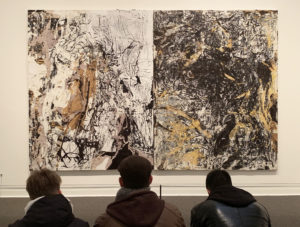
Hung in the spot long occupied by an iconic Jackson Pollock drip painting, and inspired by Clyfford Still’s monumental abstractions, Mark Bradford’s mixed media on canvas artwork declares that non-representational art is still cutting-edge in the Metropolitan Museum of Art’s ‘Epic Abstraction’ rehang. The bleach and water degraded layered paper surfaces of ‘Duck Walk’ reference Chuck Berry’s famous dance move, also adopted by ballroom voguers, maintaining Pollock’s scale and dynamic movement while prompting alternative considerations of race, gender and history. (Ongoing at the Metropolitan Museum of Art).
Mark Bradford, Duck Walk, mixed media on canvas, 2016.