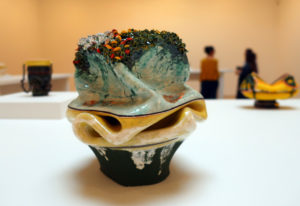
Vases grimace and boxes flirt in Kathy Butterly’s sometimes anthropomorphic, always charmingly eccentric ceramic sculptures. Butterly’s new work – on view for the first time at James Cohan Gallery – is larger than ever and still defying convention with its raucous combinations of color and forms. (In Chelsea through Oct 20th).
Kathy Butterly, Flux, clay, glaze, 7 ¾ x 7 ¼ x 7 inches, 2018.
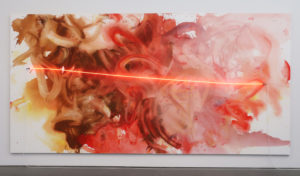
LA-based abstract painter Mary Weatherford had an epiphany while driving through the streets of Bakersfield, CA one evening. The peachy tints of a radiant sunset and the glowing storefront lights inspired her to add neon light to her abstract expressionist canvases, making each uniquely expressive of a particular time and place. In her first solo show at Gagosian Gallery in Chelsea, Weatherford’s huge works are inspired by politics as well as specific experiences; one of the most impactful, GLORIA, operates with explosive force. (On view through Oct 15th).
Mary Weatherford, GLORIA, flashe and neon on linen, 117 x 234 inches, 2018.
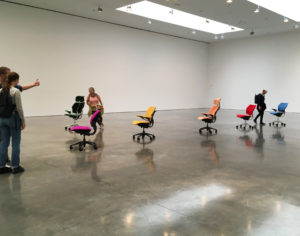
Urs Fischer wants art to ‘do more than it does.’ With a team of software engineers and the input of choreographer Madeline Hollander, the New York-based Swiss artist sets out to surprise gallery visitors with a troupe of dancing office chairs, programmed to interact with each other and humans. Dubbed ‘robotic sculptures,’ the chairs come across as sinister if they come up behind you but strangely cute from the front as they hover nearby, slowly swiveling their wheels like a dog wagging its tail. Here, several engage in a group animation reminiscent of a chorus-line about to kick up its heels. (On view at Gagosian Gallery through Oct 13th).
Urs Fischer, installation view of ‘Play’ at Gagosian Gallery’s 522 West 21st Street location, September, 2018.
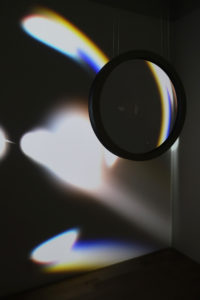
A plano-convex lens dangling under three projectors creates a mesmerizing, constantly shifting pattern of light on the walls in Rafael Lozano-Hemmer’s latest solo show at Bitforms. In advance of a major exhibition of his interactive environments at the Hirshhorn this fall, the artist’s current exhibition tantalizes with small scale pieces from the past few years that evoke wonder at the intersection of technology and the natural world. (On view on the Lower East Side through Oct 21st).
Rafael Lozano-Hemmer, Semioptics for Spinoza, projection version, computer, 3D sensor, projectors, metal bracket, motor, Arduino processor, lens, dimensions variable, 2012.
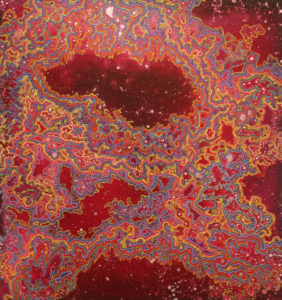
Barbara Takenaga’s abstract paintings evoke natural phenomena – here, a polished cross section of a stone or a distant view of far galaxies. In the case of ‘Overview,’ a standout in her latest solo show at Chelsea gallery DC Moore, she electrifies the heavens with vibrant color and gratifying complexity. (On view through Oct 6th).
Barbara Takenaga, Overhead, acrylic on linen, 37 ¾ x 35 9/16 inches, 2017.
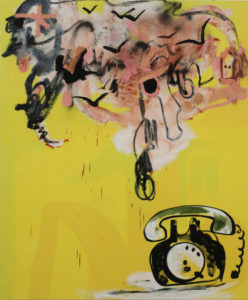
An ominous cloud of fleshy tones and dark lines conjures hidden images (birds? an angular face?) as it hovers over an old-fashioned telephone in Charline von Heyl’s ‘Dial M for Painting.’ Like Hitchcock’s ‘Dial M for Murder,’ intrigue and tension dominate; a hastily drawn telephone leads us in to the drama while the floating mass above gives pause for thought, all against a screaming yellow background. (On view at Petzel Gallery in Chelsea through Oct 20th).
Charline von Heyl, Dial P for Painting, acrylic and oil on linen, 60 x 50 inches, 2017.
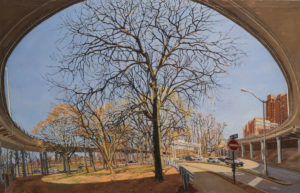
Concrete embraces nature in this painting of a ‘disprized’ location by New York artist Rackstraw Downes at Betty Cuningham Gallery. From a seemingly unremarkable spot under a u-turn ramp, Downes considers what and how the eye really sees and how a ‘forgotten’ place might yield a bit of wonder. (On view on the Lower East Side through Oct 14th).
Rackstraw Downes, Under a U-Turn on the Ramp from the George Washington Bridge to the Rte. 9A North, oil on canvas, 23 ½ x 37 inches, 2013.
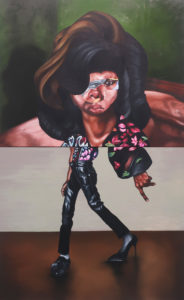
From a couple of everyday guys to this fabulously coiffed model, Nathaniel Mary Quinn’s characters astound and intrigue as layers of personality come together to make a disjointed but coherent whole. Inspired by real characters from his life and Brooklyn neighborhood, Quinn’s paintings acknowledge human complexity while celebrating individuality. (On view at Salon94 Bowery on the Lower East Side through Oct 27th).
Nathaniel Mary Quinn, America’s Next Top Model, oil paint, paint stick, oil pastel, gouache on linen canvas, 80 x 50 inches, 2018.
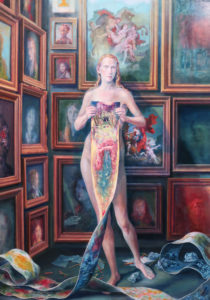
Over the past four decades, Brooklyn painter and art professor Julie Heffernan has questioned traditional roles for women in fantastical works that channel art history and champion female agency. Her latest body of work lauds women who have stood up to power in portraits that hang alongside framed paintings that reverse typical art historical power relations. In the background here, Heffernan’s reworks Rubens’ ‘Rape of the Daughters of Leucippus,’ by replacing a man with a woman on horseback, making her rescuer rather than perpetrator. (On view at PPOW Gallery in Chelsea through Oct 6th).
Julie Heffernan, Self-Portrait with the Daughters, oil on canvas, 79 x 56 inches, 2018.
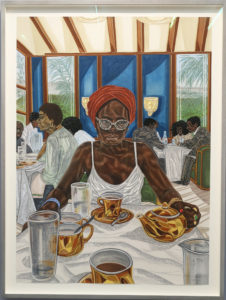
Wealth is a provocative topic for Nigerian-American artist Toyin Ojih Odutola, who depicts two well-heeled fictional Nigerian families in her latest charcoal, pastel and pencil drawings at Chelsea’s Jack Shainman Gallery. Vibrant and moody, the portraits ask – as Ojih Odutola puts it – ‘what would wealth look like’ had colonialism not happened? (On view at both Jack Shainman Gallery locations through Oct 27th).
What Her Daughter Sees, pastel, charcoal and pencil on paper, 57 ¾ x 42 inches (paper), 2018.
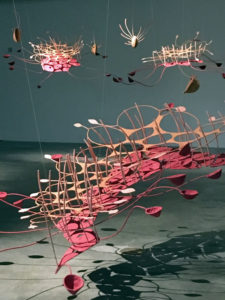
Southern Indian sculptor Ranjani Shettar’s concern for threatened rural Indian ecosystems informed her dramatic mezzanine installation at the Metropolitan Museum of Art, ‘Seven ponds and a few raindrops.’ Crafted from organic muslin and bound to a welded and molded steel base with tamarind paste, the piece’s floating organic shapes conjure 3-D scientific models, intricate plant life or alien life. (On view on the Upper East Side through Sept 16th).
Ranjani Shettar, detail installation view of ‘Seven ponds and a few raindrops’ at the Metropolitan Museum of Art, July 2018.
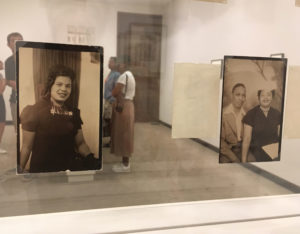
One hundred and fifty studio portraits of unidentified African Americans by unknown photographers now on view at the Metropolitan Museum of Art offer a fascinating peek at self-representation in the mid-20th century. By recently acquiring two major portrait groups represented in the show, the Met announces its intention to build its collection to include images of African Americans. (On view on the Upper East Side through October 8th).
Installation view of ‘African American: Photographs from the 1940s and 1950s at the Metropolitan Museum of Art, July 2018.
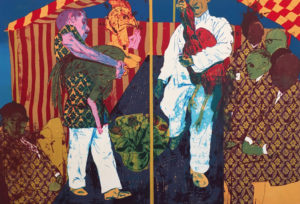
Male behaviors and rituals occupy Ohio-based printmaker and current International Print Center New York resident artist Morteza Khakshoor’s colorful, dream-like prints. This piece, ‘Men of High Culture’ is a standout in the IPCNY’s current juried exhibition of new prints. Including a homogeneously dressed cast of male wall flowers and two figures grappling with eccentric creatures and separated by a vase of flowers, Khakshoor’s setup reinterprets the uber-male cockfight. (On view through Sept 22nd).
Morteza Khakshoor, Men of High Culture, screenprint on paper mounted on panel, 29 ¼ x 42 ¾ inches, 2018.