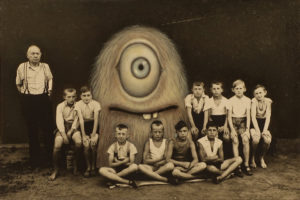
Self-taught Czech artist Jana Paleckova’s endlessly inventive paintings on original vintage photos reimagine the past in humorous and surreal ways. The apparent awkwardness of these boys and their wary-looking adult takes on new meaning, given the gormless looking cyclops in their ranks. (On view through August 3rd at Edward Thorp Gallery in Chelsea).
Jana Paleckova, untitled (man, boys and furry cyclops,) oil paint on vintage photograph, 7h x 9w inches, 2017.
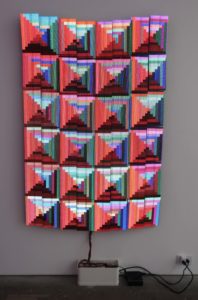
A campfire made of LED matrix panels, a slightly misshapen monolith in cool blue light and this glowing quilt with changing patterns are standouts in computer programmer/ artist Luke Murphy’s latest show at Canada NY. Here, both subject matter and execution exude homey charm. (On view on the Lower East Side through July 15th).
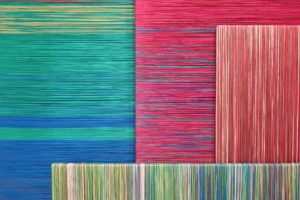
Known for large-scale installations of hanging, twisting and looping fibers, Sheila Hicks favors rich, 2-D color-fields in her latest solo show at Sikkema Jenkins & Co. As seen in this detail, Hicks combined several panels wrapped in individual strands of linen floss to create harmonies that speak to a lifetime of absorbing and rethinking textiles from around the world. (On view through July 6th).
Sheila Hicks, installation detail at Sikkema Jenkins & Co., June 2018.
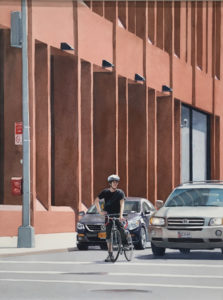
British Columbia based artist Tim Gardner revisits his college-day haunts in vibrant, precise watercolors of a surprisingly tranquil New York, now on view at 303 Gallery. A Statue of Liberty with stars brightly shining above (light pollution magically banished), a quiet (!) High Line park and a subway station with a train arriving are magical moments. This bike messenger (actually waiting at a light?) helps interpret the scale of the pleasingly symmetrical terracotta-colored building framing the scene. (On view in Chelsea through July 13th).
Tim Gardner, Bike Messenger, watercolor on paper, 16 x 12 inches, 2018.
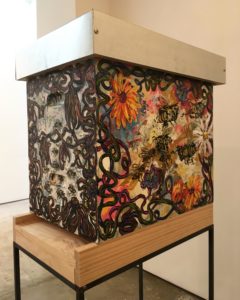
Brooklyn-based artist Joseph Zito’s forays into beekeeping inspired his recent series of hives, created in tandem with artist friends and currently on display at Lennon Weinberg Gallery in Chelsea. Here, painter Gary Mayer’s energetically painted box issues a warning, portraying a cluster of frenetic bees in a paradise of flowers on one side and dead bees experiencing colony collapse on the other. (On view through August 17th).
Joseph Zito with Gary Mayer, Lamentation, 22 ½ x 22 x 13 3/4 inches, 2018.
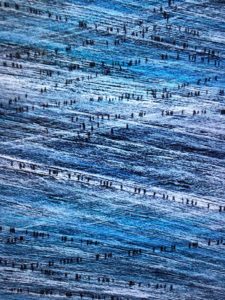
Lines of moving silhouettes endlessly crisscross rugged terrain in ‘Blue Hills,’ an arresting video at the entrance to Michal Rovner’s latest solo show at Pace Gallery. Suggesting constant migration across inhospitable land, the piece’s calm colors belie more overt alarm in several of the show’s other works, in which bodies with flashing red lights for heads or constantly waving arms sound a warning. Reflecting on the role of technology in our daily lives, Rovner muses that we are becoming ‘bar codes with DNA.’ (On view at Pace Gallery’s 25th Street location through June 29th).
Michal Rovner, Blue Hills, LCD screen and video, 57 1/8 x 32 5/8 x 3 3/8 inches, 2018.
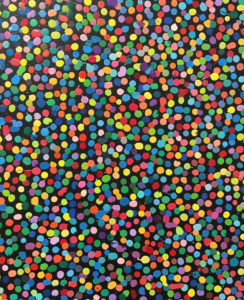
If you thought Damien Hirst could possibly be done with painting dots, think again. Gagosian Gallery’s cavernous space is filled with new dot paintings, freed from their usual grid format and now swirling across the canvas. (On view in Chelsea through June 30th).
Damien Hirst, detail from ‘Colour Space Paintings’ at Gagosian Gallery, 555 West 24th Street, through June 30th.
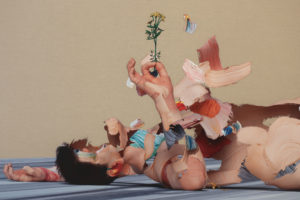
British artist Matthew Stone’s stunning merger of virtual and real (as played out on canvas) was a standout in The Hole NYC’s past ‘Post Analogue Painting’ shows, in which artists demonstrated how digital tools have altered the way they conceive of painting’s possibilities. In his latest work, Stone introduces a maelstrom of bodies, half-formed by a vocabulary of brushstrokes that he first paints on glass, photographs, then digitally models into not-quite-classic nudes. (On view on the Lower East Side through June 24th).
Matthew Stone, detail of Neophyte (St John’s Wort), digital print on linen, 63 x 98.4 inches, 2018.
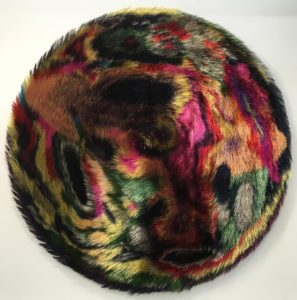
Nick Cave’s mixed media sculptures at Jack Shainman Gallery look like soft, dyed fur, but the reality is more somber. Patterns painted on short, sharp wires portray what the gallery reveals is a “…layered mapping of cataclysmic weather patterns superimposed onto brain scans of black youth suffering from PTSD as a result of gun violence.” (On view on 20th Street in Chelsea through June 23rd).
Nick Cave, Tondo, mixed media including wire, bugle beads, sequined fabric and wood, 96 inches diameter, 2018.
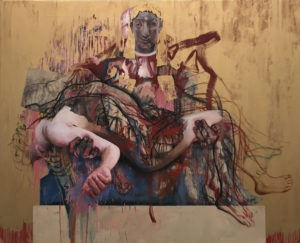
The most provocative – and political – of British painter Jenny Saville’s recent canvases remake traditional Christian pieta imagery in a way that both modernizes it and suggests timelessness. In this striking piece titled ‘Byzantium,’ Mary is replaced by a figure recalling an ancient Greek striding youth – a kouros – while her dead son’s reclining body is transparent, as if real flesh gave way to a Gray’s anatomy diagram. Elsewhere in the show, a male parent cradles a lifeless child with a modern war-ravaged city in the background. As the heads in both images overlap heads and feet reappear many times, Saville seems to suggest that history repeats itself with dire consequences. (On view at Gagosian Gallery’s 21st Street Chelsea location through July 20th).
Jenny Saville, Byzantium, oil on canvas, 76 ½ x 94 1/8 inches, 2018.
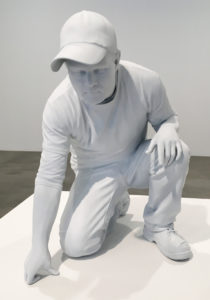
In a gallery titled ‘the repair annex,’ two new sculptures by Charles Ray depict mechanics absorbed in their work. A man squats in a pose reminiscent of Ray’s own kneeling self-portrait from a few years back but also suggesting supplication or rapt attention to a task. Ray’s meticulous renderings, here in painted steel, can take years to realize and the attention to detail and smooth finish give the piece an elegance and preciousness that connect this subject less to an autobody shop and more to an art history of heroic bodies. (On view at Matthew Marks Gallery‘s 526 West 22nd Street location in Chelsea through June 16th).
Charles Ray, Mechanic 1 and Mechanic 2 (detail), painted steel, mechanic 2: 21 x 14 ½ x 18 ¾ inches, 2018.
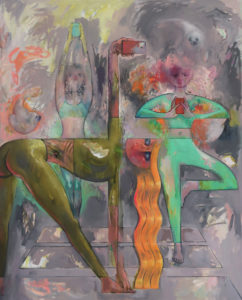
Nodding to the title of Picasso’s carefully posed 1907 bevy of red-light district workers, ‘Demoiselle D’Avignon,’ Delia Brown’s exhibition ‘Demoiselle d’Instagram’ is a hilarious, tongue-in-cheek take on today’s social media self-styling. Departing radically from her signature realist style, Brown surrounds her subjects in shimmering halos of energy, perhaps emitted from the phones that absorb the attention of each woman. Meanwhile, baby seals float through the air – their plight ignored by self-absorbed humans. (On view at Tibor de Nagy on the Lower East Side through June 17th).
Delia Brown, mountain, red arrow and tree emojis, oil on canvas, 74 x 60 inches, 2018.
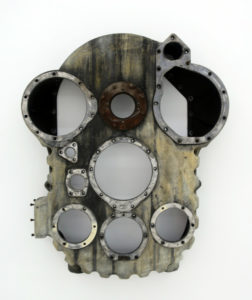
Marianne Vitale gives new meaning to life on the rails with her repurposed railway tracks as minimalist sculpture, steel junctions as totemic figures and now, a train engine housing resembling a gas-masked ghoul. Part of an exhibition that includes stacks of metal flangeway blocks that recall indecipherable letter shapes, Vitale’s art is anthropology – a search through remnants of a recently bygone era for clues to life in the not-so-distant past. (On view at Invisible Exports on the Lower East Side through June 24th).
Marianne Vitale, Skull, repurposed train engine parts, 49 x 42 x 8 inches, 2018.
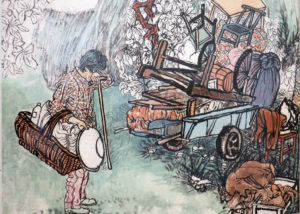
Amid lush landscapes, bundles of household goods and furniture await removal in Yun-Fei Ji’s watercolor paintings of rural China. As the government relocates huge numbers of country-dwellers to urban areas, the artist zeros in on individuals and their belongings in the process of being uprooted. (On view at James Cohan Gallery’s Lower East Side location through June 16th).
Yun-Fei Ji, detail of The Family Belongings, watercolor and ink on Yuan paper mounted on silk, 15 ½ x 26 ¼ (unframed), 2011.
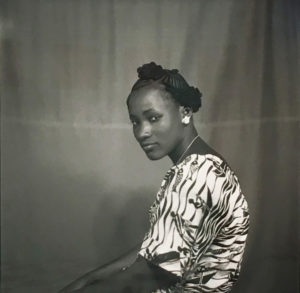
Fatoumata shows off a new braided hairstyle in this portrait by Burkina Faso photographer Sanle Sory, whose photo studio attracted the young and fashionable of Bobo-Dioulasso for decades after opening in 1960. In dozens of images taken from the 60s to the 80s, now on view at Yossi Milo Gallery in Chelsea, Sory captures the lively self-styling of the country’s youth post-independence, calling photography ‘a witness to everything, a kind of proof of life.’ (On view through June 23rd).
Sanle Sory, Fatoumata nouvellement tressee, gelatin silver print, paper : 20 x 16 inches, 1978.