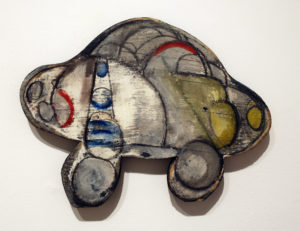
Jenny Snider’s small shaped painting of a car is a standout in Edward Thorp Gallery’s summer group show, its rounded corners and many planes suggesting a cartoonish vehicle with zany passengers taking an unconventional ride. (In Chelsea through July 29th).
Jenny Snider, 5/F, acrylic and pencil on wood, 12 ½ h x 9 w x ¾ d, 2002.
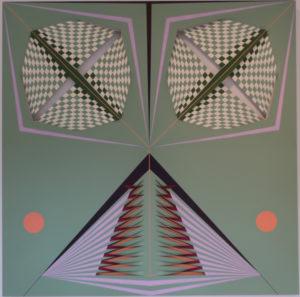
How much can a human face tell us? Young Columbian artist Cristina Camacho’s sliced canvases first look like geometric abstraction, then resolve into portraits that hint at humanity or the digital visage of an intriguing but radically strange creature. (At Praxis International Art in Chelsea through July 8th).
Cristina Camacho, Olivia, acrylic on canvas, 56 x 56 inches, 2016.
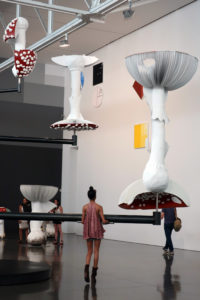
Seven hallucinogenic mushroom replica spin like a model of the solar system in Carsten Holler’s ‘Flying Mushrooms’ sculpture at Gagosian Gallery, pointing to out-of-body experience, experienced in person in the gallery. Holler’s first show since 2011 (when he installed a slide and sensory deprivation chambers at the New Museum), this interactive exhibition is sure to be another crowd pleaser. (On view on 24th Street in Chelsea through August 8th).
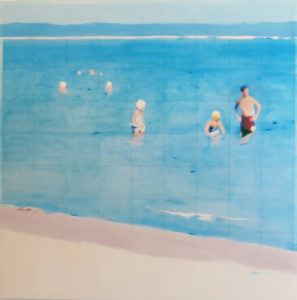
Vintage color slides are the basis for Isca Greenfield-Sanders’ light infused beach scenes. Impossibly bright, they document a day by the water and suggest sunny memories. (At Ameringer McEnery Yohe in Chelsea through July 1st).
Isca Greenfield-Sanders, Beach (Detail), mixed media oil on canvas, 63 x 63 inches, 2107.
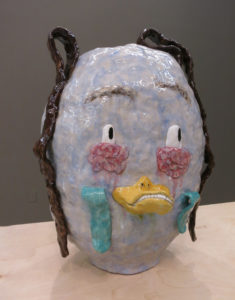
Swedish artist Joakim Ojanen’s odd ceramic heads resemble gourds and various animals, in this case, a bird. The creatures formerly manifest themselves in two dimensions as drawings. Now in the round, they allow Ojanen’s strange vision to inhabit space with us. (On view at The Hole on the Lower East Side through July 7th).
Joakim Ojanen, Monday Face, glazed stoneware, 17.5 x 12 x 13 inches, 2017.
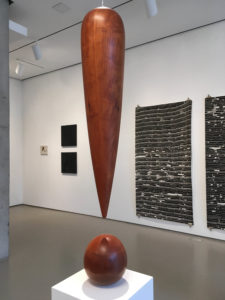
Richard Artschwager’s two-foot tall wooden exclamation point – which shapes artistic language out of the forms of language itself – adds a note of excitement to Jane Lombard Gallery’s summer group show. (On view in Chelsea through July 28th).
Richard Artschwager, Exclamation Point, wood, 28.5 x 6.5 x 6.5 inches, 1970.
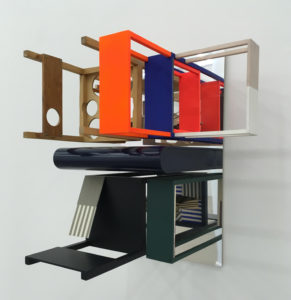
Nahum Tevet’s wall mounted sculptures are small-scale but full of action, a workout for the eye. Frames, furniture and machines come to mind amid patterning that recalls mid-century abstraction, cut outs that recall typography, colors that shout and mirroring that makes every element repeat. (At James Cohan Gallery’s Lower East Side location through July 28th).
Nahum Tevet, Double Mirror (SLDB), acrylic and industrial painting on wood, veneer, metallic mirror, 19 5/8 x 16 ½ x 13 3/8 inches, 2015.
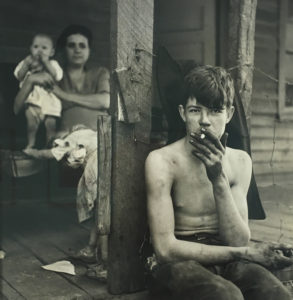
After serving in the Naval Aviation Photographic Unit during WWII, Fons Iannelli returned to the States to establish a successful career photographing for McCall’s, Life, Fortune and other magazines. Alongside striking images of naval life, and later photos of efficient housewives shot for commercial purposes, Iannelli’s scenes from his 1946 Kentucky Coal Miner series, now on view at Chelsea’s Steven Kasher Gallery reveal the difficult circumstances of family life in the mining community. (On view through August 11th).
Fons Iannelli, Boy Smoking Cigarette (from the Kentucky Coal Miner series), Harlan County, KY, vintage gelatin silver print, printed ca. 1946, 10 ½ h x 10 ¼ w, 1946.
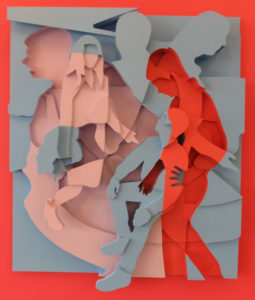
How do you make representational painting in the digital age, when bodies no longer have to be near each other to interact? Pieter Schoolwerth ponders this in a multi-step process that involves photographing figures and shadows, drawing them, altering them in the computer, creating them in foam core or wood and printing and painting on canvas. The resulting images are convincingly attractive but unsatisfying – in this enigmatic relief sculpture depicting a student center, various figures are together but don’t connect. (At Miguel Abreu Gallery on the Lower East Side through June 28th).
Pieter Schoolwerth, Model for “Student Center,” enamel on wood, 54 3/8 x 47 ¼ x 7 ½ inches, 2017.
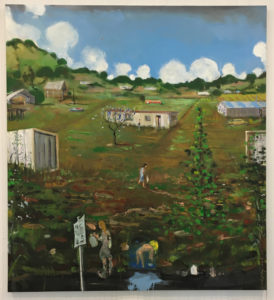
New paintings made in New York and North Carolina feature spring blossoms and mobile homes in Verne Dawson’s current show at Gavin Brown’s Enterprise. In the foreground of this bucolic but blighted landscape, Dawson portrays a pastoral scene of women bathing and gathering water, not from a sylvan spring but from a ditch. (At Gavin Brown’s Enterprise on the Lower East Side through June 24th).
Verne Dawson, N.C. 25, oil on canvas, 66 x 60 inches, 2017.
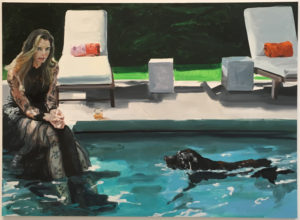
Though the pool is enticing, this isn’t a tranquil summer scene. Eric Fischl’s ‘Daddy’s Gone, Girl’ suggests that the woman in the voluminous black dress is in mourning for an absent father and maybe a little unmoored. As an update on Fischl’s well-known 1984 painting Daddy’s Girl, it’s a meditation on loss and isolation. (At Skarstedt’s Chelsea location through June 24th).
Eric Fischl, Daddy’s Gone, Girl, oil on linen, 78 x 107 inches, 2016.
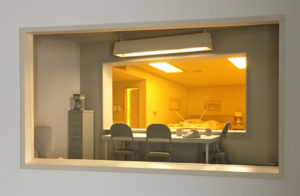
Roxy Paine’s three new dioramas at Paul Kasmin Gallery continue the artist’s interest in systems of control. Here, a view into a view into a hotel room alludes to the CIA’s experiments in administering LSD to unsuspecting civilians in the 1950s. The meticulously crafted scene illustrates a shocking invasion of privacy and personal well-being. (On view in Chelsea through July 1st).
Roxy Paine, Experiment, steel, maple, fluorescent lamps, acrylic prismatic light diffusers, aluminum and oil paint, 96 3/8 x 106 3/8 x 71 3/8 inches, 2015.
Subway advertising boards, scraped free of ads before being recovered by new posters, continue to inspire Wyatt Gallery’s ongoing photo series, ‘Subtext.’ In the latest work, he considers his images as portals to more tranquil, meditative environments than the train platform. (On view at Foley Gallery on the Lower East Side through June 25th).
Wyatt Gallery, 135th BC: 157-245.9, UV Cured Pigment Ink on Dibond, 42 x 54 inches, 2017.
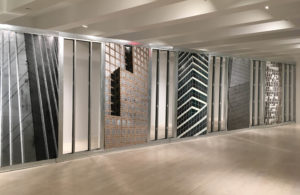
Nicola Lopez mixes interior and exterior walls, façade and skeleton in her bold installation at Jacob Lewis Gallery in Chelsea. Titled ‘Big Windows: Skin: Portals’ Lopez questions the impenetrable quality of anonymous modern glass wall architecture, mounting woodcuts on normally hidden metal studs that support interior walls. (On view through June 30th).
Nicola Lopez, installation view of ‘Big Windows: Skin: Portals’ at Jacob Lewis Gallery, Chelesa, June 2017.
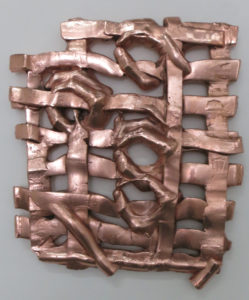
Four hands repeat a gesture with multiple interpretations in the roughly woven lattice of Athansios Argianas’ bright, electroformed copper wall sculpture at On Stellar Rays. Interpretable as OK, perfection (if kissed by the lips), zero or something ruder, the sign is enhanced by a long title that suggests that seeing is as changeable as the sea. (On view on the Lower East Side through June 25th).
Athanasios Argianas, Sea a zero, see a zero, Zero seas, To see a zero, To sea two zeros, electroformed copper, resin, ground coral, 15 x 13 inches, 2017.
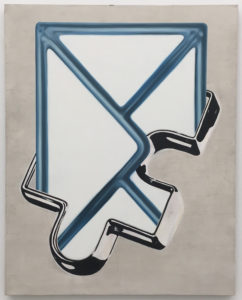
Anne Neukamp’s post-analogue paintings picture office tools in large-scale, graphically simple images that look as if they’ve been composed in digital space, yet are manifest before us in oil, tempera and linen. Titled ‘Morsel,’ this tantalizing icon offers a puzzle piece and a mystery envelope, dangling meaning in front of viewers. (At Chelsea’s Marlborough Contemporary through June 24th).
Anne Neukamp, Morsel, oil, tempera, acrylic on linen, 39 3/8 x 31 ½ inches, 2017.
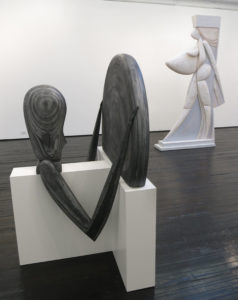
From the front, Ryan Johnson’s ‘Driver’ looks like a single, solid disk. From the side, the form becomes a steering wheel and a driver materializes, instantly morphing the sculpture from a mysterious biomorphic abstraction into an everyday scenario. Johnson’s sense of humor also comes across in his stylized ‘mother’ at rear, a stylized caryatid whose belly makes her all the more dramatic. (At Nicelle Beauchene Gallery through June 25th).
Ryan Johnson, Driver, plywood, oak, epoxy clay, acrylic paint, 59 x 41 x 41 inches, 2017. (Background: Mother, 95 x 53 x 10 inches, 2017).
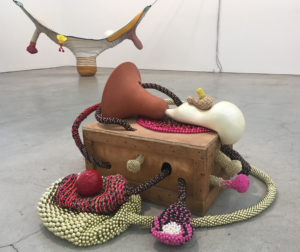
Organic shapes snake around and into a wooden box in this work by Brazilian artist Maria Nepomuceno, suggesting that whatever is inside cannot be contained. A trumpet-like ceramic form introduces the idea of broadcasting sound, offering the possibility that an unheard song might further animate this alluring organism. (At Sikkema Jenkins & Co through June 30th).
Maria Nepomuceno, Untitled, ropes, beads, ceramic, wood, fiberglass and resin, 27.5 x 29.125 x 24.375 inches, 2015.
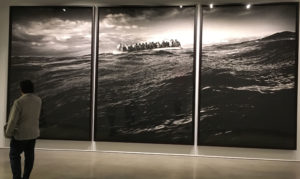
Round the corner into Metro Pictures smaller back gallery and suddenly you’re in the valley of an enormous wave, dwarfed by a ominous black swell that prompts terror even on dry land. The scene is the highlight of Robert Longo’s show of huge, charcoal drawings, a body of work that pictures refugees, CIA prisoners and Ferguson protesting football players in a tour de force of contemporary conflict. (On view in Chelsea through June 17th).
Robert Longo, Untitled (Raft at Sea), triptych; charcoal on mounted paper, 140 x 281 inches overall, 2016-2017.
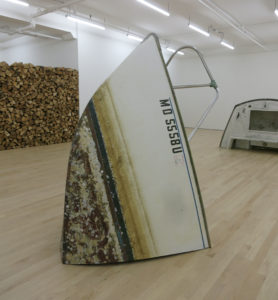
Charles Harlan’s artwork happens at the meeting place of man-made and natural objects, so it comes as no surprise to see him engage repeatedly with boats. For his current show at JTT Gallery on the Lower East Side, Harlan disassembled a boat belonging to a late family member of JTT Gallery owner Jasmine Tsou, turning it into two objects that evidence the effects of time and nature on a once-cherished object. (On view through June 17th).
Charles Harlan, RCL, wood, fiberglass, plastic, stainless steel, installation dimensions variable: (part I), 63 x 60 x 51 inches (part II), 45 x 75 x 60 inches, 2017.
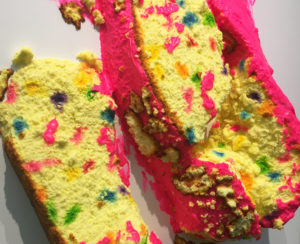
A cherry pie, a smashed chocolate bunny and this giant piece of cake by Peter Anton are highlights of an asylum for sweet-lovers created by the artist in Chelsea’s Unix Gallery. A response to the idea that the American addiction to sugar borders on the insane, Anton’s super-sized sculptures push the idea to extremes, prompting visceral reactions so much sweetness. (On view through June 17th).
Peter Anton, (detail of) Sugar Madness – Pink Confetti Cake, mixed media, 74 x 50 x 12 inches, 2017.
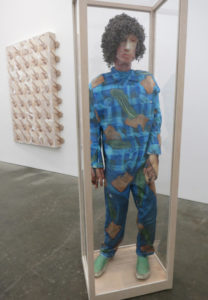
David Kennedy Cutler pushes the idea of self-display by putting a scanned and printed effigy of himself in a vitrine in his latest solo show at Derek Eller Gallery. Wearing one of his signature plaid shirts, further enhanced by a kale and bread pattern, Kennedy Cutler refers to his role as consumer as the audience consumes his artwork. (On view on the Lower East Side through June 25th).
David Kennedy Cutler, Fourth Self, plywood, Plexiglas, dummy and wooden hammer, 76 x 22.5 x 18 inches, 2017.
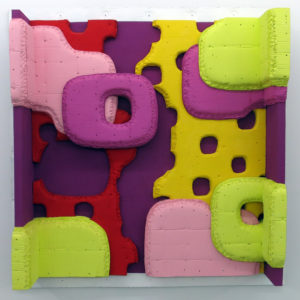
Guy Goodwin’s large paintings on cardboard forms are among the most unusual and enticing in New York galleries now. Projecting over a foot from the gallery wall, they’re cross between painting and sculpture that the artist likens to a ‘plush booth’ where a visitor might rest and contemplate. (At Brennan and Griffin on the Lower East Side through June 18th).
Guy Goodwin, Flowers in the Grotto, acrylic and tempera on cardboard, 68 x 68.5 x 13.25 inches, 2017.
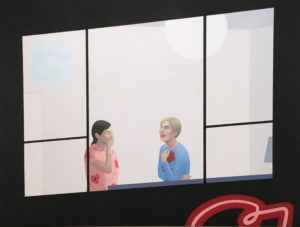
Marinaro Gallery’s huge 2nd floor windows invite glimpses from the street of the artwork inside; upstairs on the gallery wall, Ridley Howard occupies a similar vantage point in ‘Over the Star’ as he portrays two women with guarded postures laughing together. Awkward or intimate, their joke is irresistible, inviting us to keep watching. (At Marinaro Gallery on the Lower East Side through June 18th).
Ridley Howard, Over the Star, oil on linen, 50 x 66 inches, 2017.
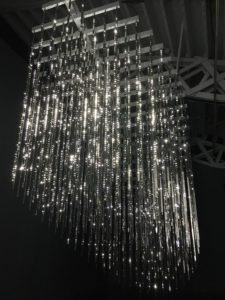
Leo Villareal’s light sculptures have transformed the San Francisco Bay Bridge, the walkway between buildings at DC’s National Gallery and many other high profile sites. On a smaller scale but with no less mesmerizing impact, Villareal has transformed Pace Gallery’s 24th Street location with hanging stainless steel bars displaying an ever-changing combination of LED lights. (On view through June 17th).
Leo Villareal, Ellipse, LEDs, stainless steel, electrical hardware and custom software, 17’ 6 ¾ inches x 10’ 7 ¼ inches x 20’ 5 ¾ inches, 2017.
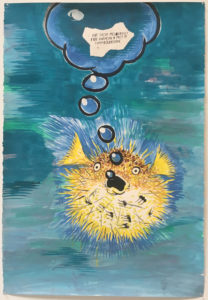
This comically alarmed puffer fish is apparently startled by the empathy of an unnamed individual; in a thought bubble, the fish remarks that ‘his great melancholy eyes swim in a mist of commiseration.’ As comment on warming seas and endangered wildlife, the painting pits emotion vs action. (At David Zwirner Gallery’s 519 West 19th Street location).
Raymond Pettibon, No Title (His great melancholy…), 44 x 30 ¼ inches, 2017.
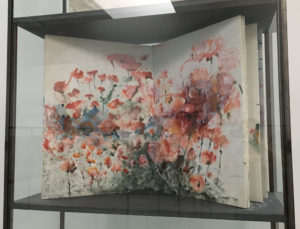
The heart of Anselm Kiefer’s latest exhibition at Gagosian Gallery is a series of large-scale handmade books crafted from cardboard covered in plaster and painted with watercolor. Titled ‘Walpurgia,’ after an 8th century English nun, this lush, flesh-colored rendering of flowers echoes the erotic nature of the new paintings. Though the subject matter seems like a departure for Kiefer, it continues work begun in the 70s for which he merged the landscape and female bodies. (At Gagosian Gallery’s 21st Street location through July 14th).
Anselm Kiefer, Walpurgia, watercolor and pencil on plaster on cardboard, 14 pages (six double page spreads, front and back cover), 34 ¼ x 25 9/16 x 2 ¾ inches, 2013.
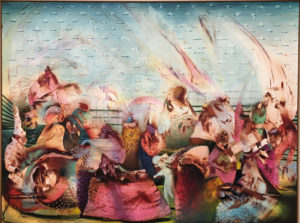
From amid sweeping and energetic forms in Ali Banisadr’s painting ‘Myth’ emerge odd faces that suggest a camel (upper left) a clown with a tall, spotted cap (middle left) and a cast of slightly sinister characters. The Iranian born, NY-based artist explained that the paintings in his current show at Sperone Westwater Gallery were inspired by politics in the US; he suggests both mass migration and a barbed wire fence in the sky and a mass of menacing figures in the foreground. (On the Lower East Side through June 24th.)
Ali Banisadr, Myth, oil on linen, 66 x 88 inches, 2016.
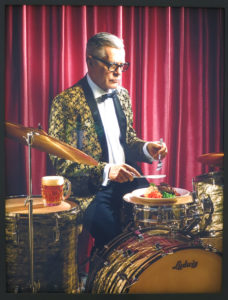
Displayed on a lightbox, Canadian artist Rodney Graham’s staged photographs are enticing, glowing portals into the past. In this unlikely scenario, a jazz drummer from yesteryear uses his kit as a table for a traditional meal of Salisbury Steak. (At 303 Gallery in Chelsea through June 2nd).
Rodney Graham, Dinner Break (Salisbury Steak), printed aluminum lightbox with transmounted chromogenic transparency, 44 5/8 x 34 5/8 x 7 inches, 2017.