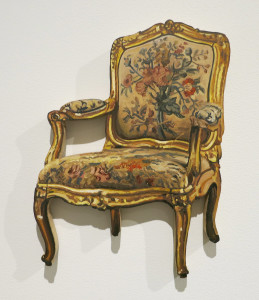
Spanish artist Lino Lago’s recent ‘Reality (Show)’ series jumbles art and artifacts from pop culture and art history together on the flat surface of a canvas. This shaped artwork in the form of a chair, part of the same series, allows collectors to make their own groupings. (At George Adams Gallery in Chelsea through Feb 11th.)
Lino Lago, Point of View, oil on wood, 14 x 10 ½ x 1 inches, 2016.
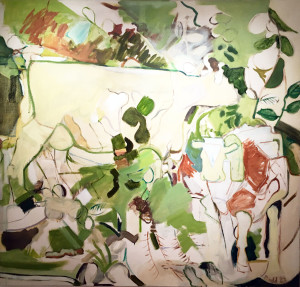
Plants, ponds and (for a time) cows generated New York painter Lois Dodd’s subject matter as she painted the natural world in canvases that provocatively mix figuration and abstraction. This 1963 image, painted on summer vacation in Maine, continued Dodd’s studies in pattern, merging avant-garde painting style with bucolic pleasure. (At Alexandre Gallery in the 57th Street area, through Feb 25th).
Lois Dodd, Cows, oil on linen, 72 x 76 inches, 1963.
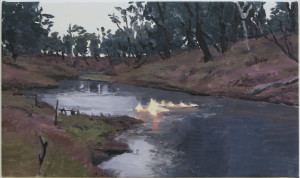
Roger White’s new oil paintings at Rachel Uffner Gallery approach the wondrous in the everyday – a mirror reflects light, an array of mushrooms grows from a bag – but the artist amps up the drama in this picture of fire on a river. Has there been a chemical spill? Is this a miracle? A sci-fi scene? This small, intriguingly moody canvas asks good questions. (On the Lower East Side through Feb 19th).
Roger White, Touristic Scene with Burning River, oil on canvas, 10 x 17 inches, 2017.
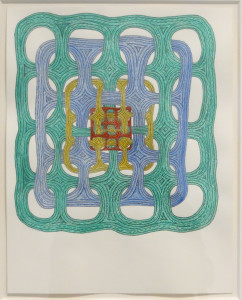
James Siena continues to produce mesmerizing patterned images with his latest show of drawings at Pace Gallery. However, instead of repeating an initial mark that establishes a rule system, Siena’s new work glories in interlocking patterns that boggle the mind with their detail and their complex consideration of space. (At Pace Gallery’s 25th Street location through Feb 11th).
James Siena, Manifold X, ink and watercolor on paper, 11 5/8 x 9 ¼ inches, 2015.
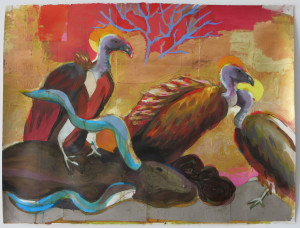
Karen Heagle’s sumptuous, gold leaved paintings of scavengers, predators and fallen prey are irresistible, even at their goriest moments. On a solitary drawing, the text ‘The Unwashed Masses’ hints that Heagle’s interests stray beyond the lifecycle of animals to reflect on humanity’s ‘natural’ inclination to violence. (At On Stellar Rays on the Lower East Side through Feb 19th).
Karen Heagle, Untitled Scene (three vultures and a carcass), acrylic, ink, collage, gold and copper leaf on paper, 22 ½ x 29 ½ inches, 2016.
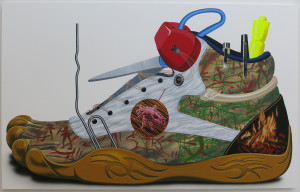
Fit for a student or a teacher, this monumental painted shoe not only holds scissors, pens and other school supplies, it’s a history lesson all on its own, from the cave paintings to a digitally rendered portrait in green lines. Titled after Magritte’s Le Modele Rouge (a painting of boots that take on the appearance of bare feet), Henry Gunderson’s update is more practical than surreal, but no less fun to ponder. (At 247365 Gallery on the Lower East Side through Feb 5th).
Henry Gunderson, Le Modele Rouge, acrylic on canvas, 60 x 96 inches, 2016.
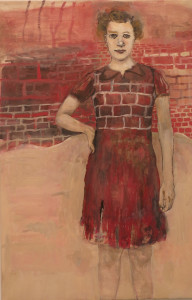
Despite her assertive pose, Dutch painter Hannah van Bart’s enigmatic young lady appears to literally blend into the background as a shape-shifting wall the color of her dress manifests over her chest. (At Marianne Boesky Gallery through Feb 4th.)
Hannah van Bart, Untitled, oil on linen, 39 3/8 x 25 5/8 inches, 2016.
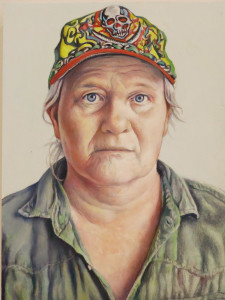
Sandwiched on the wall between two roughly lettered signs reading, ‘The End is Here’ and the enigmatic ‘You Are Pretty Good,’ Jim Torok’s photo-realist renderings of friends and acquaintances like ‘Jennifer’ bring the artist’s thoughts and his community together in the quiet of the gallery. (At Pierogi through Feb 12th).
Jim Torok, Jennifer, oil on panel, 9 x 7 inches, 2015.
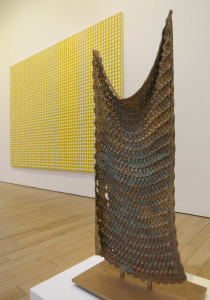
Handmade blankets rendered in bronze and boldly colored paintings based on the blankets’ patterns orient Michele Grabner’s latest body of work toward the domestic, the personal and the tactile. Each blanket’s form looks ghostly, harkening back to the bodies that used it to stay warm. As 2-D images on the wall, the cozy factor is replaced by a reference to the grid, the ubiquitous underlying principle to much mid-20th century art. Grabner suggests that context is key. (At James Cohan Gallery’s Chelsea location, through Jan 28th).
Michele Grabner, Untitled, bronze, 43 ½ x 20 x 12 ½ inches, unique, 2016. Background painting: Untitled, oil on burlap and canvas, 86 ½ x 120 inches, 2016.
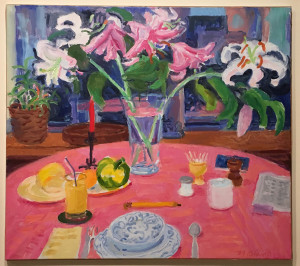
The vibrant colors and domestic setting rich with decorative details in this gorgeous still life by late New York painter Nell Blaine betray her captivation by 19th/20th century European painters like Pierre Bonnard and Edouard Vuillard. (On view in midtown at Tibor de Nagy Gallery through Jan 28th).
Nell Blaine, White Lilies, Pink Cloth, oil on canvas, 24 x 27 inches, 1990.
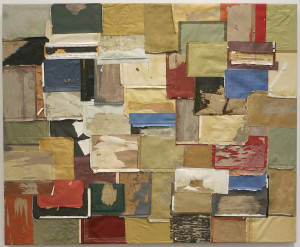
Using the covers of old encyclopedias, law books and African American reference books, Samuel Levi Jones makes collages on canvas that question what changes as time passes. Jones employs books as symbols of obsolescence to further represent how the ideas expressed therein can also run their course. (At Chelsea’s Galerie Lelong through Jan 28th).
Samuel Levi Jones, 101, deconstructed encyclopedias, law books and African American reference books on canvas, 49 x 60 inches, 2016.
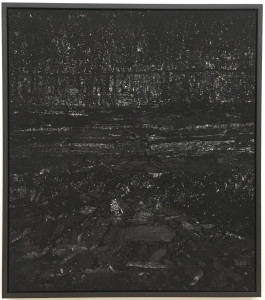
Peter Coolidge’s photos of coal seams in Germany’s industrial Ruhr region glint seductively, appealing to some as abstract compositions formed by nature. Yet not far from the surface is the understanding of coal’s powerful role in pollution and climate change, turning this coalface sinister. (At Peter Blum Gallery on 57th Street through Feb 4th).
Peter Coolidge, Coal Seam, Bergwerk Prosper-Haniel #5, pigment inkjet print, 57 x 50 inches, 2013.
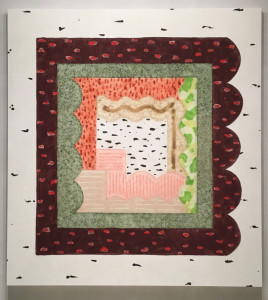
Abstract painter Rebecca Morris shows canvases controlled by a grid and, by contrast, images in which forms float freely in a selection of work at Mary Boone Gallery’s 57th Street location. In pieces like this untitled oil on canvas, Morris’ organizational strategy occupies a middle ground as recurring scallop-edged shapes nestle into each other, appearing to both advance towards us and recede. A white border flecked with black recalling ermine fur and a center that brings Dalmatians to mind create associations that drive contemplation. (On view through Feb 25th).
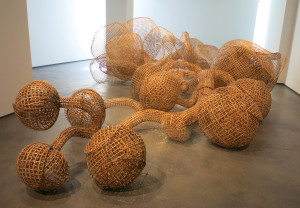
Silhouetted against natural light, the translucent petals of a blossoming flower from the cannonball tree contrast tightly shut pods in the foreground, but each indulges our pleasure in organic forms. Cambodian artist Sopheap Pich’s largest flowering plant sculpture to date sprawls across Tyler Rollins Gallery’s floor in Chelsea, recalling trees planted near Buddhist temples. Though they resemble the sal tree associated with Buddha’s birth, the plants arrived in Southeast Asia from the Americas via Sri Lanka, a reminder of complicated histories. (Through Feb 4th).
Sopheap Pich, Rang Phnom Flower, bamboo, rattan, metal wire, plywood, steel, metal bolts, 325 x 180 x 65 inches, 2015.
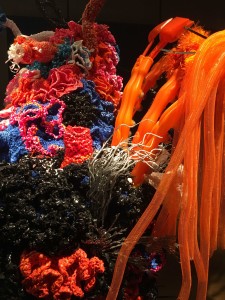
In one of the most visually stunning shows in New York this season, sisters Christine and Margaret Wertheim and a team of collaborating makers have created crocheted segments of coral reefs as sculptures, now on view at the Museum of Art and Design. Using geometry to crochet forms that correspond to the shapes of the reefs, the sisters combine yarn and plastic trash in glittering, colorful sculptures that gratify the senses as they warn against our ongoing destruction of the world’s coral reefs. (On view through Jan 22nd).
Christine Wertheim and Margaret Wertheim with Sarah Simons, Clare O’Callaghan, Kathleen Greco, Evelyn Hardin, Matthew Adnams, Christina Simons, and Jemima Wyman, (detail) Coral Forest – Ea, Plastic shopping bags, The New York Times wrappers, Hula-Hoop, plastic spades, found objects, yarn, felt, Sonotube, chicken wire, 2009 – 14.
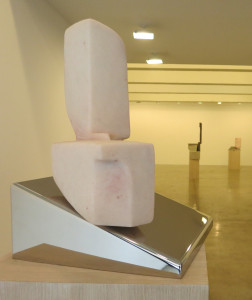
The human body meets cold hard metal in LA sculptor Charles Long’s eerie new sculptures that pair geometric forms covered in flesh-like platinum silicon rubber with mirror polished stainless steel forms. Here, RealSenseSapient2 includes the appearance of moles, veins and wrinkles, suggesting a quasi-human futuristic living being. (At Tanya Bonakdar Gallery through Feb 4th).
Charles Long, RealSenseSapient2, platinum silicon with pigment, stainless steel and pedestal, sculpture (without pedestal): 20 x 14 x 13 inches, 2016.
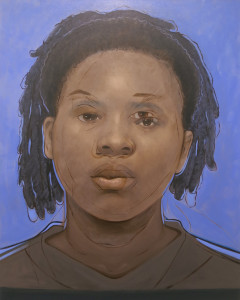
After typing ‘Destiny’ (the name of an incarcerated woman he’d met long ago) into a prison database, Titus Kaphar began painting portraits of women with this name in layered works that elide their faces and stories. (At Jack Shainman Gallery in Chelsea through Jan 28th).
Titus Kaphar, Destiny IV, 60 x 48 inches, oil on canvas, 2016.
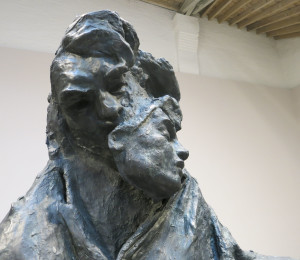
Dramatic and monumental, Rodin’s 1890s sculpture of Balzac is a figure set apart. LA sculptor Liz Glynn changed the character’s remote quality during a 2-day performance/workshop at LACMA, during which she cast several of the museum’s Rodin bronzes and recombined them to striking effect. Here, a face from Rodin’s Burghers of Calais joins Balzac’s in a dual portrait that suggests strong emotion. (At Chelsea’s Paula Cooper Gallery through Feb 11th).
Liz Glynn, (detail) Untitled (after Balzac, with Burgher), bronze, 2014.
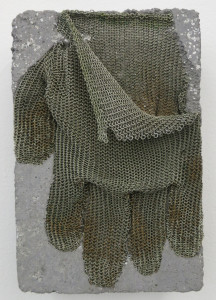
While a single glove evokes Michael Jackson in the glitter of stage lights, this lone accessory – a stainless steel mesh glove encased in concrete – conveys something sinister. Semo’s other minimalist sculptures co-opt possible residue of violence, including chains, broken glass and shell casings as art materials, asking how fine art and conflict connect. (At Marlborough Gallery in Chelsea through Jan 14th).
Davina Semo, SHE LOOKED THROUGH HIS THINGS, CAREFUL TO LEAVE EACH AS IT HAD BEEN, pigmented, reinforced concrete; mica, stainless steel mesh glove, 9 x 6 x 1 7/8 inches, 2016.
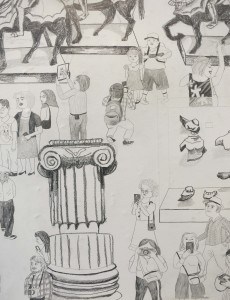
Phones, cameras and iPads outnumber art objects in Hai-Hsin Huang’s mash-up of Metropolitan Museum of Art treasures, ogled by visitors jockeying for snapshots and selfies. In this detail, a massive, 2,300 year old marble column from the Temple of Artemis at Sardis fails to attract much attention, begging the question of a museum’s purpose in today’s photo obsessed culture. (At Danese Corey Gallery in Chelsea through Feb 4th).
Hai-Hsin Huang, (detail) The MET #1, pencil on paper, 53 x 117 inches, 2014.
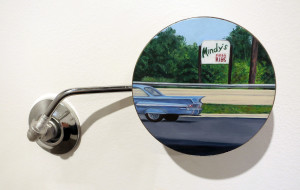
Motorcycle road trips all over the U.S. inspire New Yorker Edie Nadelhaft’s new paintings framed by vintage BMW mirror housings. Nadelhaft opts to travel on local roads for a more characterful portrait of the landscape. Looking back through the bike mirrors reveals what is receding in American culture, as evidenced by this classic car and a non-chain restaurant. (At Lyons Wier Gallery in Chelsea through Jan 28th).
Edie Nadelhaft, Mindy’s (Modena, IL), oil on panel, vintage BMW mirror housing, 4.25 inches diameter, 2017.
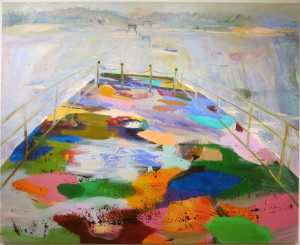
New York painter Judith Simonian charts a course through the mist on a curiously empty, fabulously colored ferry in this standout painting in the group exhibition ‘Regrouping’ at Edward Thorp Gallery’s new Chelsea location. It’s unclear what the immediate future holds on Simonian’s vessel, but the journey looks amazing. (On view through Jan 28th).
Judith Simonian, Ferry Boat, acrylic on canvas, 58 x 72 inches, 2016.
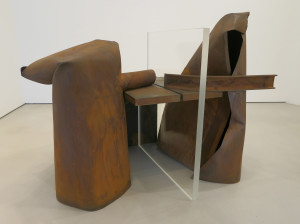
Mid-20th century American minimalist sculptors rebelled against the relationship of parts in Anthony Caro’s abstract sculptures; later in life, Caro was the one to break out, introducing Perspex into his sculptures when he was in his mid-80s. Here, a thick sheet of clear Perspex turns two pieces of rusted steel into characters in an untold story –a customer and a bank teller, or a prisoner and her visitor? (At Mitchell-Innes & Nash Gallery in Chelsea on the Upper East Side through Feb 4th).
Anthony Caro, Sackbut, steel and clear Perspex, steel rusted and waxed, 48 x 70 x 46 inches, 2011/2012.
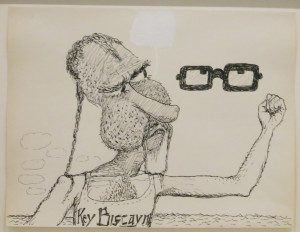
In 1971 and 1975, Philip Guston created a powerful series of drawings as protest to then-president Richard Nixon’s policies, in particular his decision to visit China after years of anti-Communist rhetoric. Now on view at Hauser & Wirth’s new Chelsea location, this drawing shows the former president scrapping with his advisor Henry Kissinger at his Florida retreat as an empty speech bubble rises with the clouds. (At Hauser & Wirth Gallery in Chelsea through January 14th).
Philip Guston, from the show ‘Laughter in the Dark, Drawings from 1971 & 1975,’ at Hauser & Wirth Gallery, through Jan 28th, 2017.
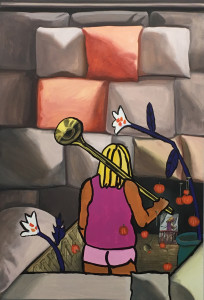
Young New York painter Anna Glantz enters an odd-dreamlike world in all of her new paintings at 11R, none more so than in ‘Britney’s Season,’ in which we follow a blond figure down a mysterious staircase amid tiny, floating pumpkins and golf tees. (On the Lower East Side through Jan 15th).
Anna Glantz, Britney’s Season, oil on canvas, 70 x 47 inches, 2016.
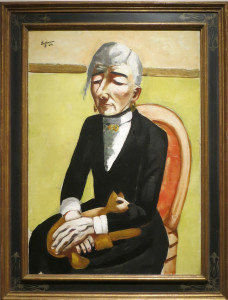
Don’t let the cat fool you. Despite her somber dress and downcast eyes, this actress – who was never identified in this 1926 portrait by Max Beckmann – isn’t relaxing with her pet so much as she seems poised to transform into a new role before our eyes. An intensely colored yellow wall and orange-upholstered chair in the background promise something electrifying as our bolt upright subject leans in towards us. (In ‘Max Beckmann in New York,’ at the Metropolitan Museum of Art through Feb 20th).
Max Beckmann, The Old Actress, oil on canvas, 1926.
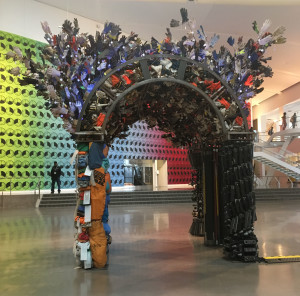
Since the 70s, conceptual and performance art pioneer Mierle Laderman Ukeles mopped museum steps, shook the hand of every sanitation worker in New York and devised plans for the public to engage with the Fresh Kills Landfill on Staten Island, all in an effort to revalue the labor involved in maintaining our city, offices and homes. At the entrance to her 40+ year retrospective at the Queens Museum of Art, Laderman Ukeles plants this arch – made of donated work gloves and other items from local and federal agencies – as celebration of and homage to the work of keeping things running. (Through Feb 19th).
Mierle Laderman Ukeles, Ceremonial Arch IV, 5,000 + gloves donated from 10 urban organizations, in steel cages and on steel rods, situated over six columns wrought from materials donated from local and federal agencies, 1988/1993/1994/2016.
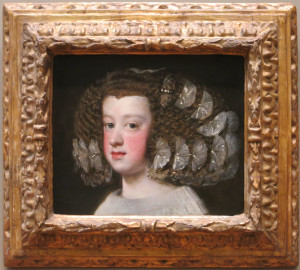
This 1651-54 portrait by Velazquez of the presumptive heir to the Spanish throne, Maria Teresa, as a fresh-faced young teen is a standout in the Met’s current seven-painting show of work the famed Spanish court painter. Framed by an elaborate wig with butterfly ribbons, Maria Teresa’s round features glow with an innocence that would vanish with her future marriage to French King Louis XIV. (At the Metropolitan Museum of Art through March 12th).
Velazquez, Maria Teresa, Infanta of Spain, oil on canvas, 1651-54.
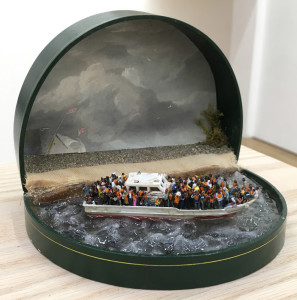
A tiny, parched figure gasps for water, a protesting crowd descends to a pool of water and here, an overloaded boat of migrants braves choppy waters in dramatic ring box dioramas by Canadian artist Curtis Talwst Santiago. Seen in Lilliputian scale, Santiago’s characters seem to be at the mercy of the elements and other forces beyond their control as they struggle onward. (At Rachel Uffner Gallery on the Lower East Side through Jan 8th).
Curtis Talwst Santiago, Deluge VII, mixed media diorama in reclaimed jewelry box, 6 x 4 x 4 ½ inches, 2016.
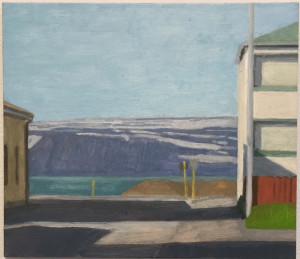
In her typically understated manner, Eleanor Ray treats the dramatic Icelandic landscape of Isafjordur as almost secondary to its town’s orderly buildings. Long shadows suggest a day drawing to a close or just beginning yet Ray’s painting argues for the importance of this solitary moment. (At Steven Harvey Fine Art Projects on the Lower East Side through Jan 8th).
Eleanor Ray, Isafjordur, oil on masonite, 7 ¼ x 8 3/8 inches, 2016.
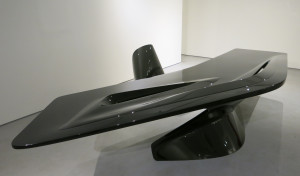
While architect Zaha Hadid’s firm worked on the Dongdaemun Design Plaza in Seoul, Hadid created a collection of related furnishings, including this stunningly sleek desk, currently on view with a selection of Hadid’s other design projects at Chelsea’s Leila Heller Gallery. How could your career fail to take flight, seated behind this desk? (On view through January 21st).
Zaha Hadid, Seoul Desk, fiberglass with high gloss lacquer paint finish, 49.2 x 166.14 x 28.35 inches, 2008.