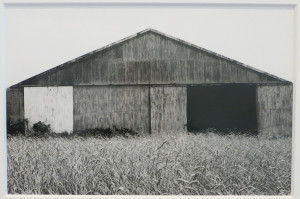
Strong shadows and angular forms in photos of barns and rural architecture shot between the 50s and early 80s by Ellsworth Kelly bear a striking resemblance to the abstract shapes of the artist’s paintings, offering what feels like a peek at the artist’s real-world inspirations. (At Matthew Marks Gallery in Chelsea through April 30th).
Ellsworth Kelly, Barn, Southampton, gelatin silver print, 8 ½ x 13 inches, 1968.
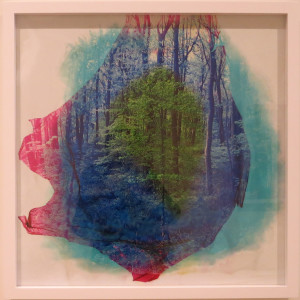
Doug Fogelson’s ‘Ceaseless’ series comprises beautiful but damaged nature photos, for which the Chicago-based artist shot traditional landscape photos, which he printed and partially destroyed by applying common industrial chemicals to the surface. Ironically, the results are gorgeous. Here, a verdant forest hovers like an apparition surrounded by peeling layers of emulsion. (At Sasha Wolf Gallery on the Lower East Side through April 16th).
Doug Fogelson, Ceaseless No. 1, 24 x 24 inches, 2015.
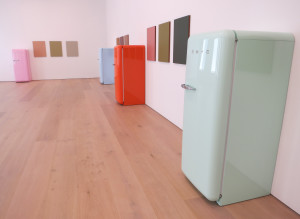
Iconic appropriation artist Sherrie Levine pairs monochrome paintings replicating colors found in Renoir’s nudes with colorful SMEG refrigerators in groupings that might serve to remind or warn snacking art collectors of Renoir’s voluptuous figures. (At David Zwirner Gallery in Chelsea through April 2nd).
Installation view of ‘Sherrie Levine’ at David Zwirner Gallery, March 2016.
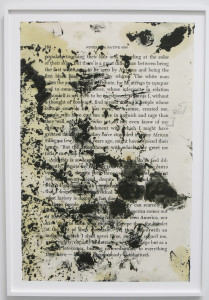
Glenn Ligon turns his well-worn copy of James Baldwin’s 1953 essay, ‘Stranger in the Village,’ into a suite of prints, each more or less obscured by paint and fingerprints left behind by years of reference use in Ligon’s studio. Ligon’s marks testify to the personal importance of Baldwin’s text, while the parts that remain visible leap out as a kind of charged concrete poetry. (At Luhring Augustine through April 2nd).
Glenn Ligon, Untitled, from a suite of 17 archival pigment prints, 71 x 49 inches, 2016.
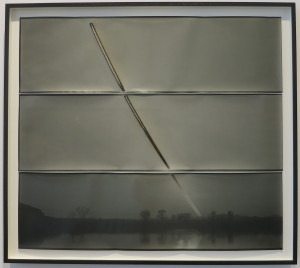
It would trouble some, but the smell of burning paper is the norm in Chris McCaw’s photographic practice. Using powerful lenses, McCaw magnifies the intensity of the sun to the extent that it burns holes in the light sensitive paper he places in his homemade cameras. The effect is ethereal, as the sun literally carves a path through the sky over shadowy landscapes. (At Yossi Milo Gallery in Chelsea through April 9th).
Chris McCaw, From the series Sunburn, Sunburned GSP#884 (Mojave), three gelatin silver paper negatives, 12 x 40 inches, 2015.
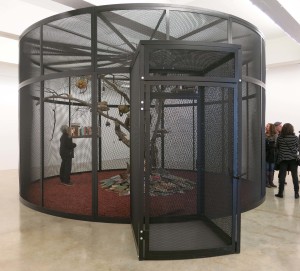
Mark Dion’s latest show is for the birds, which is to say that the centerpiece, a huge cage housing a selection of books related to birds and their predators along with several zebra finch and canaries, is intended as a gift to our feathered friends. The birds seem to be more concerned about nest building and communicating with each other than in reading, leaving the literature to humans and reinforcing Dion’s point that it’s always about us. (At Tanya Bonakdar Gallery through April 16th).
Mark Dion, The Library for the Birds of New York, steel, wood, books and birds, 138 x 240 inches, 2016.
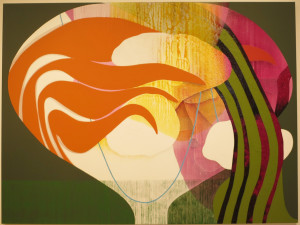
“It’s not about being a commodity, it’s about the pleasurable experience of looking,” explained Carrie Moyer to an interviewer recently, elaborating on how her once overtly political art practice has morphed into a subtle advocacy for enjoyment. (At DC Moore Gallery through March 26th).
Carrie Moyer, Candy Cap, acrylic, glitter and Flashe on canvas, 72 x 96 inches, 2016.
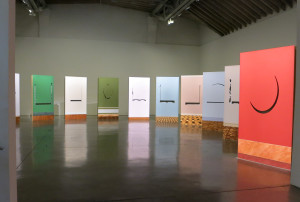
In Walid Raad’s tongue in cheek narratives about the emergence of a booming new Arab art world, he’s hunted for refugee color and fonts that have gone into hiding and reflections that are missing; here at Paula Cooper Gallery, a wall text explains that the shadows normally cast by the artwork have run away, no longer interested in being part of the art infrastructure. The artist hopefully builds a series of walls with fake shadows to entice the real ones to return, all the while ostensibly failing to notice that the art itself is missing. (In Chelsea through March 26th).
Walid Raad, installation view of ‘Letters to the Reader,’ at Paula Cooper Gallery, March 2016.
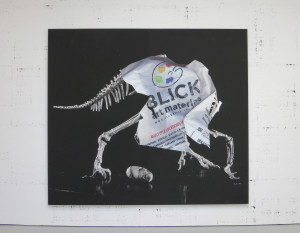
David Zwirner Gallery’s normally pristine white walls look as though they’ve been damaged by scraping; a closer look reveals that black markings are text fragments, printed onto posters that cover the walls of Michael Riedel’s latest solo show. Known for recycling text and image from his previous shows, Riedel takes the metaphor a step further by picturing animated dinosaur skeletons, creatures whose lives have been extended, in a sense, by being exhumed and put into the public realm again. (In Chelsea through March 25th).
Michael Riedel, Untitled (Art Material_Oviraptor), archival inkjet print mounted to aluminum honeycomb, vinyl, 99 1/8 x 113 1/8 x 1 5/8 inches (framed), 2015.
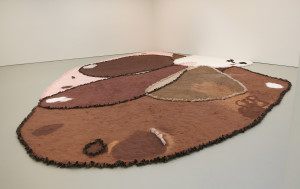
Inventive use of materials is everything in Karla Black’s huge installation, ‘Includes Use’ at David Zwirner Gallery. Mixing powder paint and plaster, Black covers the gallery floor with a beach of cocoa-like powder separated into curving organic shapes by frilly tucks of toilet paper. The artist resists the term ‘feminine’ to describe her work, but with glitter as the finishing touch, the effect is decidedly pretty. (In Chelsea through March 26th).
Karla Black, Includes Use, powder paint, plaster powder, toilet paper, and glitter, 330 ¾ x 366 1/8 x 7 inches, 2016.
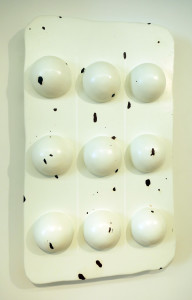
Colorful lumps of squeezed clay, or the pattern on a checked shirt are inspiration to Houston-based artist Jeremy Deprez; here, he presents visitors to Feuer/Mesler Gallery with a five foot high bar of hotel soap. Unlike pop predecessors who supersized everything from hamburgers (Oldenberg) to soup cans (Warhol), Deprez pays painterly attention to his flecked monochrome. (On the Lower East Side through March 27th).
Jeremy Deprez, WINDEL, acrylic, modeling paste and canvas on panel, styrofoam, 65 ½ x 38 ¼ inches, 2016.
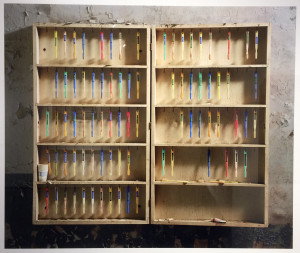
Toothbrushes hang in neat rows, labeled with the names of patients at a now-closed psychiatric hospital in Poughkeepsie in this arresting photograph by Christopher Payne. Payne traveled to hospitals around the country over several years, creating a moving document of life in a bygone era. (At Chelsea’s Benrubi Gallery through March 26th).
Christopher Payne, Patient Toothbrushes, Hudson River State Hospital, Poughkeepsie, New York, digital chromogenic print, 20 x 30 inches, 2005.
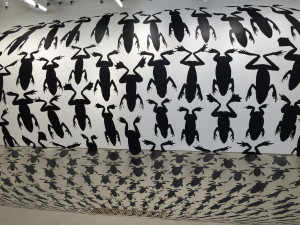
A flood of frogs (vinyl silhouttes adhered to walls and floor) escape down a fake drain in Brazilian artist Regina Silveira’s space-bending installation at Alexander Gray Associates. Referencing Biblical plagues and unexpected, underground activity, the frogs suggest that above-ground life is only half of the story. (In Chelsea through March 26th.)
Regina Silveira, Amphibia, vinyl and metal grate, dimensions variable, 2013. Installation view at Alexander Gray Associates, Feb ’16.
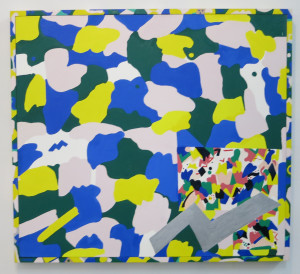
A painting is set into a painting, set into a painted frame in Nora Griffin’s ‘Painting Culture,’ a nestled presentation of homey organic shapes, cheery color and unselfconsciously handmade marks that conjures 80s design and a kind of youthful freedom exemplified by a zany silver zigzag. (At Louis B. James on the Lower East Side through March 20th).
Nora Griffin, Painting Culture, oil on canvas, wooden frame, 37 x 41 inches, 2016.
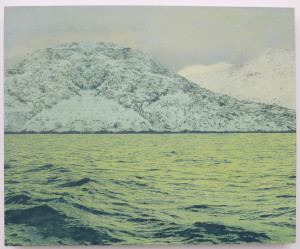
A trip to the Arctic inspired Saul Becker’s uncanny landscapes, in which mirrored hills present a Rorschach for those wishing to ponder lesser known regions and toxic colors bear witness the changing climate. (At Zieher Smith and Horton in Chelsea through March 19th).
Saul Becker, Passage, oil on linen on panel, 29 1/5 x 36 inches, 2015.
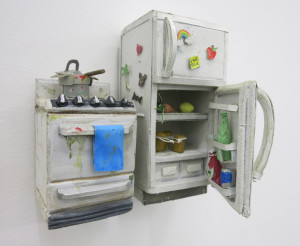
The bar below his apartment, the 99 Cent Pizza place, the Laundromat and apartment furnishings inspired New York artist Nicholas Buffon’s latest paper sculptures, what the New Yorker called, ‘elegies to a vanishing downtown.’ Here, even his stove and cheerily decorated fridge bespeak the well worn and well loved. (At Callicoon Fine Arts on the Lower East Side through March 20th).
Nicholas Buffon, Stove and Open Fridge, foam, glue, paper and paint, 2.75 x 5.5 x 6.25 inches, 2016.
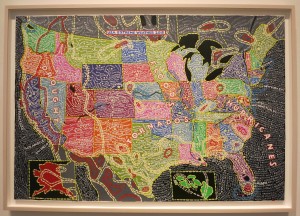
Paula Scher, principle at renowned design firm Pentagram, invites us to understand the country through its airline routes, geography, climate and here, its weather. Her painted maps of the USA emphasize how we see places through frameworks of information. (At Chelsea’s Bryce Wolkowitz Gallery through March 26th).
Paula Scher, U.S.A. Extreme Weather, acrylic on hand-pulled silkscreen, 36 ¾ x 54 1/8 inches, 2015.
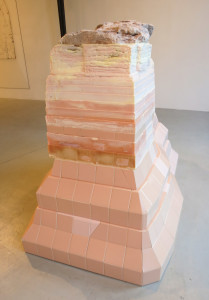
A 300 lb piece of talc was the basis of this large sculpture by Larry Bamburg, who bridged the natural and manmade by adding a similarly colored soap, then bathroom tiles to the stone, creating a conversation between materials whose properties converge yet remain distinct. (At Simone Subal on the Lower East Side through March 20th).
Larry Bamburg, Talcto Tile PL’d to MDO, talc, ceramic and plaster tiles, planitesine, medium density overlay (MDO) plywood, 70 3/10 x 43 ½ x 54 ½ inches, 2016.
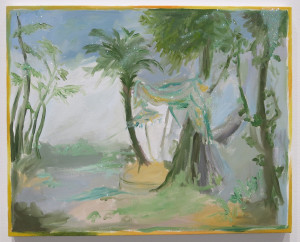
Inspired by late Renaissance and Baroque landscape painting, tapestry and stage scenery, Karen Kilimnik’s latest body of work showcases interiors with canopied beds and manicured landscapes, stage-like in their perfection. The exception is this expressionist tropical landscape with its sumptuous, glittery tent, as lush as the greenery. (At 303 Gallery in Chelsea through March 26th).
Karen Kilimnik, tropical hurricane, Thailand or Maldives, water soluble oil color and glitter on canvas, 16 1/8 x 20 inches, 2015.
David Kennedy Cutler continues to turn photographed or scanned images into provocative sculpture with a cluster of heads representing Bacchus – the god of wine and related merrymaking – grouped together like giant grapes. Paired with slices of bread, however, does the reference turns toward the Eucharist? (At Lyles and King on the Lower East Side through March 13th).
David Kennedy Cutler, Sick Bacchus (Head and Bread Repeat), inkjet on PETG and fabric, inkjet transfer on plywood, spray paint, Permalac, 60 x 24 x 42 inches, 2016.
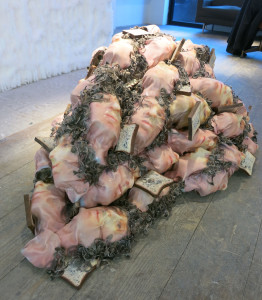
Innocuous floral arrangements in archival photos of historically important business and political meetings inspired New York artist Tayrn Simon’s latest project, ‘Paperwork and the Will of Capital.’ With a botanist’s help, she recreated bouquets present at shady dealings – when Mozambique agreed with South African not to support the ANC in the 80s, or when business owners purchased citizenship in St Kitts in return for supporting economic development there. She then entombed photos, texts and specimens in a concrete press, which acts here as a pedestal. (At Gagosian Gallery, through March 26th).
Tayrn Simon, installation view of Paperwork and the Will of Capital at Gagosian Gallery, 555 W. 24th Street, February 2016.
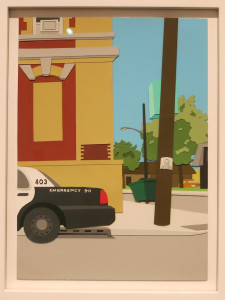
Casey Ruble’s meticulous cut paper images of former safe houses on the Underground Railway and locations of Civil Rights era riots confer a potent stillness on historical scenes that are fading from memory, largely unmarked by signage or physical markers. Here, she focuses on the epicenter of the 1967 Newark riot, where police mistreatment of an African American cab driver sparked a devastating protest. (At Foley Gallery on the Lower East Side through March 20th).
Casey Ruble, Music. Even laughter. And always the gunfire. Paper collage, 8.5 x 6 inches, 2015.
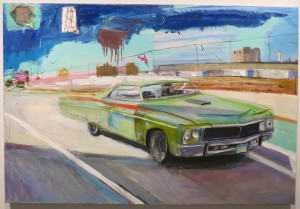
Under a darkening sky, a classic car speeds along an elevated city highway under a dollar sign and two maps of the US in this painting by Matt Blackwell. In the car, a bearded man with gritted teeth (succinctly crafted from a scrap of plaid fabric) grips the steering wheel, seemingly on a lone mission of intense urgency. (At Edward Thorp Gallery in Chelsea through March 19th).
Matt Blackwell, Going Out West, oil on canvas with collage, 44 x 64.5 inches, 2015.
Matt Blackwell, Going Out West, oil on canvas with collage, 44 x 64.5 inches, 2015.
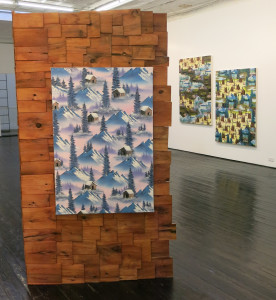
Using techniques from ‘how to’ TV shows on painting, British artist Neil Raitt makes odd juxtapositions of cabins and mountains, cacti and palm trees in repeating patterns that are like digital wallpaper but carefully hand-rendered. (At Nicelle Beauchene Gallery on the Lower East Side through March 13th).
Neil Raitt, installation view of ‘Fantasty Traveller’ at Nicelle Beauchene Gallery, Feb 2016.
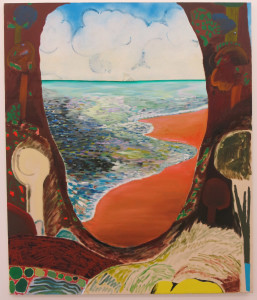
Titled ‘Trips I’ve Never Been On,’ Shara Hughes’ solo show at Marlborough Gallery includes slightly surreal scenarios like this one, a juxtaposition of landscapes that seems both dream-like and real. (In Chelsea through March 12th).
Mushroom Hunt, oil, acrylic, flashe, caulk, spray paint and enamel on canvas, 64 x 54 inches, 2015.
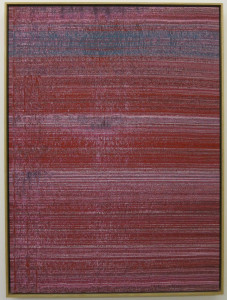
From sounds recorded at a textile factory in Bally, PA and computer data sites, Mika Tajima and a textile designer worked to translate sound waves into visual patterns. Old technology – the mill uses jacquard looms (a punch-card system invented in the early 1800s) – meets new in a beautiful abstract textile that looks like a screen interrupted by interference. (At 11R Gallery on the Lower East Side through March 13th).
Mika Tajima, Negative Entropy (Bally Ribbon Mills NASA Carbon Fiber 3D Weave, Pink, Single), cotton, wood, acoustic baffling felt, 37 x 27 ½ inches, 2015.
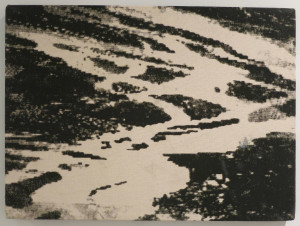
Since 1993, Richard Dupont has made silkscreens from photos of TV screens with scrambled signals. The results look like paintings of lassos of paint, actual paint skeins, abstract expressionism or a capture of paranormal activity. (At Tracy Williams, Ltd. through March 6th).
Richard Dupont, Untitled, synthetic polymer on raw canvas, 9 x 12 inches, 1994.
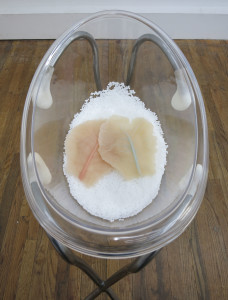
Flesh-color, cabbage-like leaves nestle in a container that recalls an incubator in Hannah Levy’s alluringly odd sculpture at 247365 Gallery. Waxy fingers that hold the tub and leaves made of something resembling skin recall Keith Edmier’s resin renderings of his mother or Matthew Barney’s plastics and petroleum jelly, making for fascinating but unnerving sculpture.
Hannah Levy, Untitled, steel, thermoplastic, silicone, plastic tub, 25 x 44 x 36 inches, 2016.
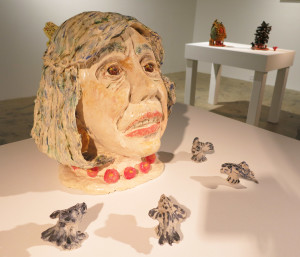
Sally Saul’s arresting ceramic self-portrait portrays her as if in mid-sentence, her eyes looking into the distance as if trying to phrase something just so. Surrounded by tiny attentive birds, what she says has caused nature to stop and listen. (At LaunchF18 on the Lower East Side through March 6th).
Sally Saul, Self-Portrait, clay and glaze, 12 x 9 x 8 inches, unique, 2010.
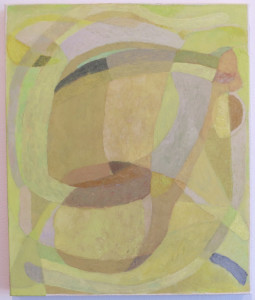
This small painting by New York artist Clare Grill is a standout in a group show at Lower East Side gallery Steven Harvey Fine Art Projects for its lively color and suggestion of a sympathetic face framed by lighter color, curving bands. (Through March 13th).
Clare Grill, Lizard, oil on linen, 18 x 15 inches, 2015.
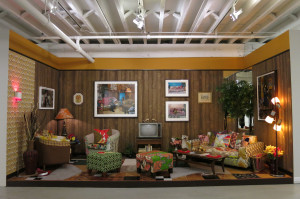
Like Freud, Mickalene Thomas’ couch has made her famous. Normally appearing as a colorful, patchworked backdrop in Thomas’ photos and paintings of lounging African-American beauties (seen on the back wall), it’s a character of its own in this retro living room, transplanted to Chelsea’s Aperture Foundation. (Through March 17th).
Mickalene Thomas, installation view of ‘Muse: Mickalene Thomas Photographs and tete-a-tete’ at Aperture Foundation, Jan 2016.