Jeff Koons at Flag Art Foundation

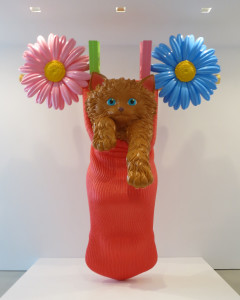
At over ten feet tall, this polyethylene sculpture by Jeff Koons magnifies kitsch to its limits. Whether it’s a contemporary crucifixion, as Koons has said, a phallic symbol, as others have pointed out, or something else entirely, there’s more than meets the eye. (At Chelsea’s Flag Foundation through May 14th).

Jeff Koons, Cat on a Clothesline (Red), polyethylene, 123 x 110 x 50 inches, 1994-2001.

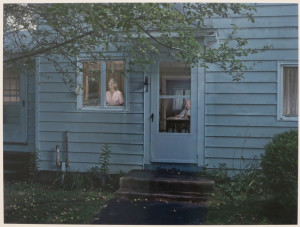
Gregory Crewdson

The color and lighting of Gregory Crewdson’s new photos can be traced to his interest in how painters of the 19th century and prior drew viewers into their paintings with detail and tones that could be appreciated from both near and far. The photos’ suspenseful and melancholy mood might be attributable to major life changes, which have included a new gallery, a divorce and a move out of New York. (At Gagosian Gallery’s 21st Street location through March 5th).

Gregory Crewdson, Woman at Kitchen Window, digital pigment print, 45 1/16 x 57 9/16 inches, 2013.

Vanessa Prager at The Hole NYC

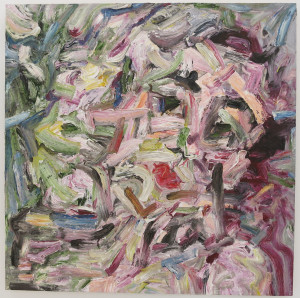
In person, the subjects of LA painter Vanessa Prager’s heavily painted portraits only faintly emerge from their textured backgrounds; in photos, they materialize more readily. The implications of being more visible on a screen aren’t lost on Prager, who has installed peep-holes through out the gallery to carry on a conversation about the absence and presence of images today. (At The Hole NYC on the Lower East Side through Feb 29th).

Vanessa Prager, Night Gaze, oil on panel, 48 x 48 inches, 2016.

Chris Killip at Yossi Milo Gallery

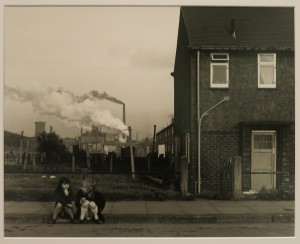
Photographer Chris Killip’s iconic images of the North of England, shot between 1973 and 1985, give meaning to the stereotype, ‘It’s grim up north.’ How will these two young girls survive their grey surroundings? (At Yossi Milo Gallery in Chelsea, through Feb 27th).

Chris Killip, Two girls, Grangetown, Middlebrough, Teeside, gelatin silver print, 16 x 20 inches (approx.), 1975.

Amy Sillman at Sikkema Jenkins & Co

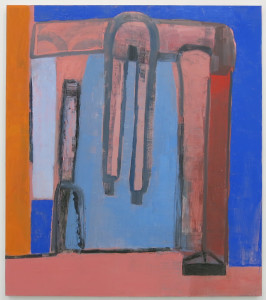
“I don’t care about beauty at all,” New York painter Amy Sillman has declared about the imperfect figures and heavily worked canvas of her paintings. Recent works at Sikkema Jenkins & Co are titled after the German word for metabolism, a nod to the process of changing paint into images that land provocatively between abstraction and figuration, suggesting both bodies and furniture in a color palette that simultaneously soothes and excites. (In Chelsea through March 12th).

Amy Sillman, Table 2, oil on canvas, 75 x 66 inches, 2015.

Irving Penn at Pace Gallery

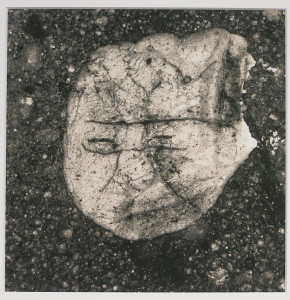
From the 1940s onward, the fashion world embraced the elegance of iconic photographer Irving Penn’s highly visible commercial work, but it sometimes took longer for his personal projects to gain traction. In the iPhone era, his investigation of the wonderful in the banal seems prescient, especially in this particularly charming shot of an eerily face-like wad of chewing gum found on the city street. (At Chelsea’s Pace Gallery through March 5th).

Underfoot XXXIII, New York, gelatin silver print, image 19 1/8 x 18 ¾ inches, 2000.

Eddie Martinez at Mitchell-Innes and Nash

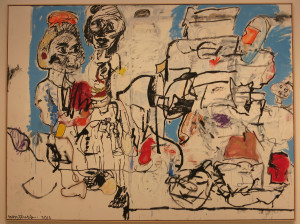
Eddie Martinez continues to mine art history in increasingly abstract paintings now on view in Chelsea at Mitchell-Innes and Nash.  Tapping into diverse sources of inspiration – from Basquiat’s jittery line to de Kooning’s boldly outlined bodily forms – Martinez creates strangely familiar paintings to ponder. (Through March 5th).

Eddie Martinez, Park Avenue Peace Out, oil, enamel, silkscreen ink and spray paint on canvas, 108 x 144 inches, 2015.


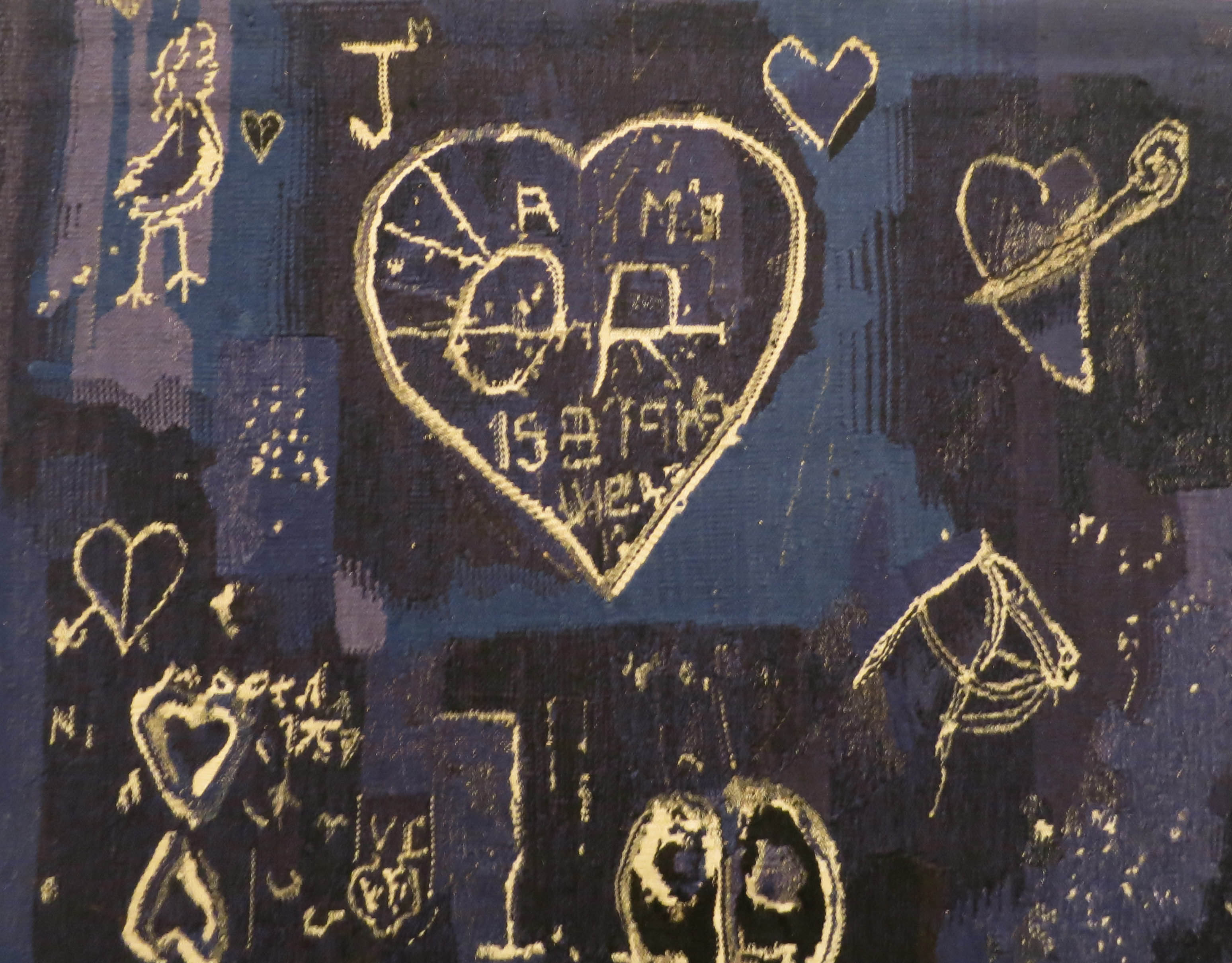
Photos of Paris graffiti, shot by Brassai in the 1930s onward, are subject matter for tapestries the artist created in collaboration with Atelier Yvette Cauquil-Prince in 1968. Currently on view at Higher Pictures, Nocturne (seen here) and ‘Graffiti I’ further immortalize sentiments first carved in the stone of Paris buildings. (On the Upper East Side through March 5th). Brassai, (detail) Nocturne, flat-weave wool tapestry, 110 x 54 inches, 1968.

Jane Corrigan at Feuer Mesler


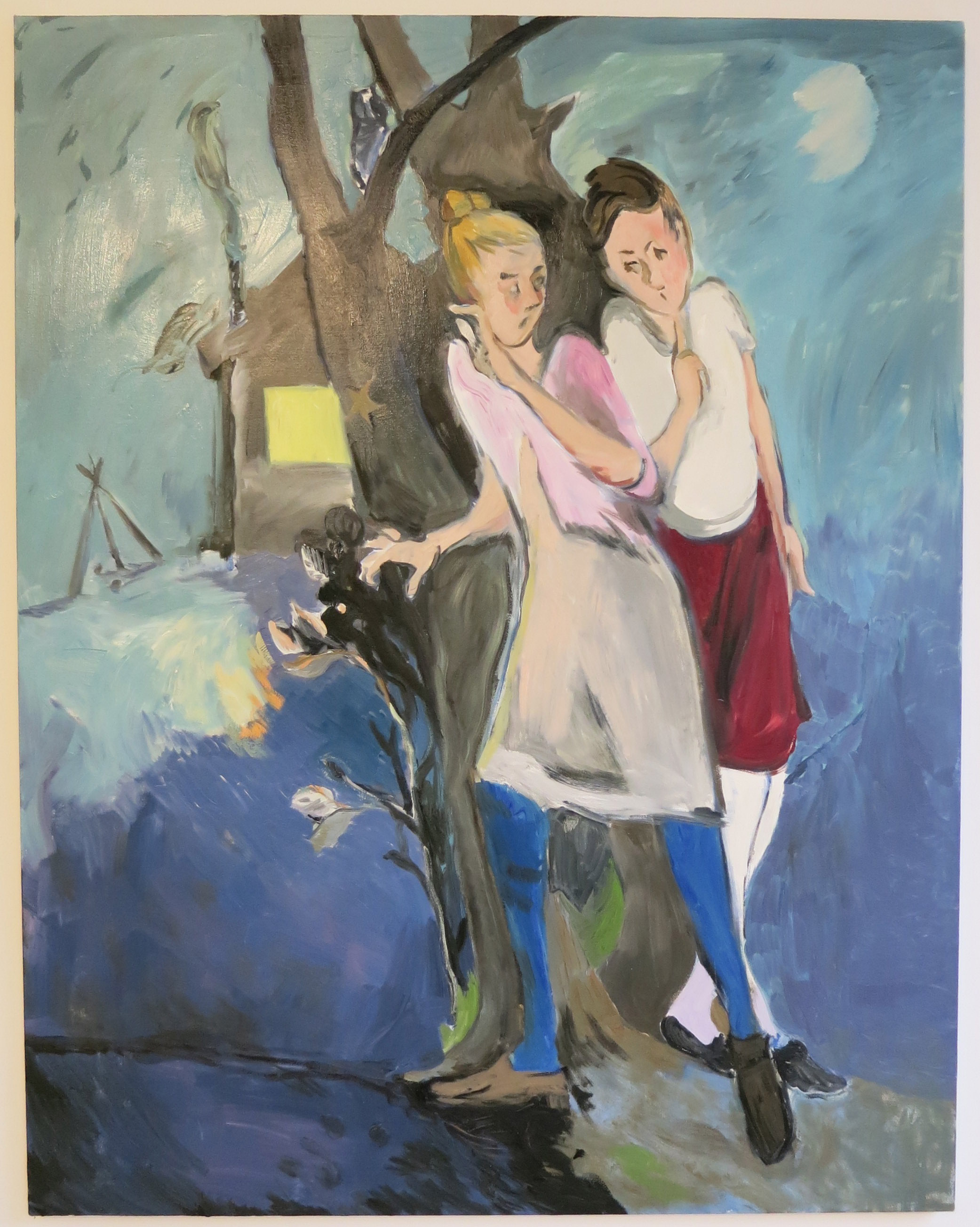
Like protagonists in a young adults detective novel, Jane Corrigan’s svelte sleuths ooze intrigue as they receive covert messages, investigate strange noises and meet secretively at night. The hook is strong. What are they up to? (At Feuer Mesler through Feb 14th).

Jane Corrigan, Spies, oil on canvas, 70 x 55 inches, 2015.


Elizabeth Kley at Canada Gallery


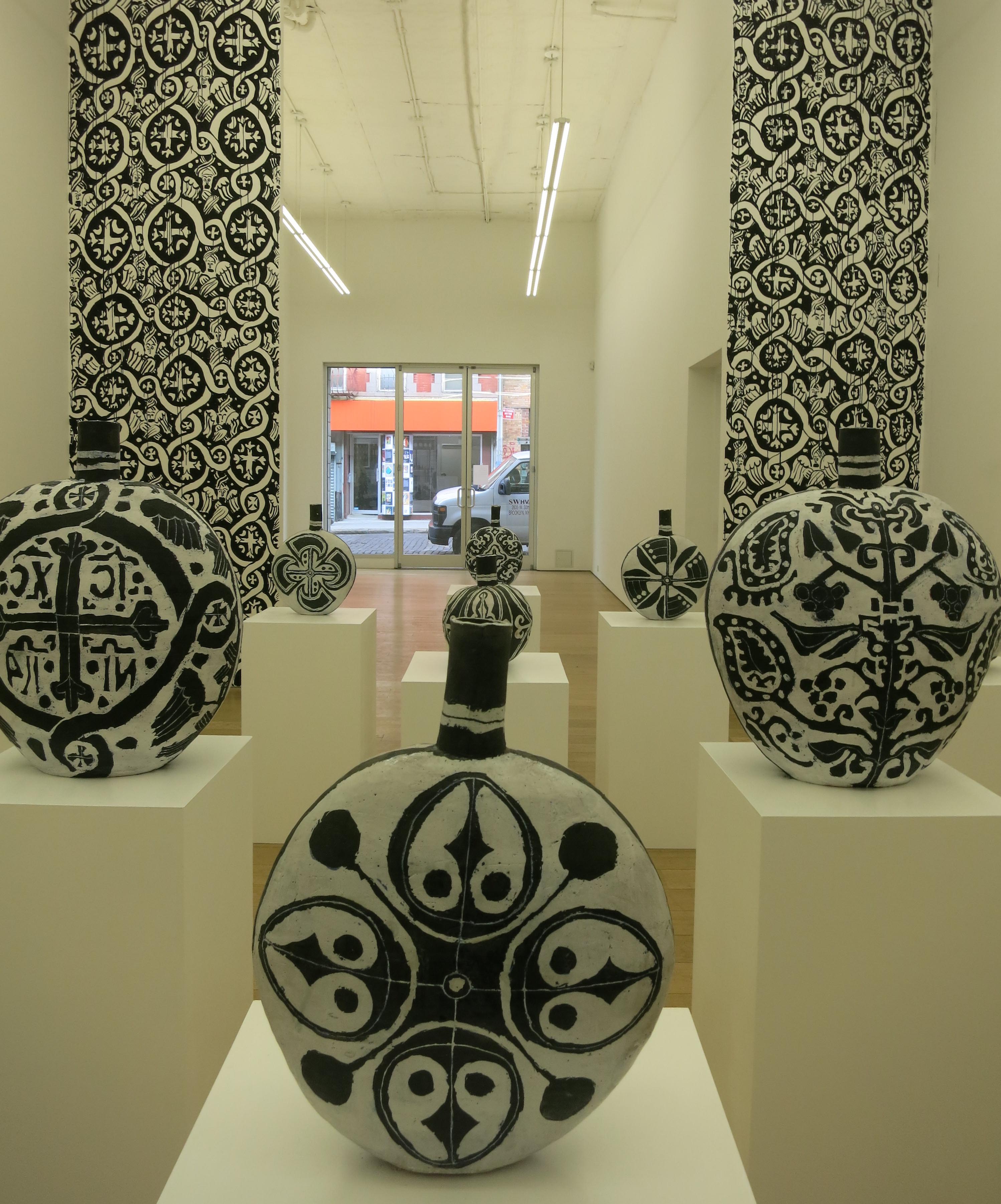
Inspired by Islamic, Byzantine and Asian historical ornaments, New York artist Elizabeth Kley’s ceramics celebrate and overwhelm with pattern. (At Canada New York, through Feb 14th).

Elisabeth Kley, Flask with Eyes, glazed earthenware, 15.25 x 11.75 x 4.75 inches, 2015.


Jeni Spota C. at Brennan and Griffin


It’s telling that young New York artist Jeni Spota C.’s heavily textured paintings of individuals grouped around mother-figures are included in the Jewish Museum’s current group show of ‘outsider’ art. Inspired by early Renaissance painting as well as a psychic’s assertion that the artist is constantly surrounded by departed relatives, Spota’s work invites speculation on the spiritual realm. (At Brennan and Griffin on the Lower East Side through Feb 14th)

Jeni Spota C., Bird Woman (detail), oil on canvas, 36 x 42 inches, 2015.


Francis Upritchard and Martino Gamper at Anton Kern Gallery


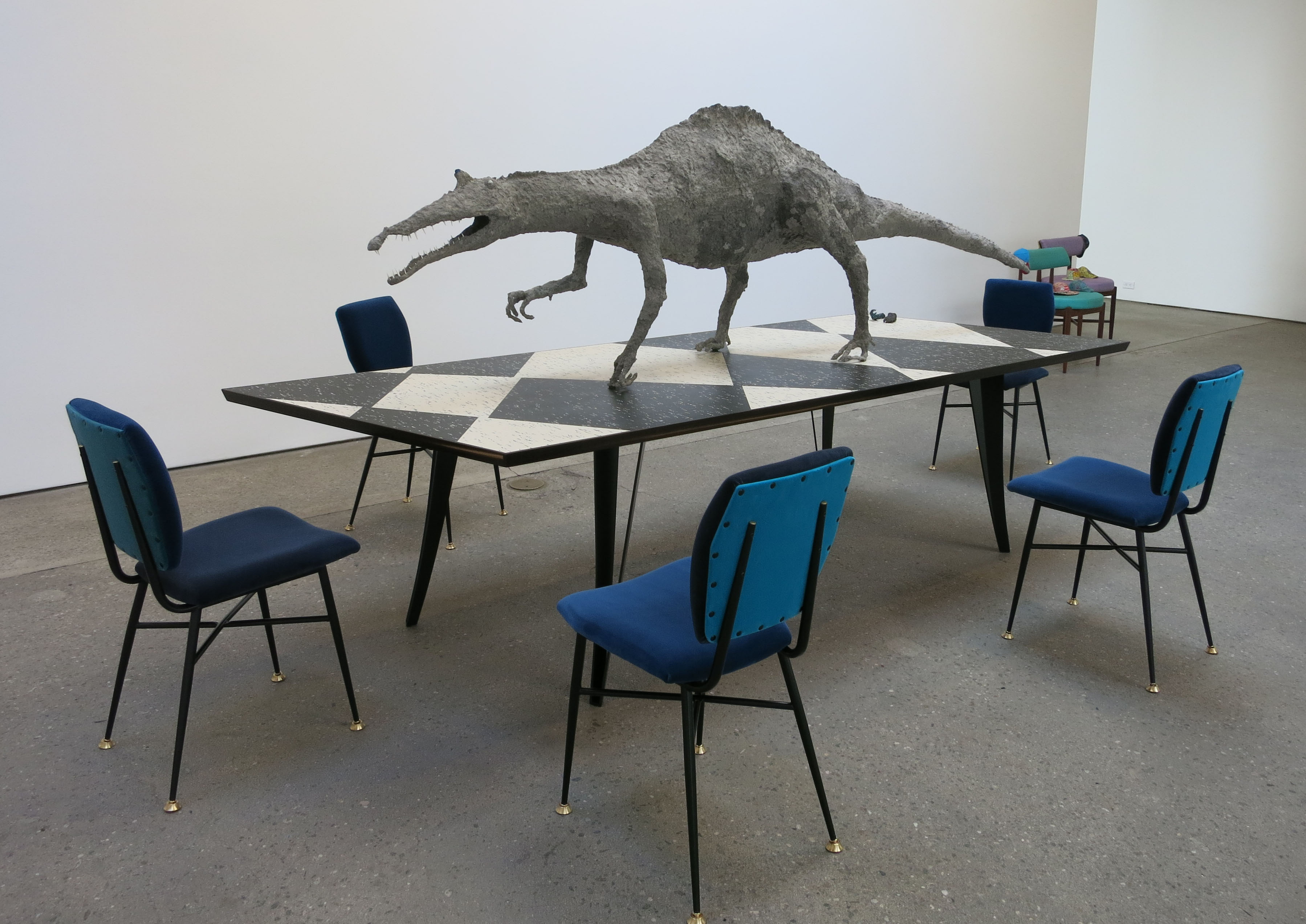
Sculptor Francis Upritchard and her designer husband Martino Gamper ask in a collaborative installation of their respective work, just what you’d do if a scrawny spinosaurus were to run across your dining table? Gamper’s playful patterning and richly colored fabrics and Upritchard’s quirky dinosaur cast the scenario in whimsy and pull out a chair for us to join in. (At Anton Kern Gallerythrough Feb 20th).

Francis Upritchard, Paper Spinosaurous, papier-mache, metal armature and modeling, 30 x 101 9/16 x 18 1/8 inches, 2014. Martino Gamper, Black and White Table, linoleum, blockboard, walnut, 107 x ¾ x 39 2/3 inches, 2015. Ice Cream Chairs, steel structure and upholstery, 19 ½ x 15 ¾ x 32 ½ inches, 2015.

John Riepenhoff at Marlborough Gallery


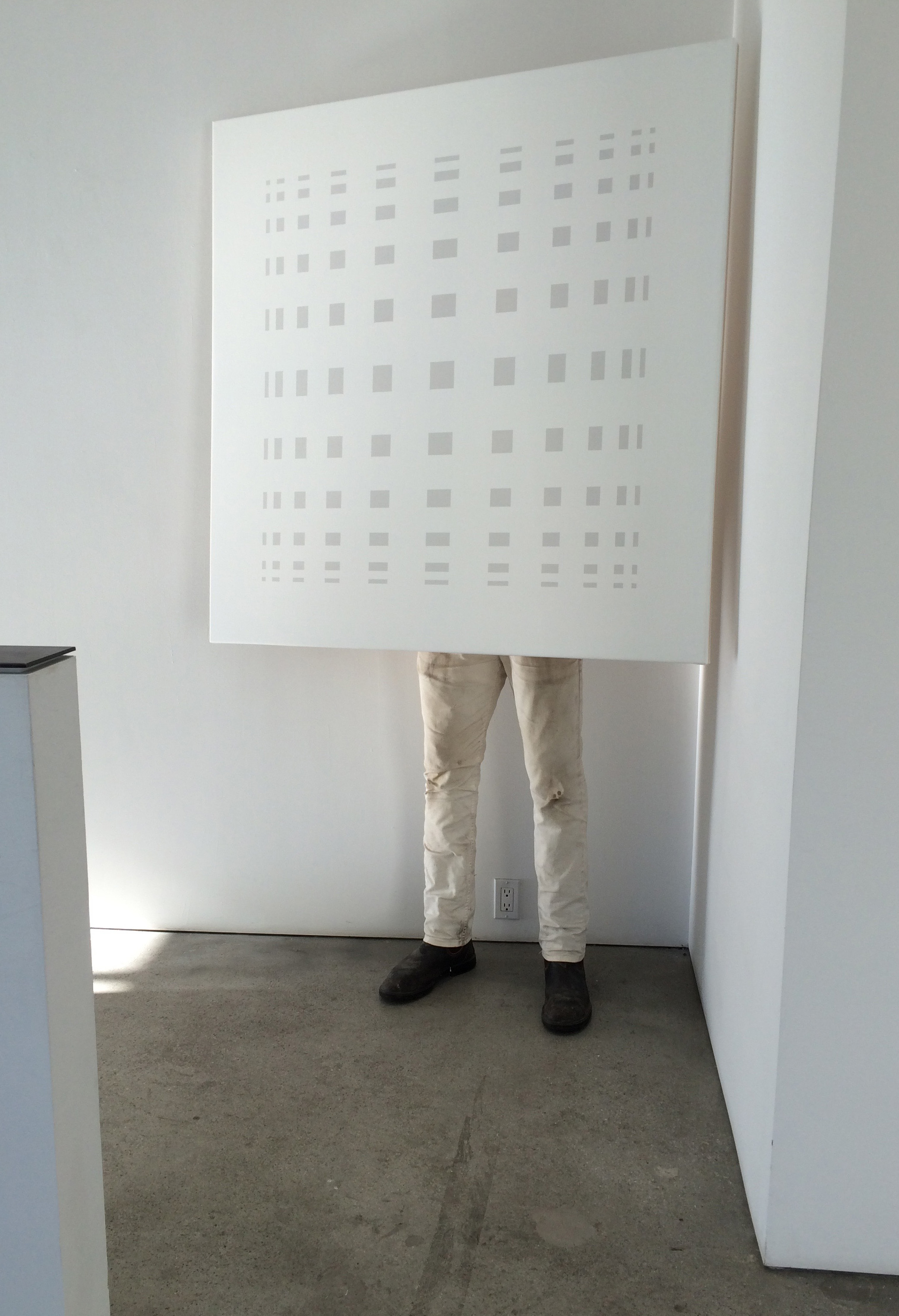
How can an artist pay homage to his/her influencers? John Riepenhoff’s ‘Group Show’ walks the line between flattery and offense by recreating artworks in the style of his contemporaries and predecessors. At the show’s entrance, legs make a stand for a space-bending geometric abstraction (actually painted) by Susie Rosmarin. (At Chelsea’s Marlborough Gallery through Feb 6th).

John Riepenhoff, Art Stand (legs), wood, wire, cloth, shoes, fiberglass and clamp, 50 x 14 x 26 inches, 2014. Susie Rosmarin, Grey and White (painting), acrylic on canvas, 48 x 48 inches, 2015.


Tauba Auerbach, Altar/Engine at Paula Cooper


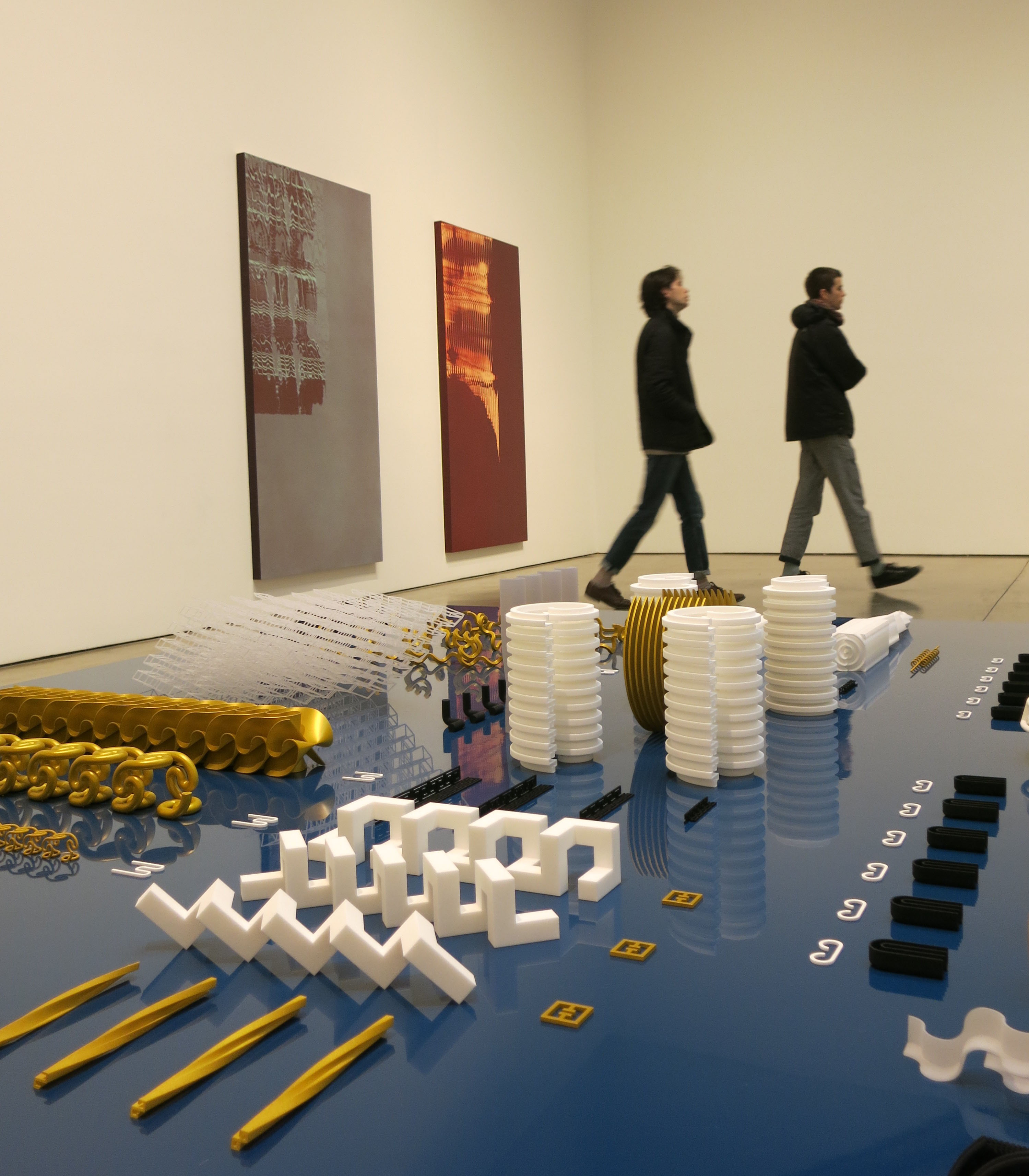
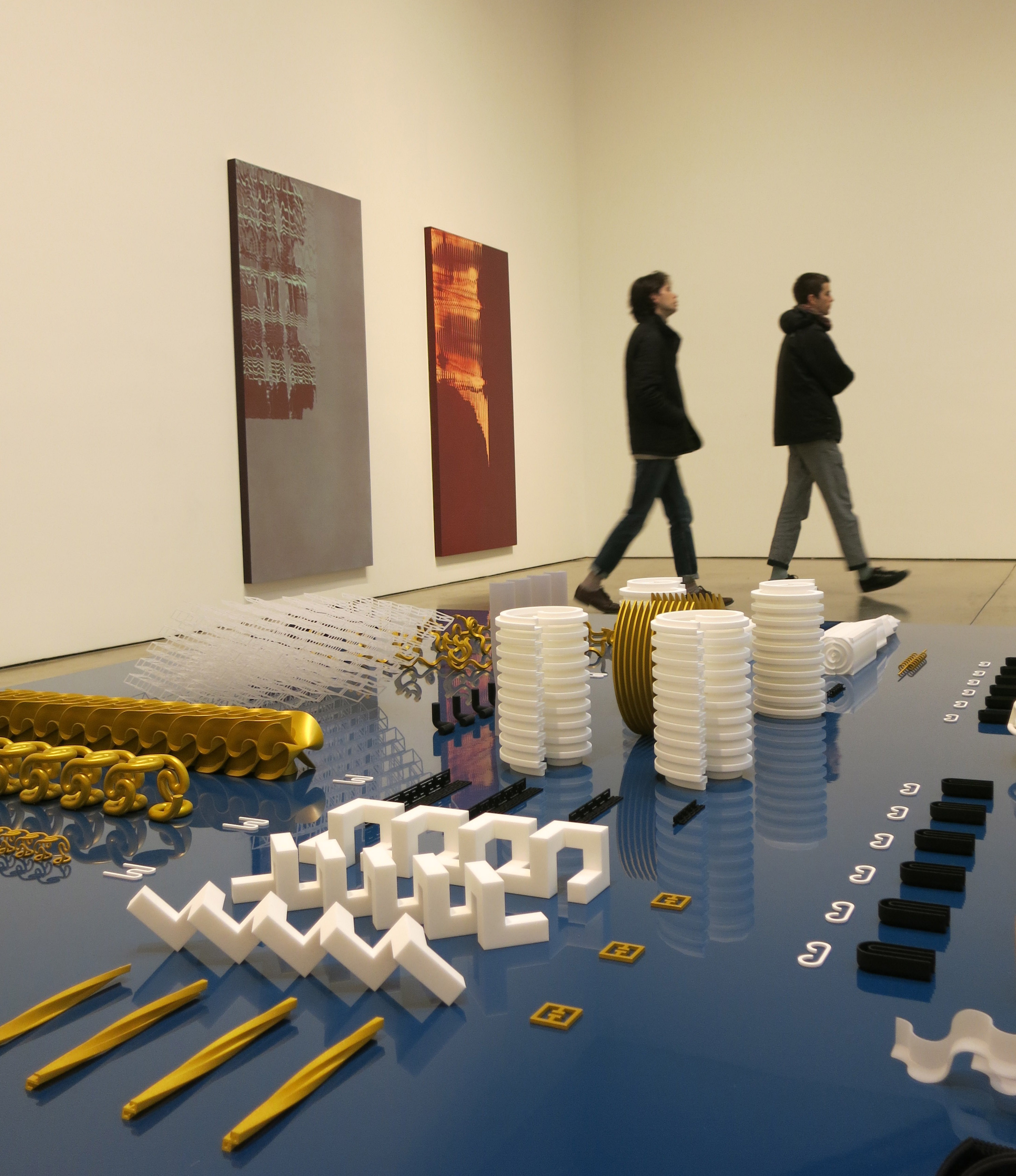
Certain ornamental patterns – waves, helices – appear across cultures, perhaps pointing to fundamental structures of our universe. New York artist Tauba Auerbach delves into these forms in a display of sculptures with rotating shapes titled ‘Altar/Engine.’ Like a display of sacred objects or an explosion diagram of an engine, these 3D printed shapes relate to twisting wave forms inscribed in the paintings behind. (At Chelsea’s Paula Cooper Gallerythrough Feb 13th).

Tauba Auerbach, Altar/Engine (foreground), 3D printed nylon and plastic, an array of several dozen parts ranging from 18 x 18 x 10 inches, 2015.


Tauba Auerbach at Paula Cooper Gallery


Certain ornamental patterns (waves, helices) appear across cultures, perhaps pointing to fundamental structures of our universe. New York artist Tauba Auerbach delves into these forms in a display of sculptures with rotating shapes titled ‘Altar/Engine.’ Like a display of sacred objects or an explosion diagram of an engine, these 3D printed shapes relate to twisting wave forms inscribed in the paintings behind. (At Chelsea’s Paula Cooper Gallery through Feb 13th).

Tauba Auerbach, Altar/Engine (foreground), 3D printed nylon and plastic, an array of several dozen parts ranging from 18 x 18 x 10 inches, 2015.


Jonathan Baldock at Nicelle Beauchene Gallery


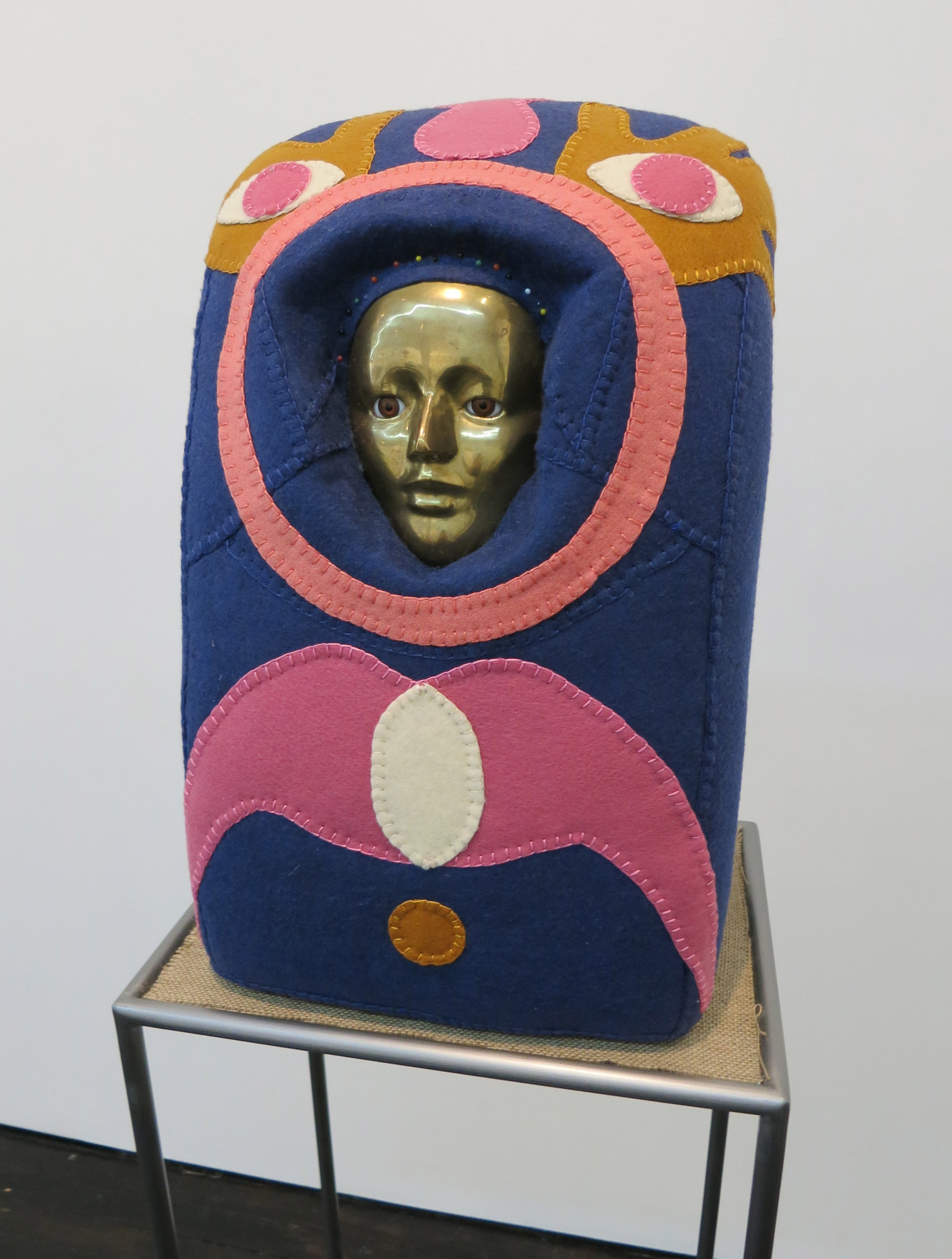
British artist Jonathan Baldock’s soft sculptures channel both Louise Bourgeois’ use of soft fabric to create unnerving characters and Barbara Hepworth’s rounded, organic sculptural forms to create cheery yet creepy totemic forms. (At Nicelle Beauchene Gallery through Feb 7th).

Mutter, steel, hessian, felt, thread, polystyrene, dolls eyes, brass, 65 ½ x 15 ¾ x 11 ½ inches, 2015.

Moira Dryer Paintings at 11R


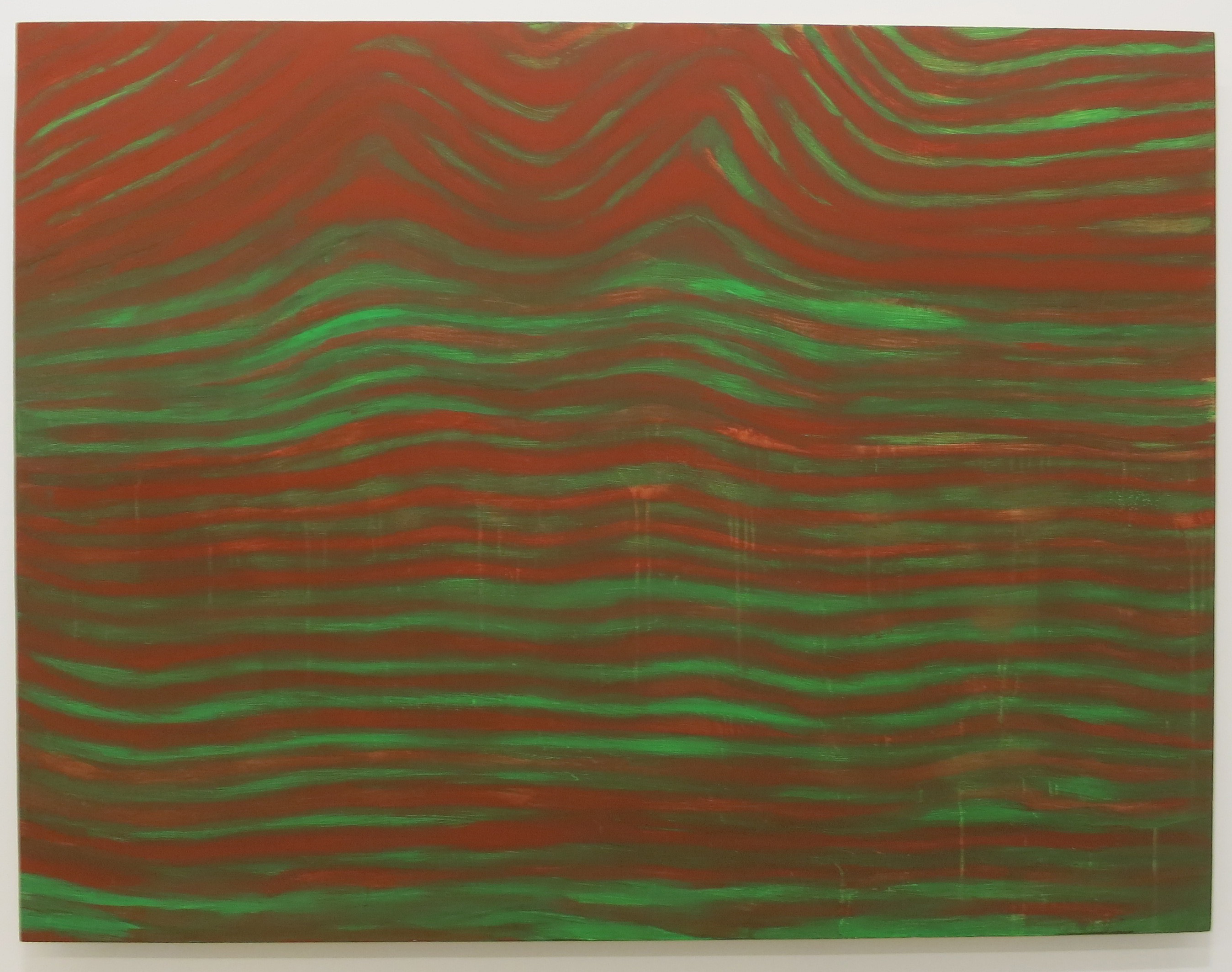
Late painter Moira Dryer’s career is in a revival as 11R gallery explores how the artist worked within the framework of minimalism to both create an emotional impact via color and convey personality via references to representation (a fingerprint, in this case). (On the Lower East Side through Feb 7th).

Moira Dryer, Untitled, casein on wood, 48 x 63 inches, 1987.


Moira Dryer at 11R


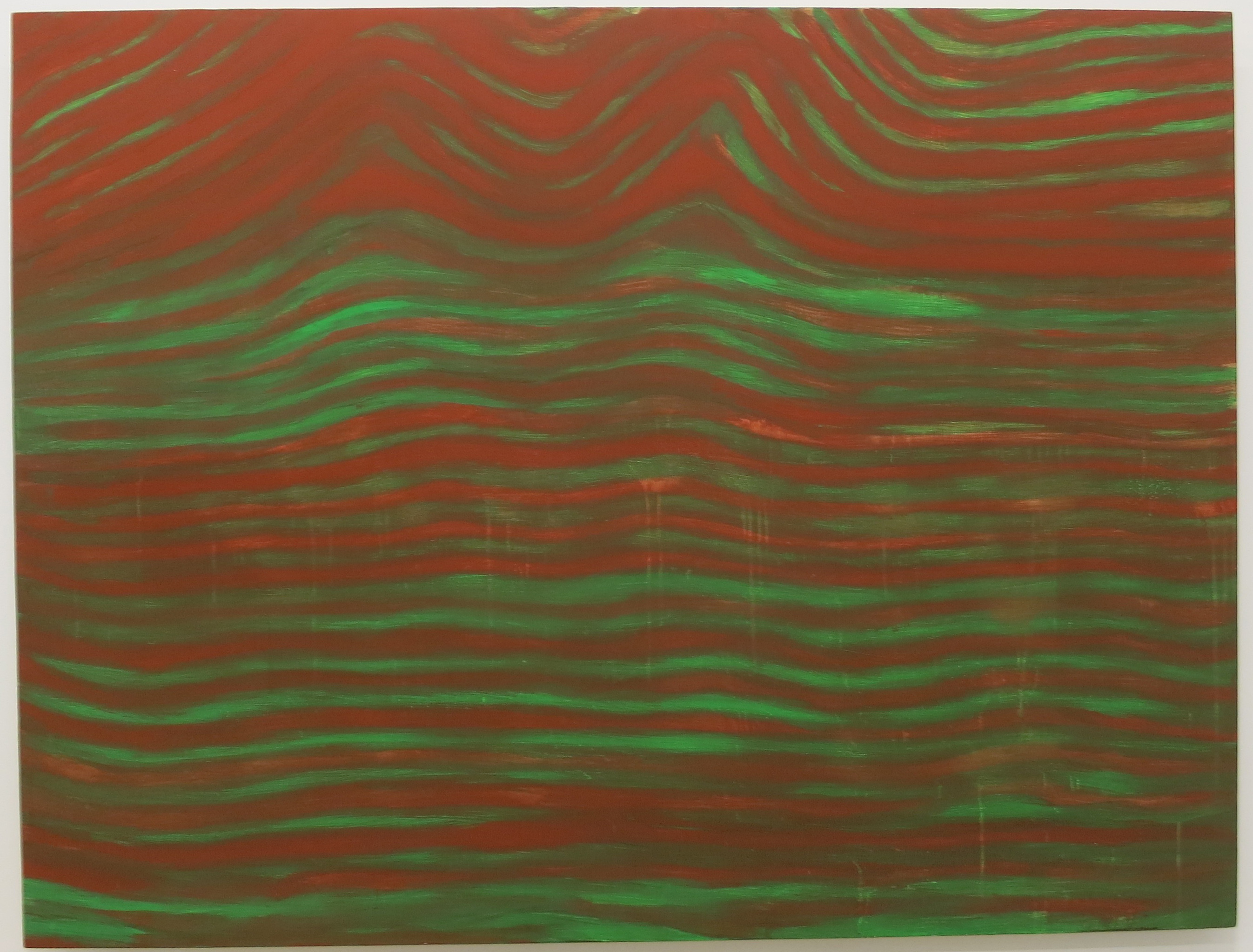
Late painter Moira Dryer’s career is in a revival as 11R gallery explores how the artist worked within the framework of minimalism to both create an emotional impact via color and convey personality via references to representation (a fingerprint, in this case). (On the Lower East Side through Feb 7th).

Moira Dryer, Untitled, casein on wood, 48 x 63 inches, 1987.


Corinne May Botz at Benrubi Gallery


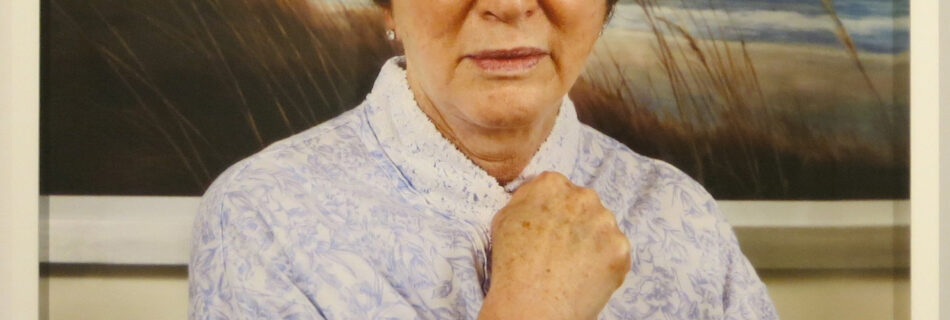
Corinne May Botz’s photos of medical actors, simulating illness in trainings for medical students are simultaneously moving and not-quite-believable. Though they don’t depict real scenarios, Botz’s photos nevertheless strongly tap a sense of dread and helplessness when our bodies fail to function as they should. (At Benrubi Gallery through Feb 6th).

Corinne May Botz, “Louise” from Bedside Manner, archival pigment print, 30 x 24 inches, 2013.


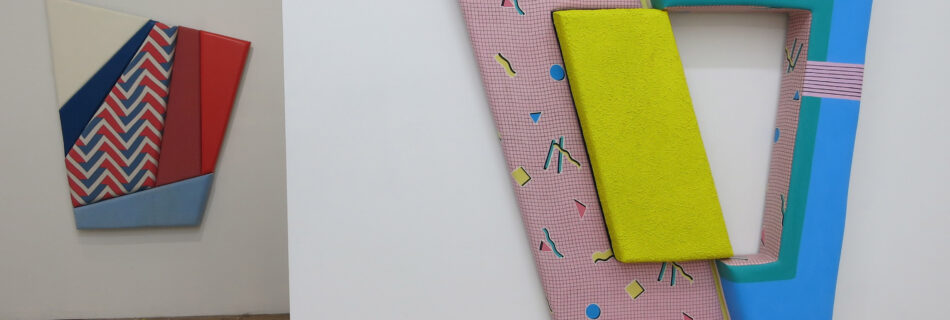
Leah Guadagnoli at 247365


1980s interior décor inspires Brooklyn artist Leah Guadagnoli’s huge new wall sculptures, perfectly conjuring the colors and fabrics of the decade and turning them into objects of contemplation. (At 247365 on the Lower East Side through Feb 7th.)

Leah Guadagnoli, Slow Dance in My Underpants, oil, acrylic, fabric, pumice stone, canvas, wood and polyurethane foam on insulation board, 72 x 58 x 7 inches, 2015.