Cindy Sherman at MoMA – The Critics Speak

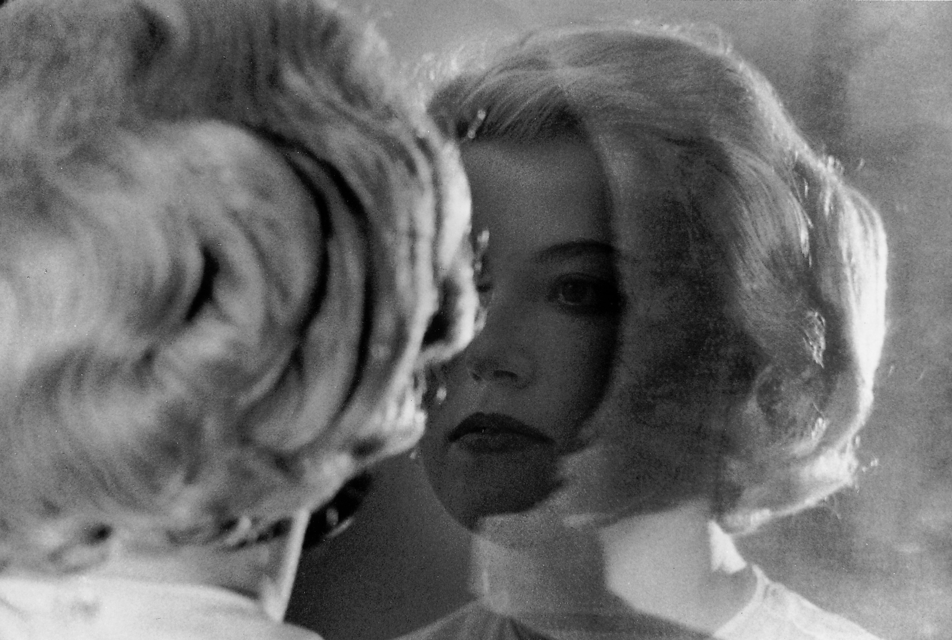
Cindy Sherman. Untitled Film Still #56. 1980. Gelatin silver print, 6 3/8 x 9 7/16? (16.2 x 24 cm). The Museum of Modern Art, New York. Acquired through the generosity of Jo Carole and Ronald S. Lauder in memory of Mrs. John D. Rockefeller 3rd © 2012 Cindy Sherman


As the reviews come out, Cindy Sherman’s retrospective at MoMA (open Feb 26 – June 11) seems set to break ‘best-loved show’ records.  Universal critical adoration usually arouses suspicion of cliquish agreeability.  But Sherman takes the very notion of conformity to fashion and self-presentation -negotiated through society’s expectations – as her subject matter.  Absurdity and grotesquery appear at every turn in this show, making Sherman an uber-critic whose acuity forces the following homages from New York’s major cultural commentators:

Roberta Smith, New York Times:

Though Smith takes umbrage with the show’s selection and non-chronological arrangement, calling it “magnificent if somewhat flawed,” Sherman herself is “…an increasingly vehement avenging angel waging a kind of war with the camera, using it to expose what might be called both the tyranny and the inner lives of images, especially the images of women that bombard and shape all of us at every turn.”
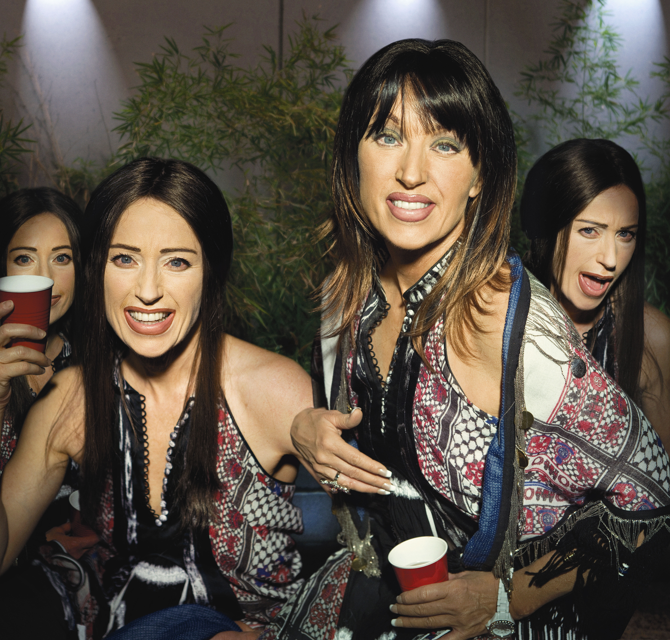
Cindy Sherman. Untitled #463. 2007-08. Chromogenic color print, 68 5/8 x 6? (174.2 x 182.9 cm). Courtesy the artist and Metro Pictures, New York © 2012 Cindy Sherman

Jerry Saltz, New York Magazine:

Saltz also gives Sherman fighting cred, calling her “…a warrior artist – one who has won her battles so decisively that I can’t imagine anyone ever again embarking on a lifetime of self-portraiture without coming up against her.”  He adds, “I think of Cindy Sherman as an artist who only gets better.”
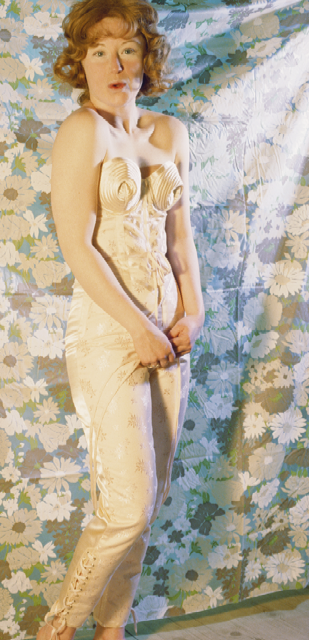
Cindy Sherman. Untitled #131. 1983. Chromogenic color print, 7? 10 3/4? x 45 1/4? (240.7 x 114.9 cm). Courtesy the artist and Metro Pictures, New York © 2012 Cindy Sherman

Peter Schjeldahl, The New Yorker:

Schjeldahl affords Sherman the highest praise, saying, “The mysteries are irreducible…they qualify Sherman, to my mind, as the strongest and finest American artist of her time.”  Pointing out that delusion allows a disconnect between “inner feeling” and “outer attributes” he adds that, “…Sherman makes hard, scary truths sustainable as only great artists can.”
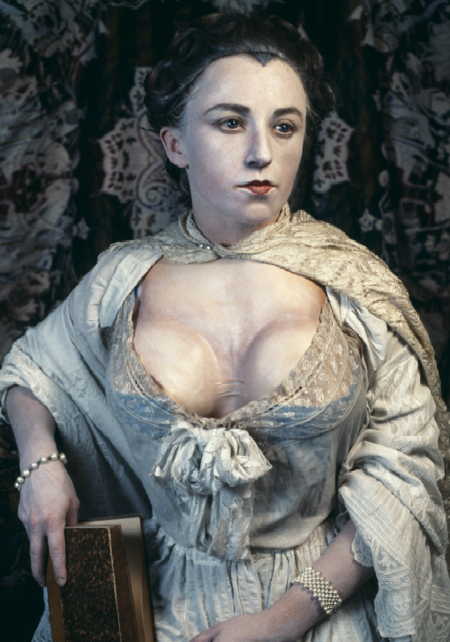
Cindy Sherman. Untitled #183. 1988. Chromogenic color print, 38 x 22 3/4? (96.5 x 57.8 cm). Courtesy the artist and Metro Pictures, New York © 2012 Cindy Sherman

Howard Halle, Time Out:

Halle calls the MoMA retrospective “…the best show I’ve seen there since the Gerhard Richter survey [in 2002], and probably the best exhibit I’ve seen anywhere in a while…The way I’d put it is that Sherman uses glamour and horror to send up and celebrate the feminine mystique, including her own. She quantifies and categorizes the notion of one’s appearance, which fashion also does. But unlike Anna Wintour, Sherman isn’t in the business of marketing the cultural; she’s in the business of laying it bare.”
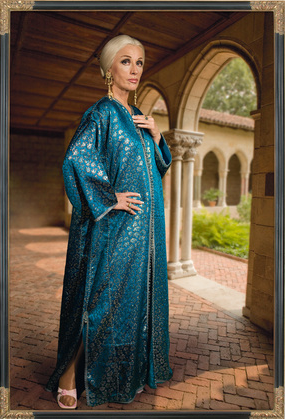
Cindy Sherman at the Museum of Modern Art

Cindy Sherman, Untitled #466, 2008.

The biggest surprise in Cindy Sherman’s major career retrospective, opening to previews today (and officially on Feb 26th) at the Museum of Modern Art, is that there are few surprises.  It testifies to Sherman’s stature and influence that so much of the work in the show – 171 photos from the 1977-80 Untitled Film stills to the most recent send-ups of society matrons – is so familiar that it’s hard to even find the critical distance to reconsider it.

What does emerge is Sherman’s consistent and merciless pillorying of character types from the fashion victim to the aging coquette in galleries arranged by series – history portraits, centerfolds, etc – or by theme – fashion, carnival, abjection.  By comparison, the Untitled Film Stills (appearing in their entirety) appear kind by virtue of their hidden fakery and purposefully glamorized subjects.

Grotesquery – not limited to the fairy tale or sex series – is a heavy component of most of the work, whether in the repellent muscles of a prosthetic cleavage or the big hair and garish makeup of a woman trying desperately to hang on to her looks.  Sherman’s caricatures let most of us off the hook – at least until we start wearing caftans to lounge around our loggias – by representing ‘other people’ who’ve lost their style compass.

Sherman’s early work – seen at the beginning and end of the show – belies such distancing, specifically a stop motion animated short film depicting Sherman as a paper doll who selects her own outfit only to be returned to her case by a giant hand.  The artist’s ‘hand of God’ is now aided by Photoshop, as she alters facial details like those on an 18 foot high mural at the gallery entrance.  But though technology lends Sherman the potential for serious distortion, she holds back, continuing to tweek the conventions of dress and representation to which we adhere to a greater or lesser degree.

‘The Ungovernables’ at The New Museum

Can a museum exhibition claiming to “embrace the energy of this generation’s (international artists in their 20s and 30s) urgencies” compete with still fresh images and reports of Arab Spring or Occupy Wall Street protests?  While socially aware, The New Museum’s second Triennial, ‘The Ungovernables’ demonstrates less of a radical edge than a persistent questioning of the status quo and power structures in artists’ home countries around the world.  More of a chipping away than an uprising, for better or worse the show largely dispenses with aesthetic pleasure or craftsmanship in favor of often personal engagements with broader cultural or national identities.

The standouts include:

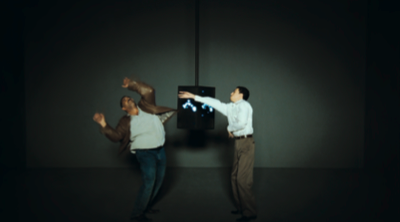
Hassan Khan, b. ’75, lives Cairo.  Jewel, ’10 – This mesmerizing video choreographing a two-man dance-off in traditional Cairo style is the show-stopper.

Hassan Khan, Jewel, ’10.
Hassan Khan, Jewel, ’10. Photo courtesy Galerie Chantal Crousel, Paris.

Cinthia Marcelle, b. 74, Brazil. The Century, ’11 – Barrels, hardhats and more objects are hurled down a street in a video orchestrated by Marcelle, offering some of that talked about urgency and exciting the senses but without reference to any particular conflict.

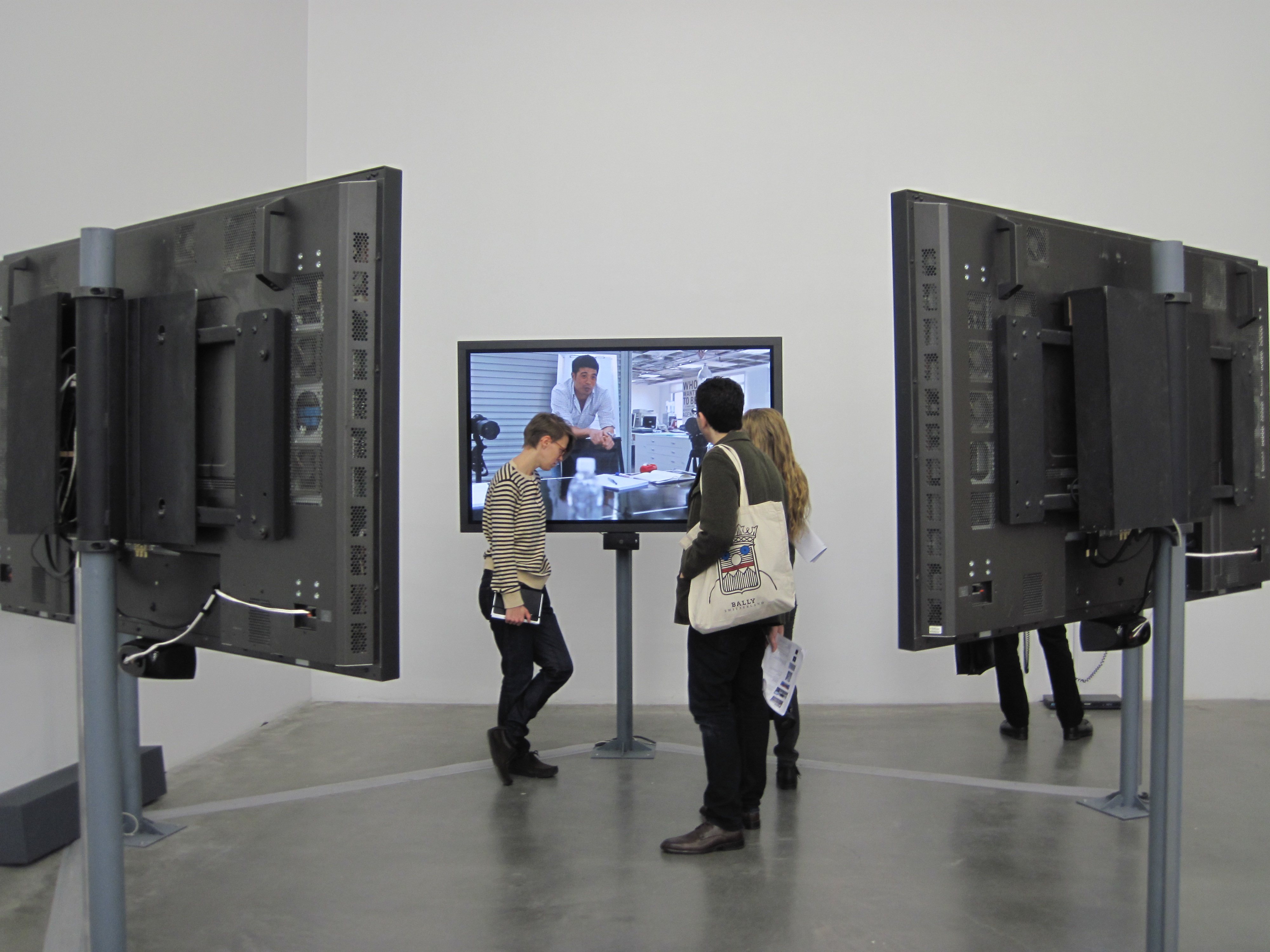
The Propeller Group, founded 2006, Ho Chi Minh City. TVC Communism, ’11 – On a circle of five monitors, five ad execs from an international agency hired by the Group hash out the intricacies of rebranding Communism, a fascinating conjuncture between competing ideologies.

The Propeller Group, 'TVC Communism', ’11

Pilvi Takala, b. 81, lives Amsterdam and Istanbul. The Trainee, ’08 – For a month, Takala posed as an intern at an accounting firm raising the ire of fellow workers as she sat motionless at a desk or rode the elevator.  Their irritation seems to be the point, and while this illumination of social and workplace expectations yields results that are hardly surprising, it’s an amusing scenario for us, especially when Takala tells chagrined employees that she’s ‘working in her head.’

Jose Antonio Vega Macotela, b. ’80, lives Amsterdam, Mexico City.  Time Divisa ’10 –  Over a four-year period, Vega Macotela exchanged labor with Mexico City prison inmates, completing agreed upon assignments simultaneous that included smuggling in items in return for a map showing the route that 100,000 pesos took inside the prison.

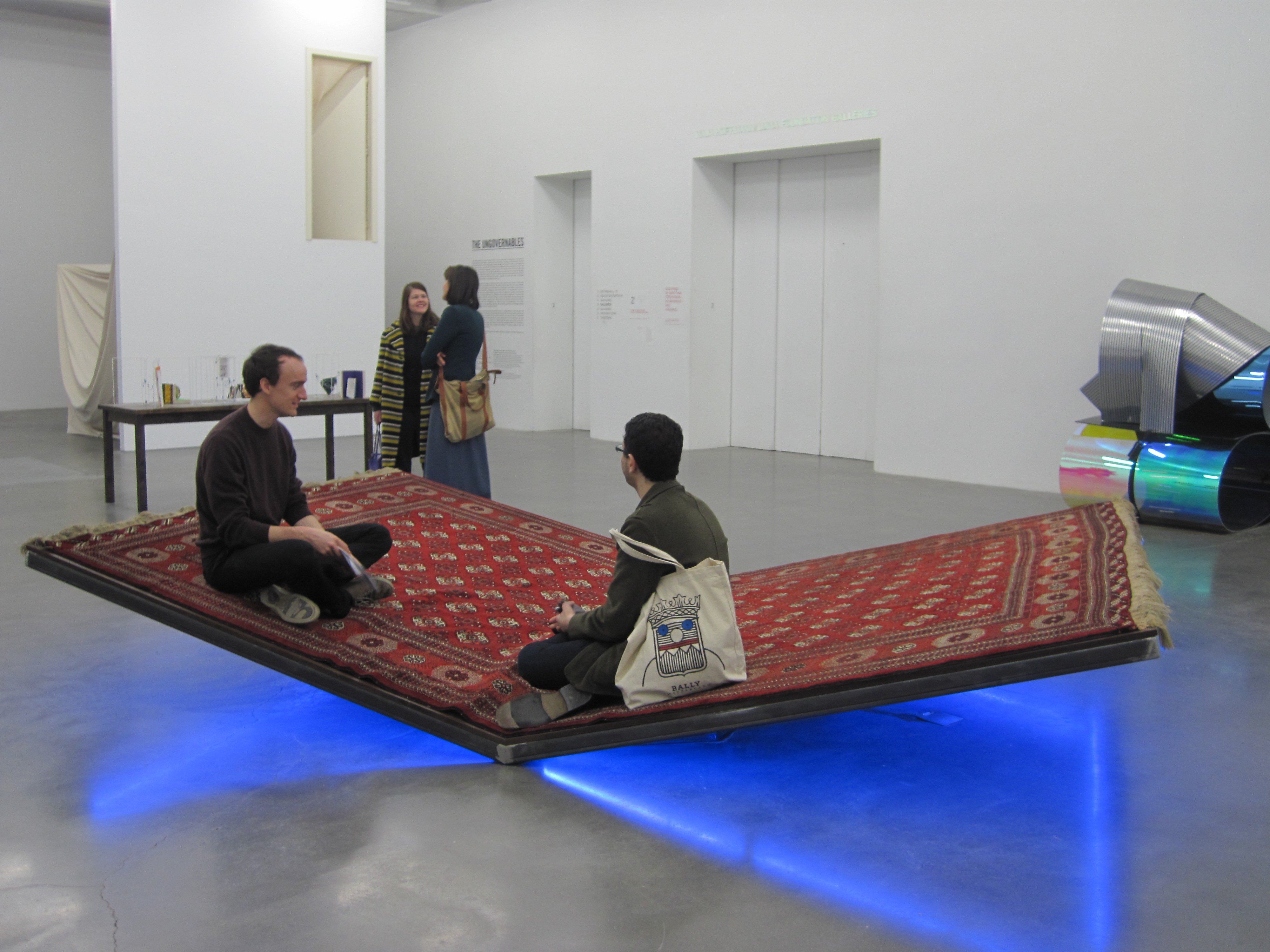
Slavs and Tatars, Prayway, ‘12.

Slavs and Tatars, founded 2006, Eurasia.  Prayway, ‘12 – A communal, ‘riverbed’ seat by the collective Slavs and Tatars appears to be an enormous folded sheet of metal resembling an open (prayer) book with a Persian rug arranged on top and a blue neon glow beneath – a Star-Trek channeling exercise in incongruity that should get conversation started.

Monica Cook, ‘Volley’ at Postmasters

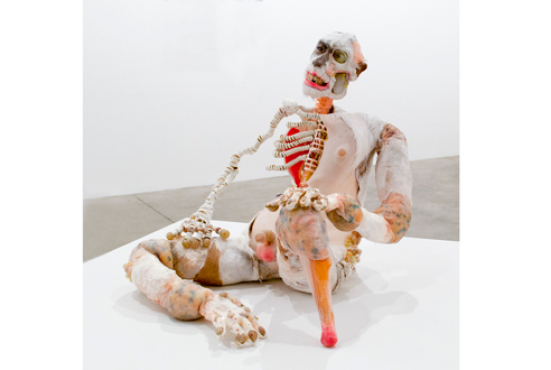
Monica Cook, Dreyvus. Photo courtesy of Postmasters.

Figurative sculpture of fantastical creatures being rare in Chelsea, Monica Cook’s first New York solo show starts out as strange, but gets more eccentrically alluring. A monkey-like character by the door sets the tone with a dignified look in his eye but a half-finished, diseased-looking body. His simian brethren, in sculptures, photos and a stop-animation video, are equally grotesque, cobbled together assortments of fur and plastic. They recall David Altmejd’s gaudy giants, but elicit more sympathy.

A parent-and-child grouping and a female with her dog hint at the possibility that the beasts are stand-ins for us humans. This suggestion is confirmed by the video, in which the critters court and mate in a manner recalling Cook’s excellent 2010 YouTube Play contribution (not in the show), featuring romantic encounters driven by bestial desires. Things work out better in Cook’s animal kingdom, however, as ulterior motives fall by the wayside and, after a series of shy glances, a male magically impregnates a female by merely proffering her a bauble.

The fact that this pretty seed was torn from a fetus-like pod, or that the female attracts the male by munching on an olive-like oval pulled from the skin of her leg, is the repulsive flip side to these creatures’ damaged beauty. Missing flesh reveals skeletons cleverly constructed from coiled phone cords, internal organs made of glass balls and baboon bottoms filigreed with lingerie-like ornamentation. Despite their disconcerting appearance, their rituals of attraction and reproduction are sincere and absurdly simple, offering a kind of prelapsarian seduction of their own.

‘Spies in the House of Art’ at the Metropolitan Museum of Art

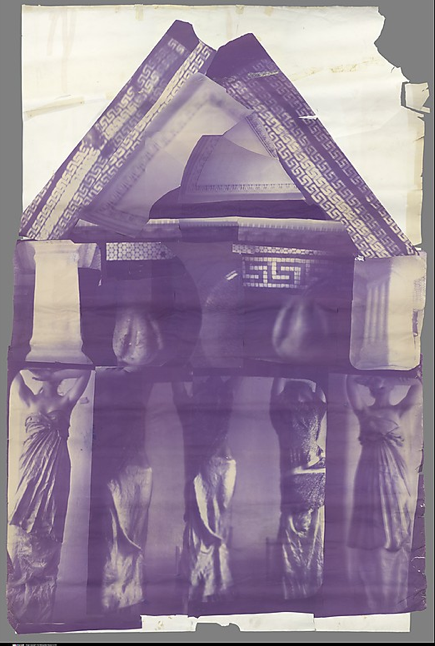
Francesca Woodman, Blueprint for a Temple, 1980.

Contrary to its title, there’s nothing particularly subversive about ‘Spies in the House of Art,’ the Metropolitan Museum’s enticingly titled exhibition of its contemporary photography collection, which opened yesterday.  Photos, films and videos take museum display and visitor responses as subject matter, but the mood of the best pieces is more fond criticism than biting institutional critique.  Still, by bringing the myriad ways we navigate the museum experience to our conscious mind, the show counteracts purely passive viewing pleasure.

A standout is Francesca Woodman’s 1980 ‘Blueprint for a Temple.’ Completed a year before her untimely death and marking a major shift from her small scale photos, this 15 foot high photo collage of a Greek temple supported by her friends dressed as caryatids and printed on blue architectural blueprint paper playfully remakes ancient culture while forces a connection between past and present that resonates with the Met’s newly crafted Moroccan court.

The show’s second major highlight, Rosalind Nashashibi’s and Lucy Skaer’s 16mm film ‘Flash in the Metropolitan Museum’ from 2006 was shot at night with a flash strobe as the artists moved through the museum, momentarily illuminating Greek ceramics one minute, African or Medieval European sculpture the next.  Unclear images, seen for a moment in varying scales and unflattering angles turn usual museum display on its head while creating an alluringly mysterious anthropological study that is equal parts ‘Blair Witch Project’ and ‘Mixed Up File of Mrs Basil E. Frankweiler.’

Less familiar work comes across as amusing and fresh, like Laura Larson’s photograph of a display in the Telfair Museum in Savannah, Georgia which delights in pointing out the tasteless clash of style in a Regency settee, a wallpapered landscape and patterned marble floor.  Sophie Calle’s text and image of a gender-ambiguous blind person describing the ‘terrific ass’ of a sculpture in Paris’ Rodin museum invites reflection on our own ideas about beauty.

By comparison, a photo of a shelf of stored artworks by Louise Lawler, an image of a painting by Tim Davis with his flash blotting out the subject’s face and a video by Lutz Bacher following a young adolescent through the Picasso Museum in Paris look at art stored, reproduced or visited in unexpected if not particularly compelling ways.   In a sense, the Met itself undermines the less nuanced work in the show – the stunning artwork and displays encountered on the way to the 2nd floor photo galleries are a tough act to follow.

Matt Collishaw ‘Vitacide,’ at Tanya Bonakdar Gallery

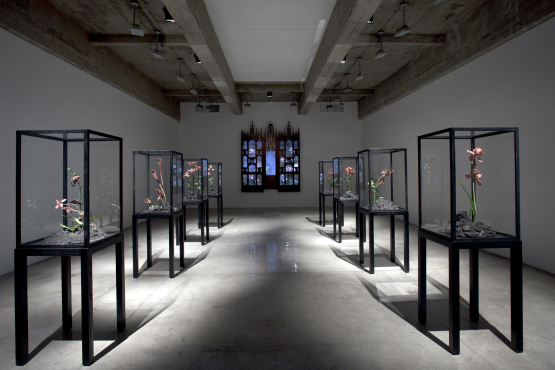
Matt Collishaw, installation view.  Photo courtesy of the artist and Tanya Bonakdar Gallery, New York.
Matt Collishaw, installation view. Photo courtesy of the artist and Tanya Bonakdar Gallery, New York.

Photos of Texas death-row prisoners’ last meals, giant prints of dead insects and sculptures of diseased flowers (titled, for instance, after a poem from Baudelaire’s Fleurs du Mal or a U.K. waste-management company) confirm that original Young British Artist Mat Collishaw still traffics in sensation. Surprisingly, the most gratuitous subject—the last meals—proves to be the most thought-provoking, despite the fact that it, too, reflects Collishaw’s fondness for grotesquery.

Collishaw rightly calculates that our morbid fascination will attract us to these photos of french fries, steak, cinnamon rolls and other repasts, dimly lit to recall Dutch still-life painting, but mainly looking gray and unappetizing. Still, evoking this last moment of pleasure does create twinges of sympathy for the condemned, whose orders range from a dish of yogurt to a heaving pile of food.

Vitrines of waxy-looking, boil-covered, meat-pink amaryllis, lilies and other flora growing in toxic soil are so blatantly gross that they kill any such nuance of feeling. A video animating decaying flowers buzzing with flies in a comically misty dead forest does a bit more than the sculptures to suggest the dark enchantment hinted at in Baudelaire’s title, but setting the flatscreen behind an 18th-century altarpiece seems like a mere ploy to stir the pot with a tangential religious reference. Collishaw gets it right when he mines the contradictions in humanity’s capacity for base thoughts and actions. But when he simply represents it, he produces more of the same.