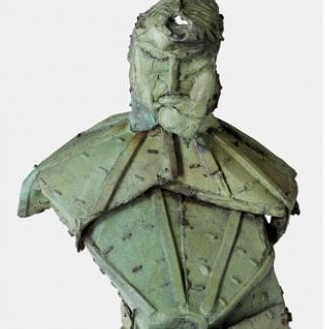
Matthew Monahan at Anton Kern Gallery

Matthew Monahan, “Seppuku.” Photograph courtesy of Anton Kern Gallery, New York.

For a card-carrying member of the “Unmonumental” generation of sculptors (he was actually in the New Museum show of that name), Matthew Monahan’s latest freestanding bronze sculptures are both reactionary and a logical next step. His previous work consisted of installational displays crowded with objects and figures, idiosyncratic minimuseums chockablock with visual allusions to art history—a Greco-Indian eye here, a Northern Renaissance visage there. At Anton Kern, Monahan distills archetypal characters from a jumble of references, creating a fascinating group that looks like archaeological finds from an alternative art history.

One slender nude’s wire-bound body recalls photographer Nobuyoshi Araki’s soft-core titillations, but her quizzical expression is more provocative, suggesting spiritual superiority and/or mental disability. Another character’s cruciform pose begs explaining, but his craggy and practically concave face closes in as if guarding secrets. Nearby, a motionless, gold-leafed droid version of Umberto Boccioni’s Unique Forms of Continuity in Spacestands stiffly by.

While Monahan’s sculptures pique our curiosity with their mix of vague familiarity and uncertain identity, a series of oil-on-board images resembling tantric diagrams fairly exudes esoteric mystery. Collectively titled “Body Electric,” they summon Walt Whitman’s passionate appreciation of the human form but feature a fairly unnuanced, everyman element: a simplified kind of line drawing made by scraping black-painted paper to reveal the white below. The sculptures, on the other hand, turn appropriation into creation with their affecting cast and enjoyable synthesis of history, pop culture and sheer invention.

Originally published in Time Out New York, issue 793, December 9 – 15, 2010.

Kristin Morgin, “New York Be Nice” at Zach Feuer Gallery

Kristin Morgin, Wrecked Spyder, 2010. Photograph courtesy of Zach Feuer Gallery, New York.

The nervous plea in the title of Kristen Morgin’s New York solo debut seems warranted at first glance. This accumulation of meticulously crafted, painted-ceramic replicas of comics, toys, personal mail and more, laid out on rickety tables, looks like the world’s most precious yard sale. But behind a facade of understatement, Morgin cleverly challenges the ways in which we value things, making art that’s real and fake, handcrafted and reproduced, imitative and innovative, vintage and new, high and low, all at the same time.

Category-busting begins at the door with a shelf of roughly fashioned teacups featuring portraits of comics icons, from Wonder Woman to Snoopy, a cheeky mix of useful craft and pop-indebted fine art. Elsewhere, doodles on Post-its lie alongside a ceramic Curious George book, featuring the trouble-prone primate traveling through space. Despite its futuristic theme, the tome’s deliberately cracked and aged condition and added-on sketches—including a version of Picasso’s Guernica—summon a specter of ruin over predigital ephemera. Large drawings of a dodo bird and ticking clocks rendered over other ceramic facsimiles of comic books likewise reinforce the sense of imminent extinction, reminding us that the past is always mediated.

What would ordinarily be the show’s star attraction—a pale and crumpled replica of the Porsche Spyder in which James Dean met his end—is the Bamiyan Buddha of roadsters: a memory so wrecked that it’s barely related to the original. Morgin, however, isn’t after the trompe l’oeil virtuosity of Steve Wolfe or even Allen Ruppersberg’s reshuffled pop references. Instead, she gives us a pointed warning that everything starting out shiny and new inevitably crumbles to dust.

Originally published in Time Out New York, issue 791, November 25-December 1, 2010.