Polly Apfelbaum, “Off Colour” at D’Amelio Terras


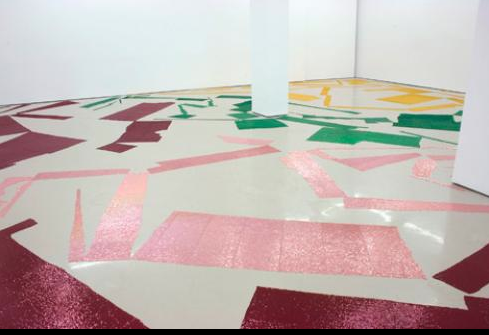
Polly Apfelbaum, "Off Colour" installation view. Photograph courtesy of D'Amelio Terras, New York.

Polly Apfelbaum is in rebellion. Unlike the pleasing forms and intricate color schemes of the floor-based fabric arrangements she’s known for, her latest installation of jagged panels in sequined cloth is attention-grabbing but jarring. Off Colour derives its title and loud appearance from amateur nude photos that Apfelbaum found at a London flea market, suggesting a futile attempt at titillation.

At previous shows Apfelbaum had brought in work crafted in her workshop, but this installation was made directly in the gallery. The result—slender fabric strips extending into the corners or hugging columns—could barely be termed a response to this unremarkable space, though the artist has upended expectations by diverting our attention from the walls to the floor. Still, tiptoeing between the zones of crimson, pink, yellow, green and orange (that a sign warns us not to touch) is more awkward than absorbing; the scheme is so calculated that it discourages any desire for interaction.

On the plus side, the panels’ rough edges, geometry and scattered appearance recall Jean Arp’s torn-paper collages, and look like they might harbor some sort of meaningful relationship between the shapes and the negative spaces they create. Unfortunately, a more concrete reading is elusive, as if Apfelbaum had deliberately left behind a self-conscious collection of isolated parts that, like her source photos, lead us on but give us no satisfaction.

Originally published in Time Out New York, issue 785, October 14-20, 2010.
Liu Xiaodong, “Yan’ Guan Town” at Mary Boone Gallery

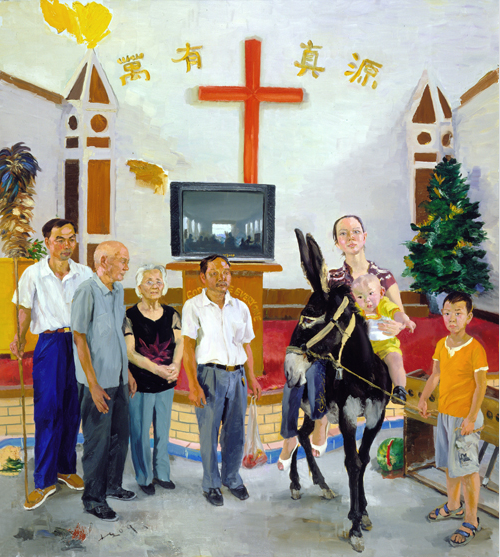
Liu Xiaodong, “Z’s Family,” 2009. Photograph courtesy of Mary Boone Gallery, New York.

Coincidently, while Liu Xiaodong painted this show’s realist portraits of a Muslim and a Christian family in China’s northwestern Gansu province, ethnic violence broke out between Muslim and Han Chinese in the region. Rather than an argument for peaceful coexistence, however, this body of work seems more motivated by the artist’s curiosity about the unique cultural adaptations of China’s religious minorities.

Coincidently, while Liu Xiaodong painted this show’s realist portraits of a Muslim and a Christian family in China’s northwestern Gansu province, ethnic violence broke out between Muslim and Han Chinese in the region. Rather than an argument for peaceful coexistence, however, this body of work seems more motivated by the artist’s curiosity about the unique cultural adaptations of China’s religious minorities. Complicated family dynamics and Liu’s own idiosyncratic symbolism add animation to already fascinating portraits.

For example, Liu places the Christian brood of Z’s Family inside a chapel, with the young mother astride a donkey while holding her antsy toddler in her lap: an image inspired (according to an entry from the artist’s diary, included in the show’s catalog) by Jesus’ flight into Egypt as an infant. Just as compelling, though, is the painting’s psychological undercurrents, particularly in a woman’s beatific expression, which barely conceals her apparent discomfort. More cryptically, a male relative on the left stands with a giant feather duster in his hand, suggesting some sort of emasculated posture, while the 80-year-old patriarch’s downcast glance conveys weakness as much as presumed humility.

The Muslim H’s Family is seen gathered together in the cramped restaurant that doubles as their home. Four adolescent daughters and a son strike awkward poses but telegraph their individuality by boldly meeting Liu’s gaze. So it seems odd that Liu asked the lively, eldest daughter to wear a head scarf (not owning one, she had to borrow one), then painted her odalisque-style in a cabinet-like enclosure in the background, which serves as a bed for the girls.

Both canvases recall the anthropological air of Thomas Struth’s family portraits, but Liu adds layers of interpretation that symbolize the challenges of understanding others.

Originally published in Time Out New York, issue 784, October 7-13, 2010.