Thomas Houseago at Michael Werner Gallery

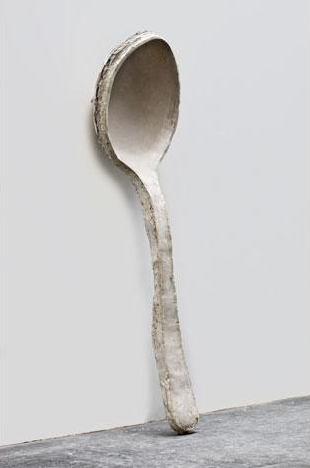
Thomas Houseago, "Spoon IV," 2010. Photograph courtesy of Michael Werner Gallery, New York.

The sculptures in Thomas Houseago’s first New York solo show defy reigning art trends by embracing monumentality, mining art history for subject matter without being overacademic or self-conscious, and conveying meaning without detailed background info. None have the commanding presence or shape-shifting potential of the artist’s towering Baby, a standout in the current Whitney Biennial. But his totemic and iconic pieces, made with labored simplicity, plumb life’s mysteries with hopeful optimism.

A line of skulls just inside the gallery would be grim if not for their wealth of associations, from Darth Vader’s mask to Picasso’s haunting late self-portraits. Jonathan Meese’s Cubist-indebted faces come to mind, but Houseago’s heads are more in keeping with the simple, alien grotesquery of Ugo Rondinone’s all-black visages. With their hollow, zombie eyes, quizzical semi-squints and fingerlike ropes of flesh on their faces, the figures float between life and death, pop culture and high art.

The show itself ambitiously aims to be many things at once—figurative and abstract, humorous and serious, historical and contemporary—but it feels crowded and thematically discordant at times. It’s tempting to hunt for humanist metaphors to tie together pieces like the two giant spoons à la Claes Oldenburg (nourishment?) and the Brancusi-like totem with bird’s head/bike helmet on top (spirituality?). Other objects make more fruitful associations: A repeated circle pattern appearing in a ghoulish face, a geometric frieze, and a sculpture representing sunrise and sunset merges personal and cosmic concerns, connecting dark souls to shining celestial bodies—and speaking for art’s ability to enlighten.

Originally published in Time Out New York, issue 764, May 20 – 26, 2010.
An interview with Los Carpinteros

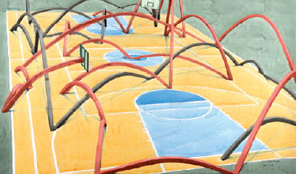
Los Carpinteros, "Bola," 2008. Photograph courtesy of Sean Kelly, New York.

MERRILY KERR: What brings you to New York?

Los Carpinteros: We’re designing the set for a ballet performance by Morphoses/The Wheeldon Company. Using windsocks filled by fans, we’ll play with the drama of Rachmaninoff’s “Suite for Two Pianos.” We’re combining the technical and emotional, a bit like at the airport, when windsocks are the last thing you see before you leave the earth.

MK: How has the difficulty of traveling to the U.S. affected your work here?

LC: After 9/11, the interest in Cuban art calmed down because visas were impossible to get. So while our work kept developing in Europe, South America and Asia, we had to arrange our last exhibition at Sean Kelly Gallery by email. When we do an exhibition, we like to touch everything, and this was too cold.

MK: If less of your work is handmade, will your name become meaningless?

LC: By now, Los Carpinteros is like a family name, so it won’t grow old. Originally it didn’t just refer to woodworking; we were acting as outsiders to the art scene, which made a lot of sense in the ’90s when censorship was an issue. We’ve actually been given a new label in a book project with Thyssen-Bornemisza coming out in May: Post-Industrial Craftsmen, which describes how we use industrial and prefabricated sources and craft them to our inventions.

MK: What do you still make by hand?

LC: The exploding rooms, for example, are still a labor of craft. Our work has always been about constructing, but for these we deconstruct a fragment of architecture making it both alive and static. When we showed a version of the piece in Prague in 2005, we didn’t want it to carry political overtones of the fallen Berlin Wall, so we decided to include furniture, making it unclear whether a storm or bullet had struck.

MK: Do you suppress politics in your work?

LC: We did our most politicized work in Havana when we exhibited a functioning lighthouse lying on its side in a dark gallery. We expected this symbol of fallen power to be censored, and were surprised when it wasn’t. Making political work can be addictive. They say that creation is an allergic reaction to reality. When you have a political situation you have a lot of opportunities to make political work, but we don’t abuse it.

MK: Do you consider how people from different cultures will interpret your work?

LC: It’s always a surprise. We try to choose the most polysemic, works. A piece might be understood completely differently in Cuba, South America, Asia.

MK: How does this apply to the humor in your work?

LC: It’s one of the most difficult things you can imagine to make a joke, especially because we don’t use human figures. Creating humor with cinder blocks, for example, is a challenge. We had an idea for a series of one-roomed hotels, which turned into a drawing illustrating an actual proposal in Athens to construct brick caravans to house gypsy families. The idea is heretical, but our work doesn’t judge.

Originally published in Flash Art International, no 270, March – April 2010.

The Bruce High Quality Foundation University at Susan Inglett Gallery

The concept behind the Bruce High Quality Foundation’s third New York solo show is more engaging than the artwork, which comes as no surprise.  The anonymous artist collective’s move to start its own free, unaccredited school is a gutsy and overdue reaction against the pressure on artists to complete costly MFA programs.  But just as student work generally hasn’t had time to mature, the sculpture created by the artists known as ‘the Bruces’ in response to the past semester’s discussions and plans for the future is more a collection of ideas than a profound statement.

Sculpture in the form of chalkboards summon the spirit of Beuys, while unusable desks fashioned from broken drywall resemble post-apocalypse Bauhaus furniture; neither looks meant to last.  Literally erasable, the chalkboards epitomize the experimental, non-product-driven nature of the Bruces’ approach.  Humor is rampant, from a blackboard reading ‘in the future everyone will be a foundation,’ a twist on Warhol’s famous 15-minute bon mot, to a study of art world gender disparity with a female superhero mask and hairdryer balancing a beer stein with a fake breast.  Obviously, these artists are having a good time inspiring each other and now a larger audience of ‘university’ attendees.  The resulting artwork may not stand the test of time, but it’s an enticing invitation to join the fun.

Originally published in Flash Art International, March – April, 2010.