Steve Mumford at Postmasters

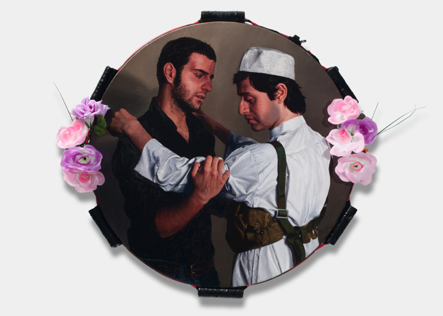
Steve Mumford, "The Great Good Friends (Suicide Bomber)," 2010. Photograph courtesy of Postmasters, New York.

Steve Mumford may have taken six trips to Iraq in the past seven years, allowing his art practice to be absorbed by picturing the war there, but while his agenda remains curiously ambiguous, he clearly avoids propaganda.  In a style inspired by the 19th century American Realist painters, he treats his subjects, from Iraqi prostitutes to Islamic leaders, U.S. soldiers to jihadist fighters with dignity regardless of their beliefs and dealings, a tactic bound to rile his various subjects, never mind his audience.

War is Mumford’s ostensible subject, but the people he depicts are in limbo, not action, putting the emphasis on their individual characters rather than symbolic identity.  The prostitutes are modest and brave, huddling together in their black, one-piece swimsuits isolated at the center of an empty swimming pool; a jihadist pausing to write in a notebook on a rocky hillside commands respect as a thoughtful intellectual. Mumford’s paintings work both sides of the fence, eliciting sympathy for a beautiful U.S. soldier who lost her arm one minute, a male suicide bomber who bids a tearful goodbye the next.

Are terrorists worthy of compassion?  Sympathy?  Mumford shifts the decision to us, obscuring his point of view by framing the painting in cheesy fake flowers and explosives that diminish its sincerity.  Likewise, there’s nothing straightforwardly heroic or the reverse in the appearance of U.S. troops skinny-dipping in a marsh, no uniforms hiding their unique complexions, builds and tattoos.  Small text paintings inspired by bathroom graffiti in military camps round out the show, trafficking in disillusioned cliché and acting as foil to the nuances of the portraits that spare judgment and replace dogma with real people.

Originally published in Time Out New York, no 755, March 18-24, 2010.
Liam Gillick at Casey Kaplan Gallery

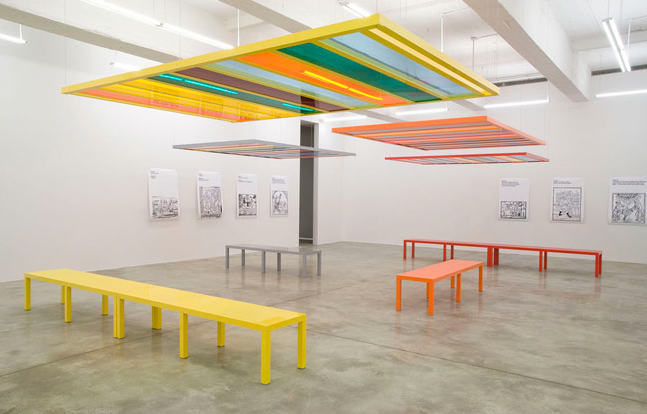
Liam Gillick, exhibition view, 2010. Photograph courtesy of Casey Kaplan Gallery.

Liam Gillick’s sculpture, writing and design relate to architectural space, but rarely encourage us to inhabit it, making the seemingly simple addition of benches to his previously debuted overhead sculptures (titled ‘discussion platforms’) a profound development.  In a video, Gillick advocates occupation of time, not space, as a means to bring about social change; paradoxically, the new sculpture seems to allow both and relies heavily on the artist’s habitual hope that simple objects will convey complex ideology.

Gillick would be the last artist to purposefully set up binary oppositions, but fundamental incongruities abound, as when the proximity of colorful sculpture makes ordinary benches look beautiful.  In the video, we peer over the artist’s shoulder into the dual emptiness of his sterile workspace and his computer screen, where he manipulates an architectural drawing of a factory inspired by a Godard film.  The accompanying jargon-filled soundtrack offers a flood of words from the ‘authoritative voice’ Gillick abhors and frustratingly resists any connection to the source material.

In the main gallery, a textual exchange between a quasi time traveler and a contemporary bartender paired with images from medieval woodcuts is more likely to catalyze Gillick’s audience with its provocative blur of time and place.  Familiar and strange at the same time, the centuries-old scenes of labor and communal celebration are a puzzle and an exhortation to consider the leisure time we’re enjoying as we sit.  Benches – perches of lovers, readers or the homeless – may be less the seats of power than tables or desks, but their identity as temporary resting places is a perfect fit for the in-and-out patterns of gallery visitors and the speculative nature of Gillick’s project.

Daido Moriyama at Luhring Augustine

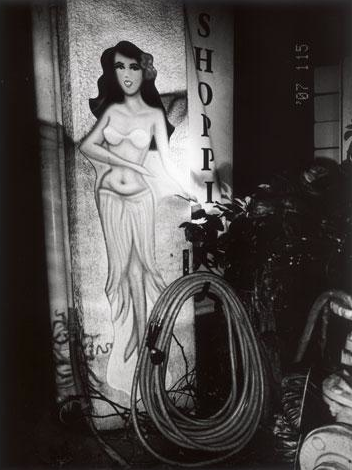
Daido Moriyama, Hawaii, 2007. Photograph courtesy of Luhring Augustine, New York.

A lone, hunched figure—Van Gogh’s Sorrow draped in a beach towel—opens postwar Japanese photography legend Daido Moriyama’s show about Hawaii, but its brooding mood is misleading. In contrast to a selection of his photos from the ’70s and ’80s in the back gallery, Moriyama’s recent work is literally and figuratively lighter, departing from his trademark rough, blurred and out-of-focus style in a redemptively upbeat portrayal of the islands.

With refreshing honesty, Moriyama doesn’t pretend to be anything other than an outsider, sticking to themes of sun, sand and tourism. Apart from a few shots—weeds engulfing an abandoned car or a hula girl mural in a grubby yard—he’s less interested in exposing life behind the scenes than transforming stereotypical subject matter, which he does with mixed success. A grainy shot of fog rolling in over tropical vegetation and blurred images of palms are nothing new, but a fast-food joint made radically strange by dramatic sunlight or a still close-up of a highly erotic conch shell render the overly familiar strange.

Instead of mounting a critique of crass commercialism, Moriyama portrays tourists as intrinsic to or respectful of the landscape—a kid crawls turtlelike on the beach, and poncho-wearing lava watchers resemble pilgrims—while uncommonly pleasant tourist-shop mannequins portray commerce as low-key. Lest the series come across as too feel-good, Moriyama adds an excremental pile of lava here, a grotesque sunbather there. But with the exception of a kitschy image of a dog wearing sunglasses—a far cry from the artist’s iconic 1971 depiction of a menacing stray—the series’s positive tone is striking evidence of Moriyama’s sensitivity to Hawaii’s mutability.

Originally published in Time Out New York, no 753, March 4-10, 2010.