Virgil Marti at Elizabeth Dee Gallery

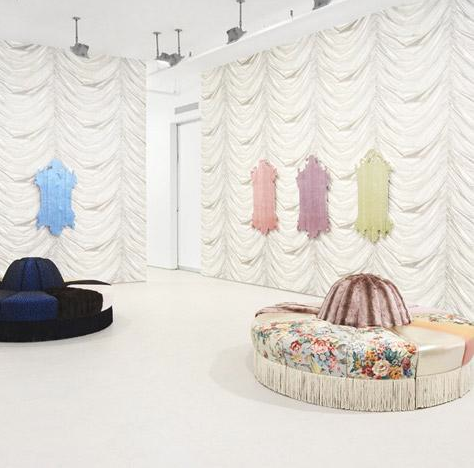
Virgil Marti, installation view. Photograph courtesy of Elizabeth Dee Gallery, New York.

Virgil Marti threw a party, but no one showed up. Or so appears his latest decor-as-fine-art installation of wallpapers and furnishings. Chromed mirrors, and anthropomorphized home trappings claiming James Whistler and Chippendale as inspiration, drive home Marti’s recurring theme, that kitsch and excess are two sides of the same coin. But while his show perfectly sets the mood for a high-camp soiree, in the quietly trafficked gallery, it leaves the lingering impression that our invitations must have been lost in the mail.

Not many artists would represent their parents as settees upholstered in flowers, fur and gold lamé (for Mom) or deep blue with black polka dots rimmed in yellow accents (for Dad), as this one does. These fabulously eccentric character studies suggest that Marti is either the secret love child of Liz Taylor and Barry White, or he’s using liberal doses of artistic license to charming effect.

Unfortunately, the seats are off-limits according to a posted sign, sinking the possibility of an impromptu gathering or interaction with strangers. Granted, Marti’s work speaks to the history of objects, but relational aesthetics has us primed to enjoy a coffee and film à la Rirkrit Tiravanija. Frankly, this show could use a little of that, especially since references to role-play, social interaction and posturing seem to run throughout, from the swagged wallpaper (resembling the curtain of an opulent old theater or movie palace) to the hardwood patterns on the mirrors (a reference to treading the boards?). Sadly, allusions to socializing aren’t as compelling as the real thing.

Originally published in Time Out New York, issue 748, January 28 – February 3, 2010.
William Daniels, “Paintings” at Luhring Augustine

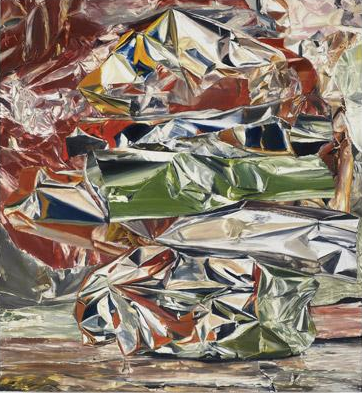
William Daniels, "Untitled," 2009. Courtesy of the artist, Luhring Augustine, New York, Vilma Gold, London and Marc Foxx, Los Angeles.

“I thought they’d be bigger!” exclaimed one visitor to William Daniels’s first New York solo show of oil-on-board paintings, none bigger than 13 inches square. In reproductions, Daniels’s images of angular metallic surfaces—mystery objects wrapped in aluminum foil situated within foil-covered sets—grab attention. In person, the seven tiny pieces dotting the walls of the main gallery convey a cheery yet shallow intimacy, evoking shiny candy wrappers or Christmas lights glinting off an ornament.

Despite the bonhomie of pretty hues, Daniels’s subject matter is monotonous, and seesaws between superrealism and lyrical license—a style that’s especially frustrating when the objects are hard to distinguish from their backgrounds and merge into shallow planes of crinkly foil. Eschewing the temptation to depict people or things in reflection—à la Jan van Eyck’s The Arnolfini Wedding, for example—Daniels rejects references to the outside world, creating little hermetic dioramas of light and color, calculated to break boundaries between abstraction and representation, painting and sculpture, by being all at once.

Undoubtedly, this show proves Daniels’s painterly ability and experimental creativity. But unlike his previous meticulously painted reproductions of torn-paper collages sending up or paying homage to canonical art-historical images, the latest work is, unfortunately, literally reflective, and not metaphorically so. The foil covered objects recall John Chamberlain’s twisted auto parts without their bravado, or James Rosenquist’s chrome panels segueing into spaghetti minus the subject matter. Ultimately, while Daniels’s paintings connect with the contemporary fashion for antimonumentality, they have disappointingly little to say.

Originally published in Time Out New York, issue 748, January 28 – February 3, 2010.