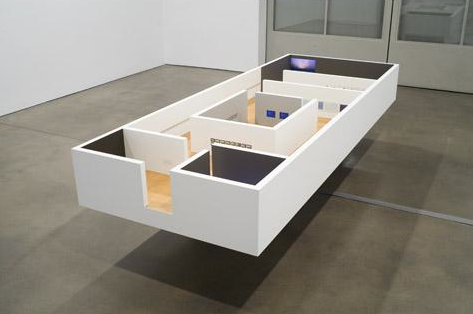
Walid Raad, “Scratching on Things I Could Disavow” at Paula Cooper Gallery

Walid Raad, "Part I_Chapter 1_Section 139: The Atlas Group (1989-2004)." Photograph courtesy of the artist and Paula Cooper Gallery.

The Arab world has recently jumped on the global art bandwagon with a spate of new fairs, biennials and galleries, but Walid Raad is less than enthusiastic. His jam-packed résumé makes him an unlikely candidate to critique the forces of globalization, but surprisingly, this show of new sculpture and work on paper—subtitled “A History of Art in the Arab World/Part I_Volume 1_Chapter 1 (Beirut: 1992–2005)”—cynically argues the powerlessness and conflicted interests of artists.

In text accompanying a sculpture of a miniature exhibition space installed with pint-size versions of his work, Raad asserts that his entire oeuvre mysteriously shrank the moment he agreed to show it in his vast Beirut gallery. The premise is absurd, but the message cautionary: Participation in the system comes at the cost of meaning.

Artists are bypassed as active parties in the exhibit’s two other main pieces. A wall text and photo essay are based on telepathic communication from misguided future artists, who long for an authoritative, editing hand. Elsewhere, a collection of pages from various publications purports to demonstrate the fanciful notion that during the Lebanese wars, compositional elements—color, line, shape—became refugees, hiding in the text and format of various documents and ephemera.

Raad’s critiques are so tangential, his story lines so elaborate, that he doesn’t quite get around to concrete hypotheses on how conflict shapes aesthetics. But if his own resistance is a catalyst for other artists to ignite a new flurry of art activity, one couldn’t hope for more.

Originally published in Time Out New York, issue 740, December 3-9, 2009.

Nick Mauss at 303 Gallery

Nick Mauss, "Insert," 2009. Photograph courtesy of 303 Gallery, New York.

For his first solo show at 303, Nick Mauss takes a decisive step away from his best-known earlier work—paintings of dandyish figures adrift in lush fields of color—with minimalist sculpture and stark, etchinglike compositions on silver leaf. Somewhere between an attack on history and self-editing in overdrive, the work makes explicit the frustrations involved in the impulse to communicate.

Though his approach is nearly abstract, Mauss takes pains to invite viewers into his universe. A huge sheet of paper hung to suggest a doorway, then torn open, stands near the gallery entrance, ushering us into the show. Beyond it, a house-shaped framework suspended from the ceiling surrounds a slide projector showing blank slides, continuing the metaphor for transparency but literally and conceptually offering little substance.

Both feel like mere stage setting for the panels, rife with subject matter yielded grudgingly. Because the works are positioned at awkward viewing heights against the gallery wall, it’s easy to miss the occasional vessels, mythological characters or beasts that remain after the artist distressed the surface to reveal a void of black paint under the silver leaf. The vigorous scratch patterns nearly obliterate the sketchy figures, evoking an aura of vandalized archaeological treasures. This subtle attack on icons of ancient art history also recalls Rauschenberg’s erased De Kooning drawing, but Mauss’ idiosyncratic selection of subjects suggests something more personal, like burning a diary or sketchbook. While he doesn’t always strike a proper balance between emulating the past and wanting to eradicate it, his bold marks on delicate panels are an admirably decisive act.

Originally published in Time Out New York, issue 739, November 26 – December 2, 2009.