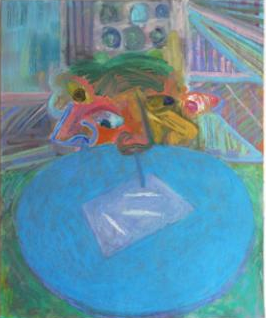
Scott Reeder, “Painter” at Daniel Reich Gallery

Scott Reeder, "Cubist Cokehead (Blue Table)," 2009. Photograph courtesy of Daniel Reich Gallery, New York.


Last spring’s late-Picasso blockbuster at Gagosian Gallery posited the nonagenarian as a potential role model for young artists today, a suggestion only partially rebuked by Scott Reeder. Reeder likewise takes sex and death as themes, but while Picasso raged, Reeder cracks jokes. With his characteristic slacker painting style and irreverent humor, Reeder’s work demonstrates just how wide the gap is between the 20th-century canon and the contemporary artists who appropriate it.

To his credit, Reeder isn’t anxious at all about the influence of modernism: His transformations of the subjects of classic Cubist portraits into coke whores, for instance, are funny. (After all, what are all those noses good for?) But while Duchamp’s addition of a mustache to the Mona Lisa was a groundbreaking act of cheek, Reeder’s alteration of Duchamp’s Nude Descending a Staircase into Cops Ascending Staircase seems like a cheap knockoff.

The entire show feels saddled with a pre-recessionary tone of sex and binge drinking, though Nickel & Dime (End of the World)—showing the two coins flanking a mushroom cloud—does convey an ominous vibe in keeping with the current economic meltdown. Still, if Reeder’s images illustrate anything, it’s that the more things change, the more they stay the same. Basically superficial, sometimes juvenile, Reeder’s paintings refuse to take life or art too seriously, which may limit their staying power, but makes for an entertaining show.

Originally published in Time Out New York, issue 725, August 20-26, 2009.
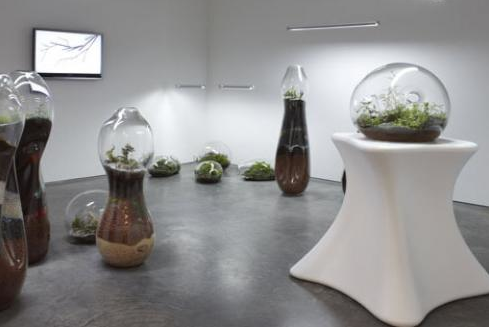
Paula Hayes Installation at Marianne Boesky Gallery


Paula Hayes, "Excerpts from the Story of Planet Thear" installation view, 2009. Photograph courtesy of Marianne Boesky Gallery, New York.

The abundantly planted new High Line, a hydroponic vegetable garden in Eyebeam’s windows, and now landscape designer/sculptor Paula Hayes’ terrariums and rooftop plantings testify that in Chelsea, green is the new black.Though Hayes’ resume includes gardens for prominent dealers and collectors, giving her plenty of art world cred, her work appears as much on terraces as galleries, and her primary media are plants and pots, begging the question of how vegetation becomes art.

Gardening has figured in the work of artists from Monet to Carsten Holler, but Hayes’ natural arrangements are an end in themselves.In undulating glass vessels roughly pedestal height, collections of tiny plants present nature as luxury object.Tiny succulents, or the fronds of a mini-fern are exquisite – a kind of maison du chocolate for greenery.Add the thrill of behind-the-scenes access to the gallery’s private rooftop installation, and taking in Hayes’ work can be a heady experience, inspiring wonder at the natural world and our ability to create beauty.

Unfortunately, Hayes doesn’t allow her terrariums and sculptures to stand on their own, introducing a thin storyline about a quasi-human gardener.On the roof, superabundant white sticks and a scattering of blue stones try for magical but come across as tacky.Part of the intrigue of Hayes project is the contrast between her organic-shaped planters and their glaringly synthetic materials – think of a small tree wearing a big blue sock over its roots.Such connections between plants and people – also evident in upright, body-shaped terrariums, or living, plant ‘necklaces’ – turn gardening from hobby to art form.

Originally published in Time Out New York, issue 722, July 30 – August 5, 2009.

“The Female Gaze: Women Look at Women” at Cheim and Read


Louise Bourgeois, Couple, Photograph courtesy of Cheim and Read, New York.

What is the ‘female gaze?’According to this show, it’s a category as wide-ranging as it sounds, running the gamut from riotous to reserved, racy to prim.In forty-one paintings, photographs and sculptures of female subjects by female artists, we’re repeated faced women demurely averting their eyes, but also find ourselves the objects of scrutiny by stony-faced characters.

In the front gallery, Diane Arbus and Julia Margaret Cameron promote voyeurism through their choice of subject matter.The former offers up a delectable young blond; Cameron, on the other hand, presents the quintessential ‘still waters run deep’ romantic type.Cindy Sherman skillfully mimics the slightly dopey Cameron look in her self-portrait, making her wistful character appear bland.

A graphic sex scene by Joan Semmel, rendered in lurid purples and pinks, is joined by a soft focus Lisa Yuskavage playmate and a coupling couple by Louise Bourgeois –all boisterously embodying the main gallery’s theme of pleasure in looking and being looked at.Pleasure meets pain in sexually derogatory texts presented by Jenny Holzer and Marina Abramovic’s self-abuse by hairbrush.The variety of approaches in this smart show, ripe with formal and conceptual connections, reinforce the idea that there’s no such thing as detached viewing.