Paul Morrison at Cheim and Read

Paul Morrison, "Cultigen," 2007. Photograph courtesy of Cheim and Read Gallery.

Flower painting may have sustained two centuries of Dutch artists, but Paul Morrison’s latest solo show suggests he’s maxed out on the genre. After a decade of producing black-and-white landscapes dominated by schematically rendered flora, Morrison has decided to add figures and a splash of gold leaf. Still, like his repertoire of cartoony dandelions and mushroomlike trees, the new material doesn’t communicate much beyond a noirish mood.

One of the show’s best pieces crowds a 19th-century Alice in Wonderland look-alike, a giant Disneyfied daisy and something suggesting an exploding pinecone into a small canvas with dizzying, psychedelic effect. Similarly, a work featuring the moon’s reflection in water, morphing into a sinister ghost, makes for a striking design. But the human subjects in two other paintings—a young Elizabethan noblewoman in a Bambi-esque woodland, and a pouty top-hatted schoolgirl in profile set against bleak pines—are just stand-ins for their floral counterparts.

The girls’ anonymity and their fakey surroundings don’t reward speculation about who they are or what they represent. Unlike Walton Ford, whose meticulous renderings of the animal kingdom reveal as much about human attitudes as animal life, Morrison’s conceptual gambit stops at juxtaposing historical and contemporary images of nature, while throwing in evocative but unrelated titles culled from botanical terminology. Allusions to the subjectivity of taste—exemplified by two huge,elegant dandelion sculptures in the show—are so common in contemporary art that Morrison’s next move will have to be more radical to be relevant.

Originally published in Time Out New York, March 12 – 18, 2009.
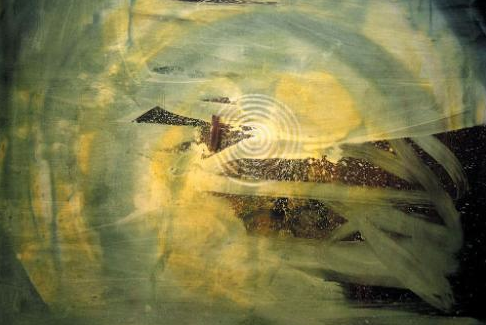
Erik Lindman, “House Wine, House Music” at V&A Gallery

Erik Lindman, "17 days, 17 long nights...but slow," 2008. Photograph courtesy of V&A Gallery, New York.

Erik Lindman can’t make up his mind to play it straight as an abstract painter or follow a conceptual path. And who can blame him? At age 23, he still has time to mull things over, though three moody canvases in his gallery debut are a cut above the other ephemeral objects on display. Colorful and complex, they’re enough to add him to a growing cadre of young painters reinvigorating abstraction.

A small photo—of a storefront window covered with torn notices and paint smudges—is the show’s Rosetta stone, directing viewers to look for evidence that the paintings were also added to over time. Lindman pays homage to those who came before him (Pat Steir, Jasper Johns), but he’s so intent on leaving traces of the significant labor put into each canvas that they’re in danger of looking overly manipulated.

Lindman’s inspirations are interior and graphic design, and while he’s careful to mask them, at least one add-on to the show tips his hand: A curvy wicker stool sitting before a painting in which the combination of circular motif with green-yellow haze creates a sense of intrigue. In the best piece, an expanse of ugly brown gives way to a triangular, rippled pattern of color, as if a subway poster had been torn away to reveal what was underneath. Rich with association, Lindman’s paintings don’t need their sources to be spelled out. They allow the pleasure of looking to be the final word.

Originally published in Time Out New York, February 26 – March 4, 2009.