Otabenga Jones & Associates, at Clementine Gallery

For ‘Time Out New York’ magazine,
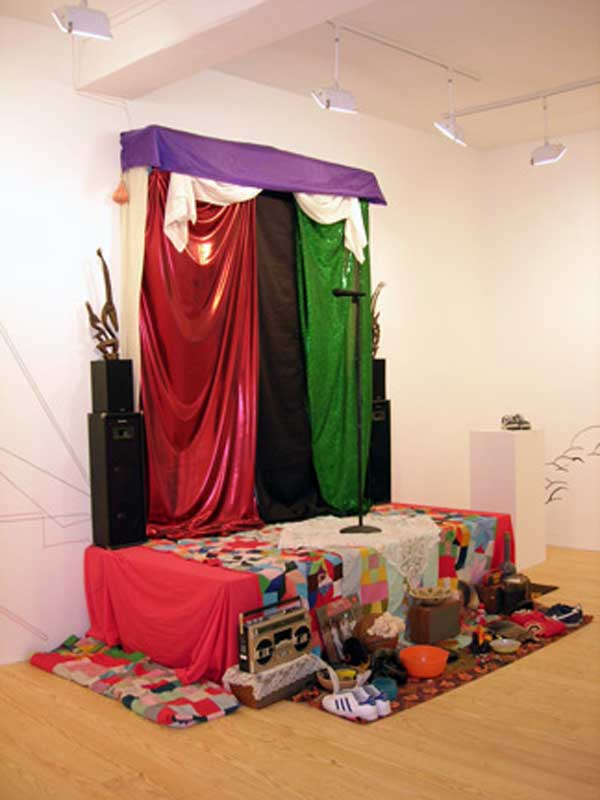
Otabenga Jones & Associates, Installation View, 'Symmetrical Patterns of Def', 2006, courtesy of Clementine Gallery

Otabenga Jones and Associates, a Houston-based collaborative that will participate in the 2006 Whitney Biennial, takes its name from an African pygmy who was put on display at the Bronx Zoo in 1906. As this detail suggests, the group is interested in the intersection of African and American history, specifically their own richly imaginative version of it as told in the show’s centerpiece: a sound installation recounting the outlandish story of Mudbone, a South Bronx MC who travels to the land of his ancestors during an out-of-body experience.

Mudbone’s tale is full of engaging magical-realist details (his crew shakes the earth as they walk to a competition; his hair takes on a life of its own and absconds). But the installation itself—a small stage decorated like an altar with a microphone; swags of red, green and black fabric; and offerings of junky items, including old sneakers and LPs—doesn’t do justice to the fabulous images conjured by the soundtrack. An amateurish wall mural, drawings and related sculptural objects feel like little more than a backup act for the main attraction.

We’re informed that Mudbone is empowered by knowledge of his ancestors, but the specifics of this revelation aren’t divulged. The tale’s ambiguity communicates an ambivalence about the possibility of constructing an African-American history. Inspiring historical figures like Harriet Tubman make cameo appearances in the tale but always in the confines of a stereotypical setting—either an urban ghetto or a forest’s dark interior. In the end, Otabenga Jones and Associates’ show hovers somewhere between an affirmation and an acknowledgment of futility.
Christopher Miner at Mitchell-Innes and Nash

For ‘Time Out New York’ magazine

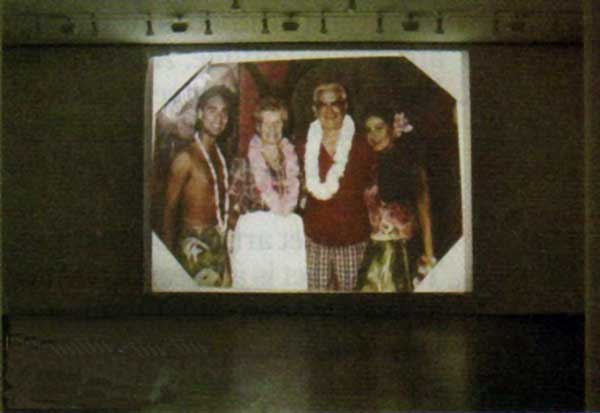
Christopher Miner, Still from 'The Best Decision Ever Made', 2004, Courtesy of Mitchell-Innes & Nash Gallery

‘How Beautiful Heaven Must Be’
You may never have heard it argued that Jesus had it easy. But, in one of two videos in his second solo show, Christopher Miner points out that at least the Son of God had a purpose in life, something the artist worries he doesn’t. Such unorthodox thoughts – and the total disregard for political correctness in his second video – indicate that Miner is unafraid to grapple with the hot-button topics of faith and race in America.

In ‘The Best Decision Ever Made,’ Miner trains his camera on the memento-filled rooms in his late grandparents’ house, while comparing their stable lives and happy marriage with his own endless string of jobs, girlfriends and homes. It’s a twist on the classic prodigal-son story: Miner leaves home dissatisfied and returns disillusioned, with no one to welcome him back into the fold. By the closing shot viewers are no wiser about the title’s “best decision” as the artist listens to a gospel song by another prodigal artist, Johnny Cash.

In the back gallery, Self-Portrait finds Miner sitting in a dimly lit room, paying the role of a foul-mouthed African-American man. In a rambling phone conversation, which includes a tirade about how wrong it is for “a white man to talk like a black man,” Miner creates a disturbingly complex closed circuit of self-portrait as self-censure.

Both videos employ monologues, a classic trope of introspection, but neither is gratuitously self-obsessed. Instead, they are at once brutally honest and confoundingly evasive, leaving viewers eager for more.