Ruth Root, at Andrew Kreps Gallery

For ‘Flash Art’ magazine
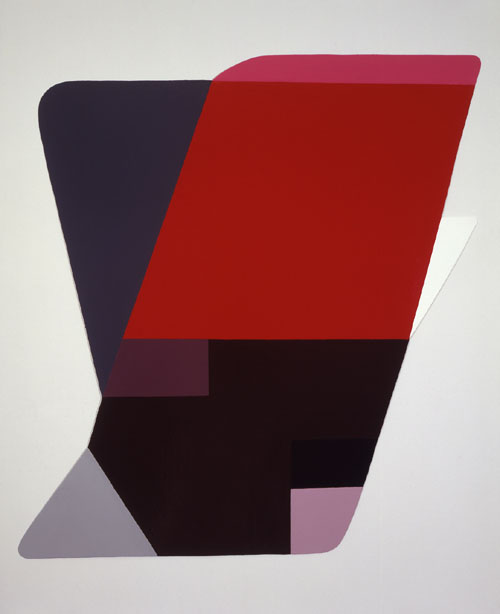
Untitled, 2002-2003, Enamel on Aluminum, courtesy Anrdew Kreps Gallery

Ruth Root’s paintings have reached their ‘mature-cute’ phase. Spread out evenly along the gallery walls, ten new pieces flaunted a grown up sophistication, with their hyper slick surfaces and tightly controlled geometric divisions. Gone were the little eyes and the smoking cigarettes that characterized previous work, and the hanging was arranged, with a few exceptions, in a traditional way. The paintings may be on their best behavior, but plenty of quirky touches in the relation of form and color still lent a mischievous character to the compositions.

Each untitled painting was an assemblage of overlapping rectangular, square and triangular shapes in various shades of purple, gray and orange with accents of yellow. All had an aerodynamic quality, with rounded edges and were hung flush against the gallery wall. One untitled piece had the look of an airplane fin or an Ellsworth Kelly painting jazzed up with more color. The rounded contours of another evoked the shape of a cartoon speech bubble, waiting to be filled by a jokey text. But what really gave the pieces their idiosyncratic, ironic character were the little blocks of color that appeared out of nowhere, usually accenting the edge of the paintings. Their diminutive size and outrageous colors gave them a cheekiness that pervaded the whole show.
Liam Gillick, at Casey Kaplan

For ‘Flash Art’ magazine

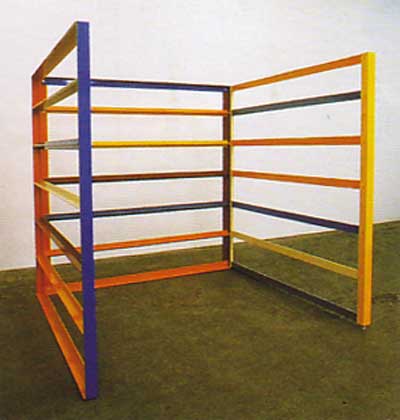
Liam Gillick, Reconciliation Corral, 2003. Installation view, courtesy Casey Kaplan

Liam Gillick offered a new take on glitzy art openings by washing the floor of Casey Kaplan’s gallery with cheap vodka and covering it with black glitter. Visitors tracked the sparkly stuff into the main space, where a row of aluminum corrals as colorful as jungle gyms faced a line of black text on the wall opposite. Arranged in a broken Greek key pattern and missing the usual colored Plexiglas panels, Gillick’s architectural sculptures tempted viewers to interact with them. On the wall, a repeated text reading, ‘sit now on a ridge,’ referred to a journey described in the artist’s recent book, ‘Literally No Place’ (a translation of the word utopia), which in turn was inspired by behavioral scientist B.F. Skinner’s proposals to alter human behavior through environmental stimuli.

Without reading Gillick’s book, which was not part of the exhibition, it was next to impossible to understand what was taking place, particularly with the unnecessary glitter and vodka element. The show was elegant but so highly conceptual that viewers who bought the book instead of the art came out ahead. Gillick’s signature retro-chic sculptures are meant to provoke discussion about how the built environment effects human thought and behavior, but it’s only in his writing that these complex investigations into social science are developed. Structured as a series of proposals for fictional stories, the book forces the issue of how space is constructed, and it’s here that the audience is taken ‘literally some place.’

Robert Wogan, at UCU

For ‘Tema Celeste’ magazine

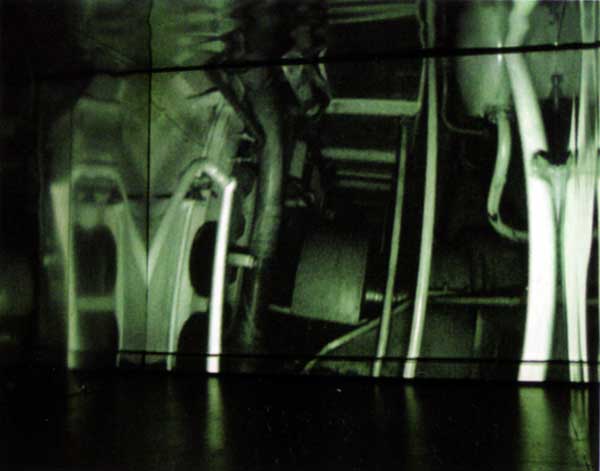
Robert Wogan, Below (United Radiance), 2003, Video Projection, Sound, Installation View

A low light bobs along a gangway in the belly of an abandoned cruise liner accompanied by the sound of heavy breathing and footsteps. It could be a scene from the film Ghost Ship, but it’s a video installation by Robert Wogan, featuring footage from the lower decks of the decommissioned SS United States. The artist made his way through room after room of mechanical apparatus, filming a journey that never seems to end. In a loop lasting just under an hour, Below (United Radiance) perfectly recreated the experience of being lost, complete with a sense of deja vu. It also documented a fall from glory by what was once the fastest and largest ship in the world.

To reach the video at UCU, viewers had to wind their way through two corridors that partially recreated a more elaborate installation from the Liverpool Biennial 2002. The metal-clad gallery walls didn’t come close to reproducing the alien atmosphere of the ship, but did transport viewers into an unfamiliar environment. The video was almost immediately disorienting and at times slightly dizzying as it followed Wogan’s unrelenting progress, never stopping to explore a room or plan a route. While the scenario would be perfect for a horror movie, the artist didn’t hesitate long enough to make his footage scary. Instead, his steady march suggested that the point was not to find a way out, but to cover as much territory as possible.

As the camera delved further and further, the ship’s enormity became apparent. At over five city blocks in length, it was unsurpassed in size and speed when it embarked on its maiden voyage in 1952. Ironically, this was also the year of the first jet airliner, an innovation that essentially paved the way for the ship to go out of service less than twenty years later. Below (United Radiance) is an exploration of loss on an industrial scale, a subject that many contemporary artists explore. The uniqueness of Wogan’s project lies in his selection of an American icon that was once world-renowned, the epitome of progress, but which now languishes in obscurity. In a unique plot twist, during the run of the exhibition, Norwegian Cruise Line bought the ship in order to renovate and recommission it. A tidy story of progress and decline is disrupted as Wogan’s documentary approach reminds us that life doesn’t stop when the cameras do.