Gregory Crewdson, at Luhring Augustine

For ‘Flash Art’ Magazine
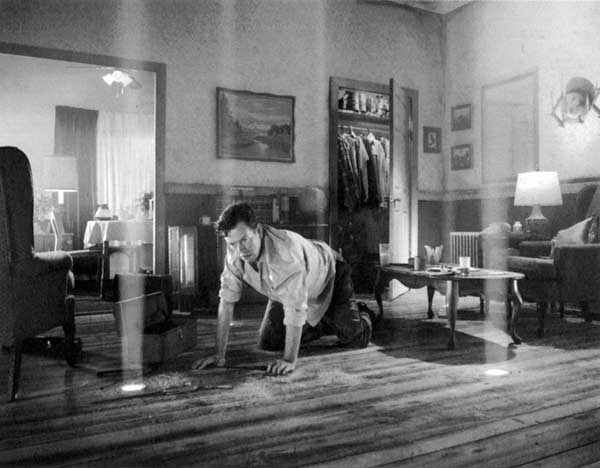
Gregory Crewdson, Dylan Floor, 2002. Photograph.

Gregory Crewdson grew up in Brooklyn, far removed from the wooded hills and neatly mown lawns that provide the backdrop for his photographs of small town America. The distance is all the better to spur his imagination as he creates the highly detailed scenes that have been compared to stills from an alien abduction film. This is the second solo show of work from the ‘Twilight’ series, on which the artist has worked for four years, and which was shot in the waning daylight or at night. In each photo, individuals or groups of citizens stand frozen in time, pausing in disbelief at some supernatural intervention or freak occurrence.

The new photographs still evoke an eerie ‘not quite right’ feel but with a fairy tale twist. In one scenario, a man has just abandoned his car, stripped out of his drab brown suit, and started to climb a gigantic flowering vine. Elsewhere, a strong searchlight (or alien spacecraft’s tractor beam?) cuts through the night illuminating a sky full of butterflies. During the day, dazed young people construct a mountain of flowers in the middle of the street. Prompted by the unnatural events, some characters lose their inhibitions or senses, like the nude and dripping wet, mother who enters the dining room while her husband and two teenage kids finish dinner.

The recent pictures lack the gore and direct menace of some of Crewdson’s earlier photographs, in which decaying human and animal bodies were not uncommon. The one cadaver that does turn up is that of a young woman, in a classic Ophelia pose, floating face up in a flooded living room. In general, the photographs are beautifully lit and the subject matter is tantalizing, but the townspeople seem to have lost their ability to respond. They are alive but stunned; there is little action and almost no emotion evident on their faces, which does nothing to create sympathy in the viewer. They wander stunned, like Hamlet’s Ophelia in her insanity before she drowned, their blank stares proving King Claudius right when he said, “Poor Ophelia. Divided from herself and her fair judgment without the which we are pictures, or mere beasts.”
Jason Meadows, at Tanya Bonakdar Gallery

For ‘Flash Art’ Magazine

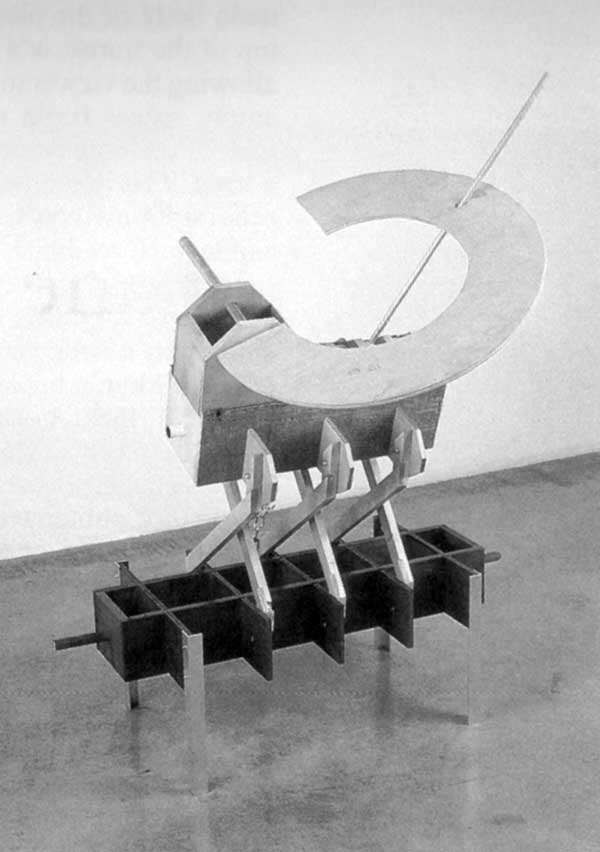
Jason Meadows, Protagonist, 2002, Wood, Aluminum, Hardware and Paint, 152 x 86 x 116 cm

Five years ago, the sun rose on a group of young sculptors from L.A. who shared nothing so much as a new look. Jason Meadows was one of the promising talents with a willingness to experiment with modernism and a gift for crafting objects at once familiar and strange. From this initial impulse, Meadows kept the momentum going with ‘Microcarving,’ his second solo show at Tanya Bonakdar in as many years.

The new work breaks loose from the strict minimalism and control of his previous sculpture and supplies plenty of evidence of the artist’s hand and his trips to the hardware store. Unhidden nuts and bolts, wooden joints taped together and hardware with the manufacturers labels still stuck on, along with frequent use of a black marker pen create a tension between the overall impression and the ‘micro,’ surface details.

Most of the sculpture is at the average human height (150-170 cm) making intimate viewing easy, and the shapes sometimes mimic the human form in a way reminiscent of Modernist sculptor David Smith. ‘Soldier of Fortune’ and ‘Upskirt’ are horizontal constructions of wooden beams, the former rough and tumble with protruding nails, the later involving a small square platform on wooden ‘legs’, draped by a canvas suggesting a dangerously short skirt.

Canvas reappears on the floor under ‘In the Process of Becoming’, a three-legged construction suggesting an artist’s easel with a shelf holding a Polaroid of a barred window in the artist’s studio. Is the angst-ridden ‘prison window’ and the triumph of the easel as it rests on top of canvas an ironic take on the creative process? Sculptures like ‘Albatross,’ in which a jaggedly cut piece of white, laminated composition board replicates ruffled feathers, suggest that Meadows is a playfully self-aware artist. But one thing is clear. Unlike the ancient mariner who wears the albatross around his neck for his sins, Meadows’ sculpture doesn’t languish in the doldrums.