Huang Yong Ping, at Barbara Gladstone

For ‘Flash Art’ magazine
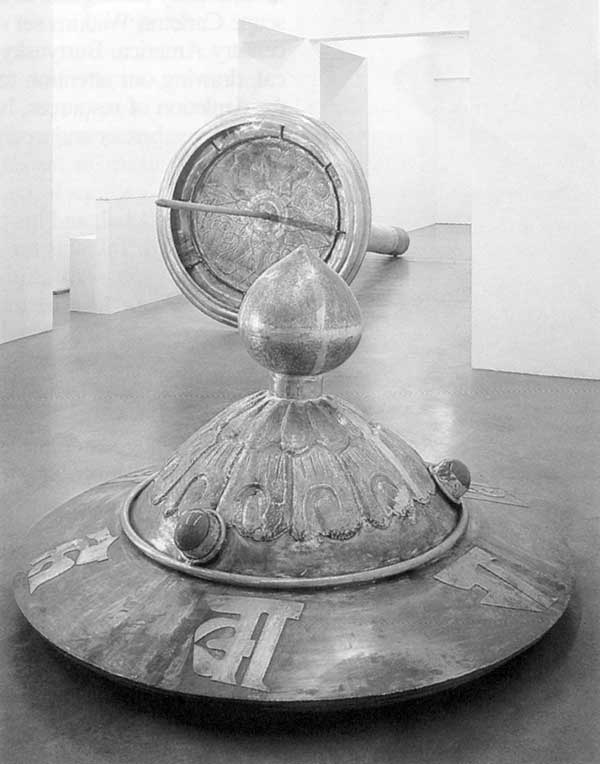
Huang Yong Ping, Om Mani Padme Hum, 2001. Wood, copper, bronze, and burnt paper

Since ancient times, Buddhist civilizations have erected monumental sculptures like the cliffside Buddhas destroyed last year in Afghanistan. Carrying on the tradition in a distinctly avant-garde vein, Huang Yong Ping devised an ultimately unrealized project to install a 15 meter high Buddhist prayer wheel in the Christian Chapelle St Louis Salpétrière in Paris and surround it with Islamic tapestries. The enormous, dismantled wheel, and a scale model of the church are the basis for ‘Om Mani Padme Hum’, Huang’s latest New York show.

In Tibet, devotees spin handheld wheels in prayer. With Huang’s version, only a god-sized hand could wield the massive rod, made from an entire tree trunk. The rod and the lid occupy one room, while the circular drum housing a giant scroll covered in written prayers rests on its side in the back gallery. Two spiraling scrolls, one a Tibetan sutra and the other a text from the Koran, descend from the ceiling and a scale model of Salpétrière with motorized wheel rests on a Persian carpet. A modern version of an ancient chariot and a long scroll complete the exhibition.

Huang’s use of monumental scale is not unprecedented in his work. Nor has he shied away from overtly Buddhist imagery, once combining a bottle rack structure on the order of Duchamp, with 50 pairs of arms to create a version of the multi-armed deity Guan-Yin. Since his involvement in the radical Xiamen Dada group in the late 80s, Huang has strategically incorporated Western ideas into his Buddhist influenced philosophy. But given the artist’s past attack on the West’s self-perceived hegemony, it doesn’t seem likely that he is hoping for the reconciliation of three different faith systems by simply placing their symbols in proximity to each other. In previous work, Huang has often used insects and reptiles, often enclosing them together, forcing them to kill or be killed. Considering that the creatures were intended to represent different cultures, the Salpétrière project may be the subversive opposite of a wish to homogenize the world’s religions.
Adreana Arenas, at Roebling Hall

For ‘Tema Celeste’ magazine

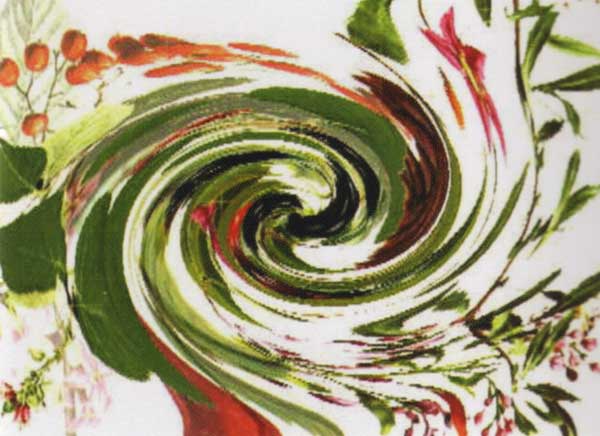
Adriana Arenas, The Precious Stone & Gold Factory - Twirling Flowers, 2002, 1 hour DVD disc and LCD Monitor, 16.5 x 11.4 x 12.7 cm

“Sublime soul of my being, my future with you is a pleasure,” croon the musicians of El Binomio de Oro. These sugary Spanish-language lyrics greeted visitors entering The Precious Stone and Gold Factory, an installation originally commissioned by Rice University Art Gallery in Texas. Arena’s trademark use of vallenato, the folk music of her native Columbia, set the mood for an adventurous show full of wistful meditations on romance and storytelling.

The music was accompanied by a small wall-mounted monitor that displayed not images of the band but the lyrics of the song “Full of You,” translated into English. On another monitor, flashes of lightning periodically shattered a perfect night sky full of twinkling stars. The presence of these stars during a storm was as mysterious as the unexplained dazzling light that appeared in a short video projected against a gallery wall. Shot at sunrise on a beach, the clip featured a beam of light on the horizon that was brighter than the rising sun. Both scenes served to introduce the short story that was at the heart of the exhibition: Using Dramatica, a software program used by writers to generate story outlines, Arenas concocted a narrative about a man who, suffering from unrequited love, exiles himself to the countryside, where he invents a machine to manufacture gems from the beauty of nature. On the back walls, three small monitors and three digital prints tracked the transformation of flowers, berries, and buds, sucked into a spinning vortex and released as sapphires, diamonds, and rubies.

The relationship between El Binomio’s lyrics and a story in which the countryside gives up precious stones for a clever inventor is hard to pin down but evocative. Perhaps the Golden Duo (a rough translation of the band’s name) was mining the language of the Latin love song to come up with its lyrical gems. In light of the fact that the lover serenaded in vallenato is considered by some to represent the homeland, Arenas seems to be making love to her native country while realizing that her recollections of its beauty are seen through the soft-focus lens of nostalgia.

From the Observatory, Curated by Robert Nickas, at Paula Cooper Gallery

For ‘Flash Art’ Magazine

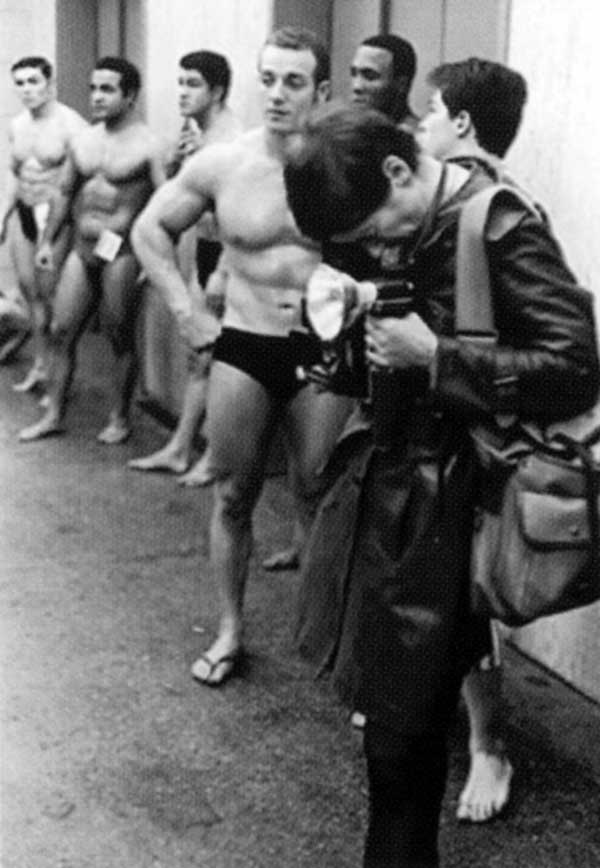
William Gedney, Diane Arbus Photographing Body Builders, NY, c. 1968, 1967, Vintage Gelatin Silver Print

Like good art, a well-curated exhibition makes some suggestions and then allows viewers to draw their own conclusions. The selections in this 35-artist, intergenerational show were sometimes idiosyncratic but never dull. The earliest artwork was Gene Beery’s 1961 painting reading ‘Sorry, this painting is temporarily out of style – closed for updating…” Located in the reception area, it set the tone for a show that makes thoughtful comparisons between art by established and emerging artists without chasing the fashion of the day.

John Miller’s eerie mannequin also subverted fashion and, positioned near the gallery windows, attracted attention from the street. Its physical presence was echoed in Sam Samore’s two-way mirror piece composed of the “room, viewers, interiority, exteriority, etc.” Mirroring was everywhere, with a mirror in the shape of a Rorschach by Kelley Walker, tree roots on a mirror by Sam Durant and a Roy Lichtenstein mirror painting.

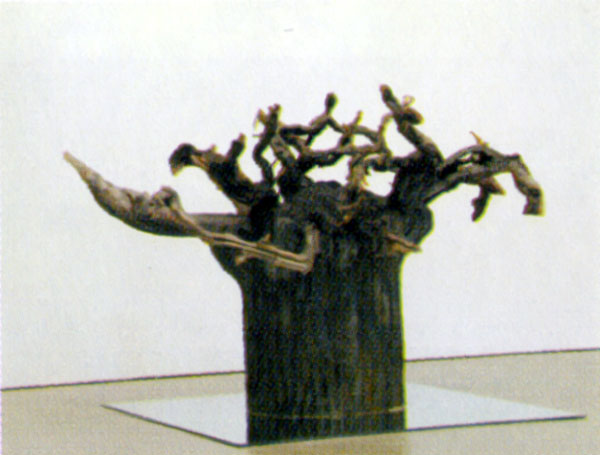
Sam Durant, Study for Strange Fruit, (Upside Down Tree, Southerrn Tree, Tree of Knowledge, 2002.  Mixed Media with Tree Root and Mirror
Sam Durant, Study for Strange Fruit, (Upside Down Tree, Southerrn Tree, Tree of Knowledge, 2002. Mixed Media with Tree Root and Mirror

The only color photography came in the form of orchids by Sherrie Levine and a sandcastle photographed by Wolfgang Tillmans, while black and white photojournalism by Diane Arbus, William Gedney, and Peter Hujar took center stage. A mysterious nighttime view of a Disneyland castle by Arbus contrasted with Tillmans’ beach scene, and a photo of a body builder by Arbus was complimented by Gedney’s picture of Arbus taking these shots.

Seven large paintings, hung salon style on the back wall of the gallery’s cavernous space, were a visual highlight of the show. What at first looked like one of John Tremblay’s frisky abstract paintings turned out to be a yellow and black Infinite Dot painting by Yayoi Kusama, while a Trembly in muted tones hung above. Next to these, an enormous date painting by On Kawara contrasted the open-ended possibility of the Kusama and Tremblay with its blunt statement of a single date.

It’s not always evident what curator Bob Nickas was intending by his eclectic mix. He admits that he curates “…as if free-association was an accepted curatorial/art historical tool,” explaining, for example, that Sherrie Levine appears because she is foundational to contemporary art in general. Lisa Ruyter’s day-glo jets are included because she invigorates her painting by working from her photographs rather than her having any specific aesthetic affiliation to the art on the walls around her. But as an exploration “from the observatory” into the deep space of contemporary art, Nickas provides enough connections to suggest a bigger picture, while still keeping us gazing with curiosity.