During the COVID-19 pandemic, Tokyo-based artist Yuko Mohri was drawn to materials that would change or, as she puts it, be as unstable as people’s lives were at the time. Her current sculpture, installation and painting at Tanya Bonakdar Gallery in Chelsea continue to explore the creative possibilities of impermanence in surprising ways; in this sculpture, electrodes attached to the fruits on the table measure changing moisture levels that are translated into data that cause the hanging lightbulbs to turn on and off. In other works, the decomposing fruits create sounds that echo though the gallery and remind viewers of forces (decay, sound) that are invisible but active. (On view in Chelsea through April 18th).
Yuko Mohri, Decomposition, vintage table, speakers, lights, 3-channel audio generated by fruits, and 3 LED lights dimmed by fruits, 26 x 23 ½ x 24 inches, 2026.
Titled ‘Meta-Painting,’ Korean artist Kimsooja’s exhibition at Tanya Bonakdar Gallery questions the essence of painting via an installation of unpainted panels and a light-absorbing black orb. In one of the gallery’s main spaces, raw linen on stretchers hang from the ceiling while the artist’s signature bottari (a cloth bundle referencing the act of packing one’s belongings in bedclothing) rest nearby. Kimsooja speaks of both panels and bundles as paintings, though they were not made with paint, much as Deductive Object – a welded steel oblong covered in paint that absorbs ambient light – has presence in its own gallery yet has boundaries that are difficult to perceive. Linked to the Brahmanda stone of Indian origin, this mysterious object hints at profound mysteries of life. (On view through June 14th).
Kimsooja, Deductive Object, painted welded steel, mirror, wood, 72 x 43 ¼ x 43 ¼ inches, 2016.
Kelly Akashi’s poetic assemblages of sculpture in glass, stone, bronze and rammed earth at Tanya Bonakdar Gallery heighten awareness of her materials and processes while juxtaposing human concepts of time with comparatively vast measures of time on earth and in the universe. Here, the glass sphere titled ‘Cosmic Axis,’ brings to mind the axis around which the earth rotates while also alluding to the connection between heavenly and terrestrial realms. Surrounded by photos of distant nebula taken by telescopes, the sculpture feels especially present in the space of the gallery, its delicacy contrasted by a large concrete pedestal and enhanced by cherry blossoms on top that extend into the space of the sphere. (On view in Chelsea through June 10th).
Kelly Akashi, Cosmic Axis, Flame-worked borosilicate on rotating cast concrete pedestal, 77 x 22 x 22 inches, 2022-23.
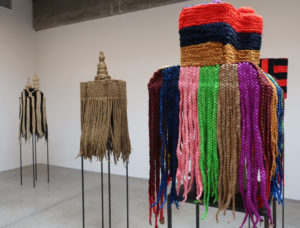
Buildings and monuments in the U.S. capital inspired Rotterdam & Benin-based artist Meschac Gaba’s latest synthetic-hair sculptures. Including (right to left) the White House, the U.S. Capitol and St John Episcopal Church, the sculptures represent a merger of African craft and sites of power. (On view at Tanya Bonakdar Gallery through July 28th).
Installation view of Meschac Gaba at Tanya Bonakdar Gallery, June, 2017 featuring at right, ‘White House,’ braided wig of synthetic hair, 35 x 20 x 14 inches, 2017.
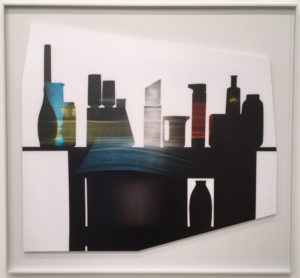
Inspired by the light in her adopted home-city of LA and by the still life arrangements of Italian painter Giorgio Morandi, Uta Barth employs everyday glassware as lenses. Transparent objects in various shapes, colors and combinations shift light to harness the properties of nature in service of art. (At Tanya Bonakdar Gallery in Chelsea through March 11th).
Uta Barth, In the Light and Shadow of Morandi (17.03), face mounted, raised, shaped, Archival Pigment print in artist’s frame, 48 ¾ x 52 ¾ inches, 2017.
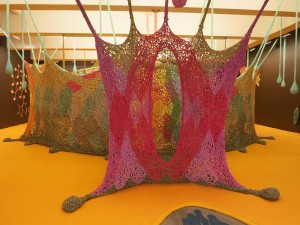
Brazilian artist Ernesto Neto opens a new chapter in his colorful immersive installations with this homage to the birth of humanity. Hand-crocheted hanging sculptures in the shape of a womb invite visitors to enter and walk back to a communal space with drum and guitar. Allusions to Adam and Eve in both western and indigenous Amazonian culture find common ground in the pursuit of knowledge. (At Tanya Bonakdar Gallery in Chelsea through Dec 17th).
Ernesto Neto, installation view of ‘The Serpent’s Energy Gave Birth to Humanity,’ at Tanya Bonakdar Gallery, November 2016.
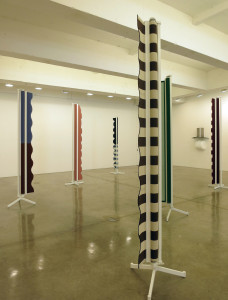
These assisted readymade sculptures by Nicole Wermers were inspired by awnings but have been fitted with custom textiles and turned to the side to create vertical columns. Their patterns recall post-war minimal painting a la Daniel Buren, but rolled up, their potential is hidden. (At Chelsea’s Tanya Bonakdar Gallery through July 29th).
Nicole Wermers, installation view of ‘Vertical Awnings’ at Tanya Bonakdar Gallery, June 2016.
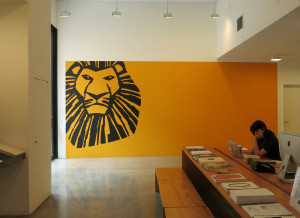
Haim Steinbach’s appropriated Lion King illustration takes over the office wall at Tanya Bonakdar Gallery, pitting a powerful creature against box office power against the power of immersion in the color yellow. (In Chelsea through May 27th).
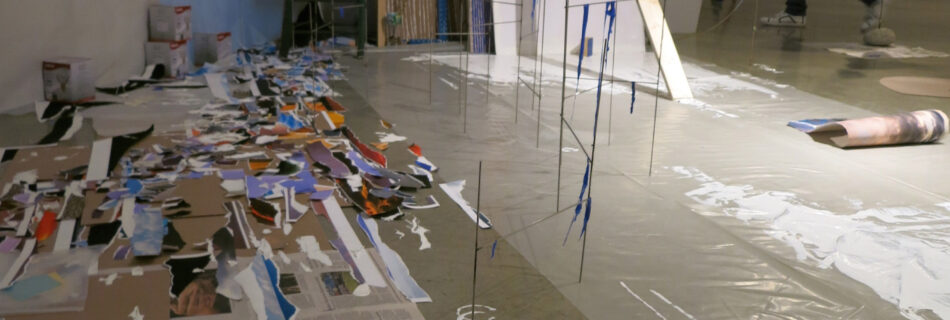
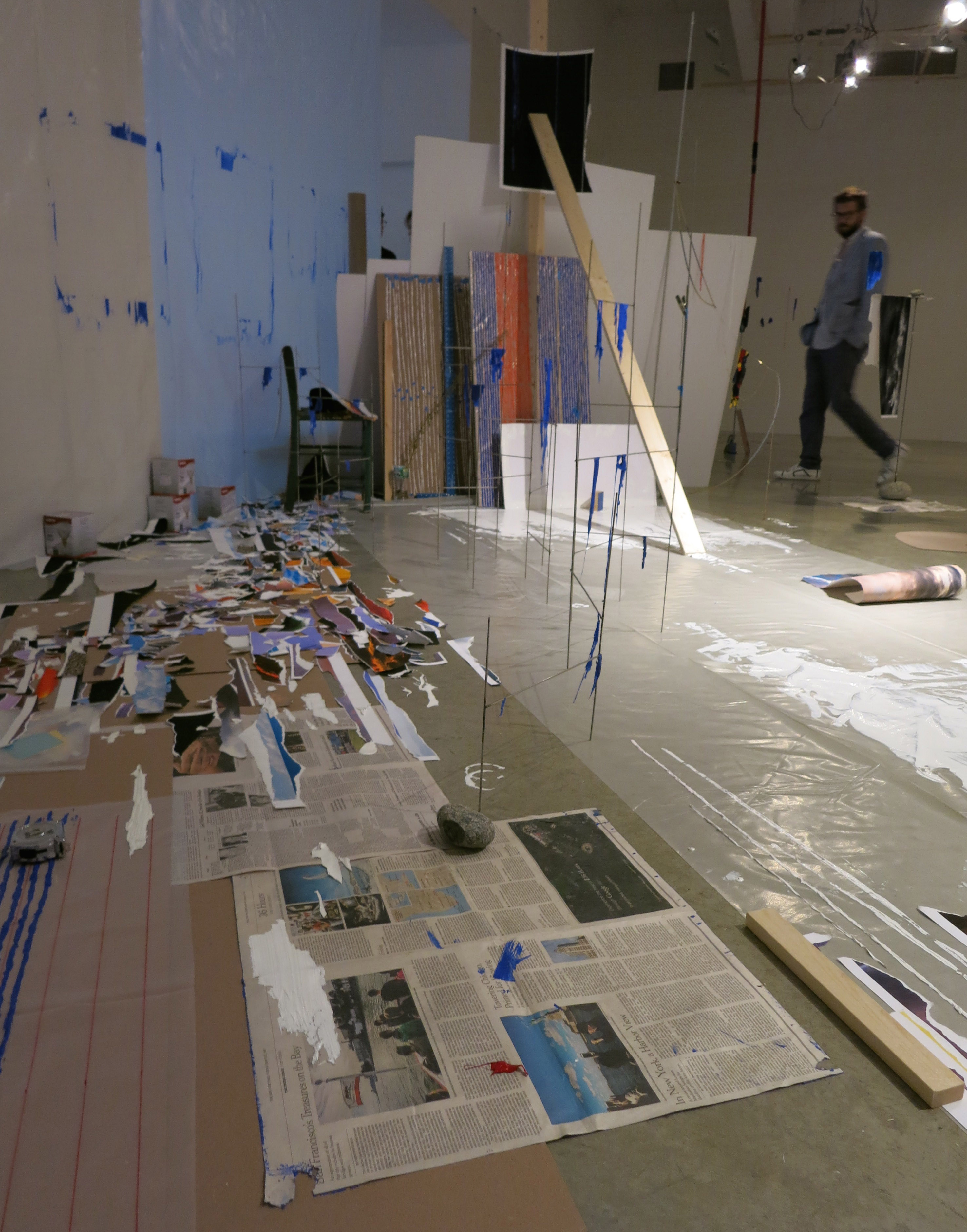
Sarah Sze’s installations have been characterized as organized chaos; her latest solo show aims to bring the mess and spontaneous decision-making of an artist’s studio into the gallery, yet the feeling of control is palpable. Torn paper, carefully spilled paint, and hanging sheets of plastic suggest a carefully arranged work in progress. (At Tanya Bonakdar Gallery in Chelsea through Oct 17th).
Sarah Sze, installation view at Tanya Bonakdar Gallery, Sept 2015.
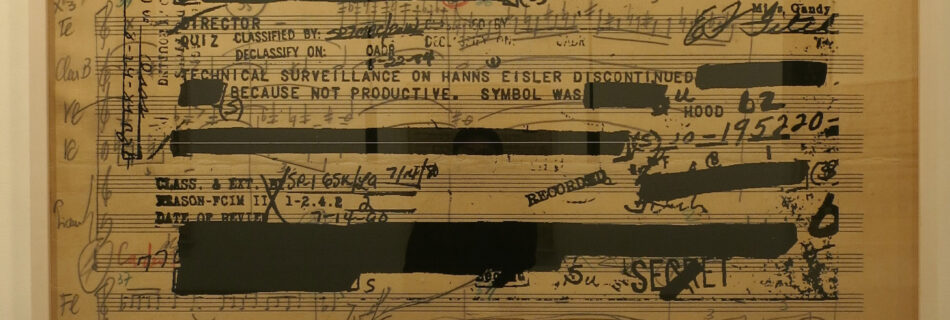
In British sound artist Susan Philipsz’s new installation at Chelsea’s Tanya Bonakdar Gallery, boldly redacted FBI documents overlay quickly penciled archival scores by composer Hanns Eisler. An LA-based refugee from Nazi Germany, his branding as a communist prevented his scores from accompanying Charlie Chaplin’s ‘The Circus.’ Here, wall-mounted documents like this one are joined by a 12-channel sound installation that plays selections from his film compositions, daring viewers to find a note of sedition. (Through Feb 14th).
Susan Philipsz, from the Part File Score series, digital print and silk screen print on canvas, 74 ½ x 59 x 1 2/3 inches, 2014.
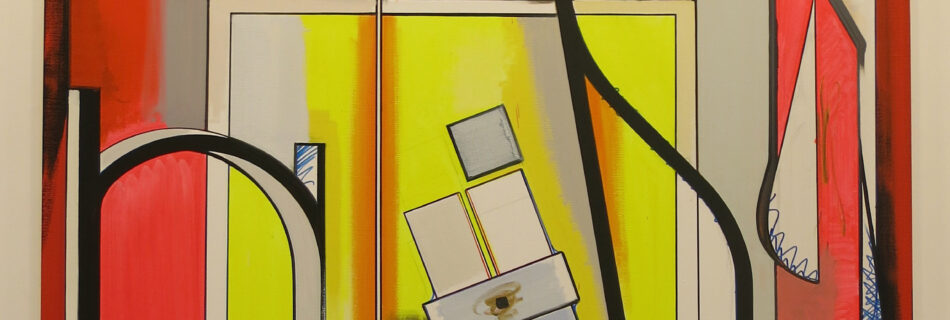
In signature strong colors and geometric abstraction, Berlin-based artist Thomas Scheibitz’s new painting series riffs on the endless possibilities for creativity in the artist’s studio. Here, a small table seems to support a letter, a number, various experiments and a giraffe-like form also resembling an electrical plug that energizes the whole arrangement. (At Tanya Bonakdar Gallery in Chelsea through Dec 20th).
Thomas Scheibitz, Studio Imaginaire, oil, vinyl, pigment marker on canvas, 114 1/5 x 70 7/8 inches, 2014.
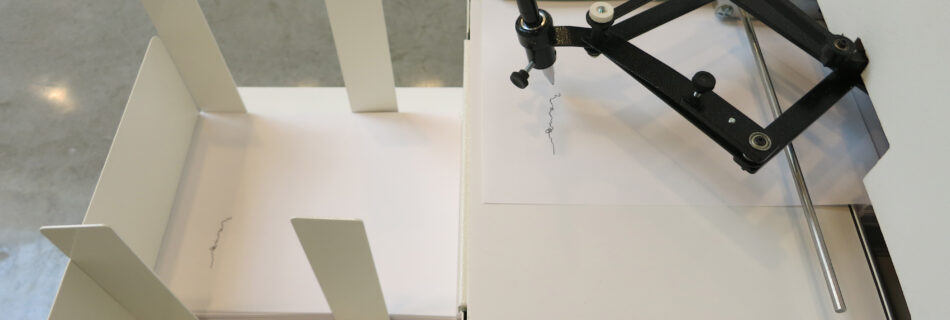
‘The End of Signature’ by New York based Polish artist Agnieszka Kurant compiles hundreds of signatures into one long scrawl, appearing on the gallery wall in black coloring on a long, tube and replicated by this machine. Kurant’s piece bears witness, neither critically nor enthusiastically, to the increase of typed communication and digital signatures. (At Tanya Bonakdar Gallery through Oct 18th).
Agnieszka Kurant, detail of The End of Signature, glass tubing, water pump, black coloring and water, installed with autopen machine, pillar of paper and ink pens, 2014.
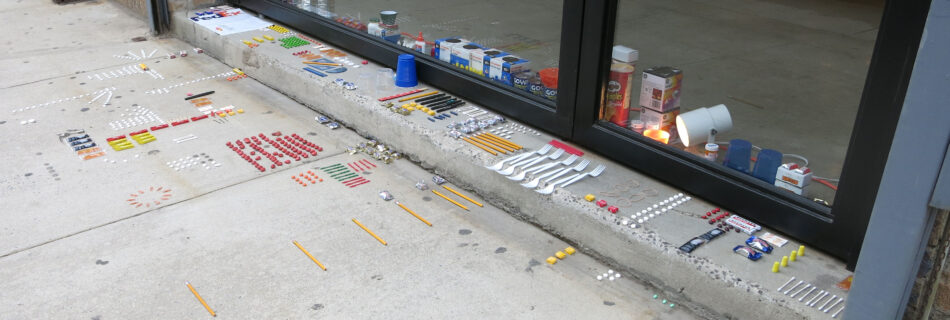
Last summer, Sarah Sze transformed the US Pavilion at the Venice Biennial inside and out with a super abundance of very precisely arranged objects. In Chelsea, Tanya Bonakdar Gallery celebrates 20 years with a group exhibition that includes a piece by Sze from 1997, originally situated by a Greek harbor. Pills, nuts, soy sauce packets and other ephemera of everyday life look like a strangely contemporary votive offering. (Through August 1st).
Sarah Sze, Untitled (Thessaloniki), mixed media, 1997.
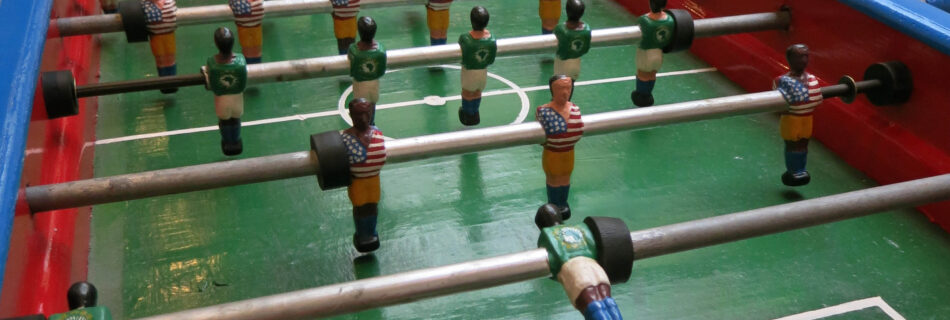
Netherlands and Benin-based artist Meschac Gaba’s first solo show in the US includes these gaming tables, handmade in Benin, that allow visitors to take geopolitics into their own hands…at least as represented by foosball. (At Chelsea’s Tanya Bonakdar Gallery through June 7th).
Meschac Gaba, installation view at Tanya Bonakdar Gallery (upstairs), May 2014.
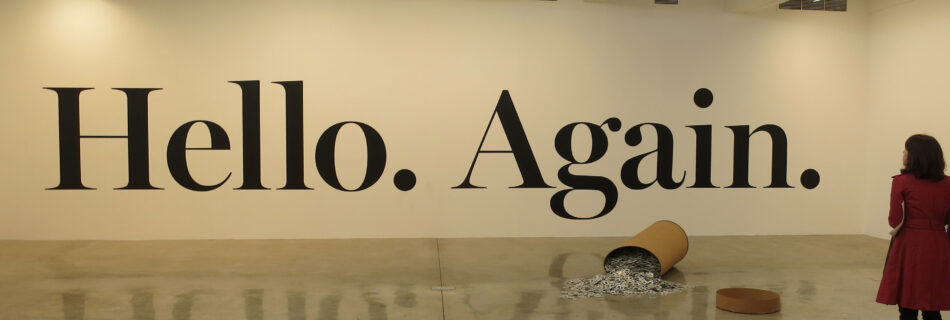
Known for his careful arrangements of consumer objects on shelves, New York artist Haim Steinbach samples readymades of a different kind in this text piece. Though the size of the greeting suggests it’s being offered at high volume, its punctuation implies a curtness lacking warmth. (At Chelsea’s Tanya Bonakdar Gallery through Feb 8th).
Haim Steinbach, ‘hello. again.’, text in matte black vinyl letters, dimensions variable, 2013.
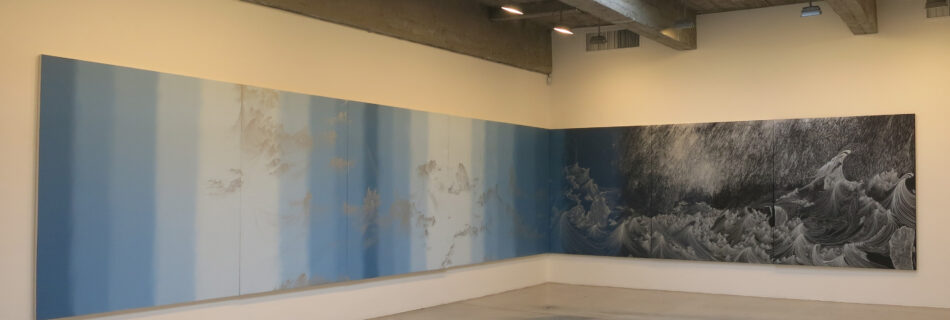
Given its subject matter and size, Brazilian artist Sandra Cinto’s thirteen meter plus pen and acrylic rendering of roiling seas is surprisingly subtle. As gradations of blue and white fog recede, what look like mountain peaks turn into frosting peak waves in a decidedly elegant storm scene. (At Chelsea’s Tanya Bonakdar Gallery through Dec 21st.)
Sandra Cinto, One Day, After the Rain, permanent pen and acrylic on canvas, 2012.
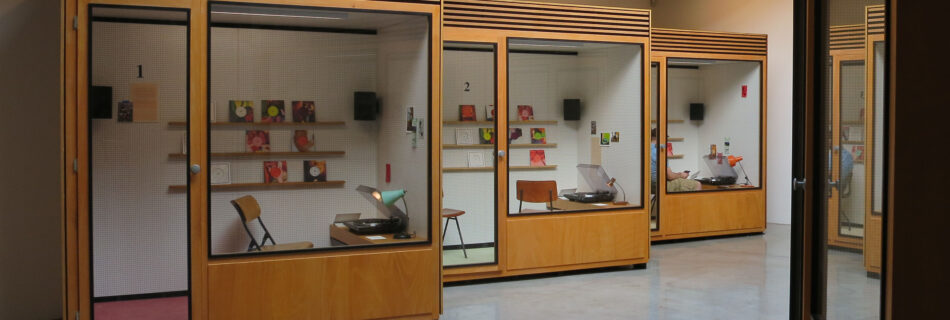
British artist Phil Collins set up a phone booth in a German homeless shelter and offered its guests a deal – in exchange for free local and international calls, they allowed the artist to record their conversations and commission songs from the transcripts. At Tanya Bonkadar Gallery, visitors are invited to listen to the results in individual sound booths. (In Chelsea through October 19th).
Phil Collins, installation view of ‘my heart’s in my hand and my hand is pierced, and my hand’s in the bag, and the bag is shut, and my heart is caught,’ sound installation, 2013.
This vegetable-strewn Steinway grand piano was the standout in Tanya Bonakdar Gallery’s otherwise spare summer group show, ‘ambient.’ It’s abundance is a foil to the hauntingly minimal musical piece ‘Natura Morta’ by Italian avant-garde composer and artist Walter Marchetti which experimental musician Alex Waterman played in the show’s first week. (In Chelsea through July 26th).
Walter Marchetti, Natura Morta, Steinway and Sons concert grand piano, selection of produce, 10-page handwritten manuscript of Walter Marchetti’s ‘Natura Morta,’ 1988.
Suspended above a steel and plywood table, a row of lanterns illuminates the dim space of Chelsea’s Tanya Bonakdar Gallery, suggesting an evening summer party staged in a design museum. Yet titles like ‘Against the Night’ and ‘The Sun Comprehending Glass’ tie Glasgow-based artist Martin Boyce’s enigmatic sculpture to the outdoors. (Through May 25th).
Martin Boyce, Against the Night, perforated steel, steel chain, plywood, wood stain, wood oil, galvanized steel, wired electrical lights, 2013.
Mark Dion’s vitrine-based sculptures often evoke the wonder of the 16th-18th century ‘Wunderkammer,’ or cabinet of curiosities. In this sculpture, the centerpiece of his current show at Chelsea’s Tanya Bonakdar Gallery, the ‘wunder’ of this cast replica of a manatee skeleton is overshadowed by a polluted sea-bed of tar-covered consumer goods below. (Through April 13th).
Mark Dion, Trichechus manatus latirostris, plastic skeleton, tar, found objects in steel and glass case, 2013.
Though not many of Olafur Eliasson’s projects are going to measure up to the impact of his past large-scale artworks (creating waterfalls on New York City’s East River or a sun in the Tate’s Turbine Hall), his latest solo show at Chelsea’s Tanya Bonakdar Gallery features this simple but mesmerizing display of three fountains, lit by strobes, which turn moving water into seemingly static sculptures. (through Dec 22nd).
Matt Collishaw, installation view. Photo courtesy of the artist and Tanya Bonakdar Gallery, New York.
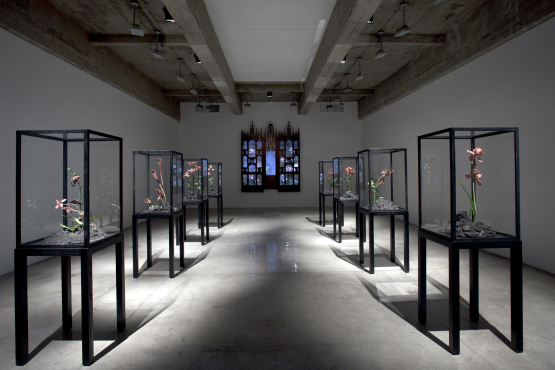
Photos of Texas death-row prisoners’ last meals, giant prints of dead insects and sculptures of diseased flowers (titled, for instance, after a poem from Baudelaire’s Fleurs du Mal or a U.K. waste-management company) confirm that original Young British Artist Mat Collishaw still traffics in sensation. Surprisingly, the most gratuitous subject—the last meals—proves to be the most thought-provoking, despite the fact that it, too, reflects Collishaw’s fondness for grotesquery.
Collishaw rightly calculates that our morbid fascination will attract us to these photos of french fries, steak, cinnamon rolls and other repasts, dimly lit to recall Dutch still-life painting, but mainly looking gray and unappetizing. Still, evoking this last moment of pleasure does create twinges of sympathy for the condemned, whose orders range from a dish of yogurt to a heaving pile of food.
Vitrines of waxy-looking, boil-covered, meat-pink amaryllis, lilies and other flora growing in toxic soil are so blatantly gross that they kill any such nuance of feeling. A video animating decaying flowers buzzing with flies in a comically misty dead forest does a bit more than the sculptures to suggest the dark enchantment hinted at in Baudelaire’s title, but setting the flatscreen behind an 18th-century altarpiece seems like a mere ploy to stir the pot with a tangential religious reference. Collishaw gets it right when he mines the contradictions in humanity’s capacity for base thoughts and actions. But when he simply represents it, he produces more of the same.
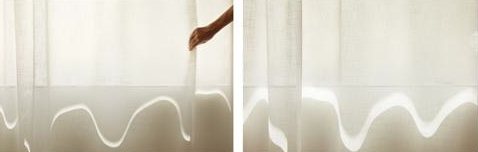
Uta Barth, ...and to draw a bright white line with light (Untitled 11.2), inkjet print, 2011. Courtesy of the artist and Tanya Bonakdar Gallery, New York.
The centerpiece of Uta Barth’s latest solo show is a photo series depicting a continually morphing strip of light beneath her living-room curtains, a preposterously simple conceit which nevertheless yields complex optical illusions. As this diaphanous sliver shifts course over an afternoon, it variously resembles a snake, a line on an EKG or a trail of cigarette smoke, all the while transforming the space between the camera, the curtain and the window into an ambiguous territory where volumes flatten or swell, and light can pass for white paint.
Two glimpses of Barth’s hand arranging the curtain folds remind us of her agency, but it’s nature’s hand that propels the work’s attractively simple narrative as the sun’s changing position gradually increases the width of the band. At this time of year, as the onset of winter makes Barth’s invitation to contemplate sunlight especially attractive, the work entices us into the pleasures of solitary idleness that are at odds with the pace of everyday urban life.
In the back room, by comparison, a second group of photographs depicting built-in closets and drawers in the artist’s bedroom seems coldly architectural. Each image is emblazoned by squares or rectangles of light cast from an opposite window: One features a particularly bright patch that suggests celestial or alien visitation; another, a band of shadow over a door latch, creates the illusion that the surface of the print is scratched. But otherwise, the real drama of transformation takes place in the front gallery.
Originally published in Time Out New York, issue 839, Dec 1-7, 2001.