Though based in Los Angeles, the mid-century Light and Space movement is well represented in New York galleries, a happy circumstance aided by Pace Gallery’s long-term relationships with key artists. ‘Irwin/Bell: The ‘60s’ at Pace’s Tribeca offshoot, ‘125 Newbury,’ presents work by Larry Bell and Robert Irwin that revisits their early shows in New York, including the premier of Irwin’s aluminum disc paintings in 1968. Installed in a back gallery with a bench inviting visitors to sit and contemplate, this untitled piece from 1967 presents a circular aluminum form that exists materially but appears to be composed entirely of light and shadow. (On view in Tribeca through Jan 11th).
Robert Irwin, Untitled, sprayed lacquer on aluminum disc, 62” diameter, 1967.Robert Irwin, Untitled, sprayed lacquer on aluminum disc, 62” diameter, 1967.
After a serious car crash in the mid-60s prompted a career shift from aerospace engineering to fine art, West coast Light and Space artist Fred Eversley applied his knowledge of materials to the creation of tinted cast sculptures like those now on view at David Kordansky Gallery in Chelsea. As a kid in his father’s basement lab, Eversley recreated Galileo’s experiments in making parabolic shapes; as an artist, he describes his work as reflecting forms of energy and light. Eminently enjoyable, Eversley explains that his sculptures are “made for spectators to amuse themselves by discovering all of the infinite combinations of internal reflections, refractions, color changes and other optical phenomena that one can perceive within an individual piece of sculpture.” (On view through June 10th).
Fred Eversley, installation view of ‘Cylindrical Lenses’ at David Kordansky Gallery, May 2023.
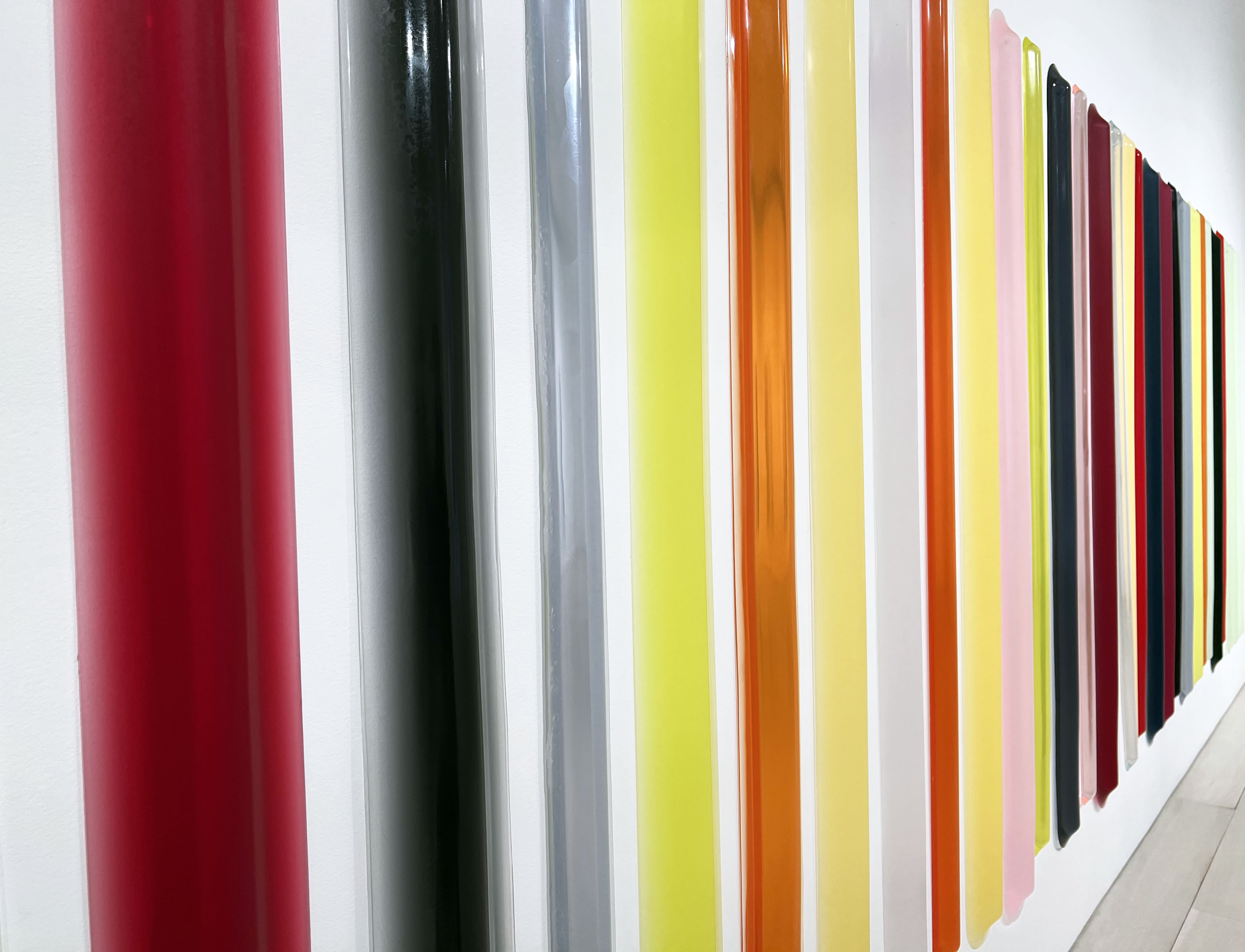
After an over two-decade hiatus from sculpture-making, late west coast Light and Space artist Peter Alexander came back strong, creating cast forms that appear to glow. Pace Gallery’s current show of these works from ’11 to ’20 features this eighteen-foot-long installation of urethane strips. Varying in width and color, the parallel pieces create an irregular rhythm that excites the senses. (On view through March 19th).
Peter Alexander, Heard it Through the Grapevine, urethane, 77 x 18’ 1” overall installed, 2019.
Visitors to Light and Space artist Helen Pashgian’s show of new work at Chelsea’s Lehmann Maupin Gallery are invited to sit on benches to appreciate disk-shaped sculptures that appear to hover over pedestals in the gallery, while other pieces require movement to be appreciated. The second scenario applies with this untitled cast epoxy with formed acrylic sphere, which reveals or conceals bands of color as the visitor moves before it. Designed to reveal how perception of a single object or phenomenon can shift, Pashgian’s invites viewers to delight in the nuances of seeing. (On view through Jan 8th).
Helen Pashgian, Untitled, cast epoxy with formed acrylic elements, 7 inches diameter, 2020.
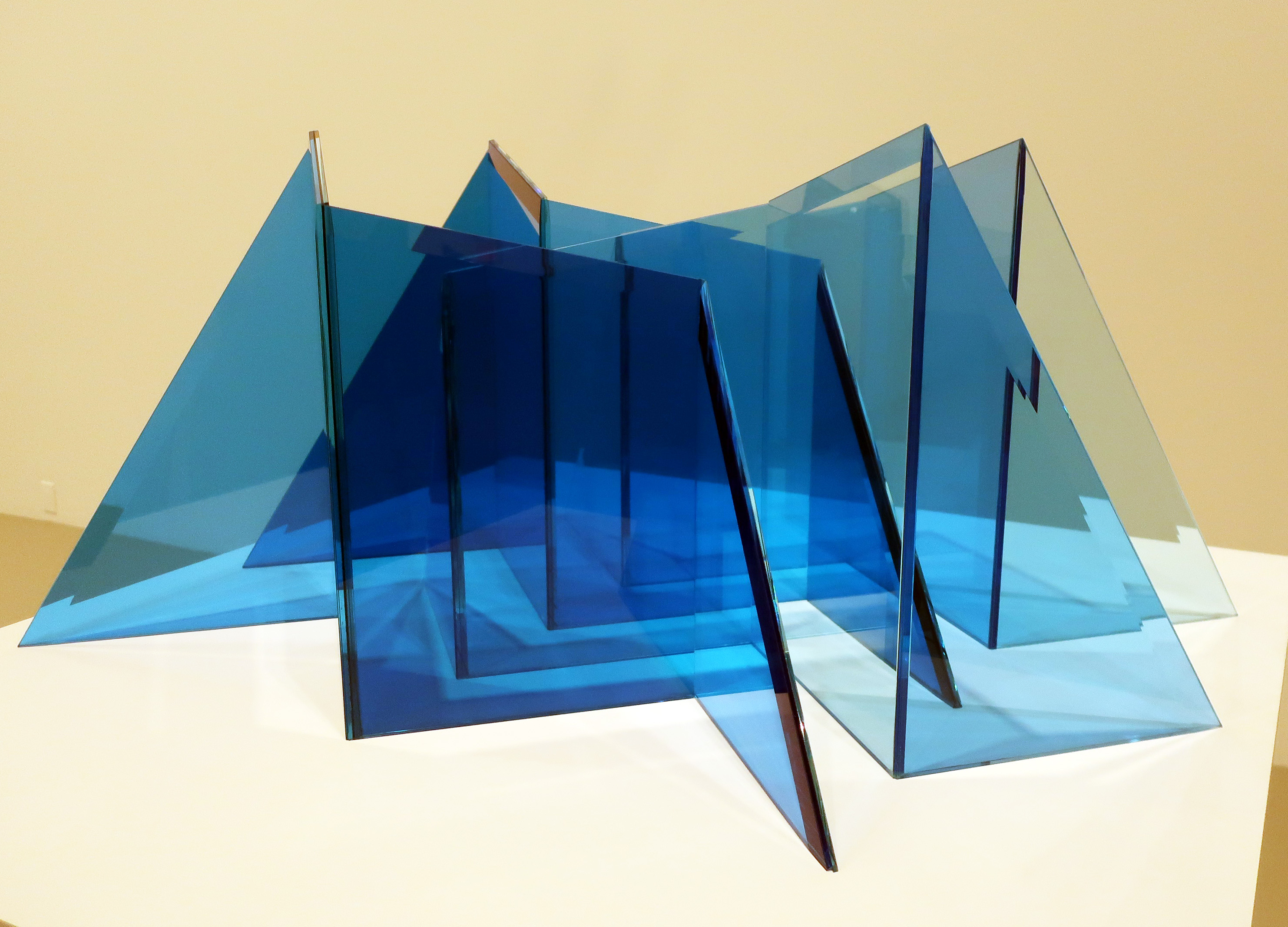
Operating under the premise that, “Art makes a positive difference at all times and in all circumstances” Hauser & Wirth Gallery has reverted to on-line exhibitions and other Internet-accessible strategies to make art available. The gallery’s recently released exhibition walk-through with Light and Space artist Larry Bell wonderfully conveys Bell’s exploration of how glass ‘reflects, absorbs and transmits light.’ We can’t visit the artist’s reflective glass panels right now (seen here in a smaller sculpture), but the next best thing is watching him activate his ‘Standing Wall’ installations to shift the space around him.
Larry Bell, Iceberg SS, French Blue, Capri Blue, Periwinkle, and Turquoise laminated glass, 4 parts, unique, dimensions variable, 2020.
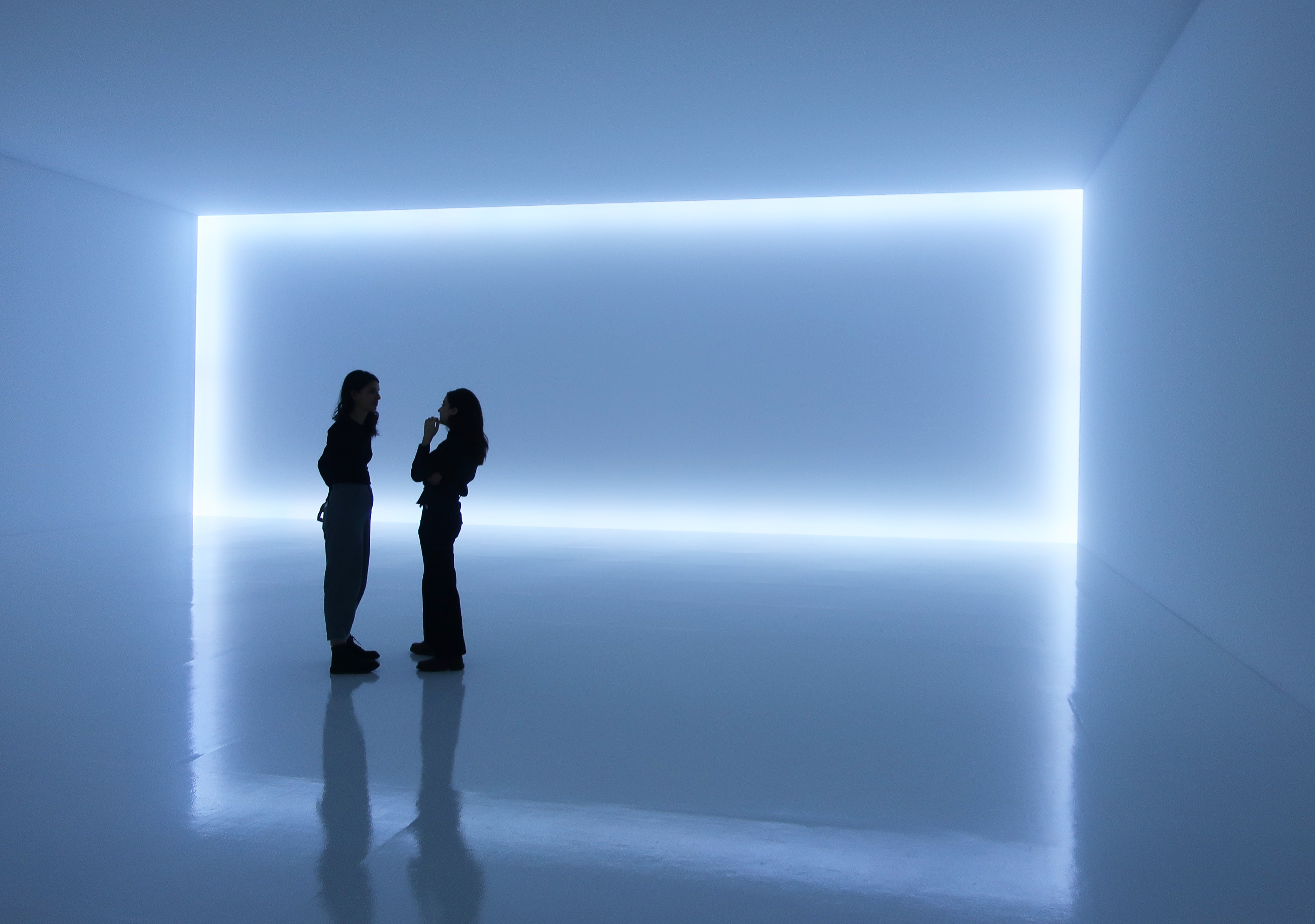
Light and space artist Doug Wheeler’s installation at David Zwirner Gallery makes light a transformative medium, turning the white cube into a glowing and changeable environment to challenge the senses. Light disperses before our eyes as it fades from the bright glow of neon tubes installed in a recessed space to the darker areas of the wall, floor and ceiling at the end of the long rectangular gallery. (On view in Chelsea through March 21st).
Doug Wheeler, 49 Nord 6 Est 68 Ven 12 FL, installation view at David Zwirner Gallery, Jan 2020.
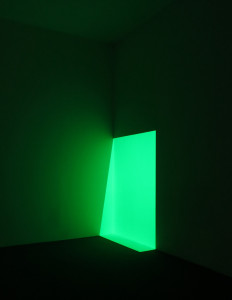
From this single-projection light work from 1968 now on view at Pace Gallery to his stunning transformation of the Guggenheim Rotunda into a light installation in 2013 James Turrell suggest that light can manifest in physical form. Juke Green – glowing an emerald green that suffuses the room with color – conjures a giant gem or a portal into another world. (At Pace Gallery’s 534 West 25th Street location.)
James Turrell, Juke Green, Corner Light Projection, 1968.
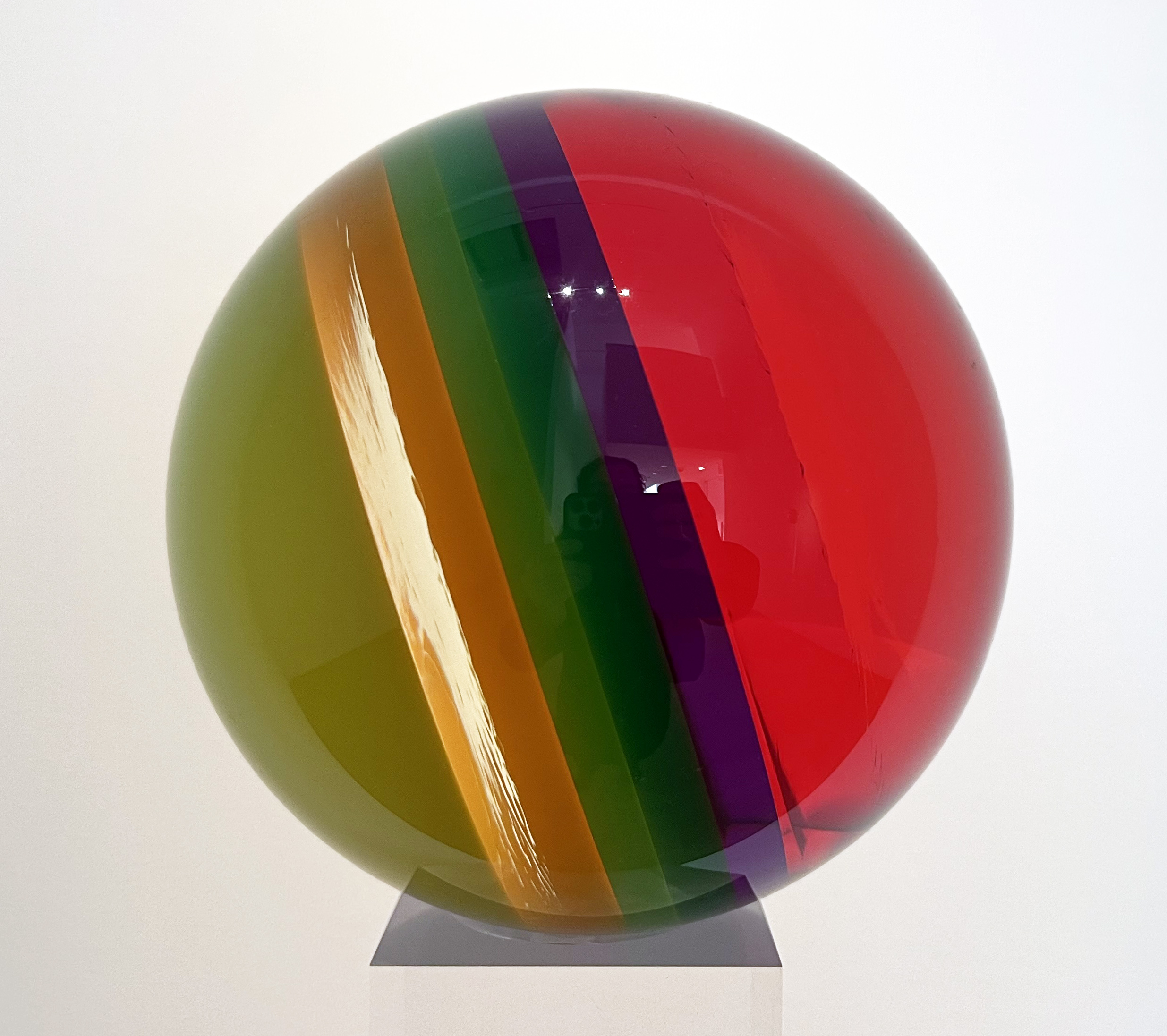
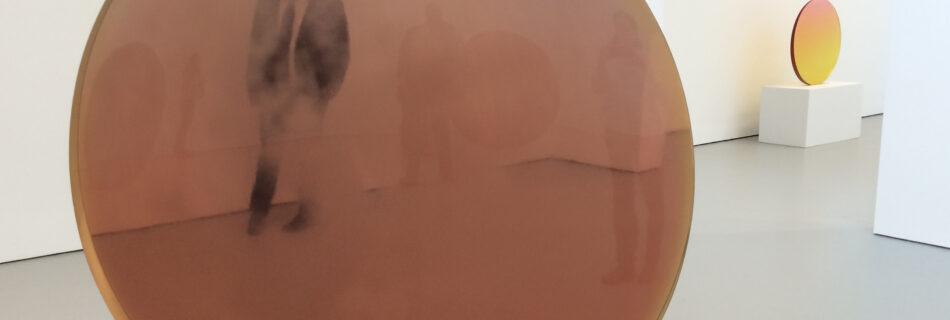
California Light and Space artist De Wain Valentine pushed his chosen medium of polyester resin by finding a way to make larger pours and bigger pieces in the ‘60s; with their huge size, pieces like ‘Circle Gold-Rose’ from 1970 become actors in the room, changing the environment with shifting color. (At David Zwirner Gallery through August 7th).
De Wain Valentine, Circle Gold-Rose, cast polyester resin, 70 3/8 x 70 x 4 7/8 in, 1970.
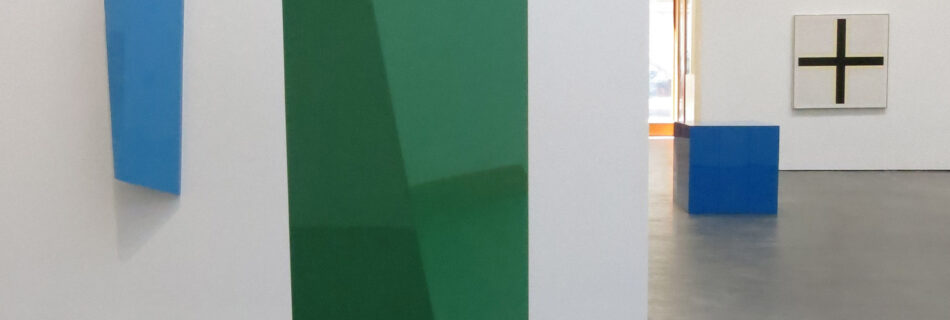
Southern Californian minimalist John McCracken’s retrospective exhibition at David Zwirner Gallery is better seen in person – where sleek objects like this one (hand-crafted from plywood covered in polyester resin & fiberglass) reflect the people, objects and light conditions surrounding them. But the color contrasts alone between the richly green ‘Minnesota’ in the foreground and the sky blue of ‘On Stream’ in this photo set the mind thinking of nature. (At the gallery’s 20th Street location through Oct 19th.)
John McCracken, Minnesota (in the foreground), polyester resin, fiberglass and plywood, 1989. On Stream (background left), polyester resin, fiberglass and plywood, 1998.
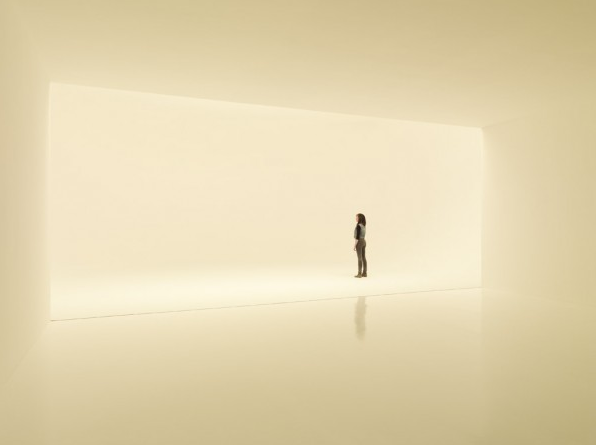
Doug Wheeler, SA MI 75 DZ NY 12, 2012, photo courtesy of David Zwirner Gallery.
Relational aesthetics took a beating last fall as critics decried participatory artworks like Carsten Holler’s three story slide at the New Museum and MoMA’s installation of Rirkrit Tiravanija’s free lunch. The visitor’s physical experience is also key to Doug Wheeler’s installation which opened today at David Zwirner Gallery and recreates a 1975 piece made in Milan by the influential So Cal ‘Light and Space’ artist. But the hushed environment, limited to ten people at a time and entered after donning white booties so as to keep the floor pristine, is all about aesthetics, and less about interrelating with your fellow gallery goers.
The lighting in the installation changes in intensity and color as it simulates the transitions from dawn to day to dusk, slowly revealing where the boundaries of the flat floored, egg-shaped room are. But even in the strongest light, it’s a strain to make out where gallery wall ends and floor begins; only the toes can tell as you feel the floor’s upward slope. The impulse is to find the spot where your senses are most confused.
Visitors who stayed in the gallery the longest this morning inched their way to the front and center of the installation and stood looking into an optical illusion – a space that appeared to extend to infinity. The sensation was like peering into a deep fog or a snowstorm (under comfortable conditions) as my perception of space kept shifting to make sense of what I was seeing.
Wheeler’s installation recalls James Turrell’s installations, in which visitors approach a shape on the wall only to realize that it’s a rectangle of recessed light. Here, the experience is more intimate – like entering into the space occupied by light rather than gazing in from the outside. Uta Barth’s photographs of light come to mind, as do Yayoi Kusama’s Infinity Nets but both treat light and infinity as more concrete subjects than Wheeler does with what he calls his ‘molecular mist.’ The scale and ambition of Wheeler’s project won’t be matched again soon in New York; catch it while you can and arrive early to avoid lines.
For more background, read Randy Kennedy’s Jan 15thNYT article.