Mariah Carey’s head dominates Carrie Schneider’s solo show at Chart Gallery in Tribeca; smiling and nodding, it is featured in a large 16mm color film projection, a still image and two impressively huge photos printed on paper rolls that total 400 feet in length. Sampled from an interview in which Carey says in response to a question about Jennifer Lopez, ‘I don’t know her,’ Schneider’s work explores how a few seconds of footage can become a meme with an unending digital lifespan and how an evasion on Carey’s part resulted in a cascade of attention. Schneider’s super-abundance of abstract imagery created via multiple exposures in a specially built camera generates its own kind of optical noise, a visual art parallel to celebrity culture.
Carrie Schneider, Voice’s Owner (I don’t know her), two unique chromogenic photographs made in camera, 20 x 4800 inches, installation dimensions vary, 2023.
Rosa Barba’s ‘Language Infinity Sphere,’ a form created from old letterpress blocks now on view at Luhring Augustine’s Tribeca space, speaks with its circular form to the ongoing output of these blocks over the years. Other text-related work in the show includes handwritten words on a filmstrip that rotates around a lightbox cube and a 35mm film depicting images and text from the Library of Congress’ massive campus, the largest media archive in the world. Language appears in unexpected forms in this show, even as marks on the landscape in a film showing disposal sites for radioactive material in the western U.S. (On view through May 21st).
Rosa Barba, Language Infinity Sphere, lead letters on steel, unique, diameter 18 1/8 inches, 2018.
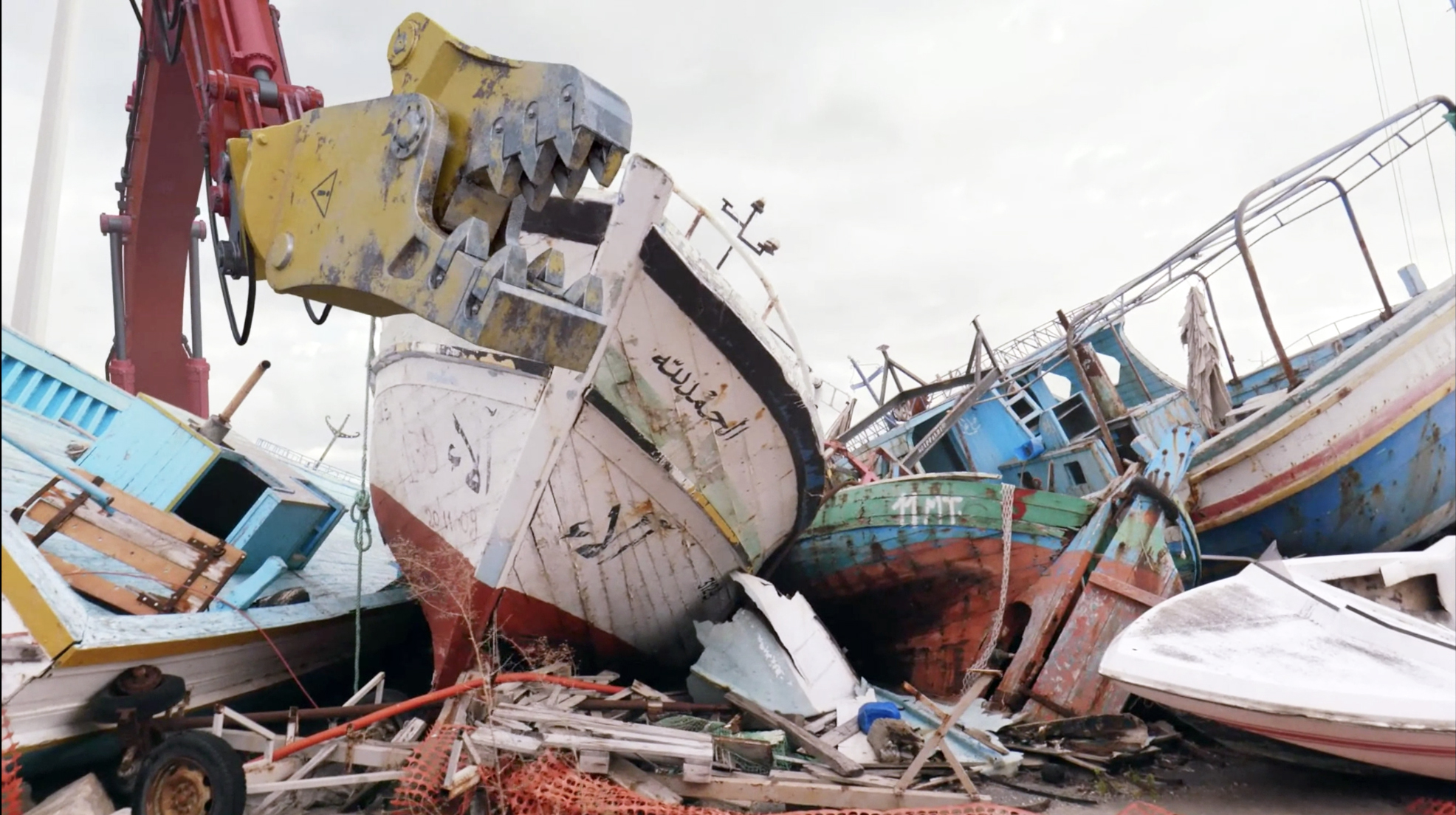
London and Berlin-based artists and photography professors Adam Broomberg & Oliver Chanarin’s short film, ‘The Bureaucracy of Angels’ grabs the imagination immediately with an unlikely casting choice; the star of the show – a mechanical wrecking arm – makes a riveting appearance as a soulful ballad singer lamenting the pain of migration. Currently available to watch via the Lower East Side gallery Signs & Symbols’ website, the piece’s premise is absurd but the effect is first mesmerizing, then moving. Part destroyer, part guardian, the machine keeps watch over migrants being intercepted by rescue agencies before eventually wrecking boats abandoned by travelers who made it to Sicily. (Available online at signsandsymbols.art through May 13th).
Broomberg & Chanarin, still from ‘The Bureaucracy of Angels,’ 2017.
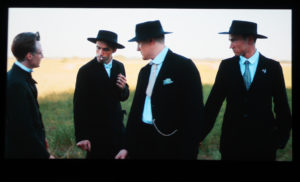
August Sander’s iconic ‘People of the 20th Century,’ a photographic project documenting the German people in the early 20th century is the starting point for Omer Fast’s ‘August,’ a captivating video imagining Sander’s haunted later years. Here, Fast restages Sander’s oft-reproduced image of young farmers as an opportunity to consider the photographer’s stagecraft. (On view at James Cohan Gallery through Oct 29th).
Omer Fast, still from August, stereoscopic film in 3D, 5.1 surround sound, duration 15:30 minutes, 2016.
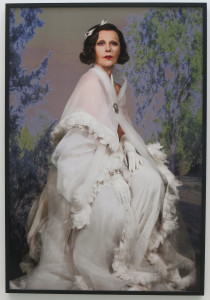
Press images of 1920s movie stars inspired Cindy Sherman’s latest body of work – photos of women who have aged out of the young starlet role but who still wear cupid lips, smoky eye shadow and wistful expressions. (At Metro Pictures in Chelsea through June 11th).
Cindy Sherman, Untitled, dye sublimation metal print, 70 ½ x 48 inches, 2016.
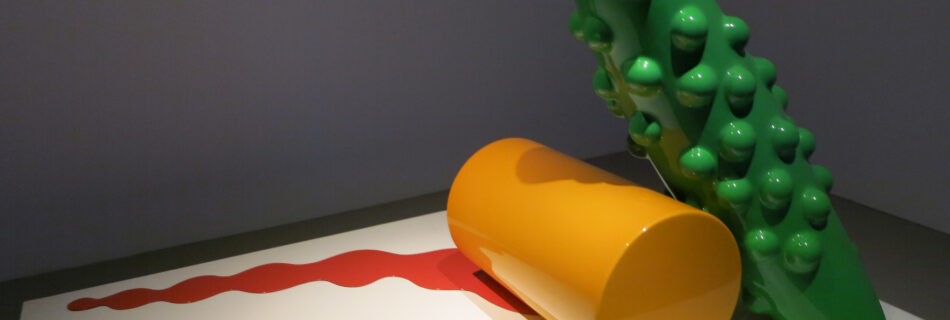
LA-based experimental film maker Pat O’Neill’s first New York solo gallery show includes film and sculptures like this surreal, suggestive assemblage. (At Chelsea’s Mitchell-Innes & Nash through Jan 23rd).
Pat O’Neill, Safer than Springtime, fiberglass, aluminum, steel, paint, 48 x 39 x 30 inches, 1964.
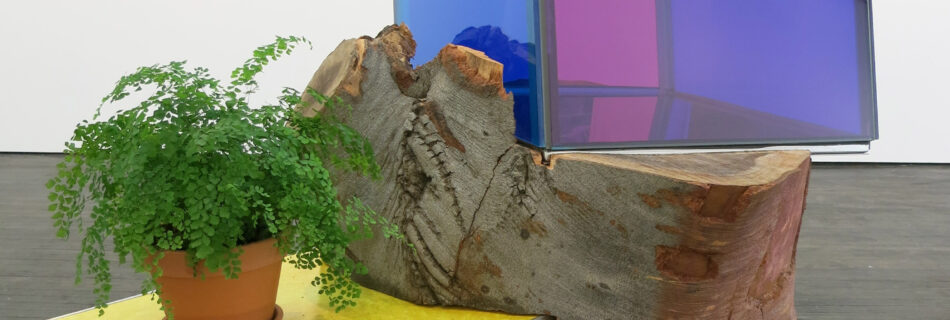
Man-made objects and nature come together in surprising ways in this sculpture by New York artist Sarah Braman, as a cube recalling modernist architecture perches atop a massive tree stump (nature sacrificed?). A table and houseplant complete this pretty assemblage which points to the domestic realm as a place where nature is potted for pleasure and convenience. (At Jack Hanley Gallery on the Lower East Side through Feb 8th).
Sarah Braman, Underthunk, welded steel, color gels, glass, tree stump, house plant, aluminum, 65 x 35 x 70in, 2014.
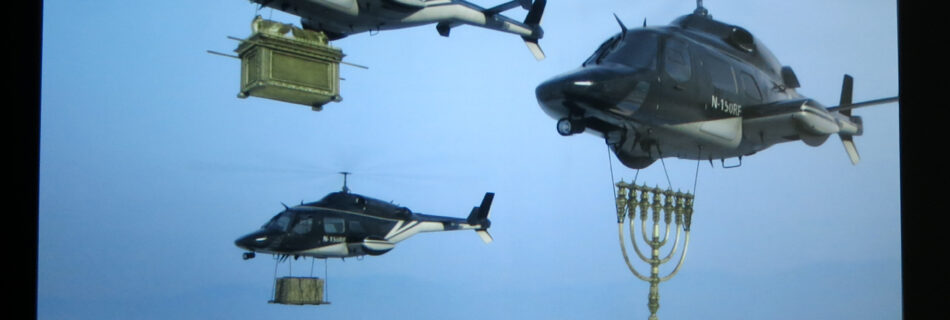
In 22 minutes of rich visuals, Israeli artist Yael Bartana inaugurates and destroys a replica Solomon’s Temple in her captivating film ‘Inferno.’ Inspired by a version of the temple finished last summer in Sao Paulo by a religious group (built with stones imported from Israel) Bartana’s film compresses a sequence of emotions – exhilaration to horror to indifference at a distant memory – at a dizzying rate. (At Petzel Gallery through Feb 14th).
Yael Bartana, still from ‘Inferno,’ Alexa camera transferred onto HD, 22 minutes, 2013.
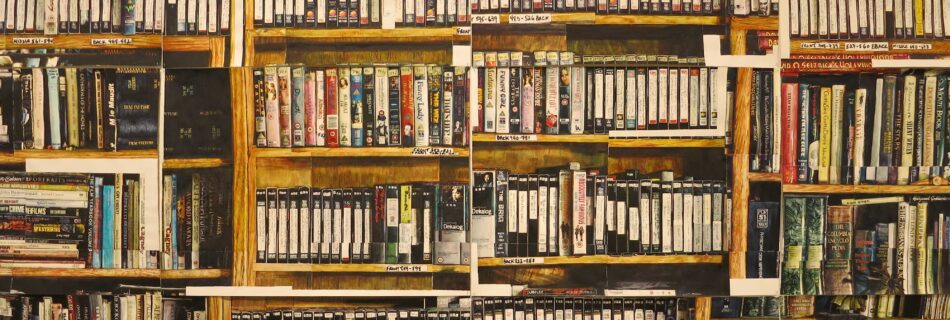
What does your bookcase say about you? London-based artist Dylan Stone memorializes his film producer parents’ collection of books, LPs and video-cassettes in a huge painting at Chelsea’s Josee Bienvenu Gallery (seen here in detail). So much pre-digital media rendered in the ageless media of watercolor makes a poignant comment on longevity. (Through Dec 13th.)
Dylan Stone, detail from Barbara and David Stone’s Videos, LPs and Books, watercolor on paper, 110 x 150 inches, 2014.
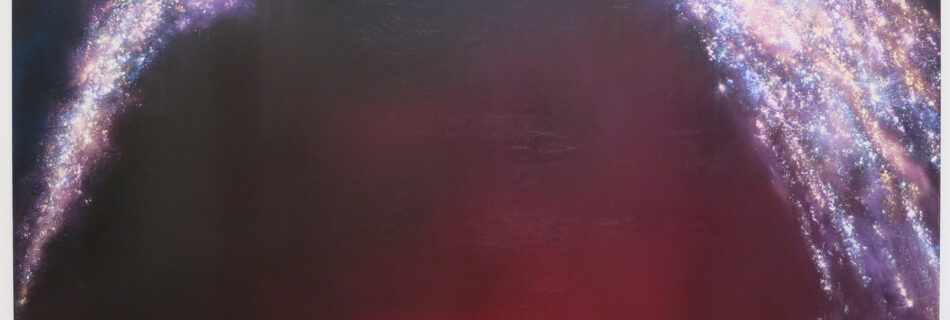
Multi-media artist and media darling Dan Colen points to Disney films as a source for his latest, mostly abstract, paintings collectively called ‘Miracle.’ Here, ‘The Sorcerer’s Apprentice’ features an arc of sparkles painted in raw pigment and oil. Colen’s process-based style is so fashionable at the moment as to prompt the question of whether this piece demonstrates magic with painting or marketing. (At Gagosian Gallery through October 18th).
Dan Colen, The Sorcerer’s Apprentice, oil and raw pigment, 67 x 102 inches, 2013.
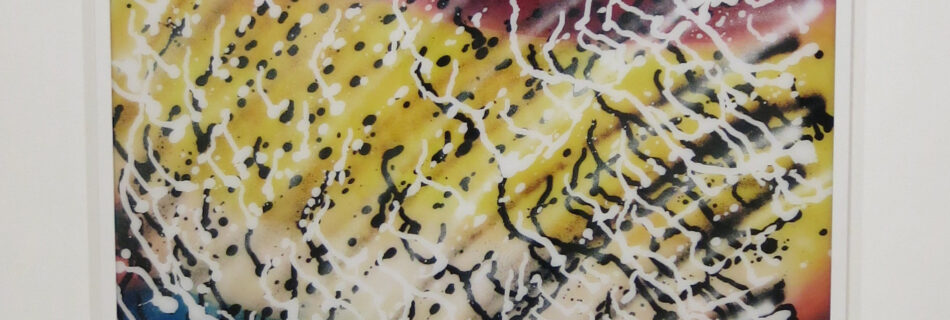
German artist Florian Maier-Aichen blurs the boundaries between painting and photography in his latest series of abstract images, created by pouring paint, transferring images to transparent film, backing them with other paintings and ultimately photographing the final product for presentation as a photograph. (At Chelsea’s 303 Gallery through July 25th).
Florian Maier-Aichen, Untitled, c-print, 81 ½ x 64 ¾ inches, 2014.
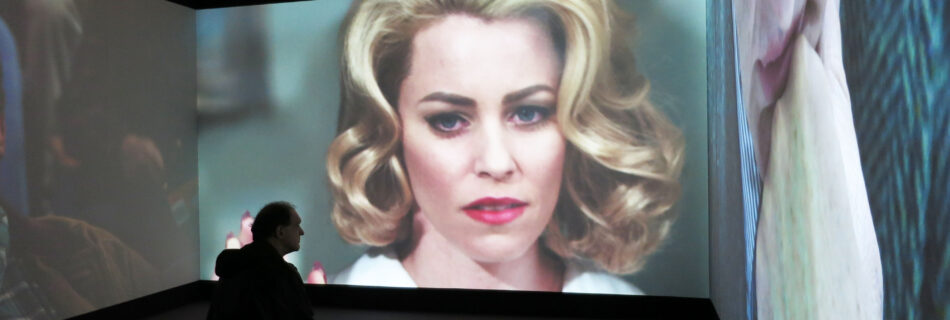
Alex Prager has explained that living in LA, she doesn’t have a lot of experience with crowds. Her latest body of photos and her film ‘Face in the Crowd,’ makes a break with the norm though as Prager directs actor Elizabeth Banks and hundreds of other actors on constructed sets as they play out scenes of crowd dynamics from the thrilling to the terrifying. (At Chelsea’s Lehmann Maupin Gallery through Feb 22nd).
Alex Prager, still from ‘Face in the Crowd’ at Lehmann Maupin Gallery, January, 2013.
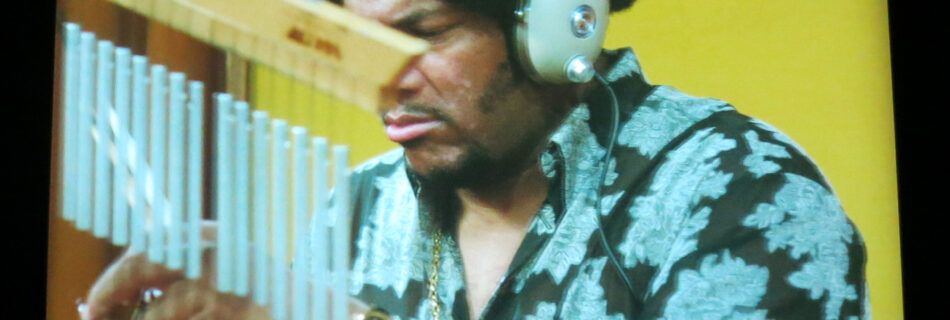
Vancouver photographer and filmmaker Stan Douglas continues a theme from his last show – the influence of Afrobeat on the NY music scene of the 70s – with his latest film ‘Luanda-Kinshasa,’ on view at Chelsea’s David Zwirner Gallery. Watching the video in its entirety – and music lovers may want to – could take six hours as the scenes run in non-sequential loops. (Through Feb 22nd).
Stan Douglas, still from Luanda-Kinshasa, Jan 2013, David Zwirner Gallery.
Contrary to its title, there’s nothing particularly subversive about ‘Spies in the House of Art,’ the Metropolitan Museum’s enticingly titled exhibition of its contemporary photography collection, which opened yesterday. Photos, films and videos take museum display and visitor responses as subject matter, but the mood of the best pieces is more fond criticism than biting institutional critique. Still, by bringing the myriad ways we navigate the museum experience to our conscious mind, the show counteracts purely passive viewing pleasure.
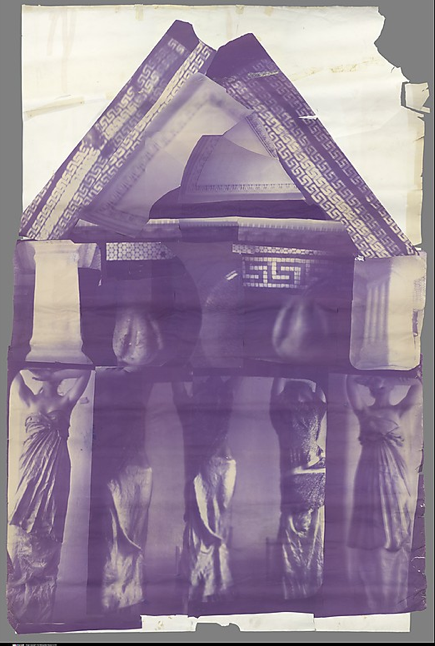
A standout is Francesca Woodman’s 1980 ‘Blueprint for a Temple.’ Completed a year before her untimely death and marking a major shift from her small scale photos, this 15 foot high photo collage of a Greek temple supported by her friends dressed as caryatids and printed on blue architectural blueprint paper playfully remakes ancient culture while forces a connection between past and present that resonates with the Met’s newly crafted Moroccan court.
The show’s second major highlight, Rosalind Nashashibi’s and Lucy Skaer’s 16mm film ‘Flash in the Metropolitan Museum’ from 2006 was shot at night with a flash strobe as the artists moved through the museum, momentarily illuminating Greek ceramics one minute, African or Medieval European sculpture the next. Unclear images, seen for a moment in varying scales and unflattering angles turn usual museum display on its head while creating an alluringly mysterious anthropological study that is equal parts ‘Blair Witch Project’ and ‘Mixed Up File of Mrs Basil E. Frankweiler.’
Less familiar work comes across as amusing and fresh, like Laura Larson’s photograph of a display in the Telfair Museum in Savannah, Georgia which delights in pointing out the tasteless clash of style in a Regency settee, a wallpapered landscape and patterned marble floor. Sophie Calle’s text and image of a gender-ambiguous blind person describing the ‘terrific ass’ of a sculpture in Paris’ Rodin museum invites reflection on our own ideas about beauty.
By comparison, a photo of a shelf of stored artworks by Louise Lawler, an image of a painting by Tim Davis with his flash blotting out the subject’s face and a video by Lutz Bacher following a young adolescent through the Picasso Museum in Paris look at art stored, reproduced or visited in unexpected if not particularly compelling ways. In a sense, the Met itself undermines the less nuanced work in the show – the stunning artwork and displays encountered on the way to the 2nd floor photo galleries are a tough act to follow.