El Anatsui’s shimmering, undulating wall sculptures made of repurposed bottle caps are uniformly stunning, but previous experience of individual pieces won’t prepare you for the Ghana-based artist’s huge installation in the Brooklyn Museum’s fifth floor galleries. Titled ‘Gli’ (Wall), sheets of aluminum and copper wire materials were inspired by visits to walled cities of Berlin, Jerusalem and Notsie (in Togo) but offer a delicate and diaphanous take on the idea of barriers. (Through August 4th).
El Anatsui, ‘Gli (Wall),’ aluminum and copper wire, 2010.
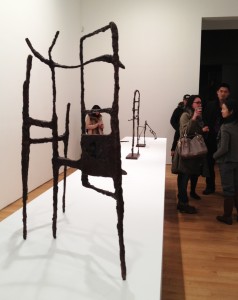
Wang Xieda, Sages’ Sayings 026, bronze, edition of 7, 2006.
‘Drawing in space’ is a familiar term used to describe abstract sculpture, but it turns literal in Wang Xieda’s new bronze sculpture at James Cohan Gallery, which brings Chinese calligraphy into three-dimensions. (In Chelsea through Feb 9th).
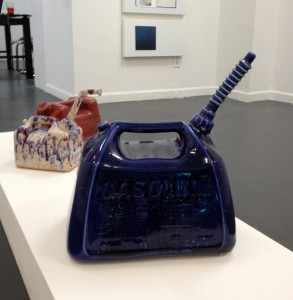
On the subject of ceramics (see yesterday’s post about Takuro Kuwata), Matthias Merkel Hess takes an amusing position on aesthetics vs use value in contemporary ceramics with these beautiful gas cans. (At Louis B. James, Lower East Side through Feb 22nd. )
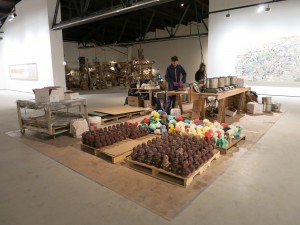
Bjorn Roth/Oddur Roth/Einar Roth, New York Kitchen, mixed media installation, 2013.
German-Swiss-Icelandic artist Dieter Roth (1930 – 1998) used natural materials like chocolate, cheese, bananas, sausages and rabbit dung to make sculptures and images that would blossom with new life as they aged. Here, assistants create chocolate casts of Roth’s famous chocolate or sugar self-portrait busts, as seen on the pallet. (At Chelsea’s Hauser & Wirth through April 13th).
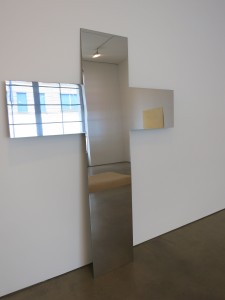
Meg Webster, Polished Stainless Steel for Reflecting Outstretched Arms, mirror-polished stainless steel, 2012.
Meg Webster’s aesthetic is minimal but rife with references to the natural world. Her current show at Chelsea’s Paula Cooper Gallery includes paper covered with egg of free-range chickens and a sand bed from 1982/2012, which she originally brought into her studio from the beach. Both are reflected in this cross-shaped sculpture designed to reflect outstretched arms. (Through Feb 9th).
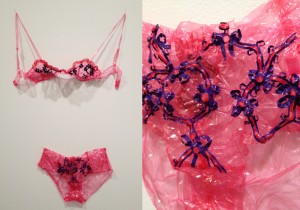
We conceive of and show off our identities via our clothes, but how often do we really ponder the look, feel, size and meaning of our garments? Julie Allen, known for her meticulous sculptures and drawings of objects important in her personal life, created this underwear from Saran Wrap and tape as one of hundreds of drawings and sculptures made to mark her recent marriage and revel in intimacies enjoyed. (At McKenzie Fine Art on the Lower East Side through Feb 3rd).
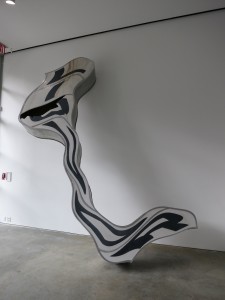
Robert Lazzarini, at Marlborough Gallery, Jan 2013.
Nothing else in Chelsea looks remotely like Brooklyn-based sculptor Robert Lazzarini’s latest sculptures at Marlborough Gallery (through Feb 16th). Partly inspired by the 1973 movie Badlands, they and evoke an American roadtrip gone badly wrong.
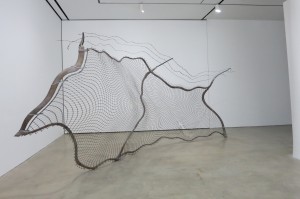
Robert Lazzarini, at Marlborough Gallery, Jan 2013.
This fence was welded together from over two-hundred individually cast steel pieces. Lazzarini’s attention to detail goes far – he even made the barbed wire. It’s the most impressive piece in the show not only in terms of how much work went into it, but in how Lazzarini reimagines a metal fence blowing as if it were a cloth or flag gently flapping the in breeze.
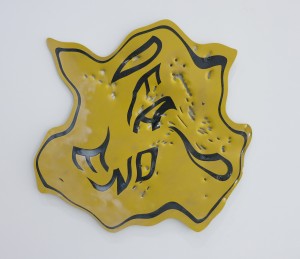
Robert Lazzarini, at Marlborough Gallery, Jan 2013.
Lazzarini called this melting liquor sign the ‘most profound piece in the show,’ saying, ‘It speaks to a damage within society that is not easily seen.’ In person, the sculpture’s text is surprisingly difficult to read, as if we had had one too many. Its towering, ghostly presence is a highlight of the show.
Robert Lazzarini, at Marlborough Gallery, Jan 2013.
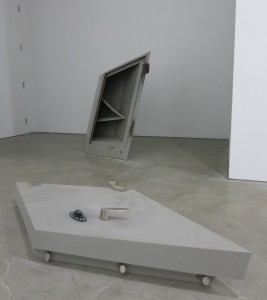
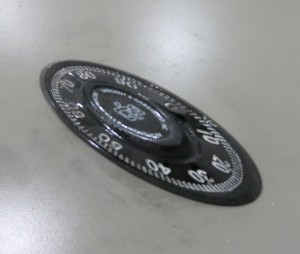
Vaults, blown open and empty, are such a Hollywood staple that this twisted lockbox looks strangely familiar. Finding it twisted in the corner, as if in a fun-house mirror, is not so expected. While struggling with that not-quite-clear sense of déjà vu, check out the sculpture’s most amazing feature – its perfectly skewed lock.
Robert Lazzarini, at Marlborough Gallery, Jan 2013.
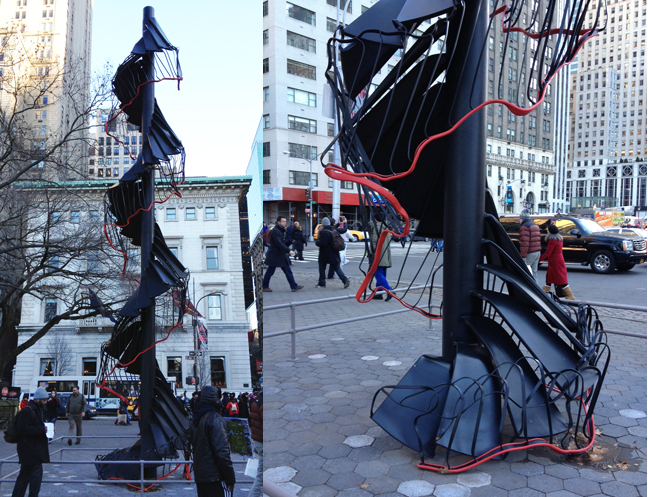
Monika Sosnowska’s ‘Fir Tree,’ a 40 foot tall steel sculpture currently located at the southeast entrance to Central Park is just a step beyond the park’s trees but is more in keeping with the solid, man-made structures surrounding the park. It belongs to neither world, however, and its lack of cheer and melted, post-disaster appearance lend it an ominous intrigue. (Through Feb 17th).
Alice Channer, installation view at Lisa Cooley Gallery, 2012.
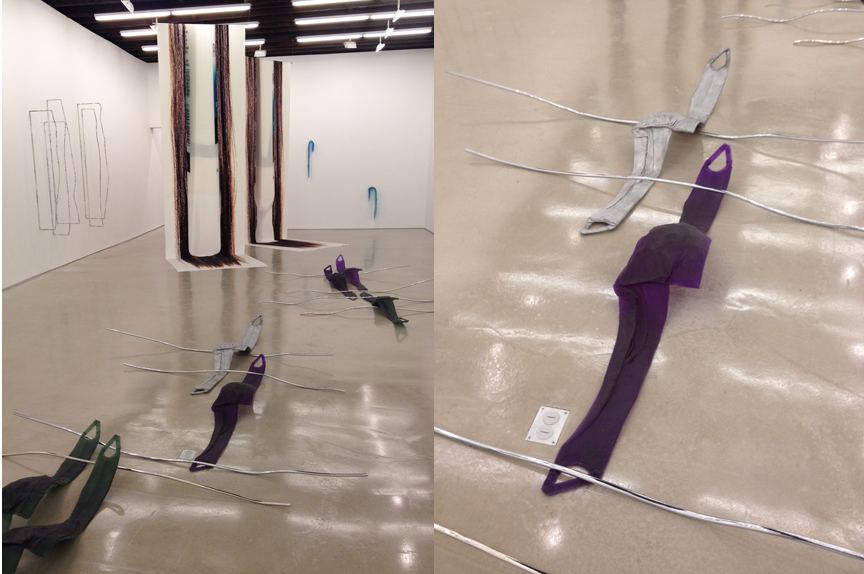
London-based artist Alice Channer’s sculpture ‘Backbone’ makes the best use of stirrup pants ever. Cast in polyurethane resin and paired with aluminum bars, they elegantly slink across the gallery floor towards two huge vertical banners featuring elongated shampoo bottles. (At Lisa Cooley Gallery on the Lower East Side through Dec 23rd).
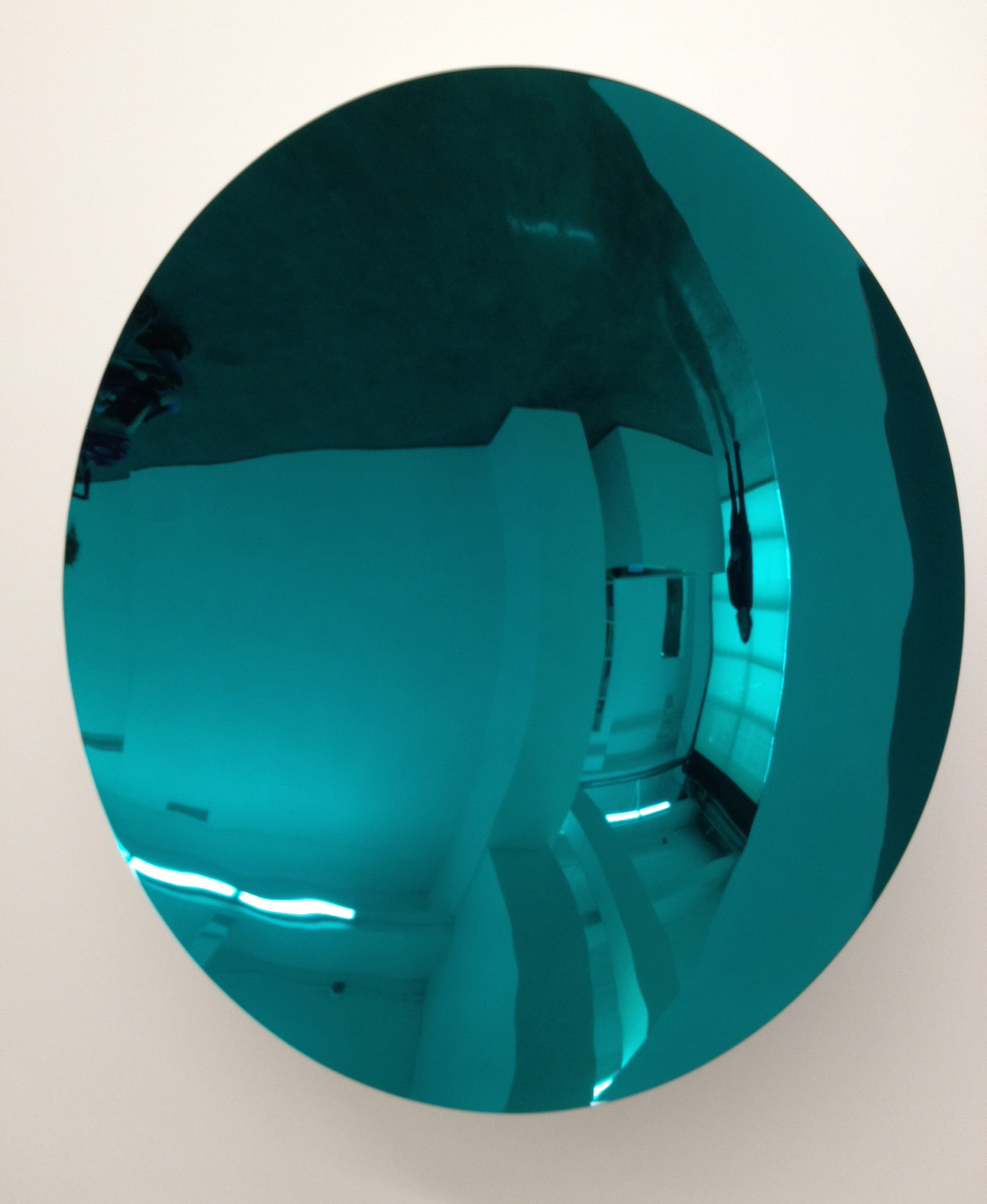
Anish Kapoor, Untitled, stainless steel and lacquer, 2012.
Anish Kapoor’s concave sculptures, like this untitled stainless steel and lacquer disk currently at Chelsea’s Barbara Gladstone Gallery (24th Street location), are austere and elegant, a complete contrast to the lively Gangnam style video he recently released in support of artist/activist Ai Weiwei and Amnesty International. It’s worth another Gangnam parody just to see clips from dancing staff at MoMA, the Whitney, Guggenheim, and Gladstone Gallery and more.
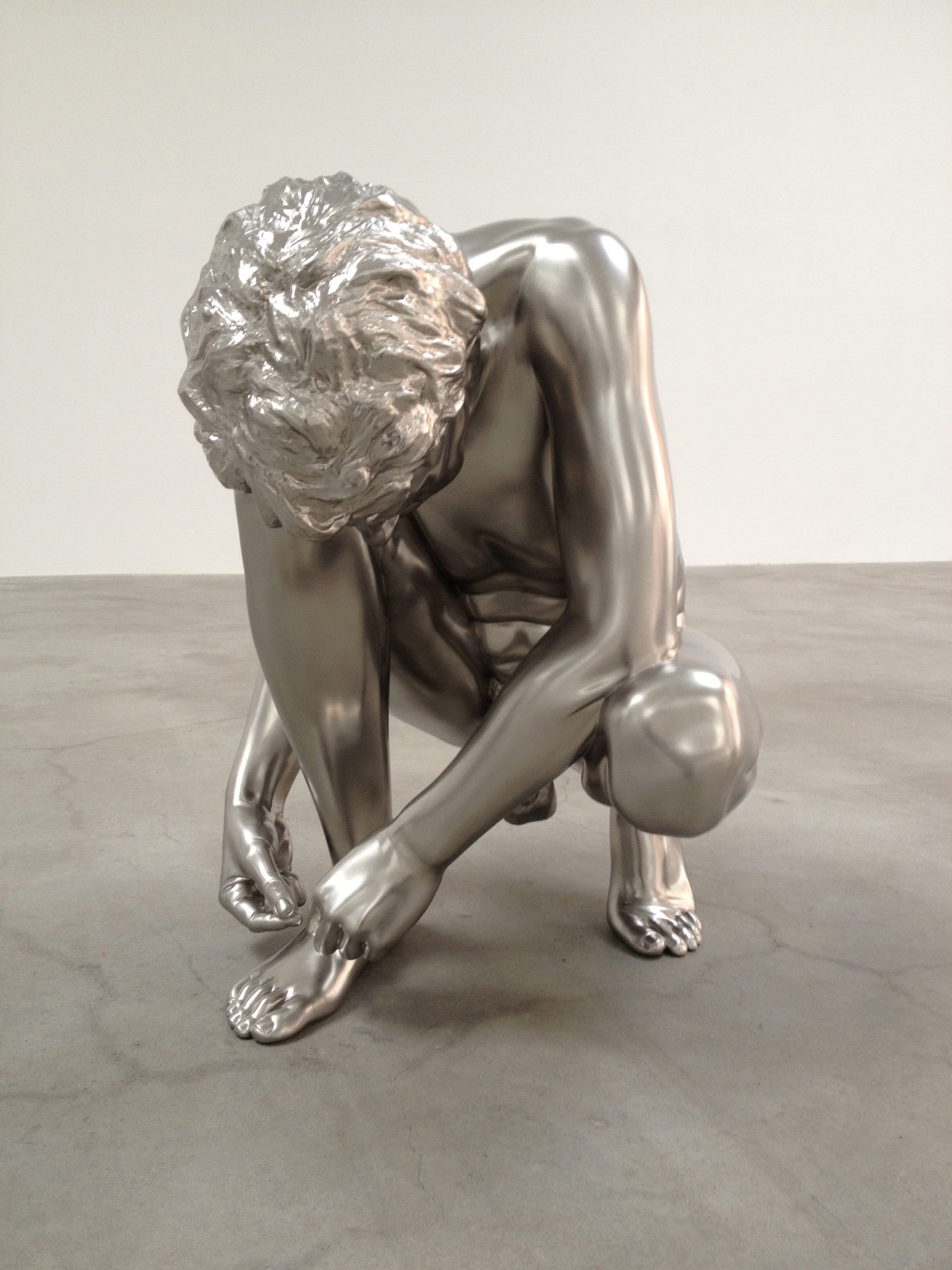
Charles Ray, Shoe Tie, solid stainless steel, 2012.
Charles Ray’s sculptural self-portrait is stunningly perfect – his body has the unflawed, fluid shine of poured mercury – and relentlessly banal – he sports an everyman physique and needs to tie a shoelace. This first impression holds true to the man vs machine process he used to create the sculpture: a digital drawing is recreated as a clay sculpture which becomes the model for a computer controlled machine that sculpts the sculpture from a solid piece of steel. (At Matthew Marks Gallery on 22nd Street through Jan 12.)
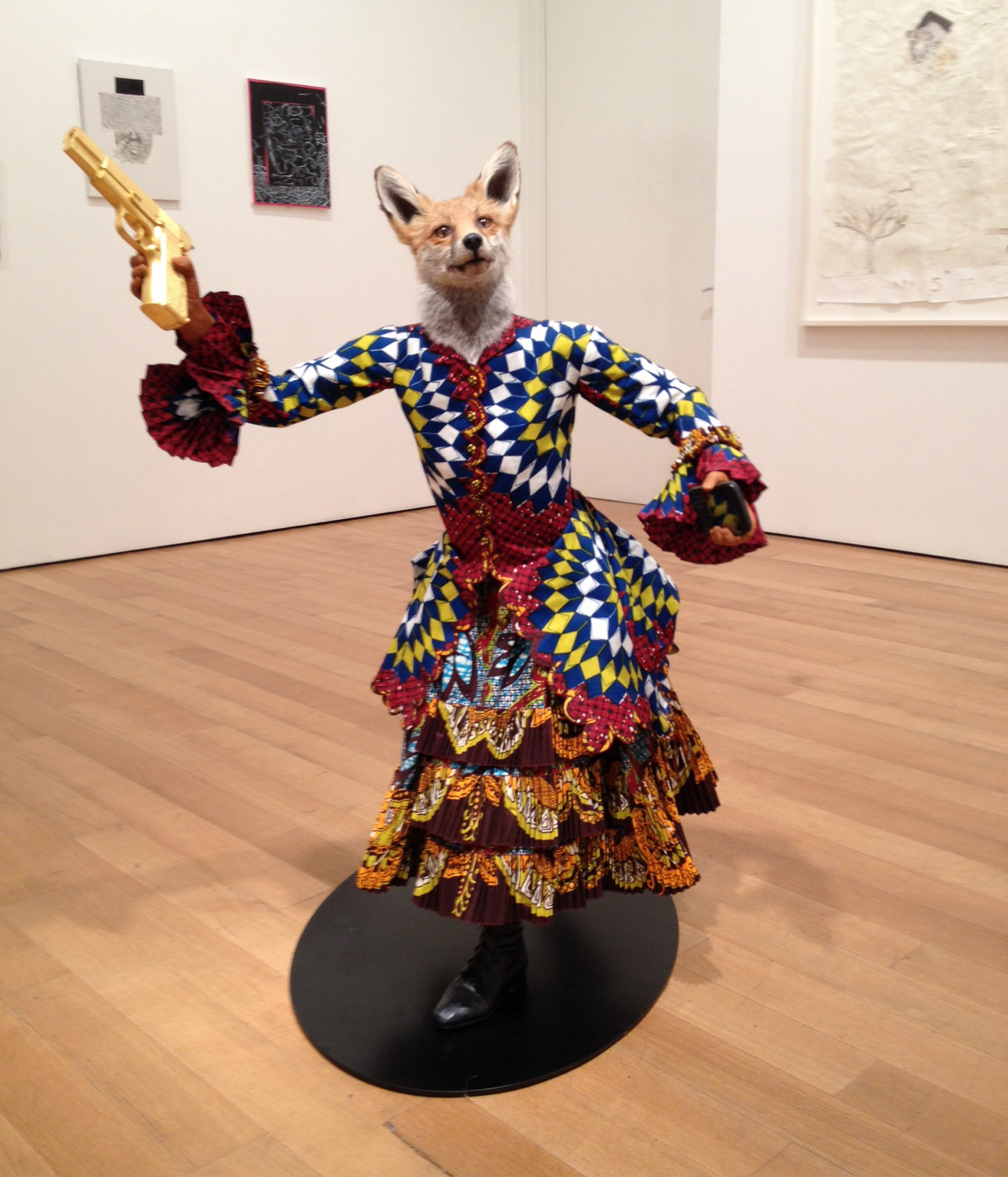
Yinka Shonibare, Revolutionary Kid (fox girl), mannequin, Dutch wax printed cotton, fibreglass, leather, taxidermy fox head, steel base plate, BlackBerry and 24 carat gold gilded gun, 2012.
Yinka Shonibare’s crafty revolutionary looks set for success with money, guns and communications, as embodied by his ’12 ‘Revolution Kid (fox girl),’ spotted today in the back viewing room of Chelsea’s James Cohan Gallery. Toting a blackberry and a 24 carat gold gilded gun and dressed in Shonibare’s signature Dutch-imported, ‘African’ textiles, she begs the question of who she is and who’s backing her.
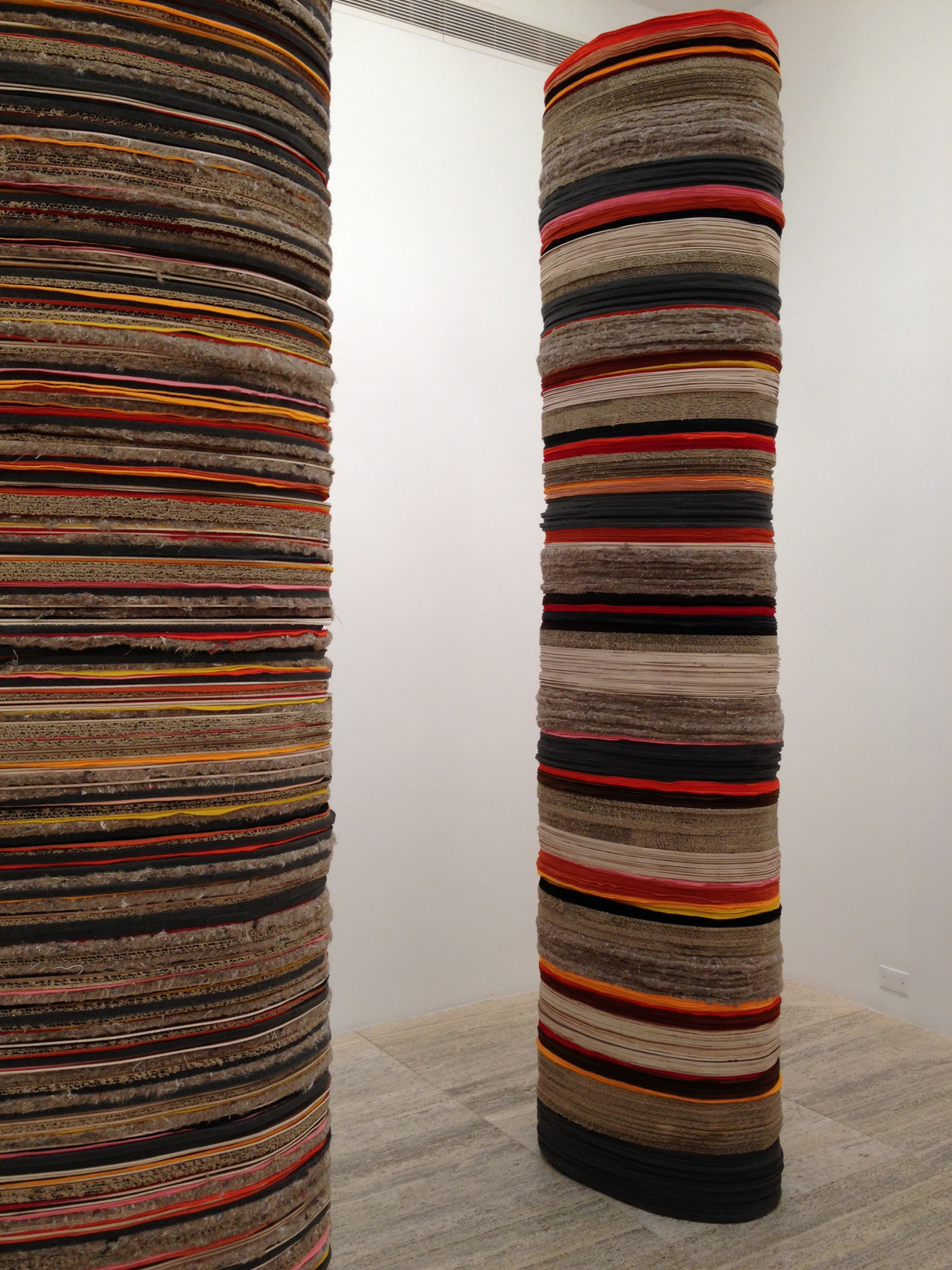
Constructed of layers of cardboard, plywood, foam and felt, Phyllida Barlow’s untitled column sculptures at Hauser & Wirth are monumental without being macho. Bright, enticing colors and soft materials humanize these minimalist stacks. (At Hauser & Wirth, 32 East 69th Street through 12/22).
Though not many of Olafur Eliasson’s projects are going to measure up to the impact of his past large-scale artworks (creating waterfalls on New York City’s East River or a sun in the Tate’s Turbine Hall), his latest solo show at Chelsea’s Tanya Bonakdar Gallery features this simple but mesmerizing display of three fountains, lit by strobes, which turn moving water into seemingly static sculptures. (through Dec 22nd).
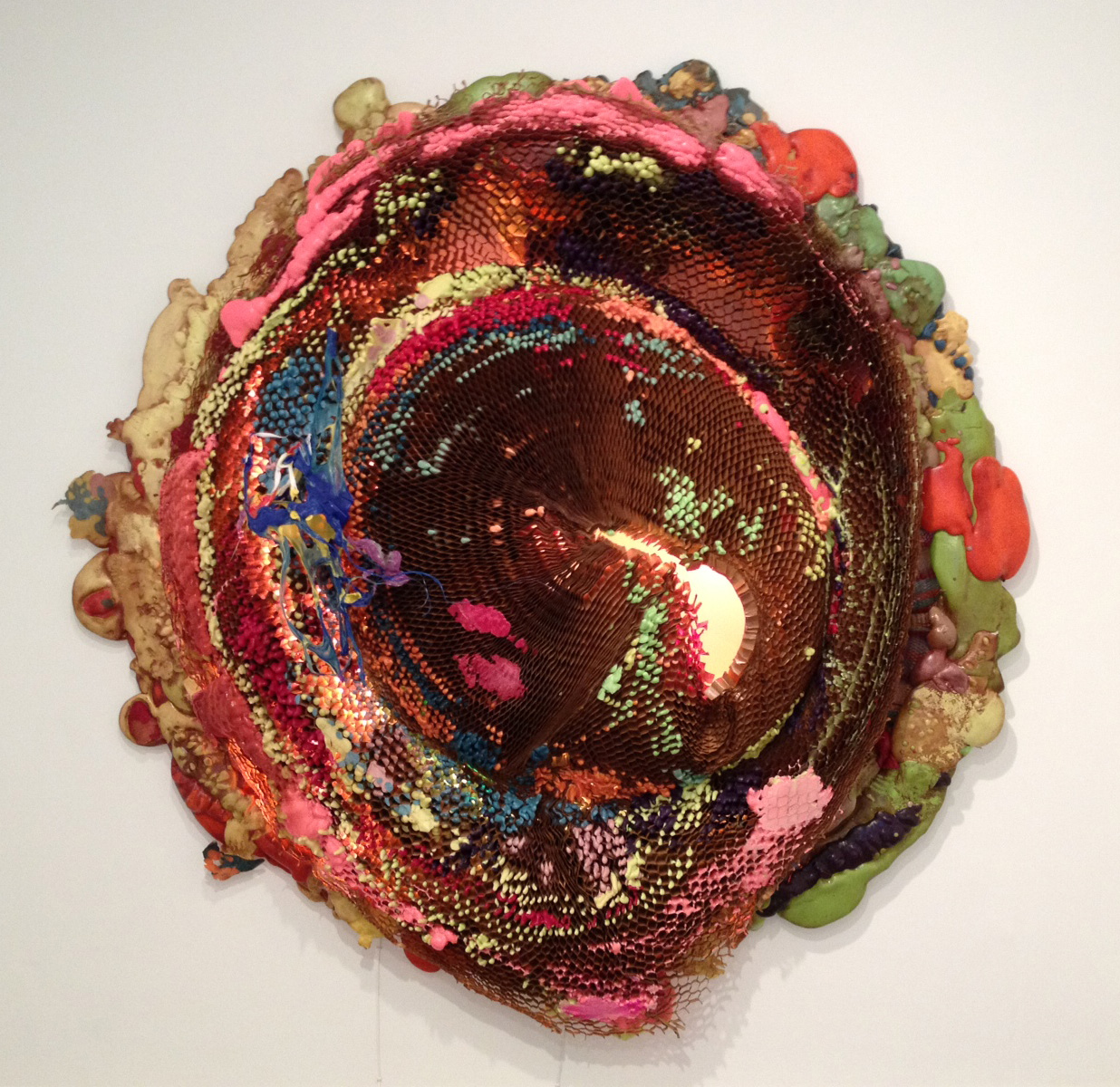
Judy Pfaff, The Path to the Center Was Clearly Marked, honeycomb cardboard, pigmented expanded foam, melted plastics, fluorescent and incandescent light, 2012.
Judy Pfaff’s new sculptures, on view at Chelsea’s Ameringer McEnery Yohe Gallery, channel Lynda Benglis’s neon colors and puffy forms, Louise Bourgeois’ or Yayoi Kusama’s profusion of phallic protrusions, and the commanding presence of a more recent wall-mounted Frank Stella. Yet the profusion of optical seduction is typical Pfaff, as seen in pieces like ‘The Path to the Center was Clearly Marked’ (2012), an over 7ft wide tour de force created from honeycomb cardboard, pigmented expanded form, melted plastics, fluorescent and incandescent light. (Through November 10th.)
Zhan Wang, Jiashanshi No 106, stainless steel, 2006.
In the 90s, Zhan Wang caused a stir in China by intervening in the landscaping around new, modern buildings by replacing natural rock formations with his large, chrome-covered stainless steel scholars rocks. In the atrium of 590 Madison Ave, the ‘stones’ are in keeping with the glass wall and bamboo plantings, but they still have a ghostly, shape-shifting presence.
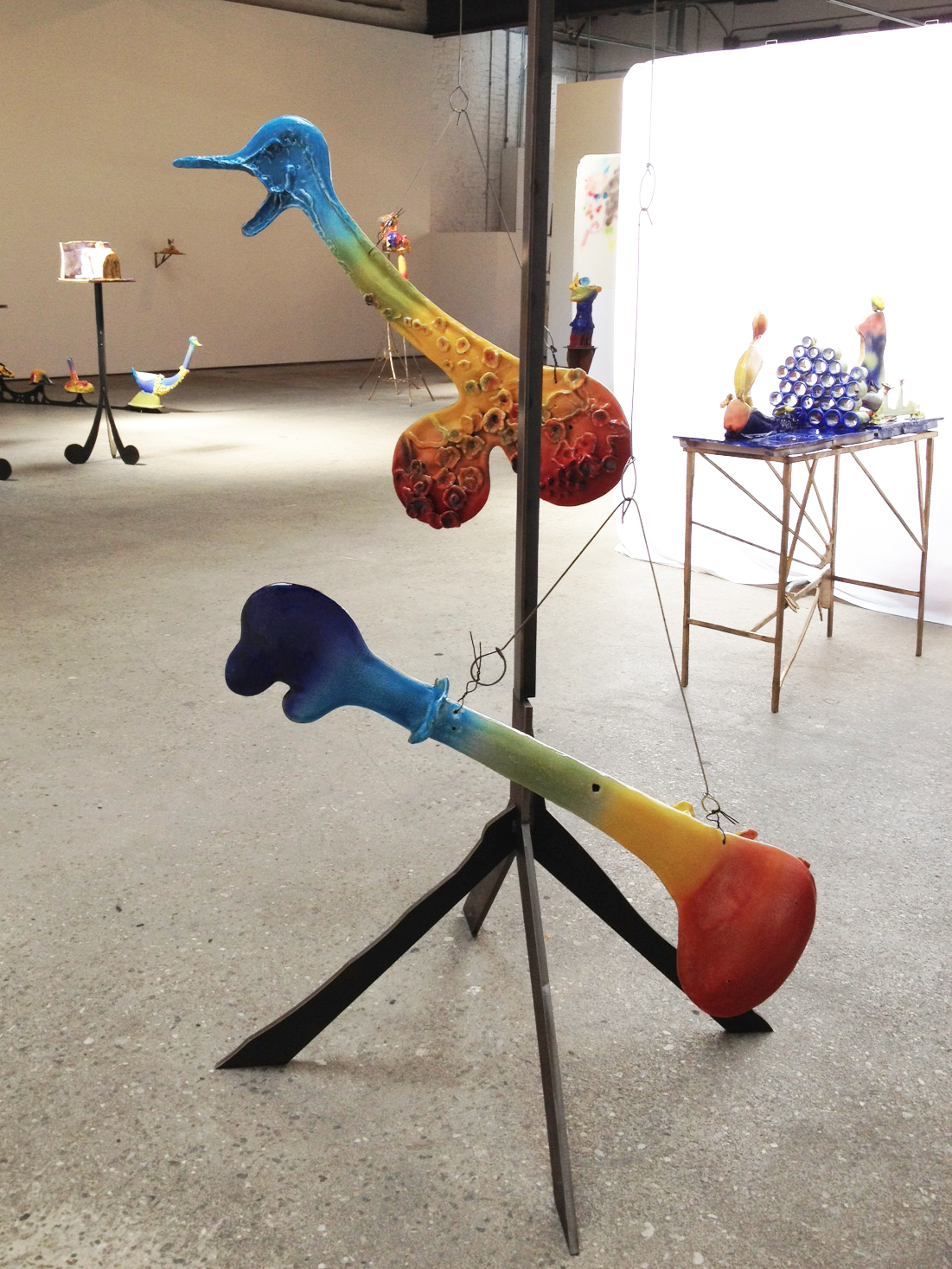
Alessandro Pessoli’s painted figures usually look like they’ve emerged from a dream or hallucination; these absurdly phallic Maiolica ceramic sculptures, fittingly titled Sancho Panza & Don Chiscotte, lack the typical atmospheric surroundings of Pessoli’s paintings, but their lighthearted vibrant colors and mobile-like hanging lend them an amusing whimsy. (At Chelsea’s Anton Kern Gallery through Oct 20th.)
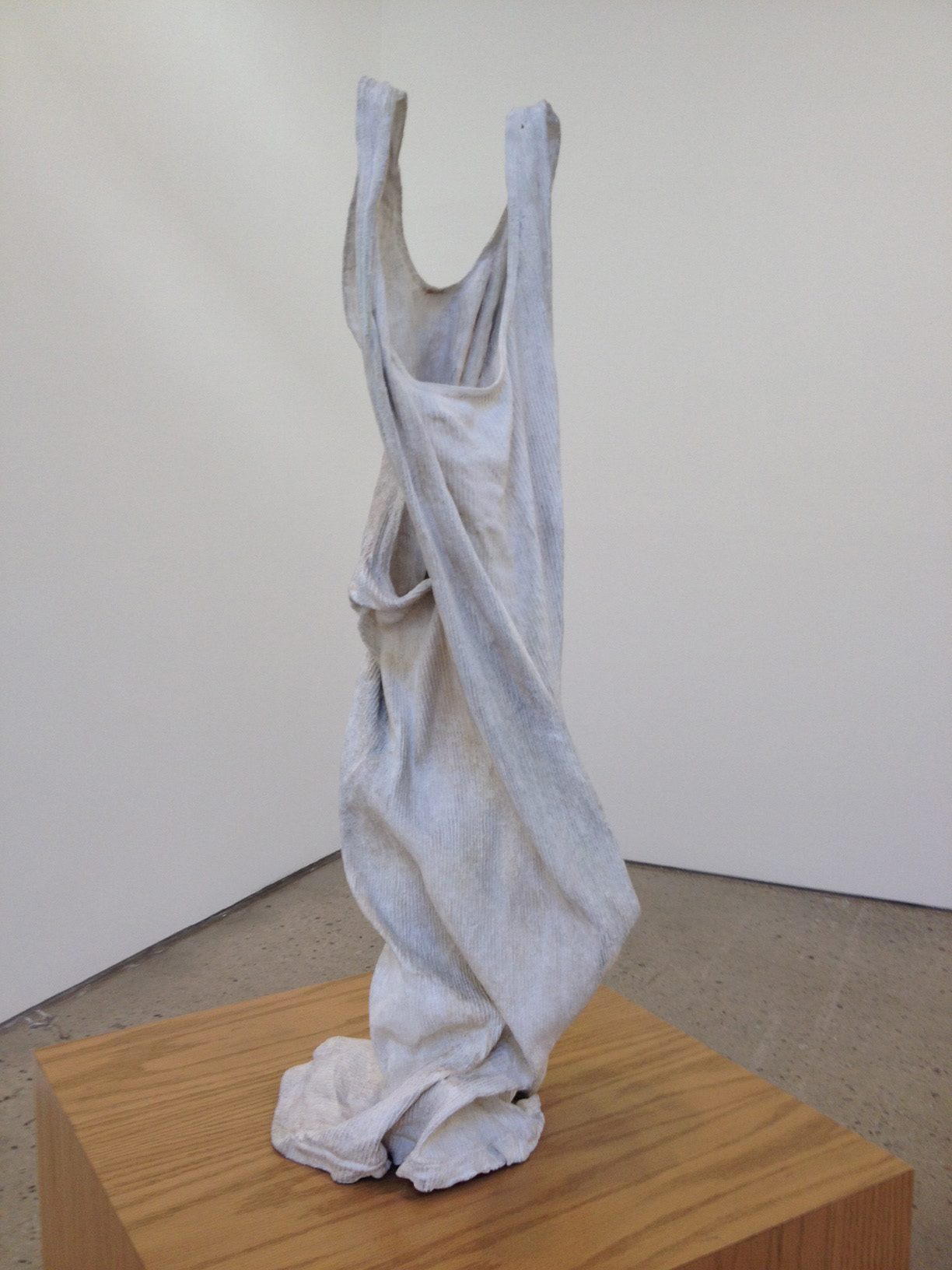
Conceived of by accident when a shirt used as a glue rag dried into an arresting form, Matt Johnson’s Wifebeater is as pedestrian and delicately ephemeral as a plastic bag in the wind. At least on first glance. A closer look reveals Johnson’s trademark twist of using unlikely materials to make his sculpture. This t-shirt is made of bronze. (At Chelsea’s 303 Gallery through Nov 17th.)
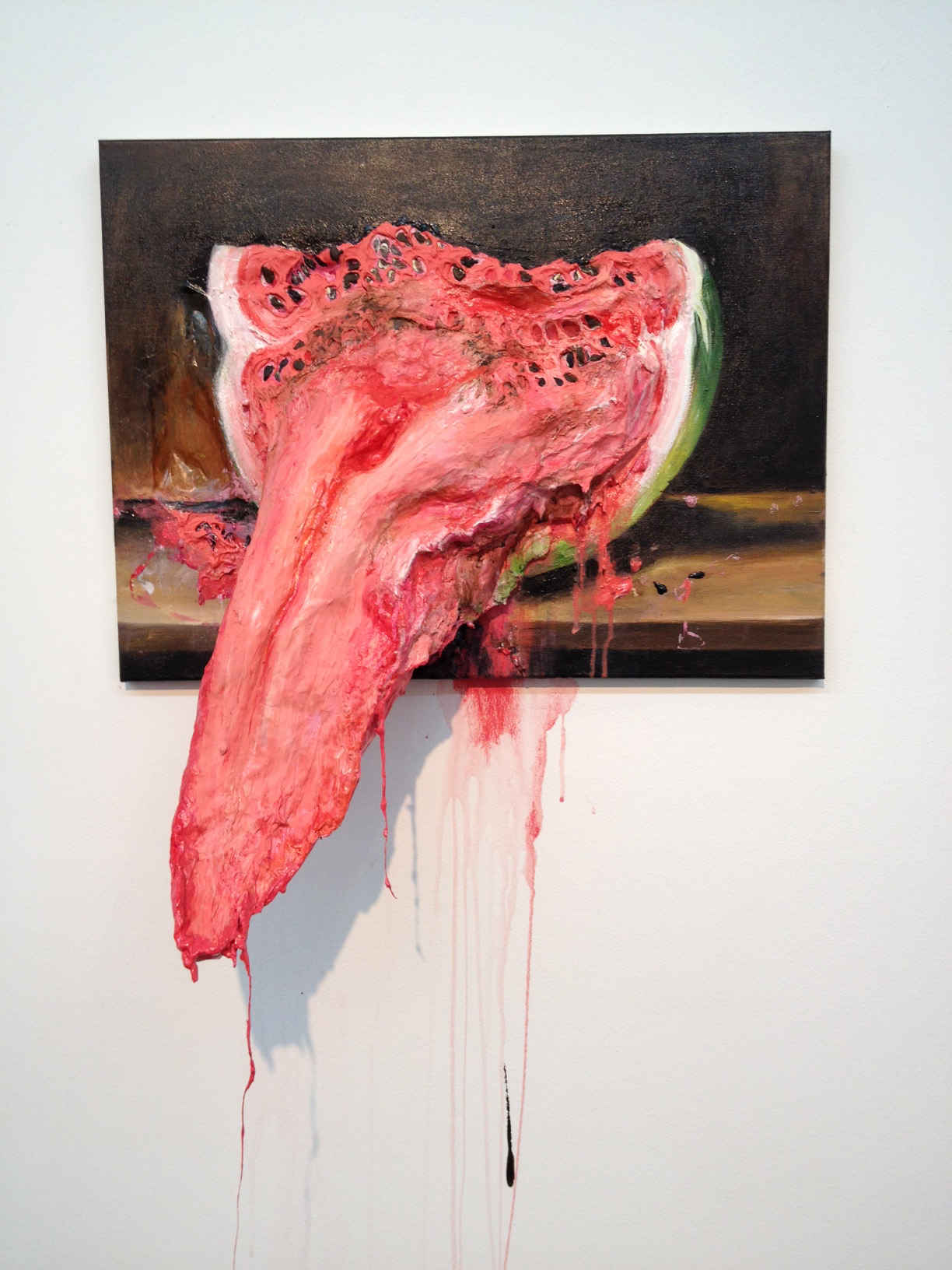
This is one watermelon you do not want to eat…or be eaten by. A giant lick of modeling paste extends from Valerie Hegarty’s repulsive ‘Watermelon Tongue,’ curbing the appetite and recalling ‘Little Shop of Horrors,’ one inspiration for this painting. Hegarty was also thinking of last year’s news reports of exploding watermelons in China, which were mistakenly sprayed with growth accelerator. Now do you want to know where your food comes from? (At Nichelle Beauchene Gallery on the Lower East Side, through October 20th).
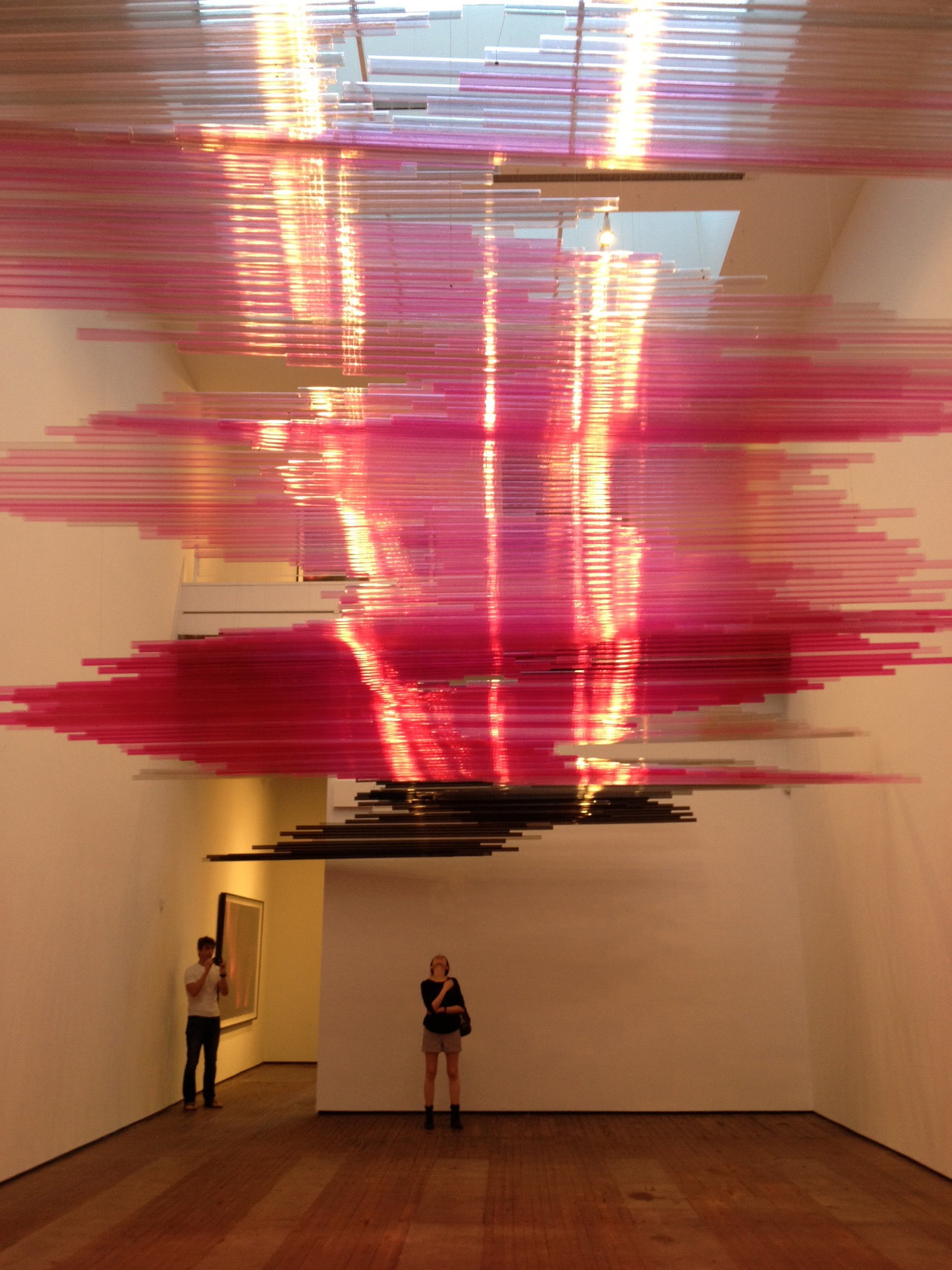
Teresita Fernandez created this sculpture on site at Lehmann Maupin’s Lower East Side location this summer, turning thousands of translucent, colored layers of polycarbonate into an installation evoking the lights of the aurora borealis. (Through October 20th.)
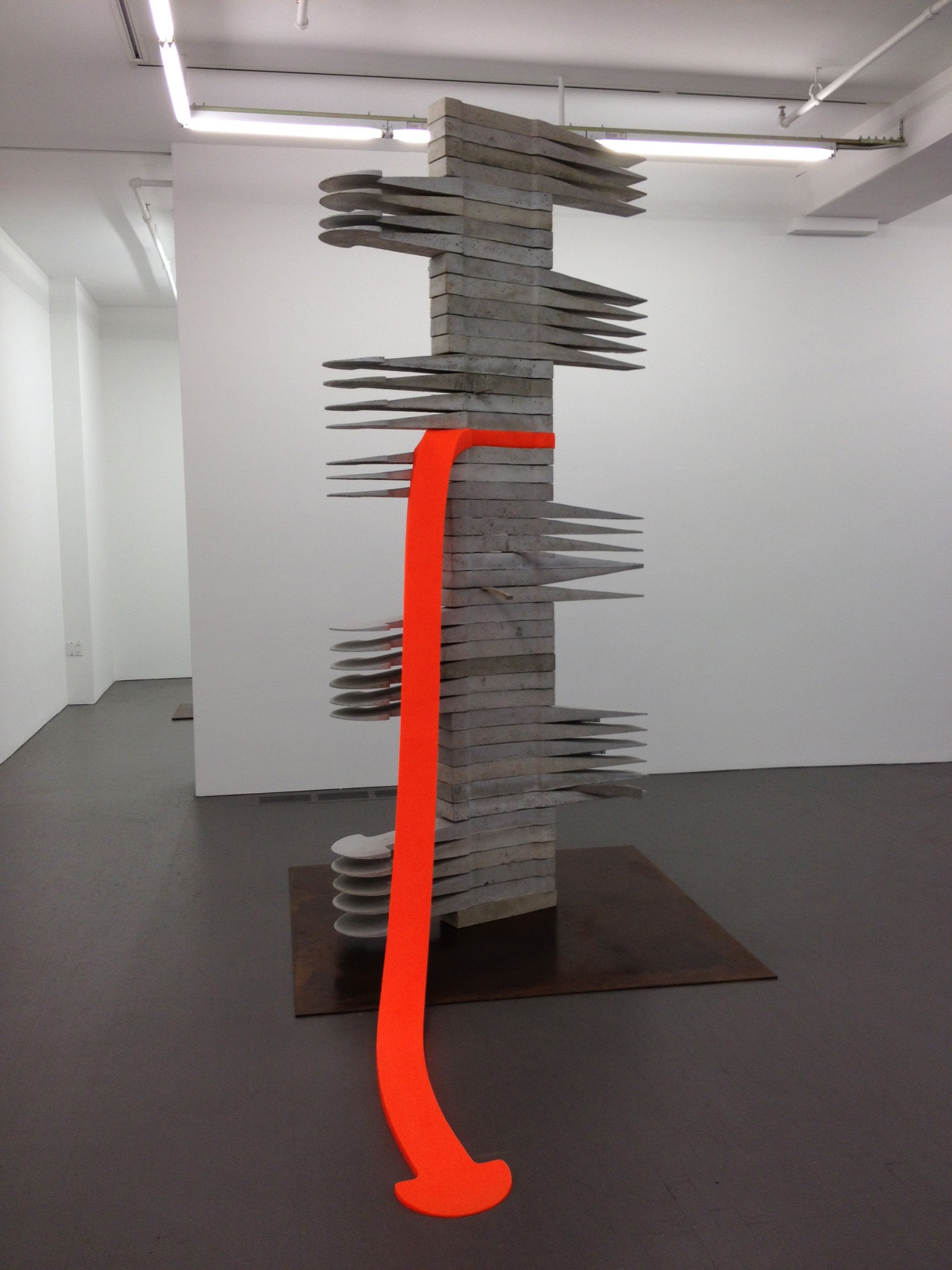
You use tools to make art, but can you make art out of studio tools? Martha Friedman gives it her best shot, transforming a rather impersonal object – the wedge – into mysteriously totemic towers punctuated with flaccid, pizza-paddle shapes in day-glo orange silicone rubber. (At Chelsea’s Wallspace Gallery through October 20th).
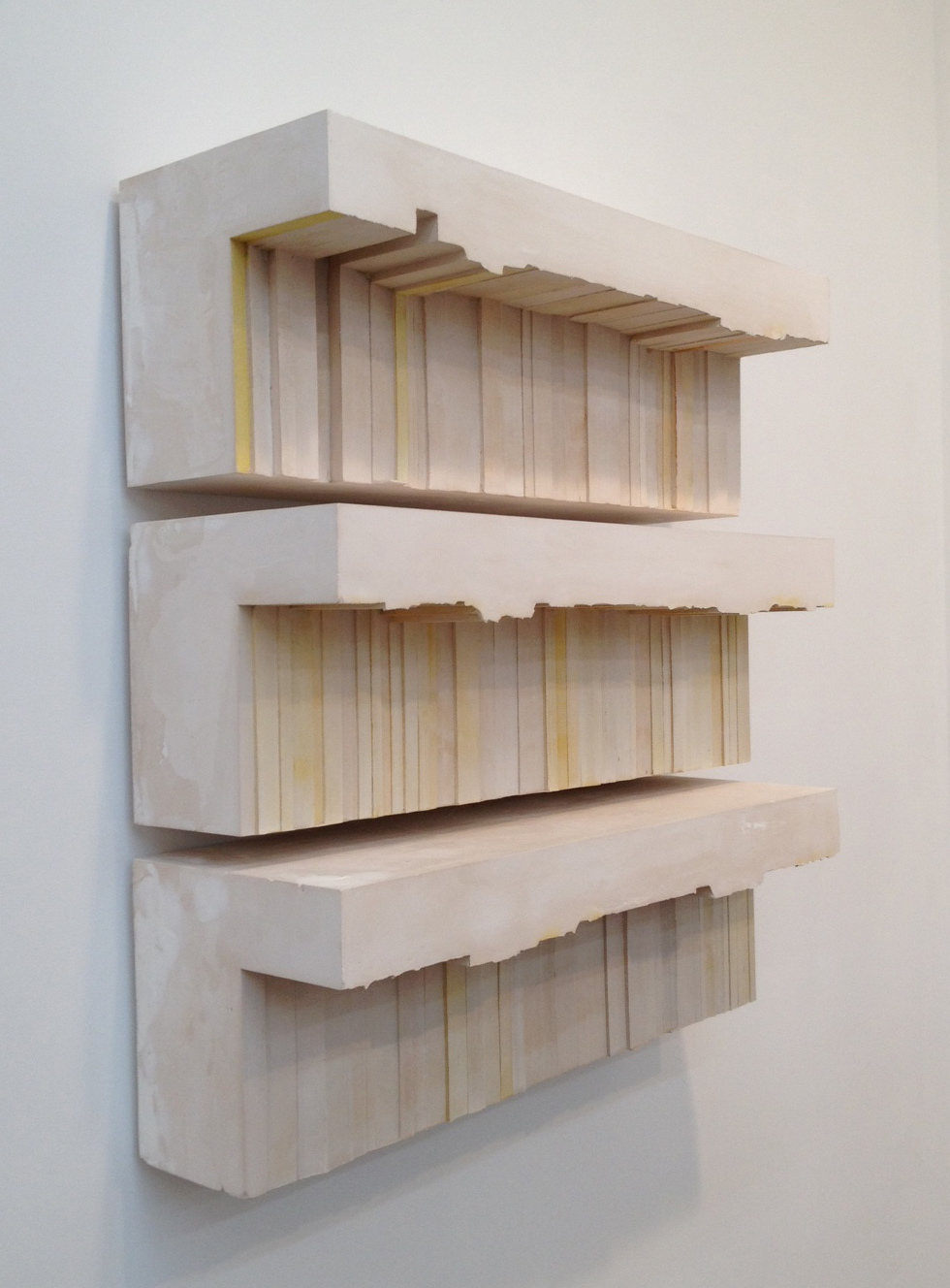
Rachel Whiteread, Untitled (Sequence III), plaster, polystyrene and steel, 2002.
Books – in colorful grids on the floor, piled on a remainders table, preciously designed and placed far out of reach on high shelves and in many more guises – fill Friedrich Petzel Gallery’s biblio-centric group show, ‘The Feverish Library’ (organized in cooperation with Matthew Higgs). Rachel Whiteread’s plaster, polystyrene and steel ‘Untitled (Sequel III)’ from 2002 lends a note of gravitas and mystery to the show by recording only the cast space around a bookshelf. (In Chelsea’s Friedrich Petzel Gallery through Oct 20th).
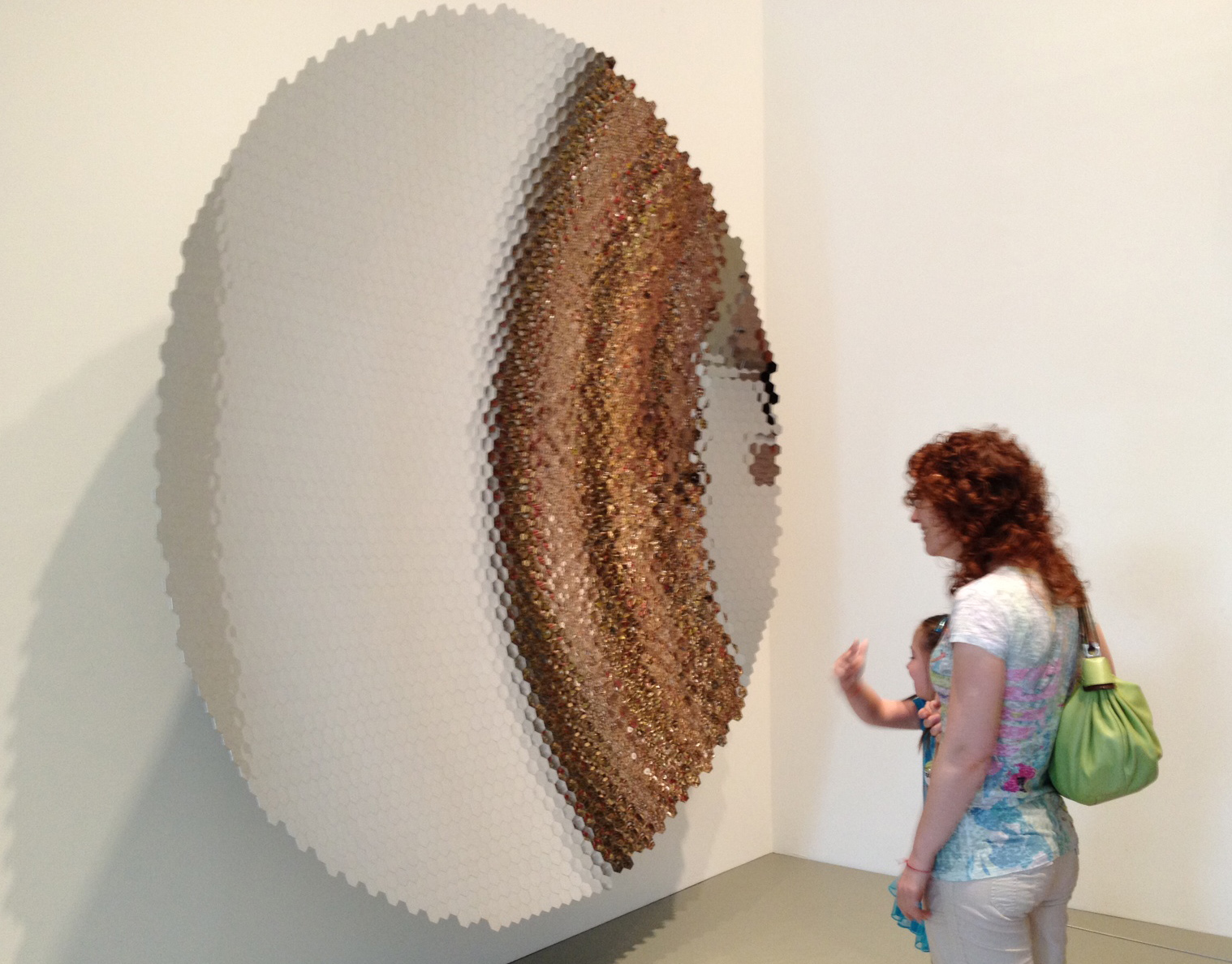
There aren’t many artworks at the Metropolitan Museum of Art that could be described primarily as ‘fun.’ Anish Kapoor’s ‘Untitled’ from 2007 falls into that category by creating a surprising visual experience as tiny, polished stainless steel tiles on a concave form reflect viewers’ images as a blurry multitude of shapes. London-based Kapoor’s best known works in the US (Chicago’s Cloud Gate, for example) make viewers aware of their surroundings. At the Met, Kapoor’s piece is surprisingly intimate and thoroughly amusing. (On view in the 2nd floor Modern and Contemporary Art Galleries).
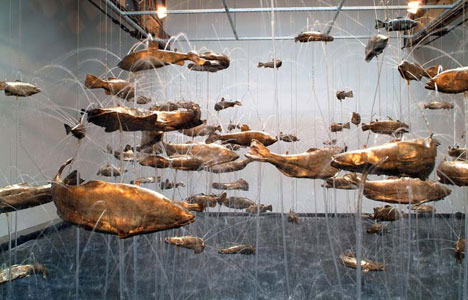
Bruce Nauman, One Hundred Fish Fountain, bronze fish suspended with stainless steel wire from a metal grid, 2005.
Stepping out of the elevator at Gagosian Gallery’s uptown, Madison Ave location, the roar of rushing water is immediate and surprisingly loud. Around the corner, squeezed into the main 6th floor exhibition space, is iconic conceptual artist Bruce Nauman’s sculpture of 97 cast bronze fish spouting water from their bodies as if they’d been hunted by rifle as well as hook and line. Elegant in photos, the mechanics of the piece – trailing tubes, a leaky basin, wires – dominate the in-person experience, creating typically Nauman-esque disconcertion. (‘One Hundred Fish Fountain’ is at Gagosian Gallery through Aug 31st).
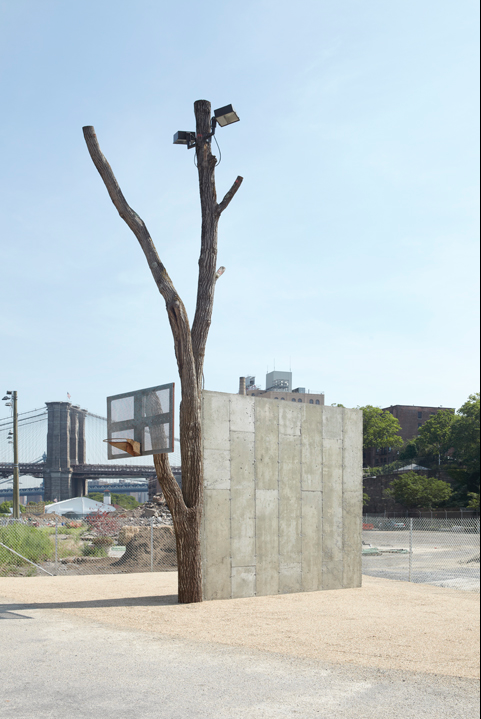
Oscar Tuazon, ‘People,’ sugar maple tree, concrete, metal basketball backboard and hoop, 2012. Photo by Jason Wyche.
Known for overtaking galleries with his wood and concrete constructions, Oscar Tuazon’s new site-specific sculptures on the Brooklyn waterfront have space to breath. Here, a sugar maple, concrete, backboard and hoop come together to form ‘People,’ a sculpture inviting folks to play a role in cleaning up the Brooklyn waterfront by having a little fun. (Organized by the Public Art Fund, Tuazon’s sculptures are on view at Brooklyn Bridge Park.)
Alyson Shotz, Wavelength #2, dichoric acrylic on aluminum tube and steel, 2008. Image courtesy of Alyson Shotz Studio.
‘Dazzling’ is a good way to describe Alyson Shotz’s optically enticing sculpture whether it’s the shimmering curtain of Fresnel lenses she memorably installed in the Guggenheim’s atrium in ‘07 or a mirrored fence hidden in plain view in the fields at the Storm King Art Center. ‘Wavelength #2’ from 2008 continues Shotz’s interest in waveforms and uses dichroic acrylic to both transmit and reflect different wavelengths of light, creating a range of colors from a clear material. (‘Wavelength #2’ is at Paul Kasmin Gallery as part of ‘Sculpted Matter’ through August 17th.)
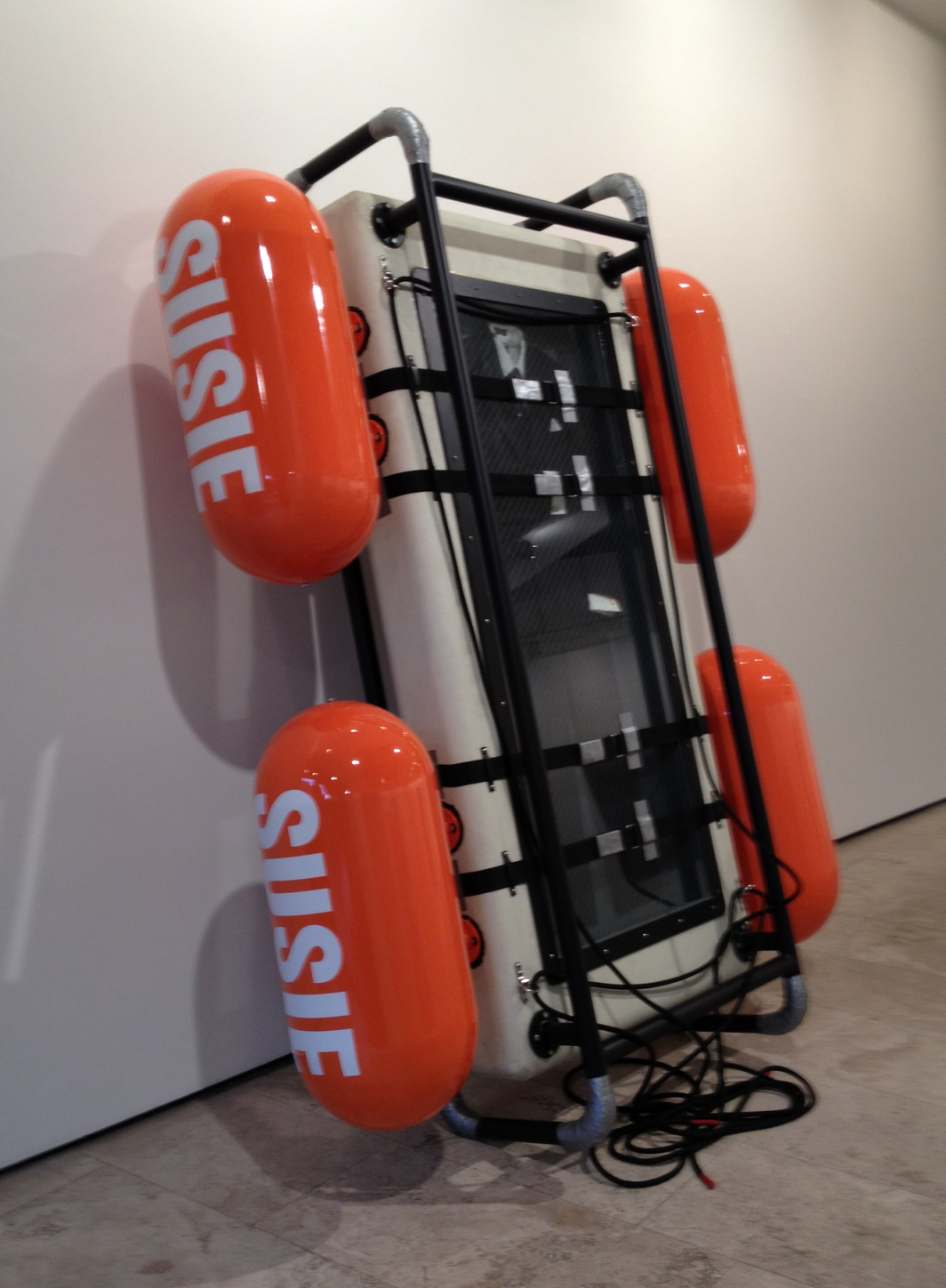
Ashley Bickerton, ‘Seascape: Floating Costume to Drift for Eternity I (Armani Suit), suit, glass, aluminum, wood, caulk, fiberglass, enamel, canvas and webbing, 1991.
As far as self-portraits go, ‘Seascape: Floating Costume to Drift for Eternity I (Armani Suit)’ by Ashley Bickerton is a little on the dark side, despite its bright orange buoys. Made in 1991, just two years before this regular on the downtown New York art scene relocated permanently to Bali, it seems to foretell his departure. Quixotic, a little lonesome, and stylishly branded by Armani and his signature ‘Susie’ logo – a semi-corporate brand of his own invention – Bickerton’s craft signals a dignified leave-taking, a memorial to a past life and an adventure about to begin. (Through August 17th at Lehmann Maupin Gallery, Chelsea.)
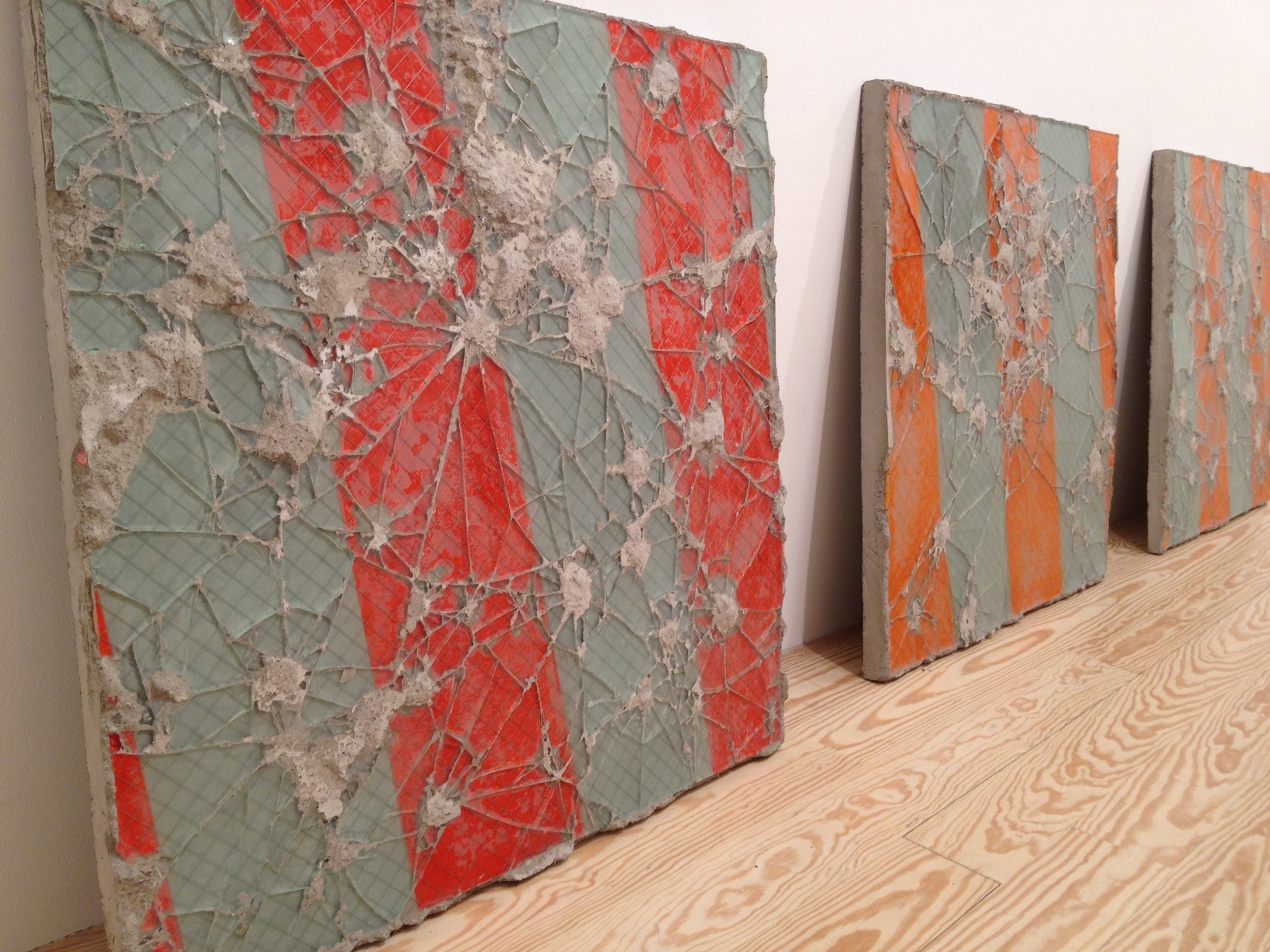
Davina Semo, You Said We’re Skipping the Prelude; Start the Insults, reinforced concrete, safety glass, enamel paint, 2011
Three panels of painted concrete covered in shattered safety glass by Davina Semo at Chelsea’s Derek Eller Gallery rest on the floor like they were just brought in from a war-zone. Minimalist stripes in safety orange appear to have suffered heavy attack but survive to bear witness. Together they’re titled, ‘You said we’re skipping the prelude: start the insults.” (Though August 16th).
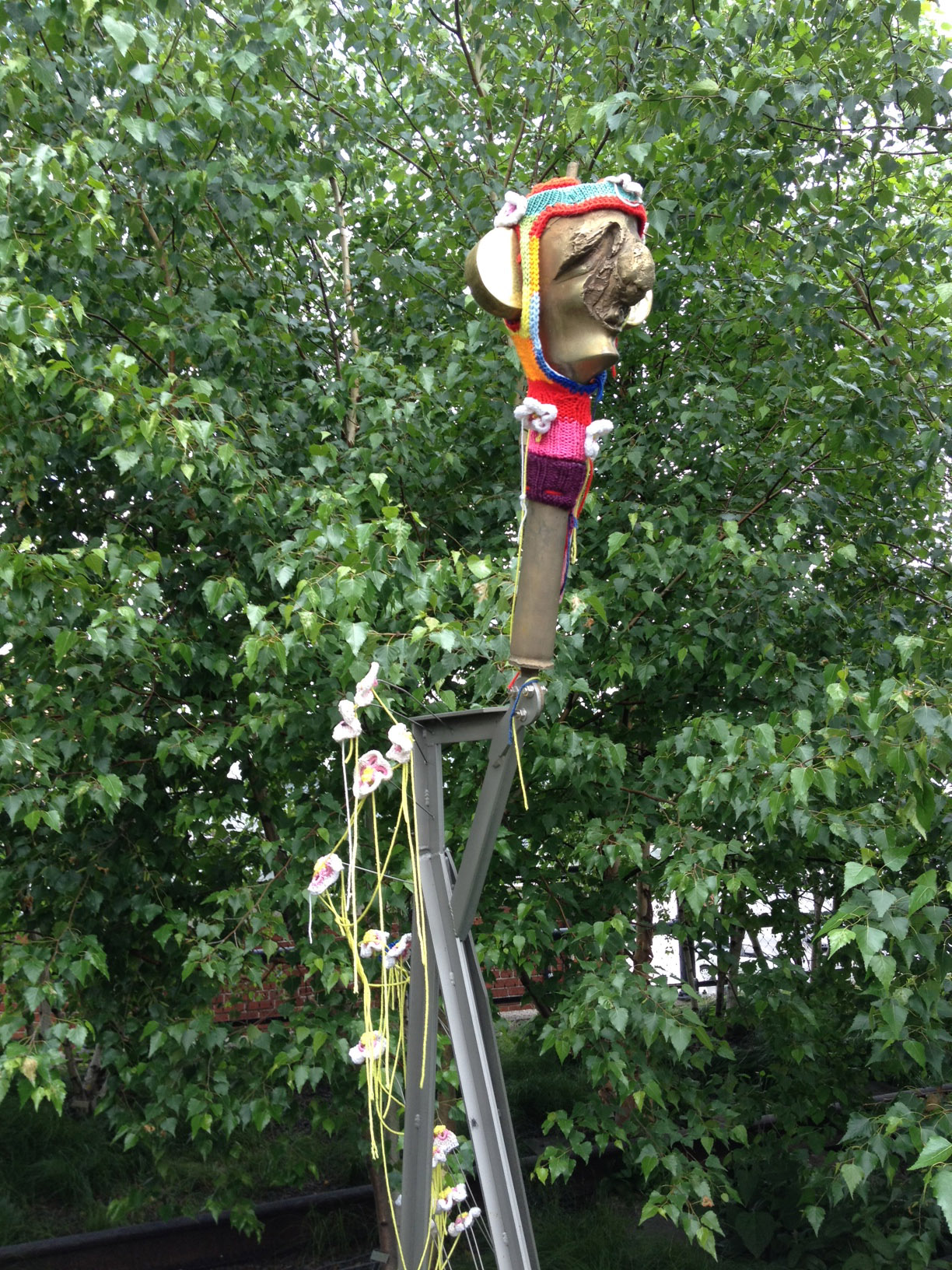
Alessandro Pessoli, Old Singer with Blossoms, bronze, steel, wool, 2012.
Alessandro Pessoli’s ‘Old Singer with Blossoms’ on the High Line is half hidden amongst short trees and lush plantings, making this odd character all the more strange once you become aware of his presence. A balaclava in pretty, rainbow colors gives him a childlike or hippy appearance completely at odds with his cold steel body and bronze head. As a mechanical creature subject to ridicule (for that silly hat), he could be one of Marcel Duchamp’s bachelors grown old. (On the High Line as part of the group show ‘Lilliput’ through April 2013.)
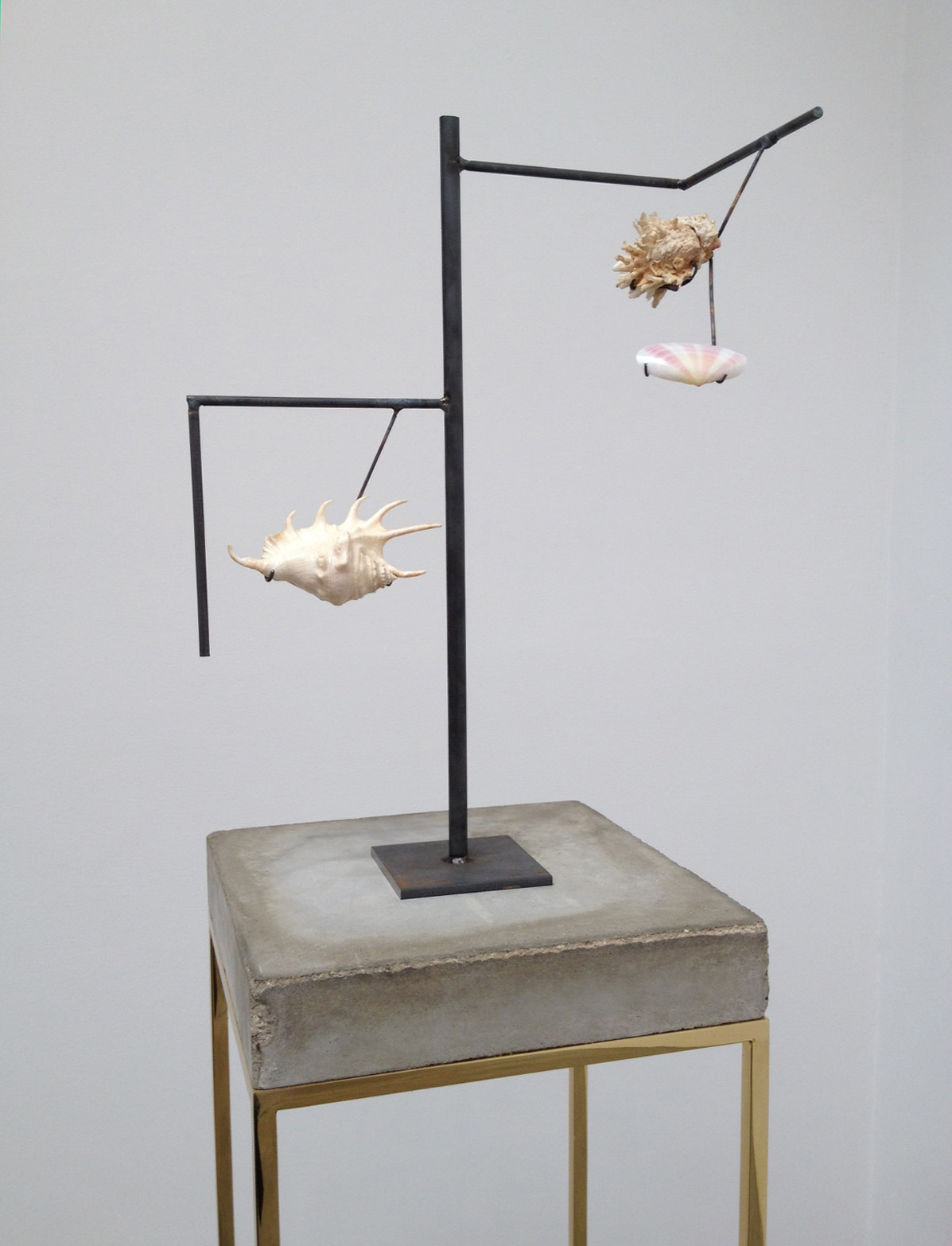
Carol Bove, Aurora, concrete, bronze, steel and seashells, 2012.
After appearing on the cover of May’s Art in America magazine, Carol Bove’s sculpture ‘Aurora’ is on view in Chelsea at Luhring Augustine’s ‘Painting in Space’ summer group show. Bove is known for accumulating and displaying books, objects and ephemera that relate to 60s culture. More recently, she’s been scavenging natural materials to continue her investigation of what a readymade object (or collection of them) might convey when put on display as art. With their spikes, undulating surfaces and bands of color, these shells are exquisite examples of nature’s creativity and a contrast to the manmade, geometric rods that cradle them. (Through August 17th).
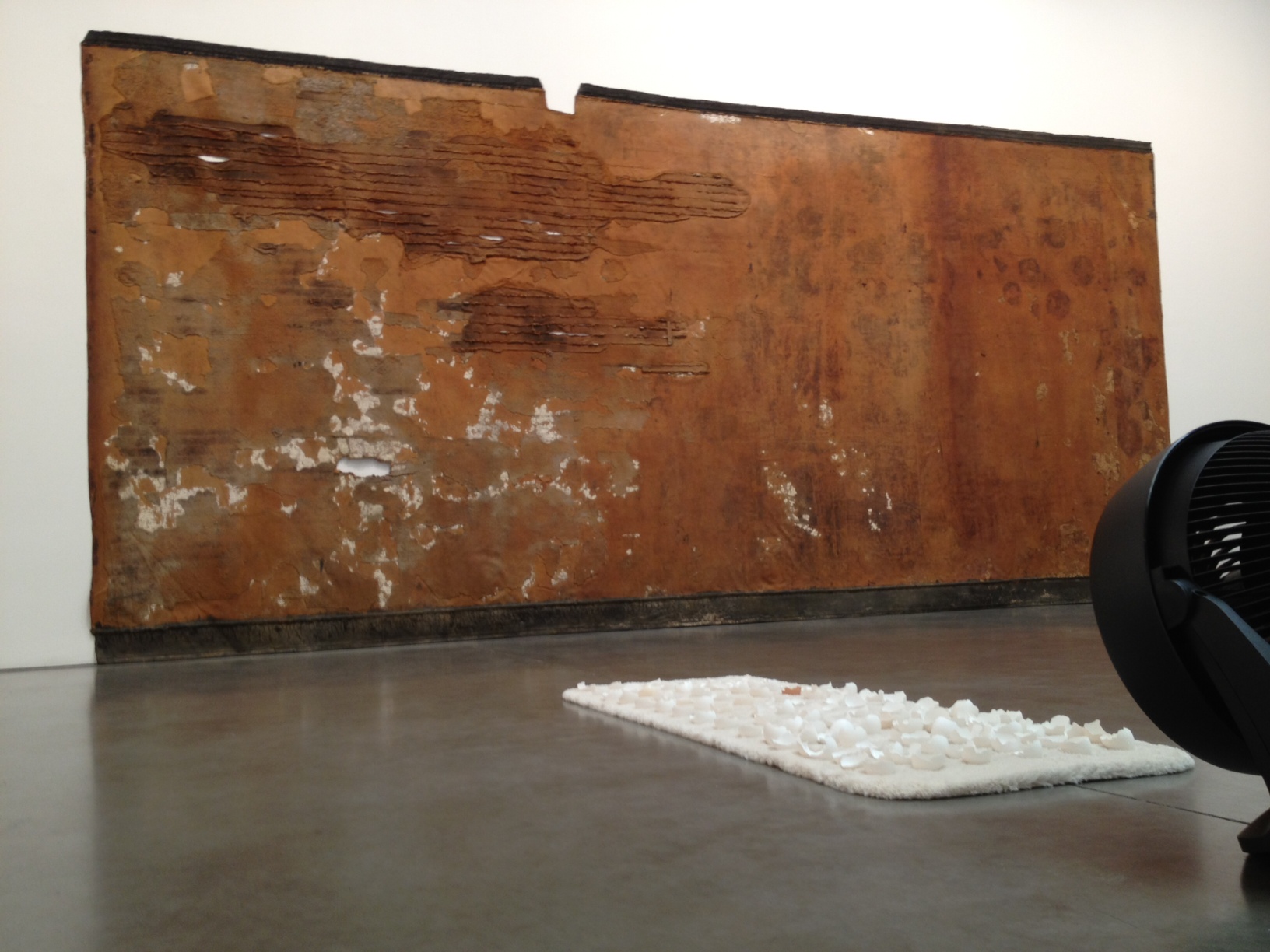
Robert Overby & Lizzi Bougatsos installation view at Andrea Rosen Gallery.
41 years ago today, LA-based artist and graphic designer Robert Overby created ‘Long wall, third floor (From the Barclay House Series), 4 August, 1971,’ a nineteen foot long cast of an abandoned building made of latex and cheesecloth. Its dirt, holes and grubby material make it a powerful symbol of entropy and decay. It’s both kin and contrast to Lizzi Bougatsos’ more delicate cracked eggshells on white bathmat – discards arranged into a fragile and pristine grid. (At Andrea Rosen Gallery, Chelsea, through August 21st.)
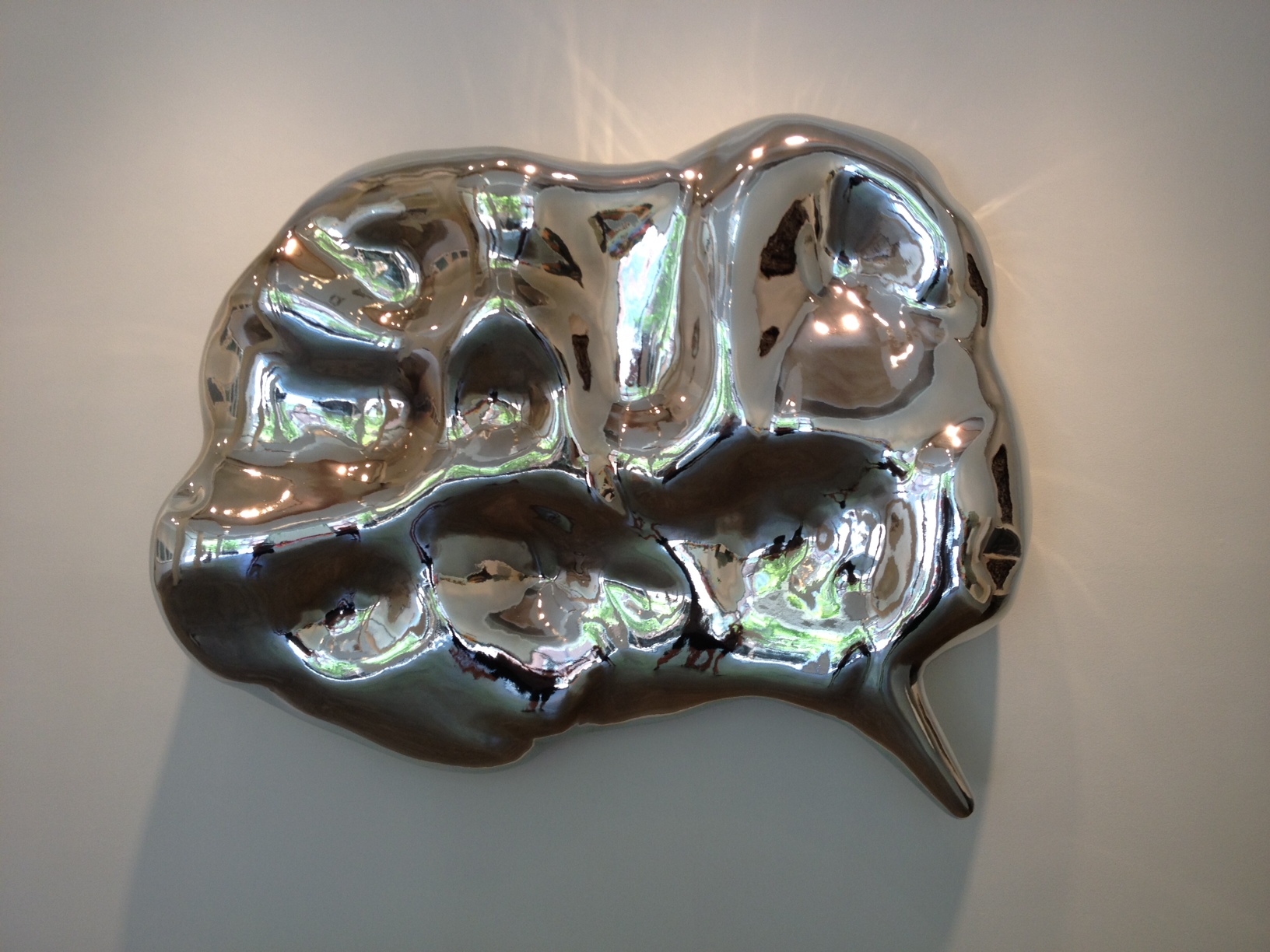
It’s not clever words or phrasing but a pretty, undulating shimmer that make German artist Juergen Drescher’s six-foot wide speech bubble attractive. Silver-plated laminated polystyrene reflects the gallery’s light and the viewer, drawing us into conversation that must surely be intended to charm or impress. (The group show ‘Systemic’ is at Carolina Nitsch through August 11th.)
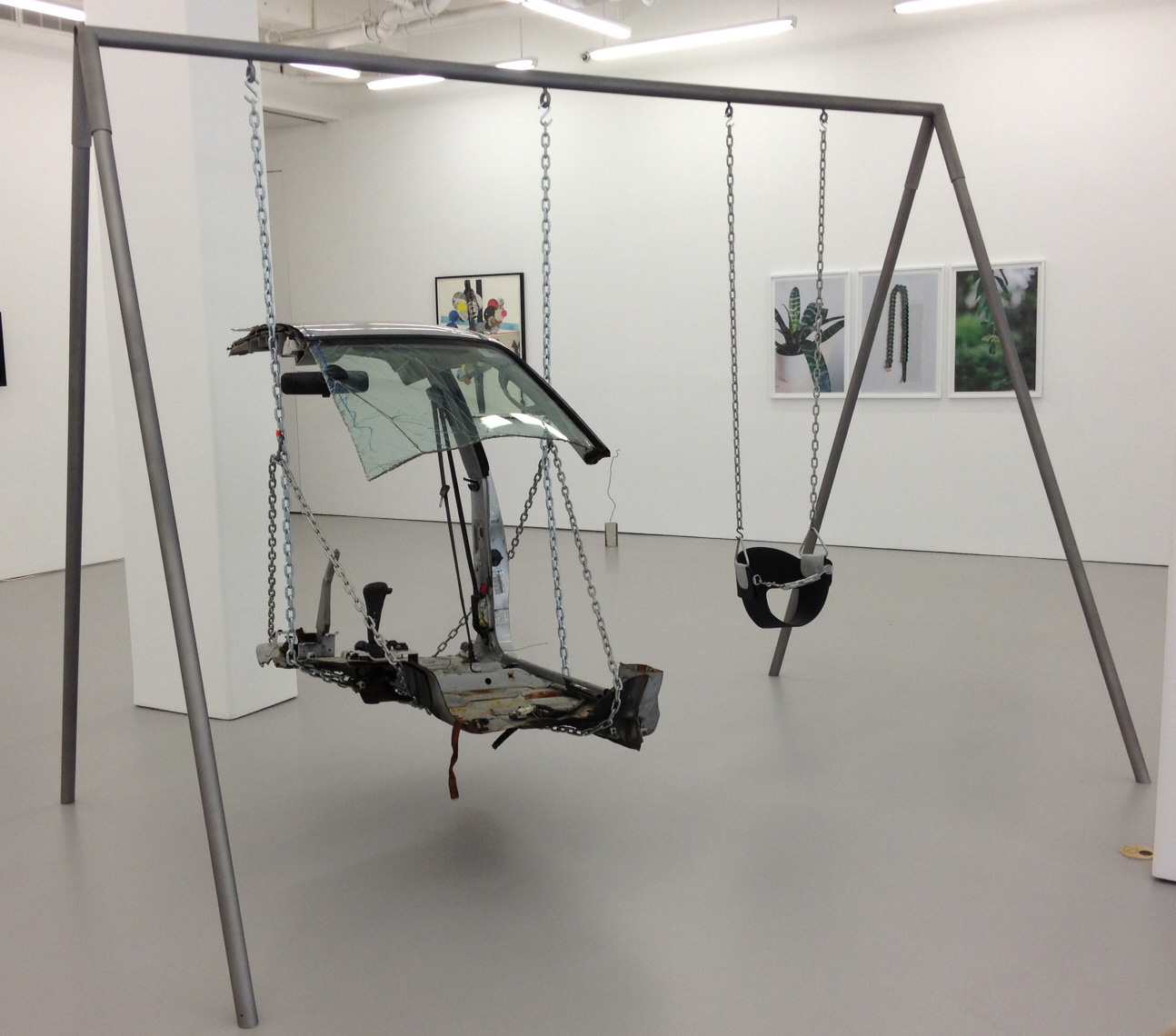
Mateo Tannatt, New Line, Mitsubishi Pajero/Montero/Shogun 1982 – Present, 2012.
With his swing set turned sculpture at D’Amelio Gallery, LA-based artist Mateo Tannatt exploits the shock value of mixing themes of car crashes and children, though after a moment, it seems just as likely that this auto fragment has been junked like so many old toys. Swinging can be relaxing or thrilling, and Tannatt deftly suggests both the insulating attraction of a car-like pod and the consequences of pushing it too far. (Though August 24th.)
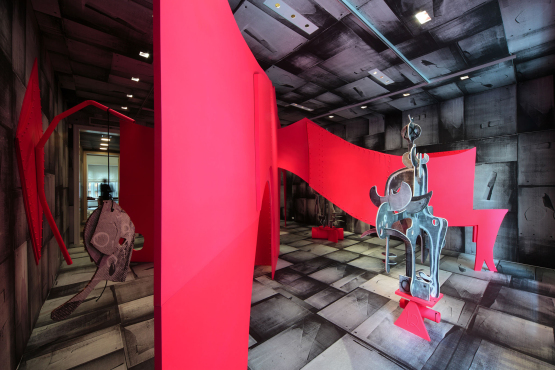
Aaron Curry, installation view of ‘Buzz Kill’ at Michael Werner, 2012. Photo courtesy Michael Werner Gallery.
When asked how he felt about his imitators in a 1962 interview, Alexander Calder replied, “They nauseate me.” Aaron Curry’s recent sculptures—which continue to blatantly quote the biomorphic forms pioneered by Calder, Frederick Kiesler and other High Modernists—suggest he wouldn’t mind irking his art-historical predecessors. The show’s tongue-in-cheek centerpiece, Buzz Kill (a hot-red rendition of a Calder-like stabile in aluminum), as well as other sculptures featuring curvy interlocking shapes à la Kiesler and Noguchi, seems eager to take down modernism’s utopian ideals without offering much in their place.
The space-hogging Buzz Kill—along with a grainy black-and-white wallpaper of Minimalist collage patterns that plasters the space, floor and ceiling included—hints at a major statement by aggressively altering the gallery’s townhouse setting. But the work fails to go beyond a kill-the-father treatment of modern art. A recurring image within the wallpaper resembles a straight razor at first glance, and a disembodied cardboard “head” briefly conjures dread, before the limp phallic protrusion it dangles from disperses any serious reaction.
The pieces in the foyer (small paper collages featuring a sci-fi sex-goddess type atop a primitive sculpture, and an alien head affixed to a nude female totem) prime viewers for a transgressive punch that the exhibition fails to deliver. Instead, we get more of the artist’s now-signature wooden sculptures composed of organic, interlocking shapes, including Dezvil, which doesn’t resemble an evil presence so much as a goofy moose with someone clinging to its back. The modernist hope of creating a harmonious society through art may be dead, but stasis and pastiche aren’t suitable replacements.
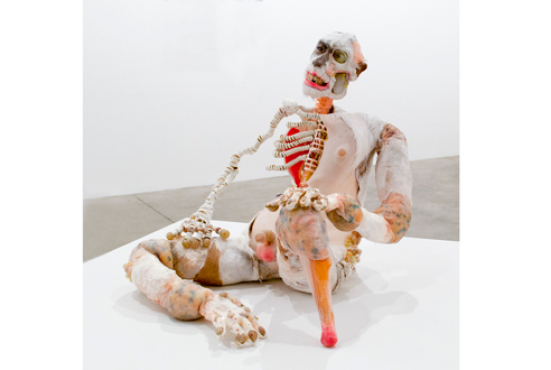
Monica Cook, Dreyvus. Photo courtesy of Postmasters.
Figurative sculpture of fantastical creatures being rare in Chelsea, Monica Cook’s first New York solo show starts out as strange, but gets more eccentrically alluring. A monkey-like character by the door sets the tone with a dignified look in his eye but a half-finished, diseased-looking body. His simian brethren, in sculptures, photos and a stop-animation video, are equally grotesque, cobbled together assortments of fur and plastic. They recall David Altmejd’s gaudy giants, but elicit more sympathy.
A parent-and-child grouping and a female with her dog hint at the possibility that the beasts are stand-ins for us humans. This suggestion is confirmed by the video, in which the critters court and mate in a manner recalling Cook’s excellent 2010 YouTube Play contribution (not in the show), featuring romantic encounters driven by bestial desires. Things work out better in Cook’s animal kingdom, however, as ulterior motives fall by the wayside and, after a series of shy glances, a male magically impregnates a female by merely proffering her a bauble.
The fact that this pretty seed was torn from a fetus-like pod, or that the female attracts the male by munching on an olive-like oval pulled from the skin of her leg, is the repulsive flip side to these creatures’ damaged beauty. Missing flesh reveals skeletons cleverly constructed from coiled phone cords, internal organs made of glass balls and baboon bottoms filigreed with lingerie-like ornamentation. Despite their disconcerting appearance, their rituals of attraction and reproduction are sincere and absurdly simple, offering a kind of prelapsarian seduction of their own.