With her grimacing face and distorted figure, Willem de Kooning’s 1950 ‘Woman I’ is an uneasy presence in modern art history and at present, a recurring one in the Chelsea galleries. She peers out from behind wide, stylized brushstrokes in a 1981 canvas by Roy Lichtenstein at Gagosian Gallery and shows up in several paintings by 91-year-old surreal-pop painter Peter Saul at Gladstone Gallery. Here, Saul’s ‘Woman’ rolls her eyes and smirks as she descends a staircase à la Duchamp’s 1912 ‘Nude Descending a Staircase.’ While Duchamp’s version shocked early 20th century art audiences and de Kooning’s presents an uncomfortably unflattering portrayal of a powerful maternal-goddess-sex worker, Saul’s version knowingly plays several roles while entertaining thoughts of her own. (On view in Chelsea through April 18th).
Peter Saul, De Kooning’s woman descends the staircase, acrylic on canvas, 55 x 60 inches, 2025.
Fascinated for decades by Post-Impressionist artist Paul Cezanne, painter Mernet Larsen applies her own delightfully eccentric perspectival distortions to her French forebear’s iconic imagery in new work at James Cohan Gallery. Larsen diversifies the cast of characters in ‘The Bathers (after Cezanne)’ adding bikinis to figures more robotic than robust and emphasizing artificiality in the human figures that replace Cezanne’s stabilizing triangle of trees in the original. A diving figure heading into flat waves akin to the slats in Japanese Bunraku puppet theater (which allow figures to move through water) and a woman to the left literally holding up the top of the painting add dynamism and complexity. By alluding to Cezanne but shifting away from his focus and results, Larsen emphasizes the choices behind a painting’s design and nods to the many iconic painters who have moved beyond inspiration to find their own unique results. (On view in Tribeca through March 16th).
Mernet Larsen, The Bathers (after Cezanne), acrylic and mixed media on canvas, 59 ¼ x 39 ½ inches, 2023.
From Marilyn Monroe to Marlene Dietrich, Yasumasa Morimura mimics the iconic looks of famous figures in the series ‘100 M’s Self-Portraits,’ now on view at Luhring Augustine’s Tribeca gallery space. Having made a name for himself in the ‘80s through to the present day via vividly colored photos that depict his reenactments of famous artworks with himself dressed as the main character (he started as Van Gogh with a bandaged ear), the now 72-year-old photographer opted for smaller format black and white images to create his 100 piece portrait series from the 1993-2000. Here, he takes his version of Audrey Hepburn in Breakfast at Tiffany’s into the subway, having his audience watch a passerby react as we also consider the implications of his race and gender transgressing role play. (On view in Tribeca through Oct 21st).
Yasumasa Morimura, one image from ‘Once Hundred M’s self-portraits, 100 gelatin silver photographs, each 13 ¾ x 11 inches, 1993-2000.
Bob Thompson’s 1965 painting ‘The Swing’ at 52 Walker resembles Jean-Honore Fragonard’s famous 18th century rendering of a finely dressed young woman on a swing and her lover gazing up at her from below but radically shifts the focus and intent. In Thompson’s characteristic style, the figures are monochromatic and nude, the eroticism of the female character emphasized by the outline of a breast and the complicity of the two men suggested by their common red color. The man who controls the swing is no longer hidden by foliage, instead playing a clearer role in the flirtation going on between the other two characters. Likewise, Fragonard’s barely noticeable lake in the background turns into a waterfall, two pink putti are locked in a more ambiguous embrace and the swing’s rope more clearly and menacingly encircles the branches above. In exhibitions of work from Thompson’s brief career (he died just shy of his 29th birthday in 1966) at 52 Walker and at Michael Rosenfeld Gallery, the artist delves into European art history, clarifying some elements of iconic works and making others ambiguous to provocative effect. (On view in Tribeca at 52 Walker through July 8th and in Chelsea at Michael Rosenfeld Gallery through July 7th).
Bob Thompson, The Swing, oil on canvas, 49 x 36 inches, 1965.
Against a hazy, apocalyptic landscape, two conjoined heads rise from a spindly stalk of a neck in this painting by Glenn Brown at Chelsea’s Gagosian Gallery, their downward facing gazes suggesting the demure demeanor of women meant to be looked at. The noir-romantic landscape and the women’s postures and youthful European features are recognizable from western art history. But self-consciously constructed in individual brushstrokes of multicolored paint, they forgo the illusion of reality. Positioned half in shadow, half in light, one with a halo, one without, Brown both withholds and illuminates their identities in a way that suggests constant morphing. (On view in Chelsea through Dec 23rd).
Glenn Brown, We’ll Keep on Dancing Till We Pay the Rent, oil on panel, 78 ¾ x 55 ½ inches, 2022.
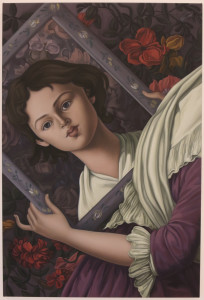
Inspired by art history and contemporary fashion, LA-based oil painter Jesse Mockrin offers glimpses of androgynous creatures with long necks, doll-like features and strangely bone-less fingers. (At Nathalie Karg Gallery on the Lower East Side through Dec 6th).
Jesse Mockrin, One Summer Day, oil on linen, 37 x 25 inches, 2016.
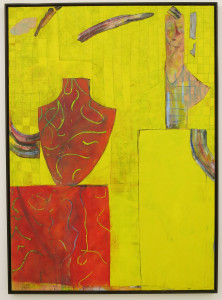
Painter and sculptor Volker Hueller is known for mining art history, remixing styles and associations from yesteryear into a contemporary visual vocabulary. In this recent painting, on view at Lower East Side gallery 11R, he turns one of his signature, geometric characters into art object, suggestively equating face and vase. (Through April 24th).
Volker Hueller, Face ‘n’ Vase, mixed media on canvas, 78 x 56 inches, 2015.
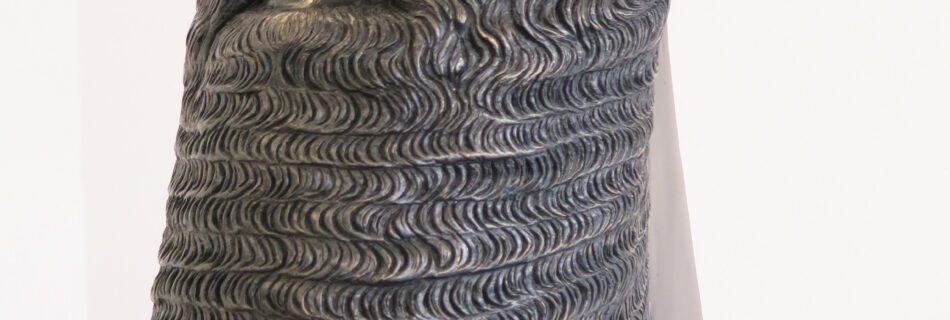
Saying her art practice is about ‘mistranslating the history of ancient objects,’ Brooklyn-based sculptor Sarah Peters ‘misinterprets’ Akkadian rulers, Greek busts and more with stunning results in several bronze heads at LES gallery Eleven Rivington. (Through May 17th).
Sarah Peters, Portrait of a Bearded Man with Triangular Base, bronze, 17.5 x 7 x 13 inches, 2015.
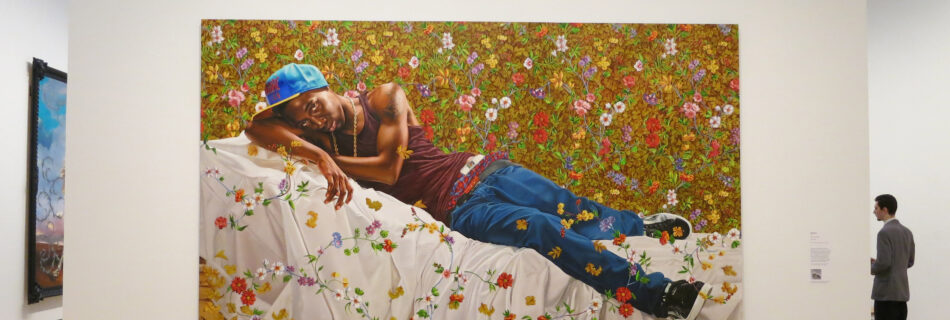
New York artist Kehinde Wiley turns the tables on canonical western art history in paintings which substitute contemporary characters of African descent for European figures. Here, in a centerpiece of Wiley’s current Brooklyn Museum exhibition, a young man plays the role of odalisque. (Through May 24th).
Kehinde Wiley, installation view of ‘Kehinde Wiley: A New Republic,” Brooklyn Museum, February, 2015.
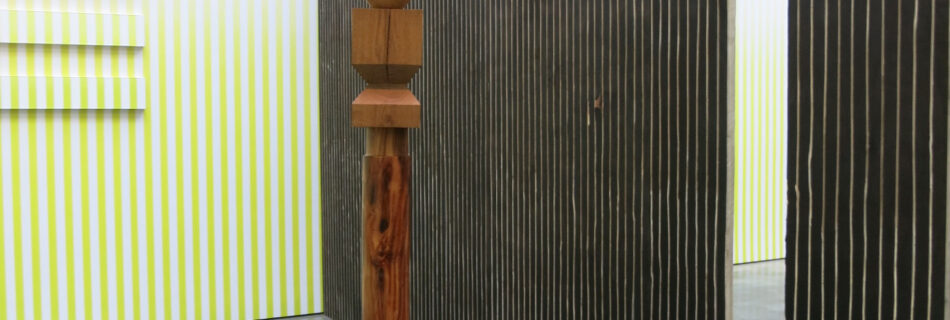
Inspired by Road Runner cartoons, Swiss artist Claudia Comte picked up a chainsaw as a young woman and started carving replica-cacti and more. Brancusi, Noguchi and other 20th century minimalists are references, along with more vernacular items, like the wine bottle opener that seems to have prompted this piece. Comte’s cheeky art historical remix results in a handsome installation. (At Barbara Gladstone Gallery’s 21st Street space through March 21st).
Claudia Comte, installation view of ‘No Melon No Lemon’ at Barbara Gladstone Gallery, Feb 2015.
Elaine Reicheck updates Henri Matisse’s Blue Nude as part of her Swatches series, for which she Googles canonical art historical works, modifies their color and size, and renders them via a digital sewing machine on small fabric swatches. Presented as one of hundreds, an iconic artwork turns cute, neutralized by its size and the suggestion that it is just one of many. (At Zach Feuer Gallery through Feb 7th).
Elaine Reicheck, installation view of Swatches at Zach Feuer Gallery, Jan 2015.
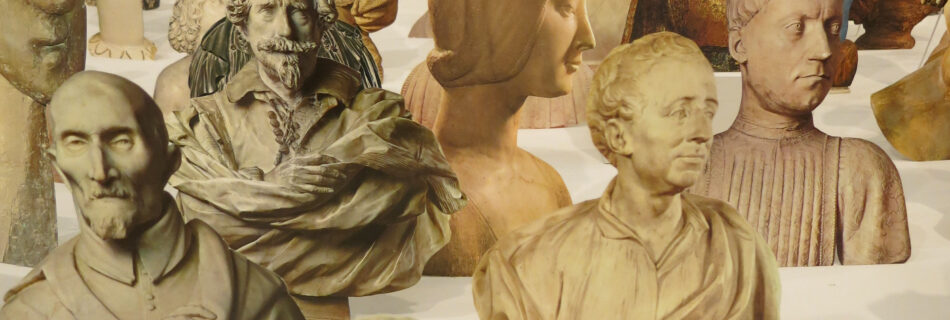
Canonical works of western art from throughout the ages – cut from the pages of art books – rub shoulders in Vancouver artist Geoffrey Farmer’s ‘Boneyard’ installation at Casey Kaplan Gallery in Chelsea. The effect is surprisingly odd as it seems to warp space and time via the simple device of propping paper cutouts on a white tabletop. (Through Dec 20th).
Geoffrey Farmer, Boneyard, paper cutouts, wood, glue, dimensions variable, 2013.
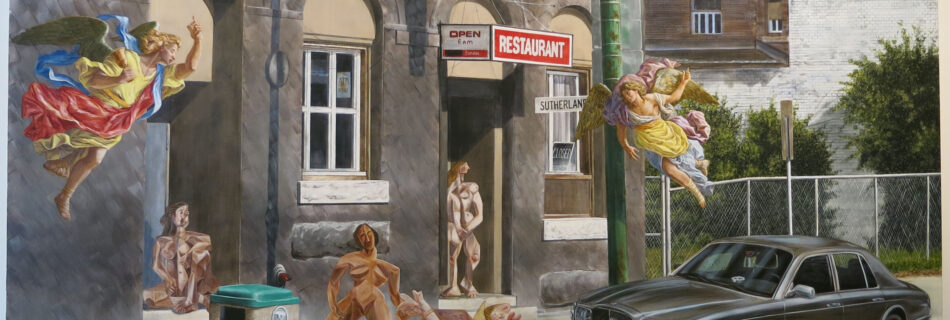
Picassoid nudes brawl on the sidewalk while two Renaissance angels airlift a Henry Moore nude to safety in Canadian artist Kent Monkman’s hilarious contemporizing of iconic art historical types. (At Sargent’s Daughters on the Lower East Side through June 8th).
Kent Monkman, ‘Le Petit dejeuner sur l’herbe,’ acrylic on canvas, 2014.
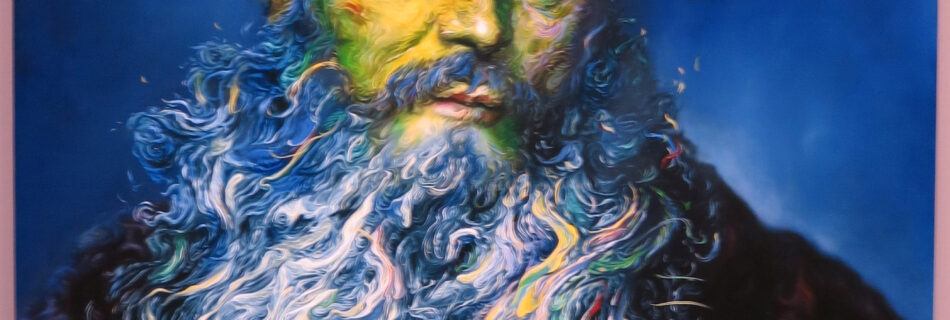
Quasi-familiar characters from art history, made repulsive by acrid colors with Fauve-like contrasts create uneasy new paintings at Gagosian Gallery by British artist Glenn Brown. Here, an unknown gentleman’s jaundiced, spotchy skin and cloudy eyes signal moral or physical disease. (At Gagosian’s 21st Street location through June 21st).
Glenn Brown, Reproduction, oil on panel, 53 1/8 x 39 ¾ inches, 2014.
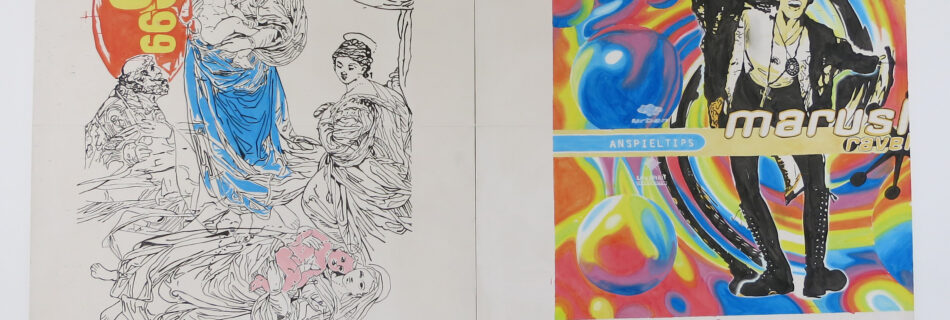
Before his untimely death in 2002 at age 35, Berlin-based artist Michel Majerus was hailed as a quintessential information age artist, mixing images and info from unrelated sources to suggest a stew of influences more than a coherent statement. Here, Andy Warhol’s discount Raphael abuts an ecstatic youth from an ad, suggesting two takes on transcendent experiences. (At Matthew Marks Gallery‘s 522 West 22nd Street location).
Michel Majerus, o.T. (69), acrylic on cotton, two panels, each: 119 ¼ x 93 ¼ inches, 1994.
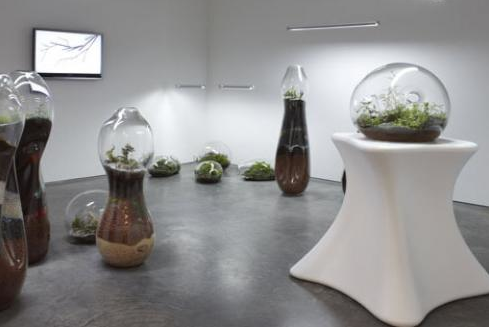
Paula Hayes, "Excerpts from the Story of Planet Thear" installation view, 2009. Photograph courtesy of Marianne Boesky Gallery, New York.
The abundantly planted new High Line, a hydroponic vegetable garden in Eyebeam’s windows, and now landscape designer/sculptor Paula Hayes’ terrariums and rooftop plantings testify that in Chelsea, green is the new black.Though Hayes’ resume includes gardens for prominent dealers and collectors, giving her plenty of art world cred, her work appears as much on terraces as galleries, and her primary media are plants and pots, begging the question of how vegetation becomes art.
Gardening has figured in the work of artists from Monet to Carsten Holler, but Hayes’ natural arrangements are an end in themselves.In undulating glass vessels roughly pedestal height, collections of tiny plants present nature as luxury object.Tiny succulents, or the fronds of a mini-fern are exquisite – a kind of maison du chocolate for greenery.Add the thrill of behind-the-scenes access to the gallery’s private rooftop installation, and taking in Hayes’ work can be a heady experience, inspiring wonder at the natural world and our ability to create beauty.
Unfortunately, Hayes doesn’t allow her terrariums and sculptures to stand on their own, introducing a thin storyline about a quasi-human gardener.On the roof, superabundant white sticks and a scattering of blue stones try for magical but come across as tacky.Part of the intrigue of Hayes project is the contrast between her organic-shaped planters and their glaringly synthetic materials – think of a small tree wearing a big blue sock over its roots.Such connections between plants and people – also evident in upright, body-shaped terrariums, or living, plant ‘necklaces’ – turn gardening from hobby to art form.
Originally published in Time Out New York, issue 722, July 30 – August 5, 2009.
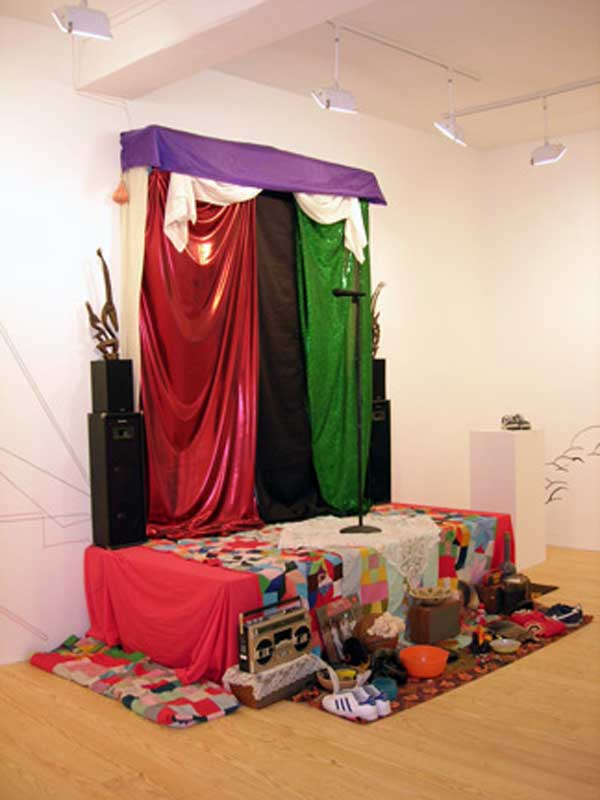
For ‘Time Out New York’ magazine, Otabenga Jones & Associates, Installation View, 'Symmetrical Patterns of Def', 2006, courtesy of Clementine Gallery Otabenga Jones and Associates, a Houston-based collaborative that will participate in the 2006 Whitney Biennial, takes its name from an African pygmy who was put on display at the Bronx Zoo in 1906. As this detail suggests, the group is interested in the intersection of African and American history, specifically their own richly imaginative version of it as told in the show’s centerpiece: a sound installation recounting the outlandish story of Mudbone, a South Bronx MC who travels to the land of his ancestors during an out-of-body experience.
Mudbone’s tale is full of engaging magical-realist details (his crew shakes the earth as they walk to a competition; his hair takes on a life of its own and absconds). But the installation itself—a small stage decorated like an altar with a microphone; swags of red, green and black fabric; and offerings of junky items, including old sneakers and LPs—doesn’t do justice to the fabulous images conjured by the soundtrack. An amateurish wall mural, drawings and related sculptural objects feel like little more than a backup act for the main attraction.
We’re informed that Mudbone is empowered by knowledge of his ancestors, but the specifics of this revelation aren’t divulged. The tale’s ambiguity communicates an ambivalence about the possibility of constructing an African-American history. Inspiring historical figures like Harriet Tubman make cameo appearances in the tale but always in the confines of a stereotypical setting—either an urban ghetto or a forest’s dark interior. In the end, Otabenga Jones and Associates’ show hovers somewhere between an affirmation and an acknowledgment of futility.
For ‘Time Out New York’ magazine Christopher Miner, Still from 'The Best Decision Ever Made', 2004, Courtesy of Mitchell-Innes & Nash Gallery ‘How Beautiful Heaven Must Be’ You may never have heard it argued that Jesus had it easy. But, in one of two videos in his second solo show, Christopher Miner points out that at least the Son of God had a purpose in life, something the artist worries he doesn’t. Such unorthodox thoughts – and the total disregard for political correctness in his second video – indicate that Miner is unafraid to grapple with the hot-button topics of faith and race in America.
In ‘The Best Decision Ever Made,’ Miner trains his camera on the memento-filled rooms in his late grandparents’ house, while comparing their stable lives and happy marriage with his own endless string of jobs, girlfriends and homes. It’s a twist on the classic prodigal-son story: Miner leaves home dissatisfied and returns disillusioned, with no one to welcome him back into the fold. By the closing shot viewers are no wiser about the title’s “best decision” as the artist listens to a gospel song by another prodigal artist, Johnny Cash.
In the back gallery, Self-Portrait finds Miner sitting in a dimly lit room, paying the role of a foul-mouthed African-American man. In a rambling phone conversation, which includes a tirade about how wrong it is for “a white man to talk like a black man,” Miner creates a disturbingly complex closed circuit of self-portrait as self-censure.
Both videos employ monologues, a classic trope of introspection, but neither is gratuitously self-obsessed. Instead, they are at once brutally honest and confoundingly evasive, leaving viewers eager for more.
The sense of expectation was huge. In the first issue of Artforum published after the 2001 attack on the World Trade Center, the first sentence of the first article read, “In the days following September 11, it was agreed upon by just about everyone that art, along with everything else, was going to ‘change forever.’” Two and a half years later, nothing as obvious as a revolution towards the political has come about. Instead, the way we look at art has changed. Aware of political events in which we have a direct stake, we look for corroborating references in artwork. At the same time, there is a growing consensus among U.S. critics and curators that there is a resurgence of craftsmanship and the handmade, a widespread interest in art and culture of the 60s and 70s and a tendency amongst artists to create fantastical worlds of their own.
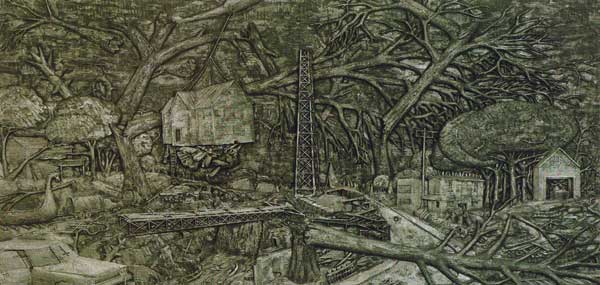
Recognizing these trends in an article on young art dealers, a New York Times reporter recently observed that, “Nobody is protesting anything.” Lack of protest doesn’t automatically disconnect art from politics, however. This article samples from the recent work of three young artists who are making waves with artwork that explores the consequences of American politics at home and overseas. Aaron Spangler’s woodcuts of anarchic Midwestern communities are a vision of American ‘can do’ spirit gone horribly wrong. On the international front, several artists have traveled to Baghdad before and after the war, including Paul Chan. His DVD ‘Happiness’ makes no illusion to the Middle East, but is highly relevant to the topic of war. In her latest five-screen installation, showing in the current Whitney Biennial, Catherine Sullivan responded to a terror attack that took place on the other side of the world, but which she nevertheless felt personally. Aaron Spangler, Mercenary Battalion, 2003, Carved and painted maple, Courtesy of the Rubell Family Collection Anarchy in the U.S.A. On Aaron Spangler’s studio wall hangs a photograph of a young man with long thin hair grasping a megaphone and shouting for all he’s worth. The picture depicts a younger Spangler and the occasion is his war, that is, one that he planned and staged with a friend at college. Since he was a child, the Brooklyn-based, Minnesota native has been fascinated by war’s devastation and its potential as a metaphor for psychological conflict. However, while the U.S. is obsessed with terrorism in its cities and abroad, Spangler focuses on anarchy in rural America in large woodcarvings of battle ravaged landscapes.
Blowing apart the stereotype of the quiet farming community, Spangler carves hellish scenes set in the Midwest. In ‘Mercenary Battalions’, a 7 x 3 ½ foot panel, a helicopter hauls an old wooden farmhouse into the air, centuries-old trees topple to the ground and an electrical tower lies on its side to act as a makeshift bridge over a river filled with debris. Similarly, ‘The Revelers’ is an apocalyptic account of a town’s destruction seen from the main street. The buildings that have not been bombed out are being used as bars and meeting places, their awnings painted with anarchy symbols, pentagrams and upside down crosses. Directly overhead, a bomber drops its payload, intent on wiping out whoever has occupied the once tranquil burg.
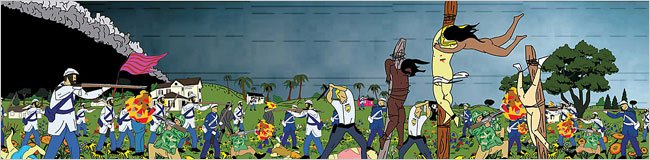
With rebellious zeal worthy of an adolescent, Spangler reverses the social order of small town America – damaging it physically and disrupting the prevailing morality. ‘Revelers’ and ‘Battalions’ are so given over to chaos, that you’d think the artist delighted in the idea of wiping out his roots. The opposite is true. In fact, Spangler feels an allegiance to country life and culture that is virtually unknown in the cities, an idea elaborated on in the monumental drawing, ‘The Poachers,’ which depicts rural citizens reclaiming land from the government and big business. They are ‘poaching’ from the powers that be by planting crops and trees and by pulling down the huge electrical towers that cut through their farmland and increase cancer rates. This resurgence of self-reliant, pioneer spirit, likely as it is to be crushed, belies notions of the peaceful heartland evoked by politicians. Spangler’s scenarios are a mix of utopian, anarchic freedom and hellish destruction, American ‘can do’ mentality and radical anti-social insurgence. They’re dark and pessimistic, despite their irony, but ultimately envision a fascinating and frightening revolution against passive consumerism ‘of the people, by the people’. Paul Chan, Happiness (finally) after 35,000 years of civilization, 2003, Digital Video Installation, 18min, courtesy of Greene Naftali, New York Trouble in Paradise Paul Chan keeps his art and politics separate. His consequent double life leads him back and forth between the roles of artist and activist. Case in point – when he traveled to Baghdad last year, he went not to produce his own work, but as a volunteer for the peace organization ‘Voices in the Wilderness.’ Nevertheless, the trip impacted Chan’s artwork, making it, as he explains, more extreme. When he returned to New York, he finished the DVD ‘Happiness (finally) After 35,000 Years of Civilization’ which was so well received in a group show at Greene Naftali Gallery that a still from the DVD landed on the front page of the New York Times arts section.
‘Happiness,’ more than Chan’s previous moving image and graphic work, is politicized rather than political. The 18 minute animation tells the story of a community of pre-teen hermaphrodites who live in harmony, suffer an invasion, and then wipe out their oppressors. The protagonists are direct relations to outsider artist Henry Darger’s Vivian girls, while their lifestyle is modeled on the ideas of 19th century ‘outsider’ philosopher Charles Fourier. Following their passions, they loll about in flower-filled meadows with piles of books, enjoying each other’s bodies and their own as they laugh, run and play. Soon, men in suits and army uniforms disrupt the tranquility. Their houses burn and the girls are brutally murdered by a host of men in the guise of various authority figures. As brutalities are inflicted on their helpless bodies, a mysterious wind begins to blow. Just as suddenly as the invasion began, it is over; the men lie dead and dying on the ground as the girls run free again.
In ‘The Communist Manifesto’, Marx and Engels briefly discuss the Utopian Socialists, including Fourier, commending them for their willingness to “…attack every principle of existing society.” Chan combines Fourier’s method of radically rethinking social structure with Darger’s outlandish band of heroines to introduce us to a land far removed from our own. Viewers may not relate to the girls’ utterly abandoned lifestyles – wild to the point of eating flowers and relieving themselves like animals in the fields. But we’re asked to imagine abandoning our inhibitions and letting our passions lead us to fight against injustice. We don’t know how the girls recover their autonomy, but Chan’s insistence on dreaming of a better life is clear. “Utopia is a proxy that stands in lieu of absolute freedom,” he has explained, “…to imagine what this looks like is…an exercise in hope.”
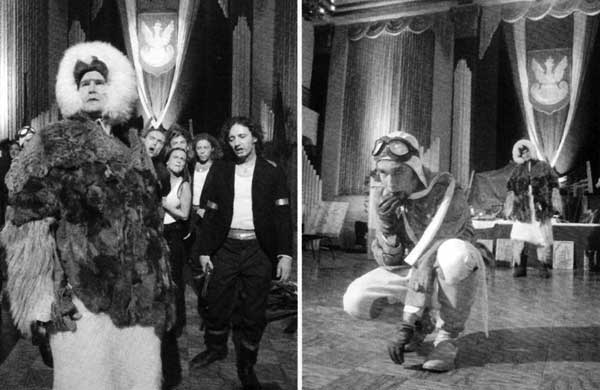
Theater of War Audiences are well advised to take a deep breath before trying to unravel the series of references that lead from Catherine Sullivan’s inspirations to her finished artwork. Sullivan, an L.A.-based artist whose work usually inspires confused admiration from critics, merges performance with visual art in film installations of alarming complexity. Her most recent production, ‘The Ice Floes of Franz Joseph Land’ results from a trail of references that begins with the hostage drama in October 2002, when Chechnyan rebels took over a Moscow theater. Storming the building in mid-performance, they not only captured the audience but interrupted the simulated reality of the musical with a terrible drama of their own.
When it was overtaken, the theater was performing ‘Nordost’ a production adapted from a novel featuring the long suffering lovers Sanya and Katya. Their story is transplanted to the time-warped ambiance of Chicago’s Polish Army Veterans Association, where most filming took place. This building’s ballroom, small bar area and offices provided Sullivan’s cast of 25 with idiosyncratically decorated spaces in which to enact five pantomimes from each of the novel’s ten sections. Each actor learned all of the parts, so a motion performed by a row of women representing Katya at different points in her life is, for example, performed at other times by male and female actors in a variety of costumes. At the same time, odd characters, like two stony-faced pilots who put on masks, refer to the actual events that took place in Moscow. Catherine Sullivan, Production Stills from Ice Floes of Franz Joseph Land, 2003, courtesy of Metro Pictures, New York Sullivan invests ‘Ice Floes’ with many more layers of meaning than most viewers will ever realize, particularly if they only watch the piece without reading about it. The disconnect between what is seen and what Sullivan means to communicate would be a problem if we didn’t realize that this probably occurs with most art that we see. Although the installation is overwhelming, with actors constantly swapping roles and costumes and action happening on five screens simultaneously, what we do see references the conventions of old Soviet and American film enough to capture the imagination. Most vignettes, particularly those in which only a few actors are involved, are staged and acted in a way that entices viewers to stay and try to figure out the meaning. Of course, a search for narrative will be frustrated. But what may remain is the memory of how Sullivan marshals acting conventions and snippets of action to consider the Moscow siege without making it into another story, burdened with its own point of view. Sullivan doesn’t seem to want her viewers to ‘understand’ ‘Ice Floes’ but somehow, this doesn’t make it any less tempting to try. Instead, the artist correlates confusion in the art gallery with the confused and tragic events of the real world.