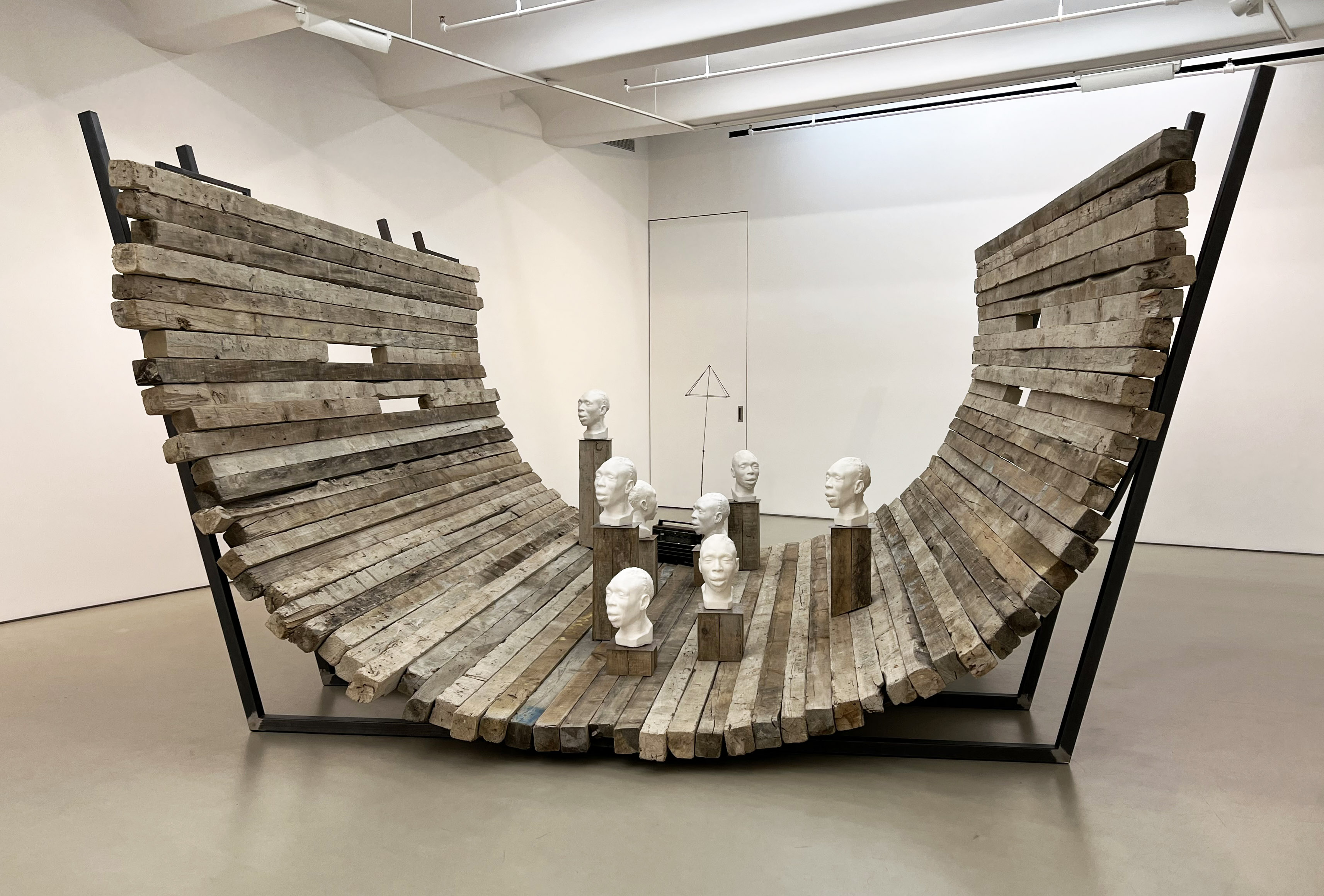
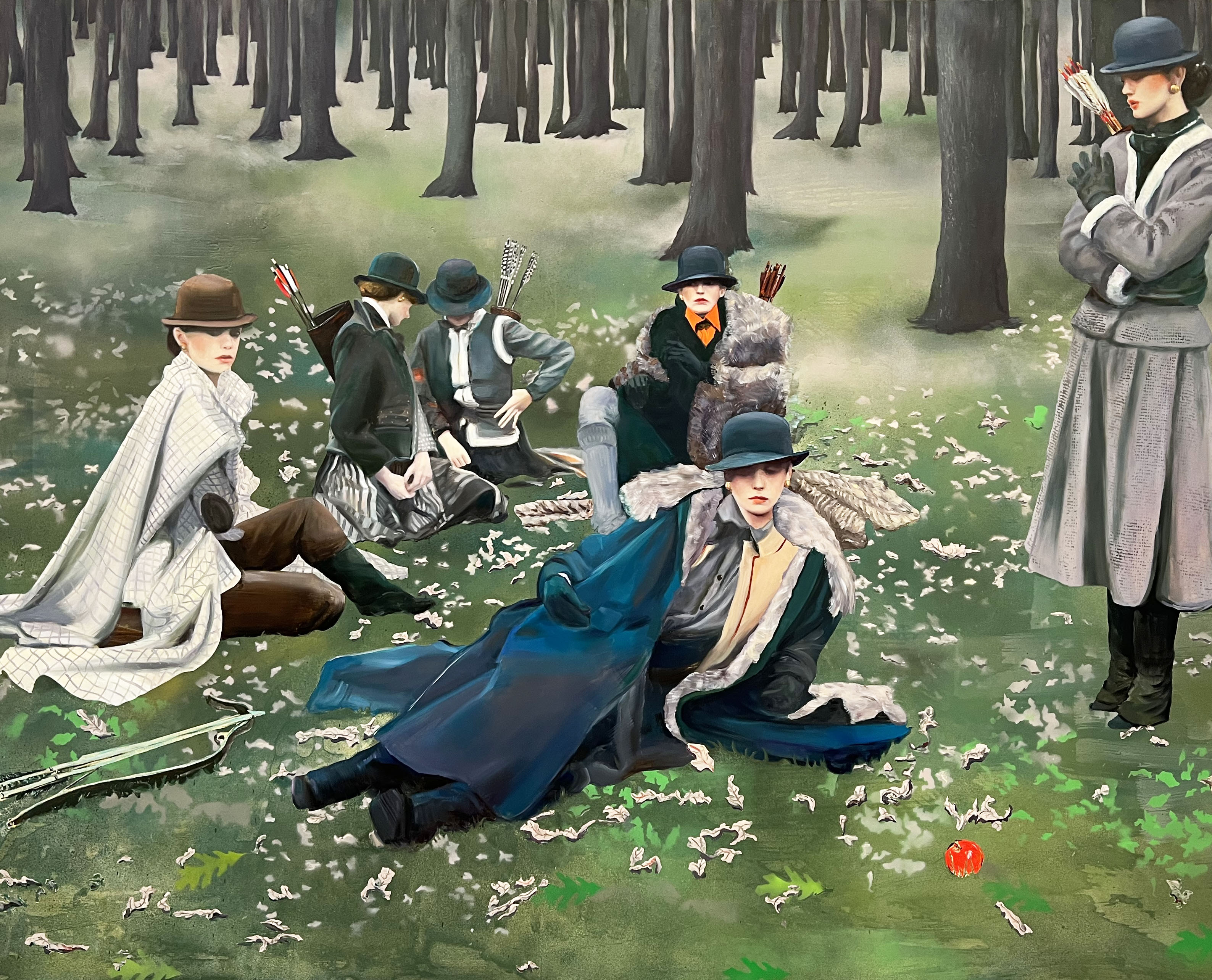
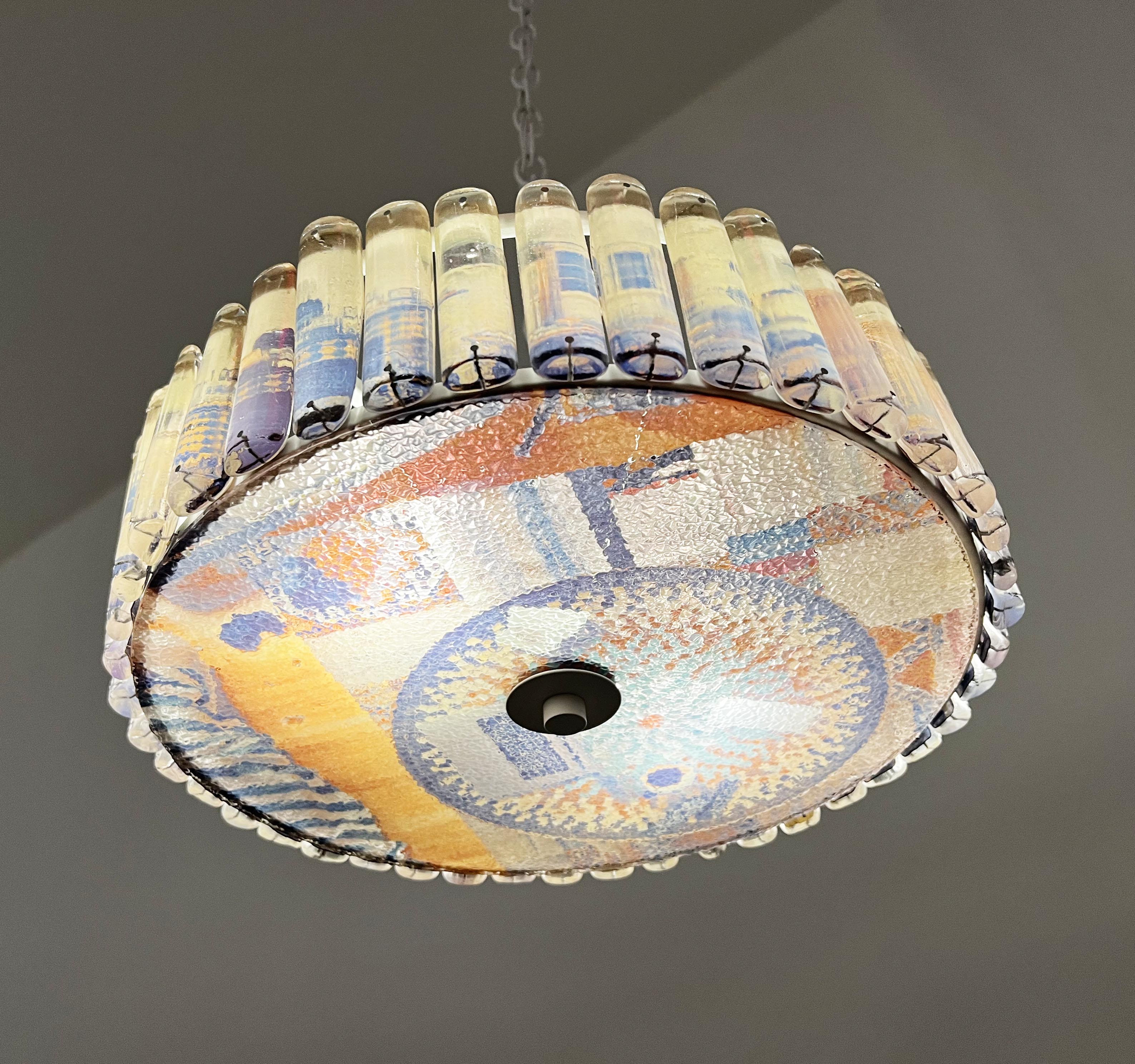
Emily Kraus, ‘In Relation’ at Luhring Augustine Gallery

Emily Kraus’s oil paintings tower over visitors to Luhring Augustine’s Tribeca space, their repeated patterns alternately boldly colored and faded, like a stutter that periodically bursts into explosive expression.  The London-based American artist calls this group of abstract paintings her ‘Stochastic Series,’ after their unpredictable patterns and emphasizes the paintings’ relation to her own body.  Assigned a small studio with bad lighting while pursuing her MFA a few years ago, Kraus innovated by wrapping the walls in 360 degrees of canvas and later painting from within a cube structure which she rotates as she works.  Titled ‘Anemoi’ after the winds from Greek mythology, this painting suggests an opening through which twisting gusts might pass.  (On view in Tribeca through June 13th).

A large abstract painting hung in the corner of an art gallery.
Emily Kraus, Anemoi, oil on canvas, 125 ¼ x 225 ¼ inches, 2026.
A closeup view of an abstract painting.
Emily Kraus, Anemoi, oil on canvas, 125 ¼ x 225 ¼ inches, 2026.

Jakkai Siributr, ‘There’s No Place’ at Canal Projects

Family and national history come together in ‘Broadlands,’ the centerpiece of Bangkok textile artist Jakkai Siributr’s show at Canal Projects, a work crafted from the artist’s late mother’s clothing.  As part of Thai King Rama VII’s encourage on a visit to England in the mid 1930s, Siributr’s mother was present when the king abdicated and remained in England; her garments symbolize her role as witness to political upheaval, while the chains of beads point to a family tale of a broken necklace at a social occasion.  Positioned near quilts made from antique thangkas embroidered to picture his mother and aunts, who continued to be tied to historic events, Siributr’s humble sewn medium connects personal experience with wider cultural histories. (On view through May 23rd).

Hanging clothing in pink, brown and cream-colored fabric cover a green-toned rug.
Jakkai Siributr, Broadlands, hand sewn hanging with garments, vintage pearl necklaces, beads, and acrylic thread; antique rug with hand sewn beads, 2023.

Elizabeth Peyton, mountains in my heart (the death of Sarpedon) at David Zwirner Gallery

Known for washy, intensely colored close-up portraits of celebrity musicians and creatives, Elizabeth Peyton’s paintings and prints from the last three years at David Zwirner Gallery atomize her subjects, building their forms up from stark white backgrounds via individual brushstrokes.  In the show’s best works, a face takes up all or most of the picture’s space as if the subject is leaning in to take a look at us.  Rendered indistinctly in soft tones and floating marks, faces like Bob Dylan’s (pictured here) suggest impermanence and a wistfulness conveyed by this painting’s title, ‘I Was Young When I Left Home.’ (On view through May 2nd).

A painting of the left part of Bob Dylan's face.
Elizabeth Peyton, I Was Young When I Left Home (Bob Dylan), oil on board, 12 x 9 inches, 2024.

Ileana Garcia Magoda, ‘In the Body of Light’ at Anat Ebgi Gallery

Though she’s inspired by flowers and plant life, Ileana Garcia Magoda’s paintings can look like underwater scenes lit by bioluminescence or unnaturally colored magical worlds punctuated by vivid splashes of color.  Here, in a painting at Anat Ebgi Gallery titled ‘There’s no greater repose than this beautiful garden,’ the artist immerses viewers in a field of warm yellow and orange color that generates an immediate emotional impact.  The effect links to the sunbaths Magoda takes before heading into the studio, one way of dealing with her chronic spinal pain and a means to impart “the sensations of light absorbed through the skin.” (On view in Tribeca through April 25th).

A field of large orange and yellow shapes that resemble flowers.
Ileana Garcia Magoda, There’s no greater repose than this beautiful garden, acrylic on canvas, 75 x 126 inches, 2026.

Michael Heizer, ‘Negative Sculpture’ at Gagosian Gallery

Michael Heizer’s ‘Double Negative,’ an enormous cut into the ground of Mormon Mesa, Nevada and his 1.5-mile-long shaped landscape, ‘City’ are among the most astounding artworks of the mid-20th century and were created far from urban art centers. Though a fraction of the size and located indoors at Gagosian Gallery‘s 21st Street Chelsea space, Heizer’s current installation of the sculptures ‘Convoluted Line A’ and ‘Convoluted Line B’ from 2024 are nonetheless impressively scaled and prompt a rethink of the space of the gallery.  Each is formed of twisting steel earth liners set in a specially constructed concrete floor to create long lines of negative space along which visitors can walk, taking the measure of the piece not just with the eye but with the body. (On view in Cheslea through March 28th).

A sculpture set into the floor in the shape of a twisting line with a few small figures of people walking around it.
Michael Heizer, installation view of ‘Negative Sculpture’ at Gagosian Gallery, March 2026.

Fernand Leger, ‘Typographer’ at the Met Museum

Sotheby’s iconic sale last month of Leonard Lauder’s collection is now history, but the collector’s taste in Cubist masterpieces can still be appreciated in the Met Museum’s installation of works he gifted by Picasso, Braque, Gris and Leger.  Here, Fernand Leger’s huge, abstracted painting features a worker dressed in red and wearing a round cap typesetting large red and white letters.  Part of a display that includes a cluster of works presented as they were displayed in Lauder’s own home, the multi-gallery installation gives invaluable insights into the development of early abstraction. (On view at the Met Museum on the Upper East Side).

An abstract painting with forms that suggest a figure in a round hat standing before two large letters.
Fernand Leger, Composition (The Typographer), oil on canvas, 1918-19.

Susan Hamburger, ‘Near Enemies’ at Asya Geisberg Gallery

Historical European parade armor can be so fancifully decorated, it’s sometimes hard to take it seriously as a byproduct of military activity.  New York artist Susan Hamburger picks up on the disconnect and runs with it, producing a series of wildly creative helmets at Asya Geisberg Gallery that push ornate design into the deliciously absurd. (On view in Tribeca through Dec 20th).

A white helmet shaped like a bird-like face and decorated with floral motifs.
Susan Hamburger, Helmet (Feathers), papier mache, celluclay, paperclay, wood stand, 21” h x 13” w x 13” d, 2023.

Jennifer Packer, “Dead Letter” at Sikkema Malloy Jenkins

From the first painting in Jennifer Packer’s solo show at Sikkema Malloy Jenkins to the final piece, the artist pictures individuals in repose.  Several figures lie on couches while nearby, their intimates read, smoke or simply look on.  In other works, heads fill the canvas, appearing to be sleeping peacefully, though they are rendered in visceral, red tones.  Packer’s first show of new work at the gallery since the unexpected death of her partner in 2021 poignantly pictures moments of absence and presence, usually in the same painting, while continuing her signature focus on the unique beauty and value of her subjects.  Here, in a piece called ‘Melt,’ a figure slumps down with a bag by her feet, as if grateful to arrive in a peaceful place of rest.  (On view in Chelsea through Dec 13th).

A woman leans back against a chair, resting, with a shopping bag by her side on the floor.
Jennifer Packer, Melt, oil on canvas, 26 x 30 1/8 inches, 2025.

Kader Attia, ‘Shattering and Gathering Our Traces’ at Lehmann Maupin Gallery

Born in the decade after Algerian independence, Kader Attia grew up in Paris and Algeria, forming a cross-cultural identity that continues to inspire his multi-disciplinary practice. For his latest show at Lehmann Maupin Gallery, Attia presents collages of spliced together African and European cultural objects, suggesting complicated interrelationships.  A film featuring a French supporter of the Algerian National Liberation Front, a French political scientist and the artist’s mother tells stories of colonial resistance alongside suitcases full of broken, light-reflecting mirrors that embody the notion of gathering and repair of shattered lives.  In the gallery’s main room, the installation ‘Resonance’ allows visitors to gently ring the bells installed in a series of birdcages, communicating with each other without words.  (On view in Chelsea through Dec 13th).

A room with bird cages hanging from ropes from the ceiling.
Kader Attia, installation view of ‘Resonance’ at Lehmann Maupin Gallery, New York, Nov 2025.

Hank Willis Thomas, ‘I AM MANY’ at Jack Shainman Gallery

A small bronze sculpture of two open hands, palms upward, in Hank Willis Thomas’ show at Jack Shainman Gallery is physically small but conceptually huge.  Last week, Davidson College in North Carolina dedicated a monumental, site-specific version of the sculpture by Thomas as a memorial to the enslaved individuals who labored on and built the institution in the 19th century.  Other standout works in the show include quilt-like textile pieces featuring US flags and prison uniforms that suggest that the carceral state has become part of the fabric of the nation and screenprinted retroflective vinyl panels which reveal hidden images of protesters from various points in US history.  (On view in Tribeca through Nov 1st).

In the foreground, a bronze sculpture of two open hands emerging from a reflective surface.
Hank Willis Thomas, With These Hands, patina and polished bronze, 8 ½ x 18 x 24inches, 2025.

Lawrence Weiner, AS OFTEN AS NOT at Gladstone Gallery

Late conceptual artist Lawrence Weiner realized in 1968 that he could favor the idea of an artwork more than an actual physical object and went on to make hundreds of text-based artworks.  Around thirty are on display at Gladstone Gallery through Saturday, a mini-retrospective that starts with his iconic ‘Declaration of Intent’ to physically create – or not – an artwork.  Appearing on the wall just inside the gallery entrance in pale pink text, Weiner’s foundational principle is present but subordinate to bold statements in the main gallery, such as ‘SET AT THE POINT JUST BEFORE THE POINT OF NO RETURN’ or here, ‘AS OFTEN AS NOT,’ phrases that can take the mind to a place that an image cannot.  (On view at Gladstone Gallery’s 21st Street location in Chelsea through Oct 25th).

Text on the wall in black bold font reading 'As Often as Not'.
Lawrence Weiner, AS OFTEN AS NOT, language and the materials referred to, dimensions variable, 2017.

Sonia Boyce, ‘Improvise with What We Have’ at Hauser & Wirth Gallery

What is music when you can’t hear it?  ‘Silent Disco,’ a new video work by British artist Sonia Boyce at Hauser and Wirth Gallery in Chelsea, features headphone-wearing people dancing to music that the audience can’t hear.  In an added twist, the dancers are listening to two separate channels, dancing near others who may or may not be hearing what they are.  The dancers’ interactions, movements and obvious enjoyment become subject matter, positioning dance in a new light and maybe even tempting gallery visitors to join in with their own moves. (On view in Chelsea through Oct 18th).

A wall featuring three videos of people dancing and a patterned background.
Sonia Boyce, Silent Disco, 3-channel colour video with sound, duration 9:42 min, 2025.


Nathalie Khayat, ‘Unfolded Proximities’ at Marianne Boesky Gallery

With titles like ‘Clutch,’ ‘Trespass,’ and ‘Cradling,’ Nathalie Khayat’s new ceramic sculptures at Marianne Boesky Gallery suggest emotionally evocative human actions in clay form.  Yet each centers on a merger of architectural solidity (aided by stoneware construction) and plant-like organic growth, upward and outward. Weighty and deliberate yet offering the notion of development within those restraints, Khayat situates her practice in the experience of living in the crossroads city of Beirut, where she has described a tenuous and fluid quality to life.  (On view in Chelsea through Aug 15th.  Note summer hours.)

Nathalie Khayat, The Devouring of You, glazed stoneware, 21 ½ x 23 x 19 ½ inches, 2025.

Whitfield Lovell in ‘Interlayered’ at DC Moore Gallery

Whitfield Lovell’s immediately absorbing set of fifty-three charcoal-on-paper portraits in DC Moore’s summer group show ‘Interlayered’ pairs the faces of Black men and women with playing cards from a vintage deck, suggesting that as each card has its unique identity in a group, so do the individuals assembled here.  Lovell typically finds his subjects in late 19th and early 20th century photos sourced from a variety of places, from flea markets to photo archives;  isolated from their settings, each person has remarkable presence.  Paired with cards, Lovell suggests that in life, alone or together, they might play and/or be played.  (On view through Aug 6th).

Whitfield Lovell, The Card Pieces, 53 charcoal drawings on paper with attached playing card, 12 x 9 inches (each), 2018 – 2022.

Sam Moyer, ‘Woman with Holes’ at Hill Art Foundation

Sam Moyer’s monumental ‘Fern Friend Grief Growth’ is the anchor of her show at the Hill Art Foundation, an exhibition made richer by including artworks by major contemporary artists who share Moyer’s interest in pushing the possibilities of materials.  This ‘stone painting’, as it was called when shown at The Parrish Art Museum last summer, employs painted plaster and segments of recycled marble to picture delicate plant structures that carry literal and (in the title) metaphorical weight.  Nearby, Liz Glynn’s partial recreation of Rodin’s ‘Walking Man’ sculpture abandons the heaviness of the original bronze like a shed skin while her nearby stainless-steel tumbleweed sculpture is more solid and lasting than the original.  From Isamu Noguchi’s ponderous ‘Woman with Holes’ to Robert Gober’s representation of an open window, the dynamic of contrast between weight and lightness generates continual interest.  (On view in Chelsea through Aug 1st).

Sam Moyer, Fern Friend Grief Growth, marble, acrylic on plaster-coated canvas mounted to MDF, 120 x 240 x 1 inches, 2024.
A fern leaf pattern made of canvas and stone.
Sam Moyer, (detail) Fern Friend Grief Growth, marble, acrylic on plaster-coated canvas mounted to MDF, 120 x 240 x 1 inches, 2024.

Carolyn Lazard, ‘Two-Way’ at Artists Space

Groans of pain and the sound of encouraging voices greet visitors to Carolyn Lazard’s solo at Artists Space where two videos and an installation of linoleum flooring center on women’s medical experience.  While most visitors will overlook the show’s soft institutional flooring, the drama of a birthing scene in ‘Fiction Contract’ grabs the attention immediately.  Peering over the shoulder of a team of midwives in Elmhurst Hospital in Queens as they run into difficulty delivering a baby, our absorption little reduced by the fact that the patient and infant are mannequins.  Part of a training exercise facilitated by the Maternal Mortality Reduction Program, the simulated scenario encourages audiences to consider the complexity of birthing situations, the professionalism of staff and the importance of funding to ensure equitable health care.  (On view through May 10th in Tribeca.)

Carolyn Lazard, still from ‘Fiction Contract,’ single-channel video, color, sound, at Artist’s Space, April 2025.

Jeppe Hein, ‘Expect a Miracle’ at 303 Gallery

Happiness is Danish sculptor Jeppe Hein’s stock-in-trade.  Past work includes brightly colored benches he calls ‘social sculptures’ that invite strangers or intimates to stop and converse, walls of water that dare interaction and shiny balloons of metal that appear to float on the ceiling.  A new installation at Chelsea’s 303 Gallery presents a ceiling bedecked with swathes of fabric evoking waves, home to alluringly shiny lacquered plastic fish and other animals.  The text ‘expect a miracle,’ spelled out in balloon-like letters at the gallery front door is both poignant and hopeful.  (On view in Chelsea through May 31st).

Jeppe Hein, installation view of ‘Expect A Miracle,’ at 303 Gallery April 26th, 2025.

Joan Jonas, ‘Empty Rooms’ at Gladstone Gallery

Though twelve paper sculptures hang from the gallery ceiling, a grid of drawings covers one wall and a video projection takes over another in Gladstone Gallery’s cavernous 21st Street space, Joan Jonas’ new installation ‘Empty Rooms’ feels more subtly presented than many of her past multimedia works.  Overhead, boxy forms dominate the gallery, floating like geometric clouds or 3-D kites and lit from within like lanterns.  Made of wrinkled paper (along with lights and steel frames), the sculptures connect with a towering grid of similarly textured paper bearing drawings of leafless trees.  Featuring the silhouette of a turbine and a young woman, a monochrome video adds a human actor to this enigmatic but intriguing view of the natural world. (On view in Chelsea through April 12th).
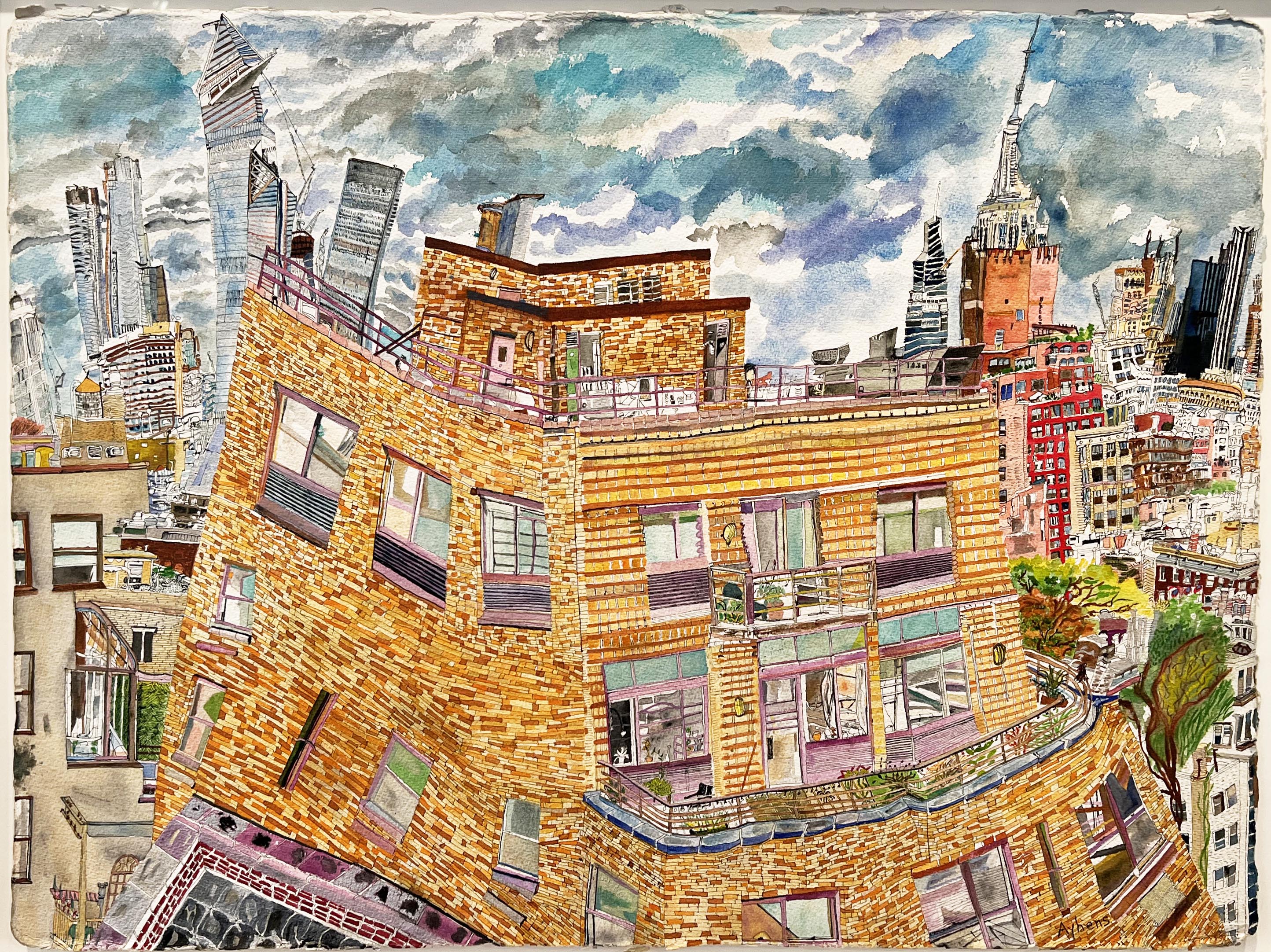
Joan Jonas, Empty Rooms (installation view) at Gladstone Gallery, March 2025.

Simphiwe Mbunyuza at David Kordansky Gallery

At over five feet tall, Simphiwe Mbunyuza’s monumental ceramics at Chelsea’s David Kordansky Gallery entice with their strong presence, striking color and unusual protrusions.  Bumps inspired by traditional Xhosa ritual vessels, house shapes that recall cylindrical South African dwellings and horns pointing to the importance of cattle in Xhosa life signal Mbunyuza’s engagement with aspects of his culture and upbringing including his spiritual identity.  The latter manifests in the sizes of the works, the larger pieces connecting to ancestors while smaller pieces are associated with the artist and his living relatives. Arranged specifically in the gallery and characterized by colors representing South African landscapes, Mbunyuza’s ceramics offer access to material and immaterial worlds.  (On view through Feb 22nd).

Simphiwe Mbunyuza, MTHIMKHULU, ceramic, 63 x 53 x 51 inches, 2024.

Svenja Deininger Paintings at Marianne Boesky

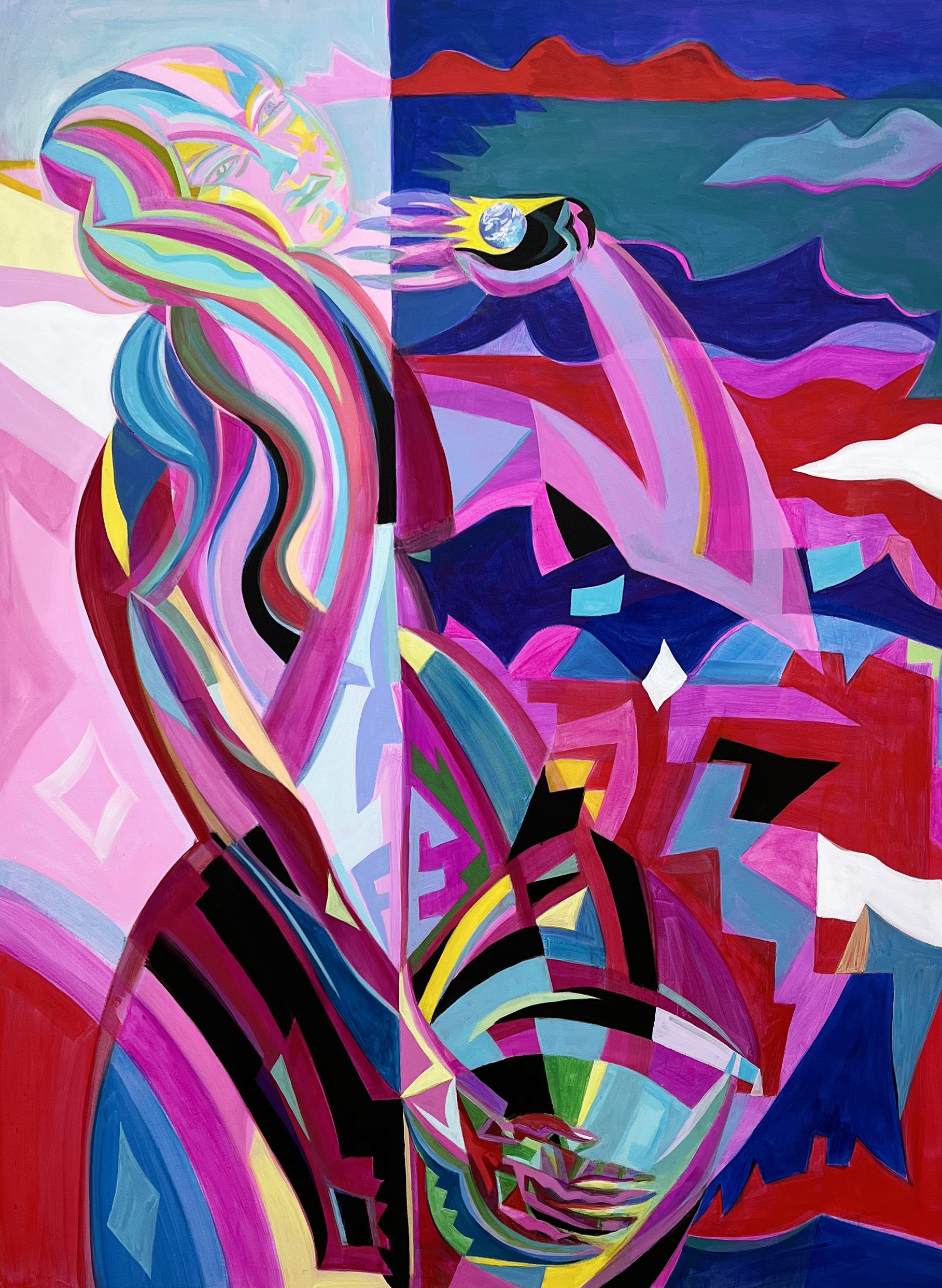
Though given ample space on Marianne Boesky Gallery’s wall, this painting by Austrian artist Svenja Deininger converses with the paintings around it like individual words work together to make up a sentence. Before the holidays, Deininger’s paintings appeared next door at the gallery’s other location; newly installed in the gallery’s single large space, they can be considered singly, in sequence or all at once.  An adjoining mustard yellow monochrome canvas and another small painting featuring fan-like shapes call further attention to color and form in this untitled painting, a standout piece that evokes a large head amid architectural or design elements.  Though individual pieces offer enjoyable juxtapositions, the show’s greatest pleasure in in tracking evocative and subtle connections across multiple canvases. (On view through Jan 24th).
Svenja Deininger, Untitled, oil on linen, 74 ¾ x 57 1/8 inches, 2024.

Mallory Weston in ‘Objects USA’ at R & Company

Looking to turn over a new leaf in 2025? Do it literally with jewelry designer Mallory Weston’s Shattered Begonia Brooch #3, a wearable artwork that pushes boundaries by combining jewelry and textile working techniques.  Part of her NODES series, which also features a dangerously spiky-looking prickly pear and enormous monstera leaf necklace, the piece grabs the attention by combining natural subject matter with a digital-aesthetic achieved with a tiled titanium construction.  It is on view in R & Company’s sprawling Objects USA, a showcase of 100 objects by 55 makers.  (In Tribeca through Jan 10th.  Note that gallery hours change during the holiday period).

Mallory Weston, Shattered Begonia Brooch #3, anodized titanium, nickel, leather and cotton, 2022.
Jiha Moon at Derek Eller Gallery

Complex and colorful, Jiha Moon’s ceramic vessels at Derek Eller Gallery entice with their cheeky updates to historic forms and their contemporary subject matter.  Dumplings and succulent fruits allude to pleasure while forming the two eyes on this pot dominated by a fake grin.  Moon explains that this work is autobiographical, the dark clouds representing the impact on her life of the weather (specifically hurricanes) in Tallahassee, where she lives. The pagoda, boat and two birds refer to Blue Willow Pattern, an English take on blue and white Chinese porcelain with an accompanying love story that alternates between tragedy and happy ending.  (On view in Tribeca through Dec 21st).

Jiha Moon, Banana Thunderhead, porcelain, underglaze, glaze, 16.5 x 11 x 9 inches, 2024.

Olafur Eliasson, Light Ensemble at Tanya Bonakdar

From his legendary 2003 installation of a sun in the Tate Modern (made with a semi-circle of lights and a mirror) to more intimate light environments and sculptures of colored glass, Olafur Eliasson creates transformative artworks using deceptively simple means. The centerpiece of the artist’s latest solo exhibition at Tanya Bonakdar Gallery in Chelsea, ‘Your psychoacoustic light ensemble,’ challenges viewers to rethink how we perceive color, light and other natural phenomena while this time including sound.  In the gallery’s darkened central room, low frequency vibrations can be heard, felt and seen as projected lights respond to the sound waves.  Inviting us to sit and be immersed in the various stimuli, Eliasson describes our experience as ‘seeing ourselves hearing.’ (On view through Dec 19th).

Olafur Eliasson, Your psychoacoustic light ensemble, spotlight, glass lens, mirror foil, tripod, transducer, embedded computer system, dimensions variable, 2024.

Cameron Welch at Yossi Milo Gallery

Cameron Welch’s mosaics at Yossi Milo Gallery pack a punch with their energetic collage-like mix of contemporary and historic imagery.  Here, Orpheus, the hero of Greek mythology who unsuccessfully descended into the underworld to bring back his wife Eurydice, holds the musical instrument with which he could charm both living and dead.  Crafted in ceramic, glass, marble and stone and enhanced with oil and acrylic paint, the artwork not only rethinks a mythological figure but melds ancient and contemporary material tradition. (On view in Chelsea through Nov 9th).

Cameron Welch, Orpheus in the Garden, marble, glass, ceramic, stone, spray enamel, oil and acrylic on panel, 96 ¾ x 80 5/8 inches, 2024.

Margarita Cabrera at Jane Lombard Gallery

Expanding concentric circles of flamenco dresses surround a soft sculpture of a Spanish ship in an eye-catching installation in Margarita Cabrera’s current solo show at Jane Lombard Gallery.  The abundant dynamic ruffles of the dress material suggest that though small, the ship is making its presence felt from Spanish arrival in the Americas to the present day.  Crafted from material used for US/Mexico border patrol uniforms, the ship and the show’s other engaging sculptures invite discussion of migration past and present.  (On view through Oct 26th).

Margarita Cabrera, installation view of El Vaiven del Mar, Flamenco dresses, uniform fabric, 120 x 168 x 36 inches, 2024.

Sky Glabush at Stephen Friedman Gallery

Sky Glabush, a Canadian artist who lives and works in the countryside outside of London, Ontario, takes inspiration from nature and early modernist art.  His arresting landscape paintings at Stephen Friedman Gallery in Tribeca alternate electric orange and yellow toned scenes with tranquil blues and purples, conveying a breadth of responses to an abundantly varied natural world.  Marked by their geometricized orderliness, Glabush’s huge paintings of forest scenes emphasize a linear quality that’s echoed in the vertical forms of gallery visitors standing before them.  Vibrant and driven by pattern and form, Glabush’s landscapes enticingly argue for the transformative and wondrous aspects of the natural world.  (On view through Oct 17th).

Sky Glabush, River Through Trees, oil and sand on canvas, 96 x 72 inches, 2024.

Aki Sasamoto at Bortolami Gallery

Performance is key to New York artist Aki Sasamoto’s practice, but for her latest show at Bortolami Gallery, she outsources the action to her sculpture and to gallery visitors.  Titled ‘Sounding Lines,’ after the devices used to test water depth from a vessel, the show consists of handmade sculptures resembling giant fishing lures and lengths of long springs stretched across the gallery between them.  Occasionally, a motorized arm causes one of the springs to dance around and unaware visitors to react with surprise.  Delightful yet disconcerting, the installation foregrounds our own response to (literally) alluring art.  (On view in Tribeca through Oct 19th.)

Aki Sasamoto, ‘Sounding Line (black, red, yellow – whip whisk), wood (red cedar), whip whisk, acrylic paint, epoxy, Mylar, plexiglass, stainless steel wire and springs, bronze rod, fishhooks, stainless-steel hardware, steel, AC motor, speed controller, timer, 9 ¼ x 27 x 1 ½ inches, 2024.

Hilary Pecis at David Kordansky Gallery

The title of Hillary Pecis’ current New York solo show at David Kordansky Gallery, ‘Warm Rhythm’ perfectly describes the vibrant colors and abundant patterning of her new paintings.  Set in LA and often inspired by scenes she encounters in her cross-country runs or daily life in the city, her paintings both sooth and excite with their tranquil subject matter rendered in bold color.  The delectable quality of a still life with half-eaten lunch or this cozy scene with cat, reading lamp and mug carries over into delight at an orange house set against lush greens of a verdant front yard or the blooms spilling out of a vividly painted flower shop.  (On view in Chelsea through Oct 12th).

Hilary Pecis, Pepita, acrylic on linen, 44 x 34 x 1 ½ inches, 2024.

Virginia Overton at Bortolami Gallery

Known for repurposing industrial and scrap materials into bold sculptural installations, Virginia Overton’s powerful show at Bortolami Gallery features new work generated from large-scale, deconstructed outdoor signage.  Overton’s evocative material aestheticizes objects that were once functional while alluding to continuous urban change and the desire to remember the past. Upstairs, as part of a group show, three of Overton’s Skylight Gem (NYC) sculptures dangle from the ceiling and rest on the floor.  Similar to the pieces Overton installed at the Delta Terminal at LaGuardia airport, the sculptures are at once iconic New York emblems, both present in today’s landscape and nostalgic as they point to past lives lived under the skylights.  (On view through Aug 30th).

Virginia Overton, Skylight Gem (NYC) coated copper, wired glass, electrical components, (suspended) 36 x 36 x 18 inches and (floor) 35 x 35 x 26 inches, 2024.

Jennie Jieun Lee in ‘Channeling’ at Nicelle Beauchene Gallery

Inspired by visitations from a spiritual entity, late self-taught British artist Madge Gill produced drawings of anonymous female figures surrounded by patterns; selections of her work from the ‘40s and ‘50s ground Nicelle Beauchene Gallery’s vibrant 3-person show in Tribeca.  Bright, patterned paintings by Chelsea Culprit and lushly glazed ceramics by Jennie Jieun Lee add color and, in the case of Lee’s sculpted heads, introduce decidedly otherworldly figures with appealingly ambiguous identities.  (On view through June 29th).

Jennie Jieun Lee, Red Face, slipcast porcelain, glaze, stoneware stand, 10 x 8 x 8 inches, stoneware stand 2 x 6 x 6 inches, 2024.

Goshka Macuga at Andrew Kreps Gallery

London-based Polish artist Goshka Macuga – known for making artwork that relates to the archives and collections of art institutions – had a major New York moment in 2019 when she installed an enormous tapestry in MoMA’s education building picturing herself surrounded by books featuring work in the museum’s collections.  That tableau was in turn a restaging of a photo of Andre Malraux similarly surrounded by his own ‘museum’ of reproductions.  Now on view at Andrew Kreps Gallery in Tribeca, Macuga’s image from the MoMA tapestry manifests as a jacquard woven soft sculpture, positioned on the floor of the gallery’s double-height space.  Titled ‘Fallen Artists/Comfort,’ the work approaches fallenness from various thought-provoking viewpoints by literally looks as if the artist has fallen from the upper gallery space and including a soft book featuring a photo of Nan Goldin’s photos of herself battered and of Nazi-sympathizers and MoMA employees Philip Johnson and Alan Blackburn when they resigned from the museum.  (On view through June 15th).

Goshka Macuga, Fallen Artists / Comfort, jacquard soft sculpture, 127 ½ x 53 ½ inches, 2023.

Yvonne Pacanosky Bobrowicz at Sapar Contemporary

In her 70+ year career, Yvonne Pacanosky Bobrowicz helped pioneer fiber art as fine art, teaching for decades at Drexel University and placing her work in both corporate and public collections.  Two years after she passed away at the age of 94, Pacanosky Bobrowicz’s beautiful and complex sculptural work is on view at Sapar Contemporary in Tribeca.  Created from knotted monofilament which she mixed with fiber and gold leaf, the artist’s signature ‘cosmic energy fields,’ as she called them, express her fascination with physics and philosophy.  (On view through June 1st).

Yvonne Pacanosky Bobrowicz, Cosmic Series Amber, 16 x 14 x 4 inches, monofilament, 2015.

Diedrick Brackens Weavings at Jack Shainman

LA artist Diedrick Brackens has called his weavings ‘a small healing tribute’ to those who came before him, depicting Black figures in moments of peace but using materials like cotton which have a heavy history in the U.S.  His latest solo show, on view at Jack Shainman Gallery’s Chelsea and Tribeca locations, includes the dramatic, ‘if you have ghosts,’ which features a silhouetted figure surrounded by a swirling wind.  Reminiscent of Leonardo da Vinci’s perfect proportions expressed by his Vitruvian Man drawing and including Romanesque architecture, the figure appears to step forth from history to command this supernatural event.  (On view through May 24th in Tribeca and June 1st in Chelsea).

Diedrick Brackens, if you have ghosts, cotton and acrylic yarn, 105 x 105 inches (approx.), 2024.

Nora Correas at Institute for Studies on Latin American Art

Titled after a line in a poem by exiled Chilean artist Cecilia Vicuna about how threads (textiles) connected her to her homeland, ‘Threads to the South’ at the Institute for Studies on Latin American Art considers how fiber-based art has alluded to customs from grape harvests to quipus.  Here, Nora Correas’s 1981 undulating virgin wool floor sculpture ‘En carne viva (In the Raw)’ is abstract but evokes living forms; complex textures suggest earth or clay while shapes formed from horizontal lines resemble cocoons. Created as a response to Argentina’s military dictatorship, the piece and Correas’ other fiber-based work from the time is an expression of grief, ‘a scream’ explains the artist in a text alongside the work.  (On view in Tribeca through July 27th).

Nora Correas, En carne viva (In the Raw), virgin wool, 1981.

Beau Dick at Andrew Kreps Gallery

Late hereditary chief and Kwakwaka’wakw master woodcarver Beau Dick’s current solo show at Andrew Kreps Gallery features carved wooden masks intended to be used in ceremonies as symbols of the spirit world.  Made between 1979 and 2015, the carvings reinvent traditional supernatural figures such as ‘Crooked Beak,’ seen here.  Made for a ceremony revoking the cannibal spirit and reinforcing correct behavior in an initiate, the mask also exists now to allow an appreciation of Kwakwaka’wakw spiritual practice.  (On view through May 11th).

Beau Dick, Kwakwaka’wakw, Musgamakw Dzawada’enuxw First Nation Crooked Beak, red cedar, cedar bark, acrylic, 12 x 8 x 34 inches, 1994.

Milano Chow at Chapter NY

In the mid to late 19th century, property developers in Tribeca could style their buildings by selecting decorative elements from catalogues of cast-iron components.  Contemporary artist Milano Chow’s drawings of fictional building facades – made precise with the aid of a drafting tool – at Tribeca’s Chapter NY recall such foundry publications as well as architectural elevations, dollhouses, and images from art and architecture history books.  In contrast to practical illustrations, however, Chow adds intriguing details – partly drawn curtains, figures peeping out from windows and dramatically lit shop windows – to each scene.  Here, a figure standing recessed in a dramatically columned house exudes mystery, as if appearing in the opening scene of a detective story.  (On view in Tribeca through May 4th).

Milano Chow, Entrance with Statues, graphite, ink and photo transfer on paper, 15 5/8 x 10 ½ inches, 2024.
Milano Chow, (detail) Entrance with Statues, graphite, ink and photo transfer on paper, 15 5/8 x 10 ½ inches, 2024.

Madeline Hollander at Bortolami Gallery

Initially trained as a ballet dancer, Madeline Hollander incorporates movement into her artistic practice in surprising and delightful ways.  Her current solo show at Bortolami Gallery in Tribeca titled ‘Entanglement Choreography’ presents a grid of six mirrored pods on round pedestals which at first glance belie the magic of peering inside.  Each sculpture houses a tiny rotating dancing figure, abstracted like a Matisse nude, which at a certain angle appears to both float above the pod and be contained within it.  Nodding in the title to the notion in physics of quantum entanglement, when two separate particles demonstrate a connection with each other as if moving as if in a dance, Hollander’s partners manifest what Einstein called ‘spooky action at a distance.’ (On view in Tribeca through March 2nd).

Madeline Hollander, Entanglement Choreography VI (figs. 6, 12, 18, 24), 24 x 24 x 32 ½ inches, 2023.

Eric N. Mack at Paula Cooper Gallery

Eric N. Mack calls himself a painter whose medium is fabric – new work at Paula Cooper Gallery in Chelsea is mostly hung on stretchers that support not canvas but collaged fabric fragments.  Like painting, Mack’s work foregrounds color and pattern, but the artist doesn’t add these elements to the canvas, rather he encounters them as found materials.  Instead of creating transparency and texture from paint, these are qualities of the surface itself.  Sourced from divergent origins – Mack might use fabric from couture clothing or neighborhood markets – the artist collapses quality distinctions in his dynamic abstractions.  (On view through Dec 22nd in Chelsea).

Eric N. Mack, Strewn Sitbon, fabric on aluminum stretcher, overall: 41 x 34 ½ x 6 inches, 2023.

Willie Stewart at Nicelle Beauchene Gallery

Warhol’s poppies, Roy Lichtenstein’s 1964 painting ‘Gullscape’ and a urinal recalling Duchamp’s ‘Fountain’ all make an appearance in Willie Stewart’s new 3-D, wall-mounted sculpture now on view at Nicelle Beauchene Gallery, signaling the artist’s intent to make something new from modern art samplings. Set upon a support that resembles a shelf or mantelpiece, Stewart’s Springer Spaniel represents the idea of the loyal family pet; paired with Warhol’s poppies, flowers associated with remembrance, the piece turns nostalgic and wistful.  (On view through Nov 25th).

Willie Stewart, Dog (Springer Spaniel), colored pencil with ink, gouache, and graphite on cotton board, polychrome wood and acrylic on canvas over artist-made panels, 60 h x 69 w x 5.5 d inches, 2023.

Nicolas Party at Hauser and Wirth Gallery

At the entrance to New York artist Nicolas Party’s exhibition of new work at Hauser and Wirth Gallery is a vividly colored, full-wall pastel painting of a forest fire.  A nearby drawing depicts a vulnerable-looking baby while further into the show, a tiny oil on copper painting of a dinosaur adds to a meditation on changes to the earth’s climate that forewarns an extinction event.  In this tiny triptych, Party repeats the forest fire imagery as backdrop to a portrait resembling a northern Renaissance devotional image, typically verdant and detailed-filled vistas replaced by destruction.  (On view in Chelsea through Oct 21st).

Nicolas Party, Triptych with Red Forest, oil on copper and oil on wood, open: 12 3/16 x 19 5/16 x 2 9/16 inches, 2023.

Carlos Motta Collaboration at PPOW Gallery

Beautifully shot and installed in Tribeca’s PPOW Gallery, Columbian artist Carlos Motta’s ‘Air of Life’ video installation is reached by passing by sculpture crafted by Indigenous Brazilian craftsman Higinio Bautista. This particular collaboration began with Bautista’s retelling of a legend of shamans who transformed into animals to protect the people and land.  He prompted Motta to draw the figures, which Bautista then carved.  Once past the protective deities, gallery visitors take in soaring views of the Amazon while watching Indigenous South American musicians, activists, and community leaders explain their work in a c. 42 minute presentation on a screen and two monitors.  Commissioned for an exhibition related to Indigenous representation now on view at Museo de Arte Miguel Urrutia in Bogota, the works in the show give insight into to the lives of those working to protect tradition.  (On view through Oct 7th).

Carlos Motta, installation view of ‘Air of Life’ at PPOW Gallery, Sept 2023. Sculpture in the foreground: Carlos Motta and Higinio Bautista, Shaman Anteater, carved wood, 43 ¼ x 15 ¾ 16 ½ inches.

Jacob Hashimoto at Miles McEnery Gallery

At first glance, the entrance to Jacob Hashimoto’s installation at Miles McEnery Gallery appears to be blocked by a super abundance of paper and bamboo disks, his signature material.  No one pauses for a moment though, before climbing the gallery stairs and whipping out a phone to photograph the strings of shapes that form a cloud overhead.  Called ‘kites’ by the artist, the forms are heavier than the airborne toys but resemble them in their paper on frame structure, sense of lightness and potential for movement.  Austere in black and white tones that echo the gallery architecture, the installation is restrained yet exuberant, balanced yet dynamic.  (On view through Oct 21st).

Jacob Hashimoto, installation view of ‘The Disappointment Engine,’ at Miles McEnery Gallery, Sept 2023.

Nina Canell at 303 Gallery

Swedish artist Nina Canell has explained that sculpture is ‘an encounter,’ meaning that the atmosphere created by a piece and its materials will drive interest.  In the artist’s first solo show at 303 Gallery in Chelsea, unusual works involving fossils and conveyors achieve this goal, prompting curiosity via strange juxtapositions.  In this piece titled ‘Mother of Dust,’ a moving conveyor belt dominates the gallery; positioned just above the belt, a broom pushes along a handful of pearls.  As large as the sculpture is, the interest is in the point at which broom and pearls meet and the constantly moving, changing pattern of pearls generated by the device.  Canell’s interest is in geology, time and the interventions of humans in nature; although humans are absent here, their presence is indicated by the broom’s work – a process that has been set in motion and left to play out as it will.  (On view through Oct 28th).

Nina Canell, Mother of Dust, pearls, broom, modified conveyor belt, 280 x 35 x 23 inches, 2023.

Kelly Akashi at Tanya Bonakdar Gallery

Kelly Akashi’s poetic assemblages of sculpture in glass, stone, bronze and rammed earth at Tanya Bonakdar Gallery heighten awareness of her materials and processes while juxtaposing human concepts of time with comparatively vast measures of time on earth and in the universe. Here, the glass sphere titled ‘Cosmic Axis,’ brings to mind the axis around which the earth rotates while also alluding to the connection between heavenly and terrestrial realms.  Surrounded by photos of distant nebula taken by telescopes, the sculpture feels especially present in the space of the gallery, its delicacy contrasted by a large concrete pedestal and enhanced by cherry blossoms on top that extend into the space of the sphere. (On view in Chelsea through June 10th).

Kelly Akashi, Cosmic Axis, Flame-worked borosilicate on rotating cast concrete pedestal, 77 x 22 x 22 inches, 2022-23.

Cecily Brown at The Metropolitan Museum of Art

Cecily Brown’s energetic brushwork comes to a boil at the center of her 2006-08 painting, Memento Mori I, a highlight of her current retrospective at The Metropolitan Museum of Art.   The museum identifies the roiling mass of white, blue and pinkish tones in the foreground as a tablecloth and place settings being yanked from the table, a reference to an English poem meant to instruct young people not to tip their chairs back.  Elsewhere, a female nude dances with death (inspired by an Edvard Munch print), a tabletop still life proffers an enormous, blood red lobster claw and the heads of two children are positioned to form a skull.  Such reminders of mortality and offers of moral instruction recall highlights from the Met’s historic European painting collections, suggesting the themes’ the continued resonance.  (On view on the Upper East Side through Dec 3rd).

Cecily Brown, Memento Mori I, oil on linen, 2006-08.

Tony Cragg at Lisson Gallery

Protesters and police clash in a blaze of color in British sculptor Tony Cragg’s 1987 piece ‘Riot’ a sculptural installation running the length of one of Lisson Gallery’s Chelsea spaces.  Forty years ago, Cragg made a name for himself with artworks and installations composed of found plastic elements, a material that lacked the associations carried by more traditional media like bronze, marble or wood.  Inspired by social unrest in ‘80s Britain, Cragg employs a modern material, fragmented and formerly discarded, to illustrate conflict between citizen and state. (On view in Chelsea through April 15th).

Tony Cragg, detail of installation of Riot, 1987 at Lisson Gallery in Chelsea, March ’23.

Carolyn Salas at The Hole NYC

A pair of long white legs tiptoe toward a hanging curtain on the right side of Carolyn Salas’ laser-cut aluminum sculpture ‘Gone’ at The Hole as if making a quick and quiet exit.  Behind, assorted disembodied heads, legs and vases suggest a crowded domestic environment from which our protagonist is slipping away to find her own space.  (On view in Tribeca through Dec 31st).

Carolyn Salas, Gone, 2022, powder-coated aluminum 3/8?, 102 x 144 inches.

Kerry James Marshall, Exquisite Corpse at Jack Shainman

A pot of gold in this new painting by Kerry James Marshall symbolizes good fortune but rests near a skeleton’s arm, suggesting that someone’s luck has run out.  Such contrast is at the heart of the artist’s new show, Exquisite Corpse, at Jack Shainman Gallery in Chelsea. Titled after the Surrealist game invented in the 1920s, each of the exhibition’s drawings and paintings are divided into three or four rectangular zones and appear to have been completed by separate individuals who had no knowledge of what was drawn or painted by the previous game participants.  The conceit might seem humorous at first – Marshall winkingly signed his own name different ways and suggests that he’s playing a game in this series.  But operating with no knowledge of the past can have implications if the stakes are higher than a fun time with friends.  Beauty ideals, a (disappearing) house, or a pot of gold are mirage-like, unstable symbols, offering food for thought about contemporary life and perceptions.  (On view through Dec 23rd).

Kerry James Marshall, Untitled (Exquisite Corpse Pot of Gold), acrylic on PVC panel, 2021.

Richard Ibghy & Marilou Lemmens at Jane Lombard Gallery

From toddler fight clubs to flat earth theories, colorful sculptures by Richard Ibghy & Marilou Lemmens at Jane Lombard Gallery symbolize rumors and conspiracies of the 21st century with seriousness tempered by humor.  The purple head in the foreground of this installation view represents the notion that climate activist Greta Thunberg is actually an actor in thrall to nefarious powers.  Other pieces suggest that the US government can control the weather or that patterns of holes in ripped jeans have been used to communicate secret messages. Lighthearted in appearance but representing harmful misunderstandings, the installation emphasizes the absurdity and ubiquity of widespread falsehoods.  (On view in Tribeca through Dec 17th).

Richard Ibghy & Marilou Lemmens, installation view of ‘Alternative Facts of the 21st Century,’ at Jane Lombard Gallery, Nov 2022.

Fiona Rae at Miles McEnery Gallery

Typically, Fiona Rae’s ambiguous painted forms suggest real-world objects but elude identification.  Further complicating the work, both gestural and geometric abstraction appear on the same canvas, a surprising combination geared to upend our expectations.  Her latest work at Miles McEnery Gallery distills these artistic strategies into paintings featuring distinctly formed clusters of organic and geometric shapes set against a spare white background.  Titles reveal that each grouping is a word from a phrase taken from a written source, from pop music to Shakespeare.  This airy assemblage reads, ‘I’ve seen things you people wouldn’t believe,’ a line from the movie Bladerunner expounding on futuristic technological marvels.  (On view in Chelsea through Nov 26th).

Fiona Rae, I’ve seen things you people wouldn’t believe, oil and acrylic on linen, 60 x 50 inches, 2022.

Emily Mae Smith at Petzel Gallery

Inspired by the manically busy brooms in Disney’s Fantasia, Emily Mae Smith’s recurring broom character is set apart – an individual posing with tense self-assurance in several of the artist’s new works now on view at Petzel Gallery.  Initially, Smith saw the brooms as representative of unrecognized female labor; separated from the pack, they become lone underdogs constructed from the discards of wheat production but forming identities of their own. This figure is host to two mice on her legs and birds and a squirrel on her head, offering sanctuary and even enduring abuse as part of her relationship to nature.  (On view through Nov 12th).

Emily Mae Smith, Habitat, oil on linen, 2022.

Rafael Lozano-Hemmer at Pace Gallery

In the middle of Chelsea’s bustling Pace Gallery, it comes as a surprise to hear your own heartbeat filling the cavernous room housing Rafael Lozano-Hemmer’s interactive installation ‘Pulse Topology.’  Placing your hand under one of three small monitor suspended from the ceiling not only broadcasts the sound of your heartbeat but translates it into flashing lights in one of thousands of lightbulbs suspended in an undulating pattern from the ceiling.  Though essential to life, we often take our beating hearts for granted; making them the focus of an artwork not only flips interior functions to the exterior, it speaks to something visitors have in common.  (On view in Chelsea through Oct 22nd).

Rafael Lozano-Hemmer, Pulse Topology, 2021, 3,000 LED filament lightbulbs, DMX controllers, custom-made photoplethysmography sensors, computers, covers any area between 1,000 and 5,000 square feet.

Kate Clark at 542 West 24th Street

Recent high-profile court cases have argued for basic human rights to be applied to animals while at the same time, many people exist with a remarkable remove from nature.  Kate Clark’s skillfully rendered hybrid human/animal characters question the nature of the relationship between humans and animals by existing as both and neither.  Confronting audiences with preternatural calm, Clark’s figures suggest an otherworldly intelligence and recall wise fictional characters from the worlds of entertainment and mythology.  (On view at 542 West 24th Street through Sept 28th).

Kate Clark, Twins, pronghorn hide and horns, blesbok antelope hide and horns, foam, clay, thread, pins, rubber eyes, H 34” x W 27” x D12”, 2021.

‘Ghana boy’ tunic in ‘The Clamor of Ornament’ at the Drawing Center

Featuring multicolor embroidery and emblems from urban life, ‘Ghana boy’ tunics like this one currently on view at the Drawing Center were worn by Malian workers who’d migrated to Ghana’s coastal cities.  The garments might depict tools of a trade (e.g. a barber’s scissors), fashionable clothing or vehicles (motorbikes to airplanes) and speak to the experience of the wearer.  On view in the Drawing Center’s wide-ranging design exhibition ‘The Clamor of Ornament:  Exchange, Power and Joy from the 15th century to the present,’ this tunic demonstrates self-fashioning between cultures.  (On view in SoHo through Sept 18th).

“Ghana Boy” style tunic (back), unknown artist, Mali, cotton cloth with multicolor embroidery, c. 1960s-70s.
“Ghana Boy” style tunic, unknown artist, Mali, cotton cloth with multicolor embroidery, c. 1960s-70s.

Emily Mullin in ‘RGB’ at Yossi Milo Gallery

Can art compete with nature?  Emily Mullin’s ceramics at Yossi Milo Gallery, presented on wall-mounted shelves and offset by a rectangle of background color, are crowned by show-stealing floral arrangements.  Yet like the flowers, which will change as the piece is displayed, Mullin sees her hand-made ceramic pieces as unique individuals, almost characters.  Together, this quirky assemblage of sculpture, support and background challenges expectations, existing, as the artist puts it, “…between the space of representation and reality.”  (On view through August 12th in Chelsea).

Emily Mullin, xtravaganza, Lime Raku fired vessels, powder coated steel, flora, 17 x 21 ¼ x 8 inches, (flora dimensions variable), 2022.

Barbara Kruger – MoMA and David Zwirner Gallery

Have you seen this eye-grabbing new installation by Barbara Kruger in the Museum of Modern Art’s atrium?  Don’t miss the rest of the show at David Zwirner Gallery in Chelsea, where the gallery’s three adjoining spaces on 19th Street showcase work from a recent exhibition of Kruger’s work at the Art Institute of Chicago and the LA County Museum of Art.  Join me on a Chelsea gallery tour to see the show before it closes on Aug 12th.

Barbara Kruger, installation view of Thinking of You. I Mean Me. I Mean You at The Museum of Modern Art, July 2022.

Yoan Capote, Requiem (vault) at Jack Shainman Gallery

Evoking light from heaven as well as the rising sun, Cuban artist Yoan Capote’s use of gold in a show of new seascapes at Jack Shainman Gallery’s Chelsea locations offers immediate uplift. After a 2019 visit to Italy, where Capote had access to abundant medieval and early Renaissance art, the artist adopted gold backgrounds and the circular format of this painting to create images that are optimistic yet also anxious.  Connecting the migrant crisis in the Mediterranean with many Cubans’ struggle to cross the Caribbean, Capote embeds fishing hooks in recent work, picturing the sea as a barrier.  (On view through Aug 5th).

Yoan Capote, Requiem (vault), 24kt gold leaf, nails and fishhooks on panel of linen mounted over plywood, 53 (diameter) x 5 (depth) inches, 2021.

Agnieszka Kurant in ‘No Forms’ at the Hill Art Foundation

In the words of one curator, conceptually oriented artist Agnieszka Kurant “makes the fictional actual.”  Whether it’s commissioning authors to write books referred to in works of fiction or creating maps of mythical places, Kurant investigates what she calls ‘phantom capital,’ or value waiting to be realized.  In this sculpture titled ‘Air Rights 2’ in the Hill Art Foundation’s summer group show in Chelsea, the artist finds a parallel in the real estate concept of air rights, the potential useable space above a property. Here, a constructed rock hovers over a pedestal as if by magic; held in place by electromagnets, the ordinary appears to be extraordinary. (On view through July 15th).

Agnieszka Kurant, Air Rights 2, powdered stone, foam, wood, electromagnets, custom pedestal, base: 59 ¼ x 9 x 9 inches, 2015.

Gracelee Lawrence at Postmasters Gallery

Is it natural to manipulate nature?  Gracelee Lawrence’s 3D printed sculpture of fruit and the human body, two commonly modified objects, question how far we’re willing to go.  In new work now on view at Postmasters Gallery in Tribeca, Lawrence prints versions of her own body in vegetable-derived bioplastic, merging it with plant or fruit-forms to create an extra-fertile figure.  Fruits and veg displayed on rotating disks include this giant (7 inches in length) strawberry, an object to admire but no longer to consume, at least in its traditional capacity as food.  (On view through July 23rd).

Gracelee Lawrence, Trampled or in Your Hands, polylactic acid 3D print, 8 available in an edition of 10 with 2 AP, 7 x 6 x 5 inches, 2021.

Gina Beavers, Hot Dog Nails at Marianne Boesky

Known for high-relief acrylic and foam paintings, Gina Beavers’ work on paper now at Chelsea’s Marianne Boesky Gallery still leaps off the surface, even though it’s fully 2-D.  Inspired by enticing ‘food porn’ images and ubiquitous makeup tutorials available on-line, Beavers combines the two here in ‘Hot Dog Nails.’ (On view through August 5th).

Gina Beavers, Hot Dog Nails, soft pastel on paper, 34 x 27 inches, 2022.

Woomin Kim at Susan Inglett Gallery

New York-based artist Woomin Kim describes Korean street markets with nostalgia, as places to hang out with friends or enjoy snacks.  Accordingly, her textile works on view at Chelsea’s Susan Inglett Gallery depict market stalls as colorful and inviting places to buy everyday items or marvel at the abundance and variety of goods.  Here, a ribbon store offers towers of stacked wares, alluring in their patterns and possibilities.  (On view through July 29th.)

Woomin Kim, Shijang: Ribbon Store, fabric, 48 x 55”, 2021.

Roy Nachum at A Hug From the Art World

Five huge photorealist portraits by Israeli-New Yorker Roy Nachum dominate the creatively titled Chelsea gallery ‘A Hug from the Art World.’ The sense of immediacy that their size generates in this compact space is amplified by expressionist painting on their surfaces.  At first puzzling for the contrast between styles, an upstairs video reveals the paintings to be layered portraits, collaborations between Nachum and blind makers like Rosie Lopez, pictured here.  Once explained, the portraits become fascinating expressions of self-representation.  (On view through May 7th).

Roy Nachum, Rosie Lopez, oil on canvas, 84 x 71 inches, 2015 – 2022.

Rosa Barba at Luhring Augustine Gallery

Rosa Barba’s ‘Language Infinity Sphere,’ a form created from old letterpress blocks now on view at Luhring Augustine’s Tribeca space, speaks with its circular form to the ongoing output of these blocks over the years. Other text-related work in the show includes handwritten words on a filmstrip that rotates around a lightbox cube and a 35mm film depicting images and text from the Library of Congress’ massive campus, the largest media archive in the world.  Language appears in unexpected forms in this show, even as marks on the landscape in a film showing disposal sites for radioactive material in the western U.S.  (On view through May 21st).

Rosa Barba, Language Infinity Sphere, lead letters on steel, unique, diameter 18 1/8 inches, 2018.

Veronica Ryan at Paula Cooper Gallery

In her solo show at Paula Cooper Gallery, Monserrat-born, England-based artist Veronica Ryan engages themes of global movement and trade with humble materials including fruits, seeds and other organic matter.  Ryan has pointed out that familiar foods bring people together to share meals and memories; she has also incorporated materials like ash from the Soufrière Hills volcano, which has covered the town in which she was born.  Pleasure and trauma also meet in this pile of stoneware cocoa beans, a product that brings happiness to many, sometimes at the expense of enslaved workers. (On view in Chelsea through May 28th).

Veronica Ryan, Cocoa Passion in Tandem, ceramic stoneware, pigment, volcanic ash, jute rug, overall: height variable x 70 7/8 x 70 7/8 inches, 2021.

David Aipperspach at Chart Gallery

The paintings in Philadelphia-based artist David Aipperspach’s current solo show at Tribeca’s Chart Gallery, ‘Prologue to a Garden Dark’ anticipate the slow end of a summer’s day by blending light and color from different times in a single scene. At the show’s entrance, a small painting tracks the path of the sun as it sinks though a grid of darkening colors, acting as a Rosetta stone for the same color shifts that appear in rectangles of stacked colors inset in the paintings.  Acting as ‘clocks,’ the rectangles break into tranquil scenes, acting as abrupt reminders of the passage of time.  (On view through April 30th in Tribeca).

David Aipperspach, 4-7pm, oil on canvas, 84 x 72 inches, 2021.

Margarita Cabrera in Group Exhibition at Jane Lombard

The artists in ‘say the dream was real and the wall imaginary,’ Jane Lombard Gallery’s excellent group exhibition organized by curator and critic Joseph R. Wolin, deftly negotiate cultural boundaries in contexts that vary from imaginary cities to remote villages.  Margarita Cabrera’s cacti are a standout; known for her ongoing collaborations with immigrants in the Southwestern U.S., Cabrera creates plants crafted from border patrol uniforms and invites Mexican migrants to embroider them with emblems that communicate personal histories.  Featuring designs including an American flag, stick figure portraits of family members, a church building and more, the sculptures communicate shared values and dreams.  (On view through April 23rd in Tribeca).

Margarita Cabrera and collaborators, Space in Between – Nopal #5, border patrol uniform fabric, copper wire, thread and terra cotta pot, 50 x 51 x 49 inches, 2016.

Andre Cadere at Ortuzar Projects

Paris-based conceptual artist Andre Cadere’s multi-colored rods seem unobtrusive now, but they caused a stir in the 70s when he brought them into other artists’ exhibitions and positioned them in public places.  Featured in an exhibition of Cadere’s work from the 60s and 70s at Ortuzar Projects, the hand carved bars were composed of wood segments with color patterns that the artist would disguise with a deliberate ‘error;’ the artist intended them as a means of merging painting and sculpture as well as a way to bring art into the public realm.  Here, a bar positioned in the corner of a NYC subway mimics the train’s poles and exudes personality.  (On view in Tribeca through May 14th).

Andre Cadere, (one from) New York City 1975, archival pigment prints (group of 30), 9 7/8 x 11 ¾ inches framed, ed 4 of 5, 1975.

Camille Norment at the Dia Art Foundation

Norway-based American artist Camille Norment conceives of social relationships past and present in terms of sound in two new commissions at the Dia Art Foundation in Chelsea.  For this untitled piece, microphones in the gallery pick up ambient sound and send it down the stem and into the bell below.  As sound creates more sound and feeds back into the loop, auditory events in the room become, in Norment’s words, “an exponential saturation of voice, existing and experienced as a negotiation of control.” (On view through Jan 2023).

Camille Norment, Untitled, brass, sine waves, autonomous feedback system, and archival radio static, 2022.

Christopher Myers at James Cohan Gallery

Christopher Myers’ applique textiles at James Cohan Gallery picture dramatic moments in history; here, a star-shape on the head of 19th century Xhosa leader Mlanjeni speaks to his vision of resistance to British colonialism in South Africa, specifically his prophesy that the Xhosa would be impervious to British bullets.  Created from a patchwork of patterned textiles, each hanging work speaks to an individual creator employing material with its own histories and associations into a larger, conceptually layered image.  Likewise, Myers’ subjects, who range from Paiute Ghost Dance advocate Wovoka to Hong Xiuquan, who fought the Qing Dynasty leaders to create an earthly Heavenly Kingdom, crafted diverse and complex ideologies of resistance.  (On view in Tribeca through April 2nd).

Christopher Myers, Star of the Morning placed itself on his forehead, applique textile, 80 ½ x 58 5/8 inches, 2022.

Eddie Rodolfo Aparicio in The New Bend at Hauser & Wirth Gallery

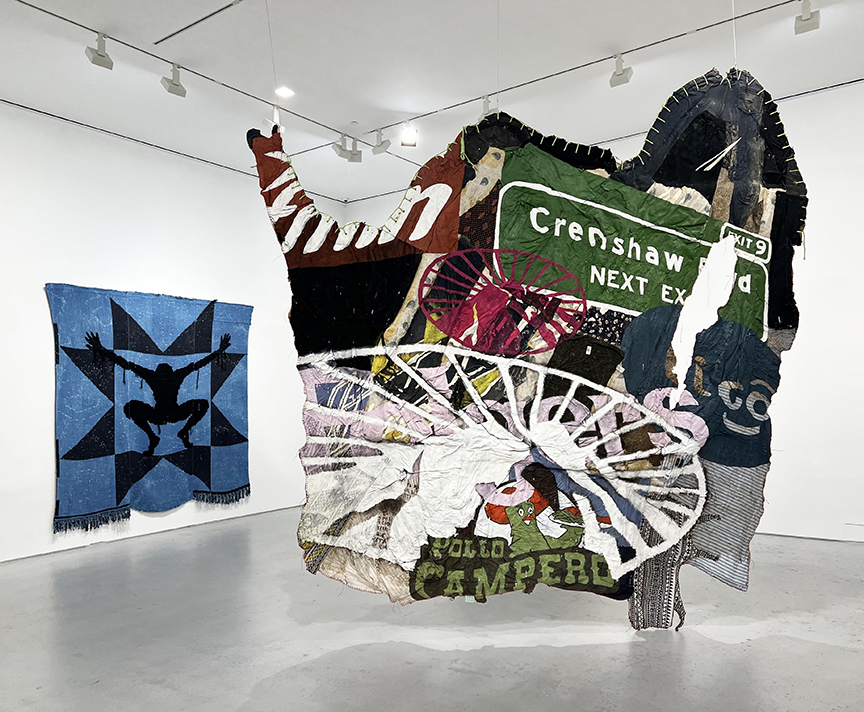
Eddie Rodolfo Aparicio’s ‘Holbein En Crenshaw,’ a rubber cast of a tree on a LA street dominates ‘The New Bend,’ a standout show of textile-related work curated by Legacy Russell at Chelsea’s Hauser & Wirth Gallery.  Layered imagery including a highway exit sign, distorted wheel-like shapes, and advertisements crowd together on one side of this hanging piece, recreating the bombardment of information pedestrians and motorists experience on city streets.  On the other side, the rough texture of the cast tree with its burls and imperfections suggests the difficulties of urban life, even for plants.  Aparicio explains that his intention is to connect beleaguered, non-native trees to the reception of migrant workers in California while also recognizing the rootedness of both in LA life.  (On view through April 2nd.)

Eddie Rodolfo Aparicio, Holbein En Crenshaw (Washington Blvd and Crenshaw Blvd., LA, CA), rubber, sulfur, tree and plant residue, wood glue, latex paint, acrylic paint, strings and found cloth quilt, 138 x 150 x 5 inches, 2018.

Roxa Smith at C24 Gallery

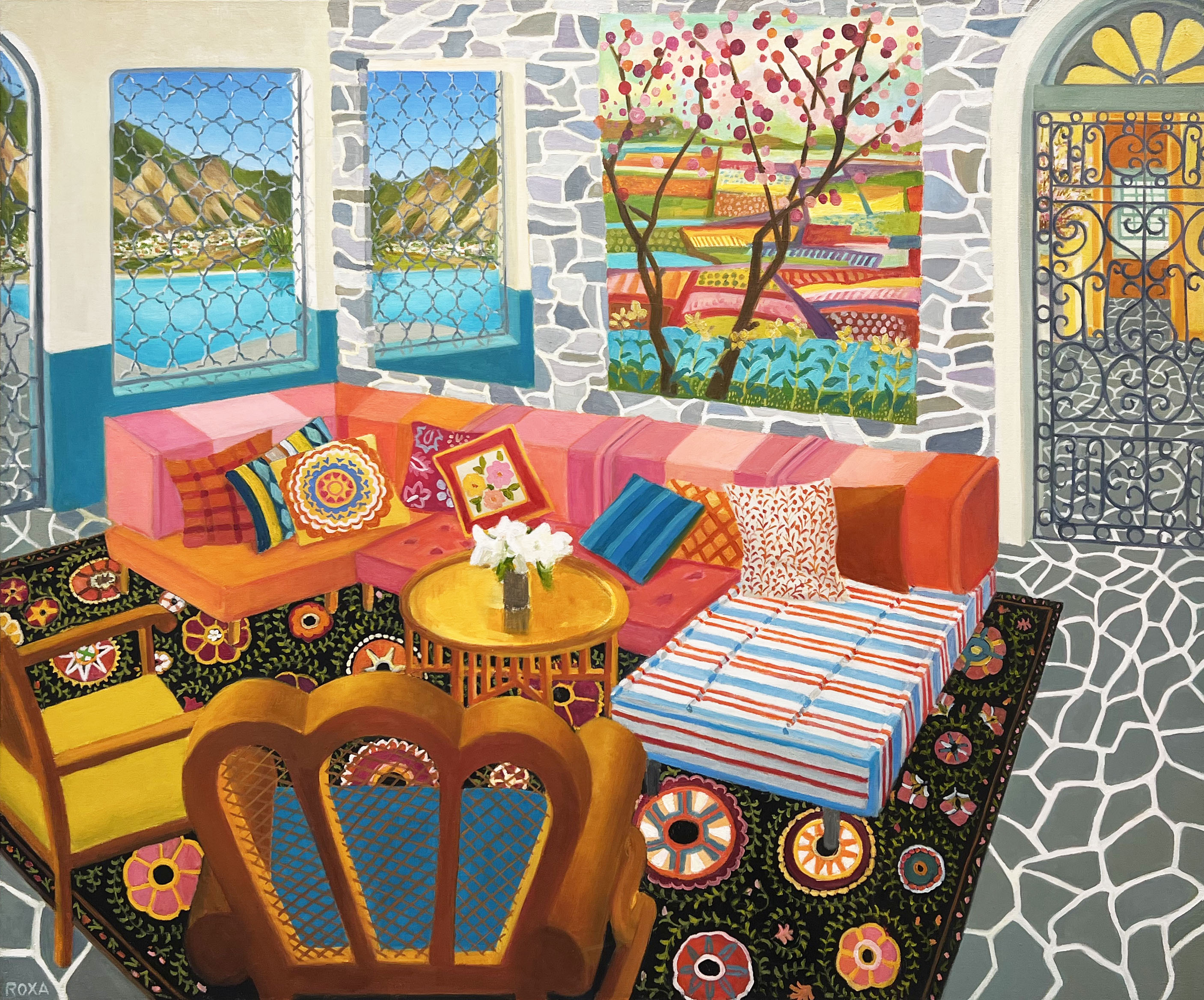
Pattern and color are the last words in Roxa Smith’s lively paintings of imaginary interiors at C24 Gallery in Chelsea.  Smith, who grew up in Venezuela and moved to New York in the 90s, explains that as a child, family trips exposed her to colonial towns and indigenous and folk art that have influenced her current aesthetic.  Already drawn to interiors, she became devoted to the subject after visiting an exhibition of Matisse’s painting at the National Gallery in Washington DC.  Uplifting, lively and engaging, Smith’s paintings offer a moment of pure pleasure.  (On view in Chelsea through March 11th.)

Roxa Smith, Gated Sanctuary, oil on canvas, 30 x 36 inches, 2016.

Francesca Galloway Presentation at Luhring Augustine

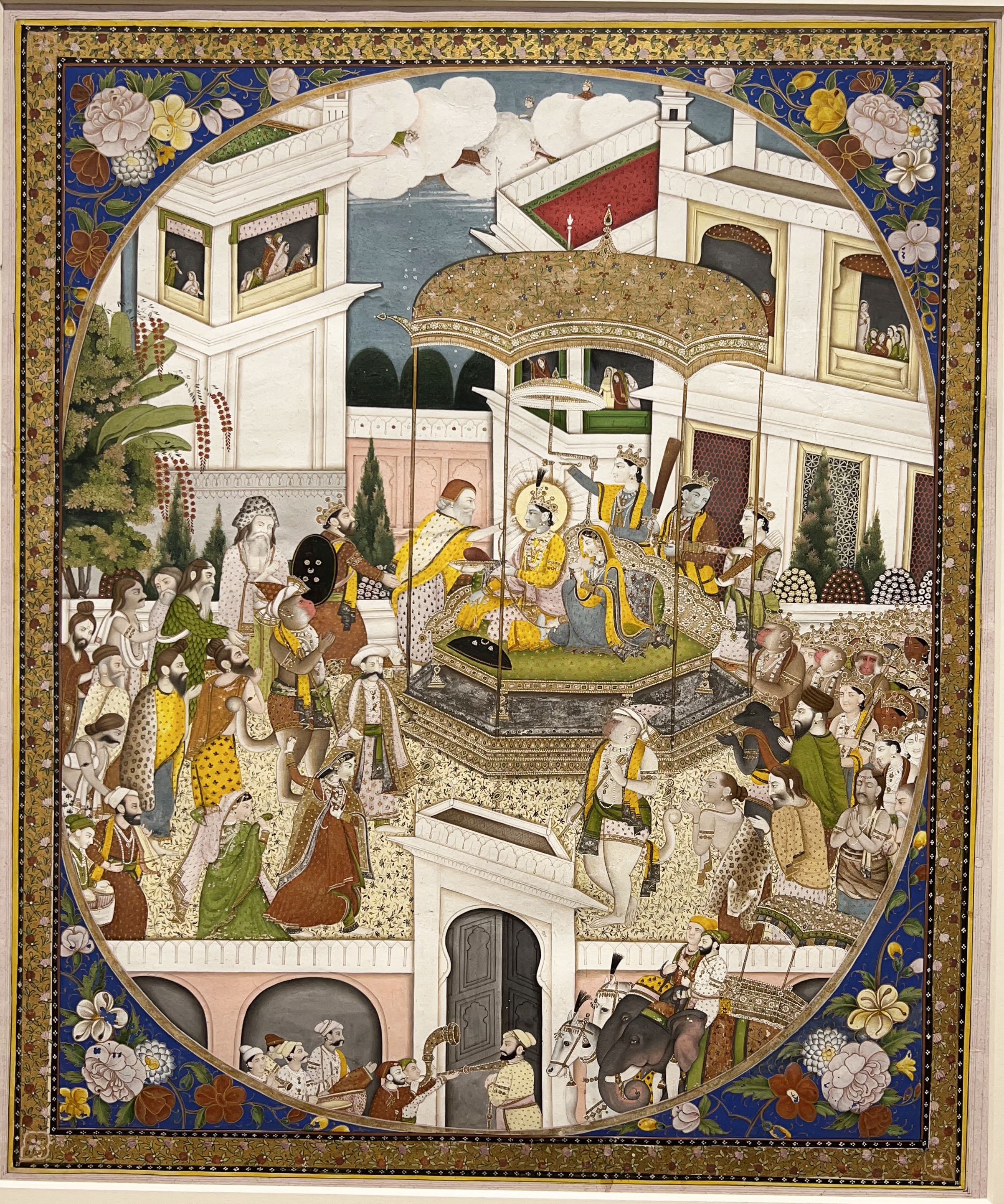
After a long, action-packed adventure described in the Sanskrit epic the Ramayana, Rama returns home to the kingdom of Ayodhya and is crowned alongside his love, Sita.  Here, in a standout painting from the exhibition ‘Court, Epic, Spirit:  Indian Art 15th – 19th Century’ presented by London dealer Francesca Galloway at Luhring Augustine Gallery, the couple literally glow as they celebrate Rama’s restoration and his triumph over evil.  Populated by dignitaries and ascetics and set among opulent furnishings and fabrics, this relatively small painting overwhelms with its intricate detail.  (On view in Tribeca through March 24th).

The Coronation of Rama based on the description in the Yuddhakanda of the Ramayana, ch 130, Mandi, opaque pigments, painting: 17 ¾ x 14 5/8 inches, c. 1840.

Mary Lum at Yancey Richardson Gallery

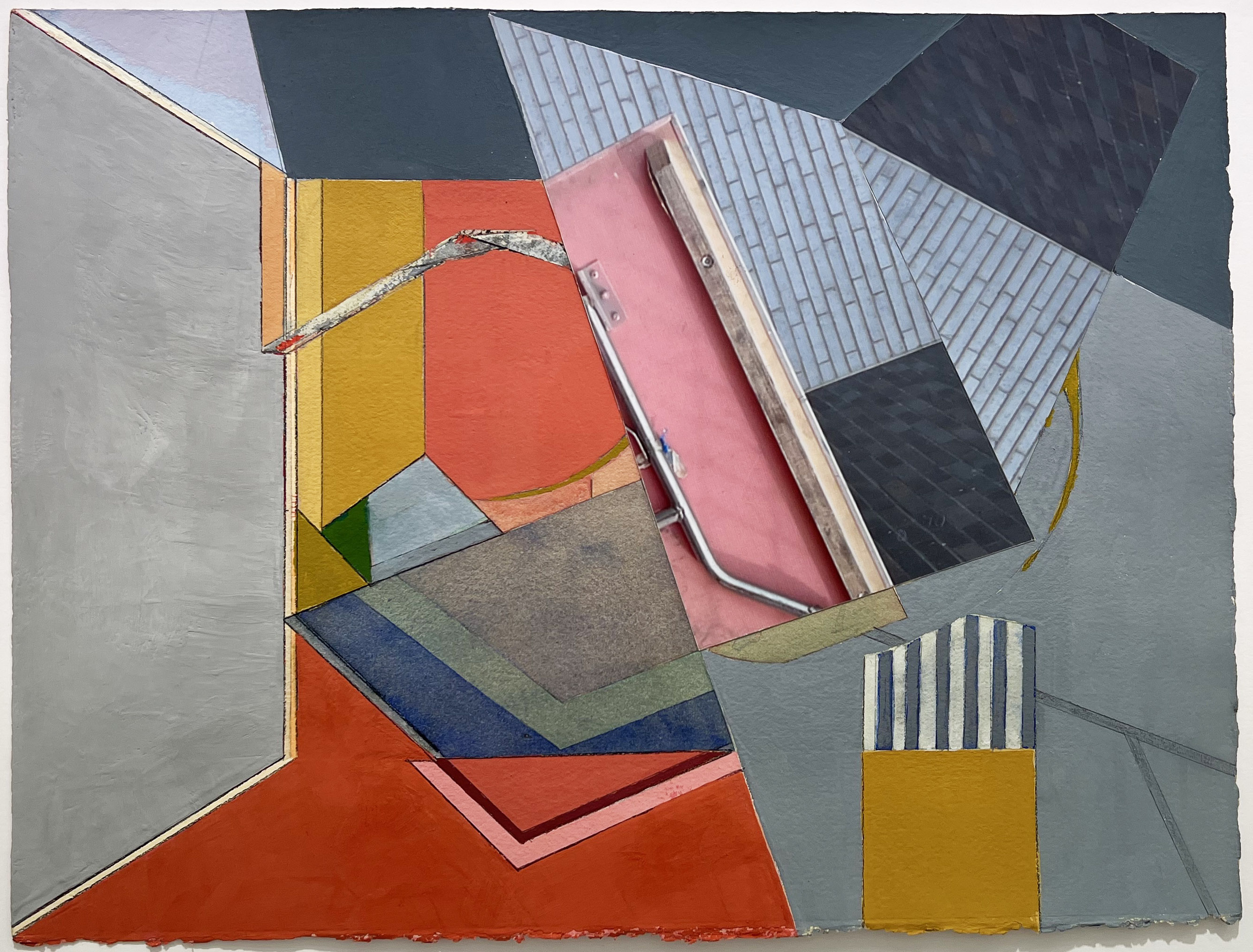
Long walks through New York, Paris and London yield source material for Mary Lum’s complex photo and paint collages, now on view at Yancey Richardson Gallery in Chelsea.  Titled 11th Avenue, this piece features slices of urban architecture and facades that dynamically multiply the grid.  At center, Lum seamlessly turns a photo of metal piping into a flattened piece of paper that in turn guides our eye up and over a grey wall – all moves that keep our sense of space shifting in an engaging way.  (On view through Feb 26th).

Mary Lum, 11th Avenue, gouache, watercolor, acrylic, colored pencil, and photo collage on paper, 11 ¼ x 14 7/8 inches, 2021.

Keith Tyson at Hauser & Wirth Gallery

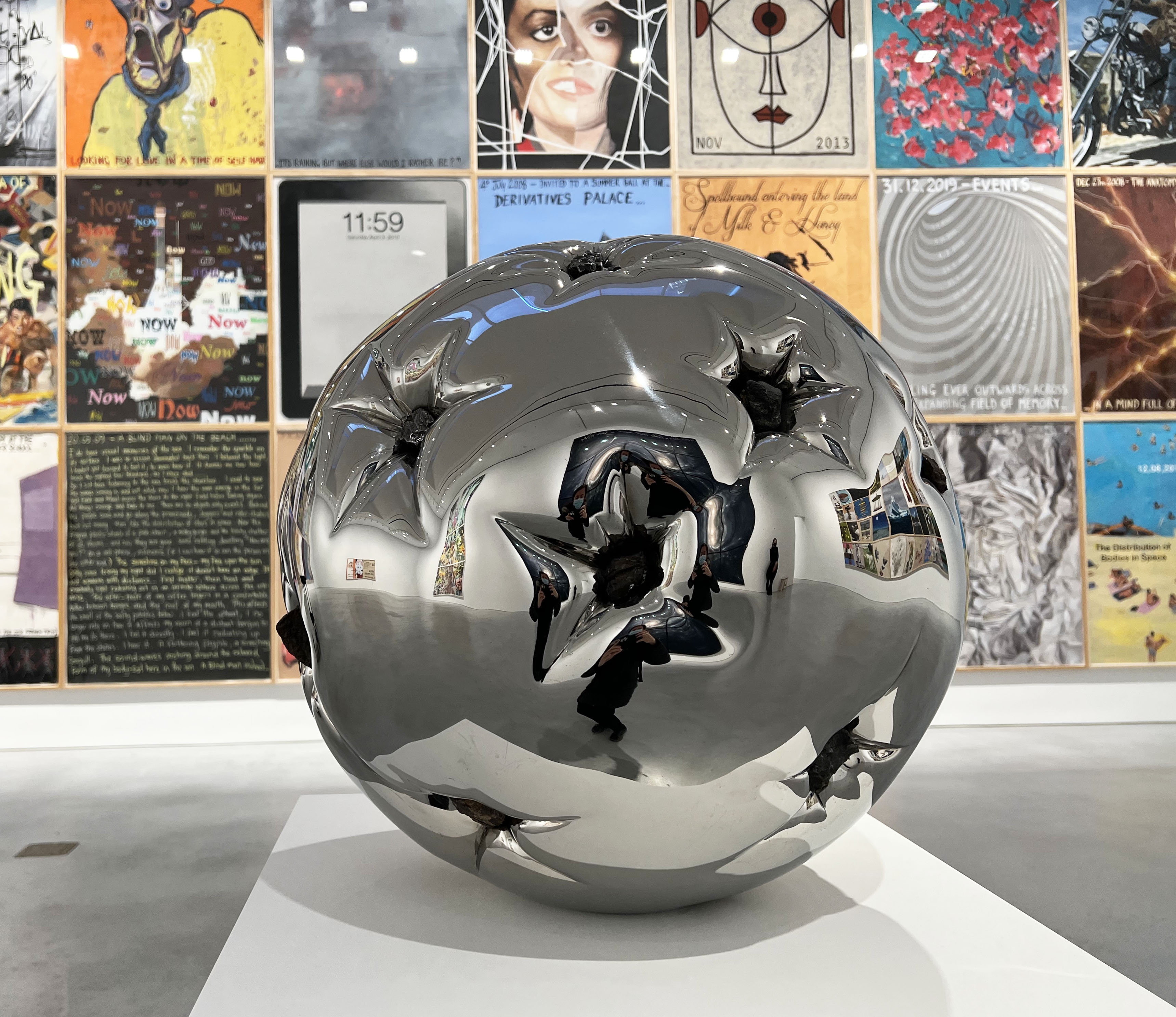
To say that British artist Keith Tyson’s art practice is expansive is something of an understatement; for decades, his painting and sculpture have aimed to show the connectedness of all things.  Drawing from thousands of paintings created over more than twenty years, grids of images now on view at Hauser & Wirth Gallery in Chelsea suggest links between neural networks, the vastness and changeability of space, mathematical concepts and much more.  Here, meteorites embedded in stainless steel prompted Tyson’s mind-boggling question in a recent catalogue essay: “What were the odds at some point in the distant past, when these chunks of matter were on their particular trajectories through outer space, that they would all end up together here in this piece of work?”  (On view in Chelsea through April 2nd).

Field of Heaven, stainless steel, meteorites, 23 5/8 x 23 5/8 x 23 5/8 inches, 2016.

Ryan Preciado at Canada Gallery

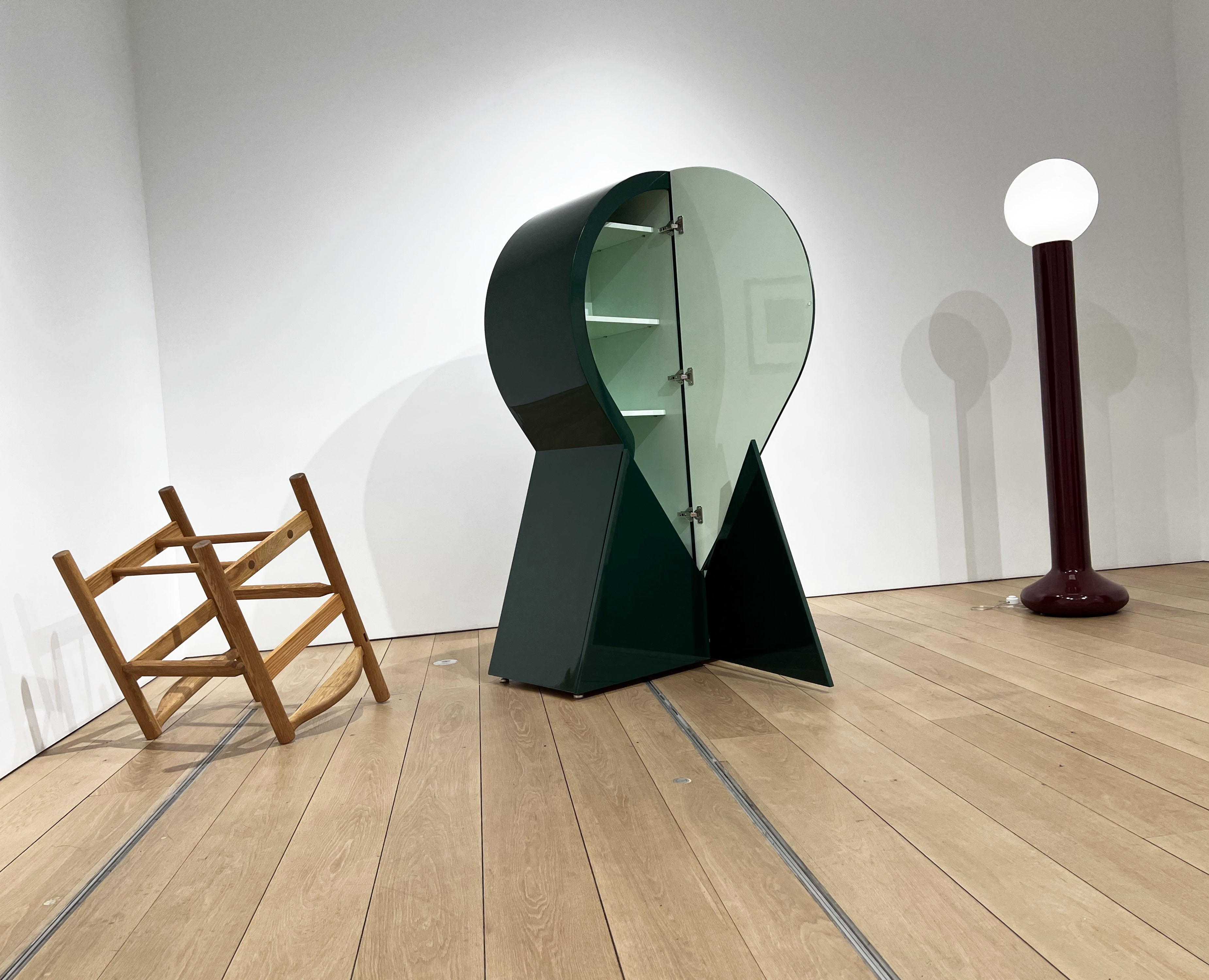
Inspired by the Pope’s mitre, Chumash tradition, California car culture and much more, young west coast designer Ryan Preciado presents furniture at Canada Gallery that conveys comfort, pleasure and sturdiness.  Like Matt Conners’ abstract paintings in the adjoining gallery, color and structure dominate our sensory experience.  Practical and welcoming, Preciado’s approach to design was impacted by watching his sister squirm to get comfortable on the family couch.  (On view in Tribeca through March 5th).

Ryan Preciado, Pope Cabinet, plywood, MDF, urethane enamel, 70 x 48 x 20 inches, 2021.

ASMA at Deli Gallery

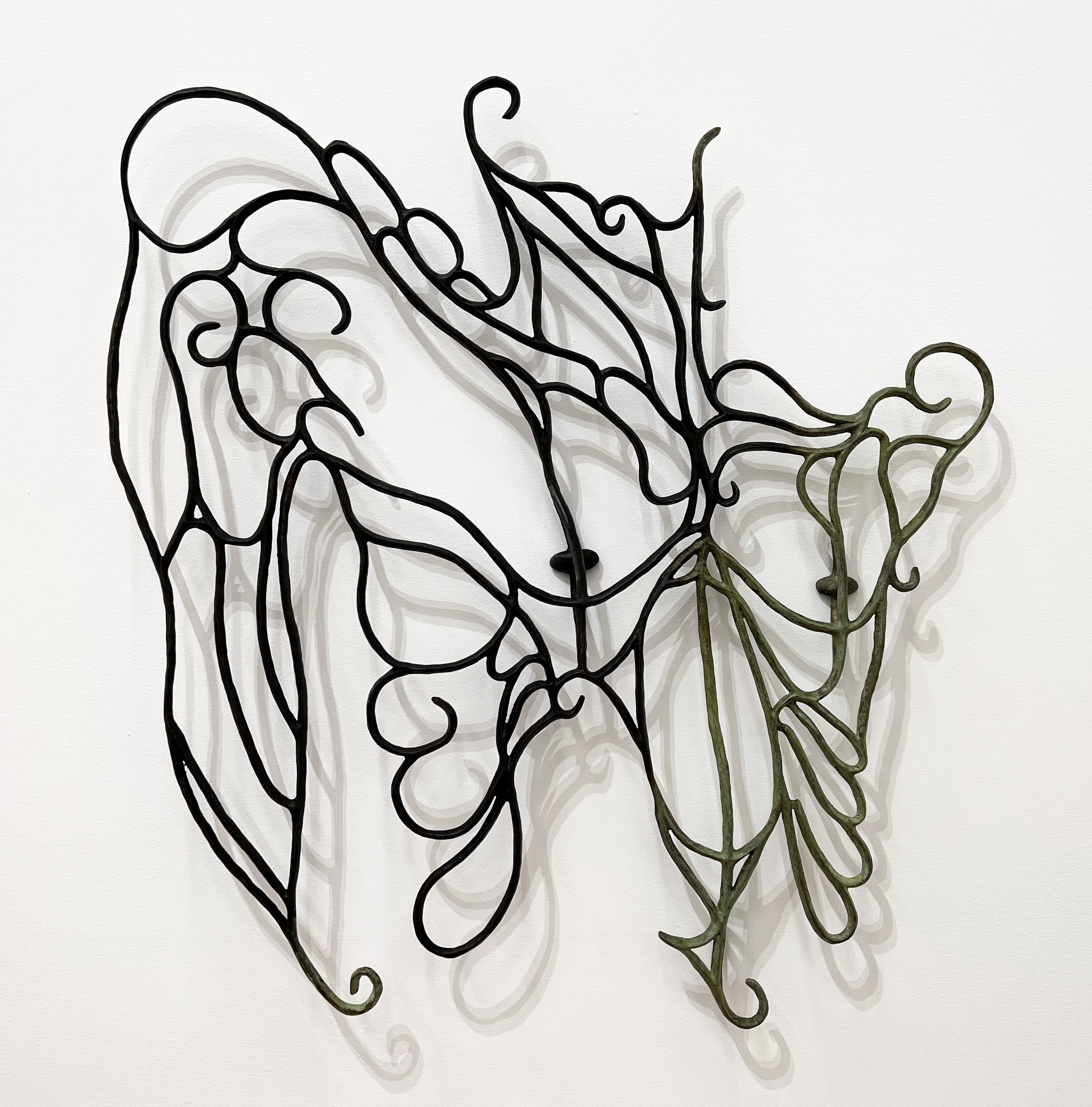
In Greek mythology, Narcissus broke hearts and in turn had his own heart broken by falling in love with his reflection in a pool of water.  Related imagery appears throughout Mexico City-based duo ASMA’s current show at Deli Gallery in Tribeca, along with a sculpture of the flower that Narcissus was said to have turned into upon his death.  Working in a variety of materials including platinum silicon and cast bronze, the artists ponder this posthumous transformative act, considering life between fixed states.  Here, a wall-mounted bronze bust of a male torso skews upward and to the side, as if being tugged out of conventional space and time.  (On view through Feb 19th).

ASMA, It seeks, is sought, it burns and it is burnt, cast bronze, 27 ½ x 24 ½ x 2 inches, 2021.

Mark Ryan Chariker at 1969 Gallery

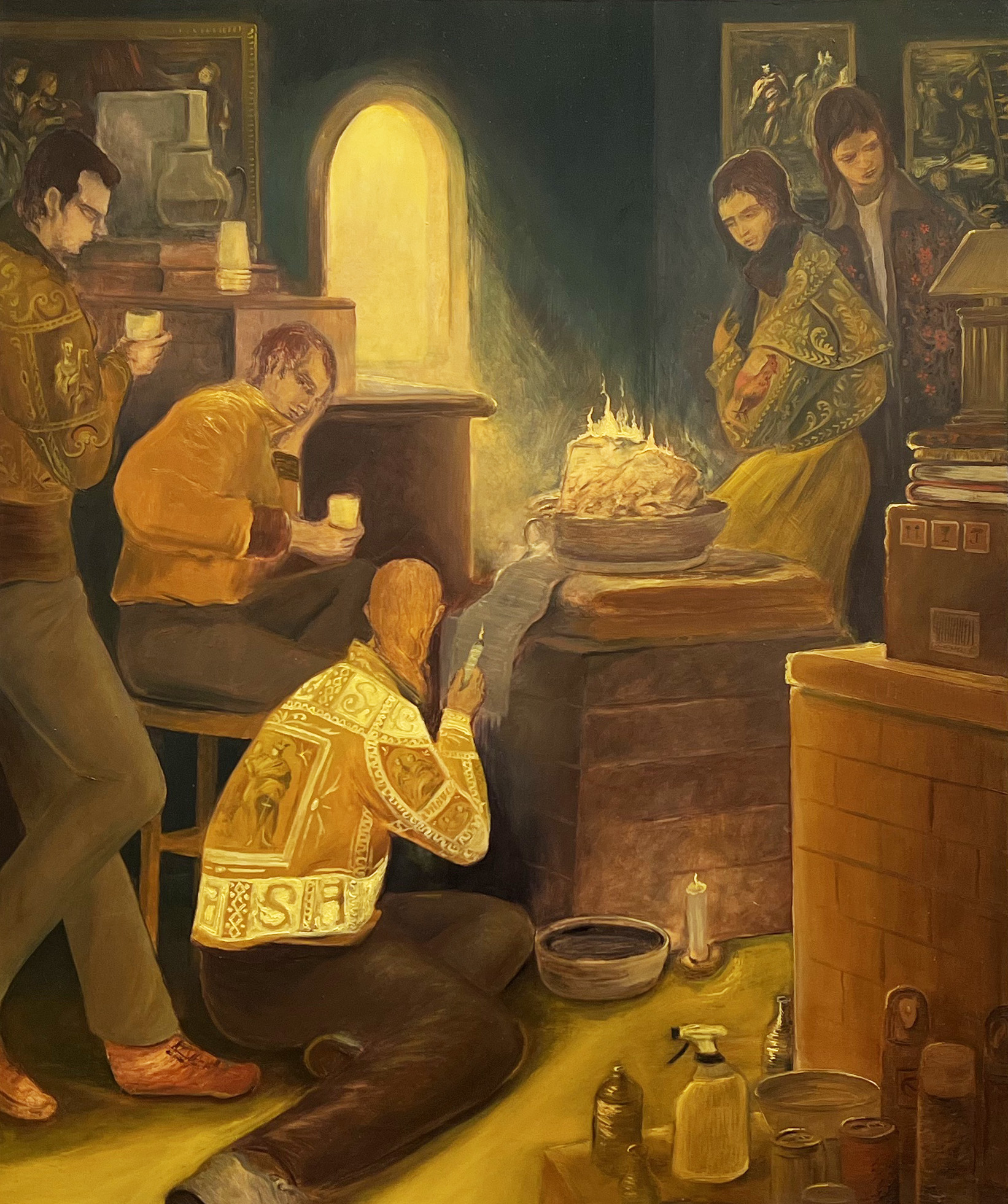
Mark Ryan Chariker’s atmospheric paintings at 1969 Gallery are an intriguing anomaly, situating contemporary characters wearing fashions inspired by European art history in historic-looking settings.  In most paintings, none of the elongated, Mannerist characters seem to be saying a word, but each appears to play a role in an understated drama or fateful moment.  Here, in a painting titled ‘Burning Ceremony,’ five figures demonstrate varying degrees of disregard for an unidentifiable flaming object in a huge dish.  Lackadaisical and lacking conviction, their ritual suggests a culture adrift. (On view through Feb 26th.  Proof of vaccination and masks are required).


Mark Ryan Chariker, Burning Ceremony, oil on linen, 24 x 20 inches, 2021.

Mulyana at Sapar Contemporary

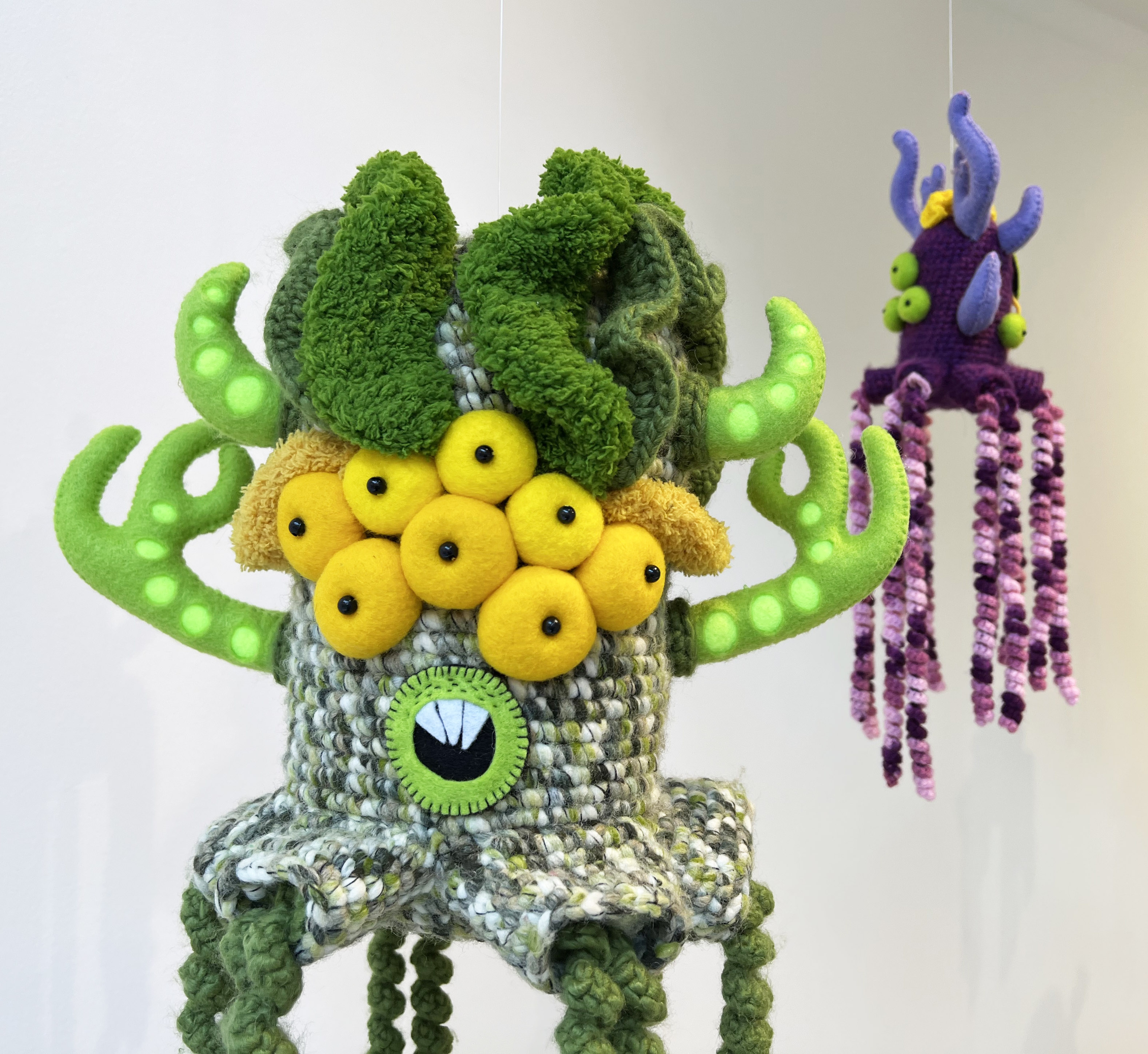
Indonesian artist Mulyana’s playful knit and crocheted sculptures are an immediate draw at Sapar Contemporary in Tribeca for their fantastical forms and bright colors.  Whether replicating a coral reef or crafting one of his signature alien or octopus-like creatures, the artist uses soft materials that create a feeling of comfort and intimate familiarity.  His intention is to encourage respect for the wonders of the natural world, titling his show ‘Fragile Ecologies,’ and explaining that for him, the process of creating the work is an act of meditation or prayer.  (On view in Tribeca through March 4th. Masks and social distancing required.)

Mulyana, foreground) Mogus 93, yarn, dacron, felt, 11 3/8 x 7 ½ x 26 ¾ inches, 2021.

Michelle Rawlings at Chapter NY

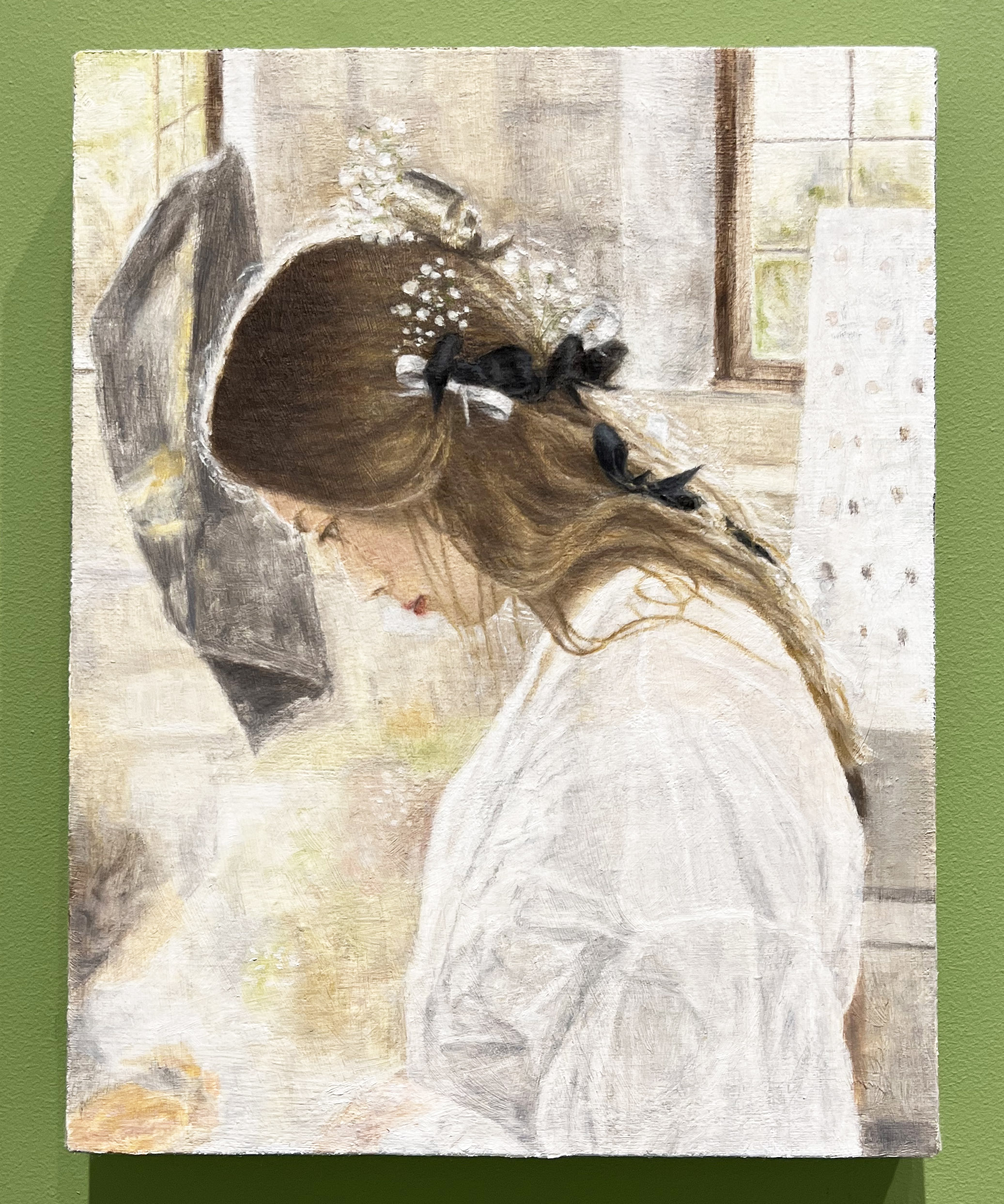
As a teen, Michelle Rawlings used to cut out and rearrange fashion spreads from magazines; her  untitled oil on linen canvases at Chapter NY in Tribeca operate on a similar scale (this painting is a mere 12 ½ inches high) and also channel the cool, distanced mood of fashion photography.  Here, she captures a different feeling of isolation as a softly sunlit young woman engages in a solitary activity.  Set against an intensely green gallery wall that emphasizes the glimpses of nature seen outside the window and accompanied by minimal collages of ribbon and ephemeral plant-related imagery, the paintings are mediations on how meaning is constructed.  (On view in Tribeca through Feb 5th. Masks and social distancing required.)

Michelle Rawlings, Untitled, oil on linen, 12 ½ x 10 x 1 ¼ inches, 2021.

Chris “Daze” Ellis at PPOW Gallery

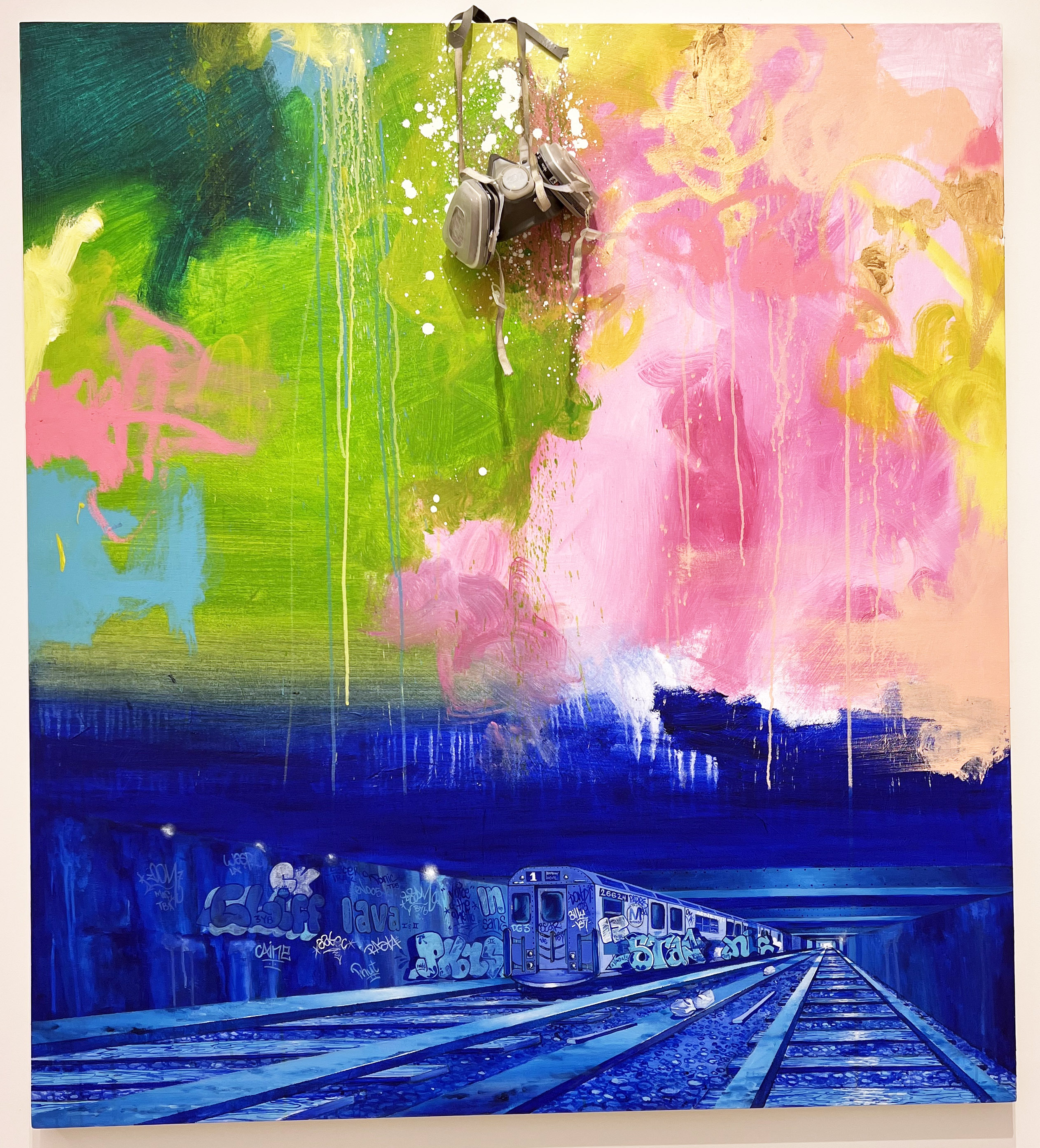
Chris “Daze” Ellis started painting train cars as a teen in the mid-70s and within a few years was showing his work indoors in shows at The Mudd Club and the renowned gallery Fashion Moda. Decades later, he reflects on contemporaries who’ve passed, including Cliff 3YB, Billy 167, Stan 153 and others in this recent painting in his current solo show at PPOW Gallery.  Above their names on the subway walls and cars, an expressionist composition of greens, pinks and yellow colors glows like a celestial phenomenon honoring the lives and memory of street art pioneers.  (On view through Feb 12th in Tribeca.  Masks and social distancing required).

Chris “Daze” Ellis, A Memorial, acrylic, oil, spray paint, respirator on canvas, 60 x 54 inches, 2020.

Raymond Saunders at Andrew Kreps Gallery

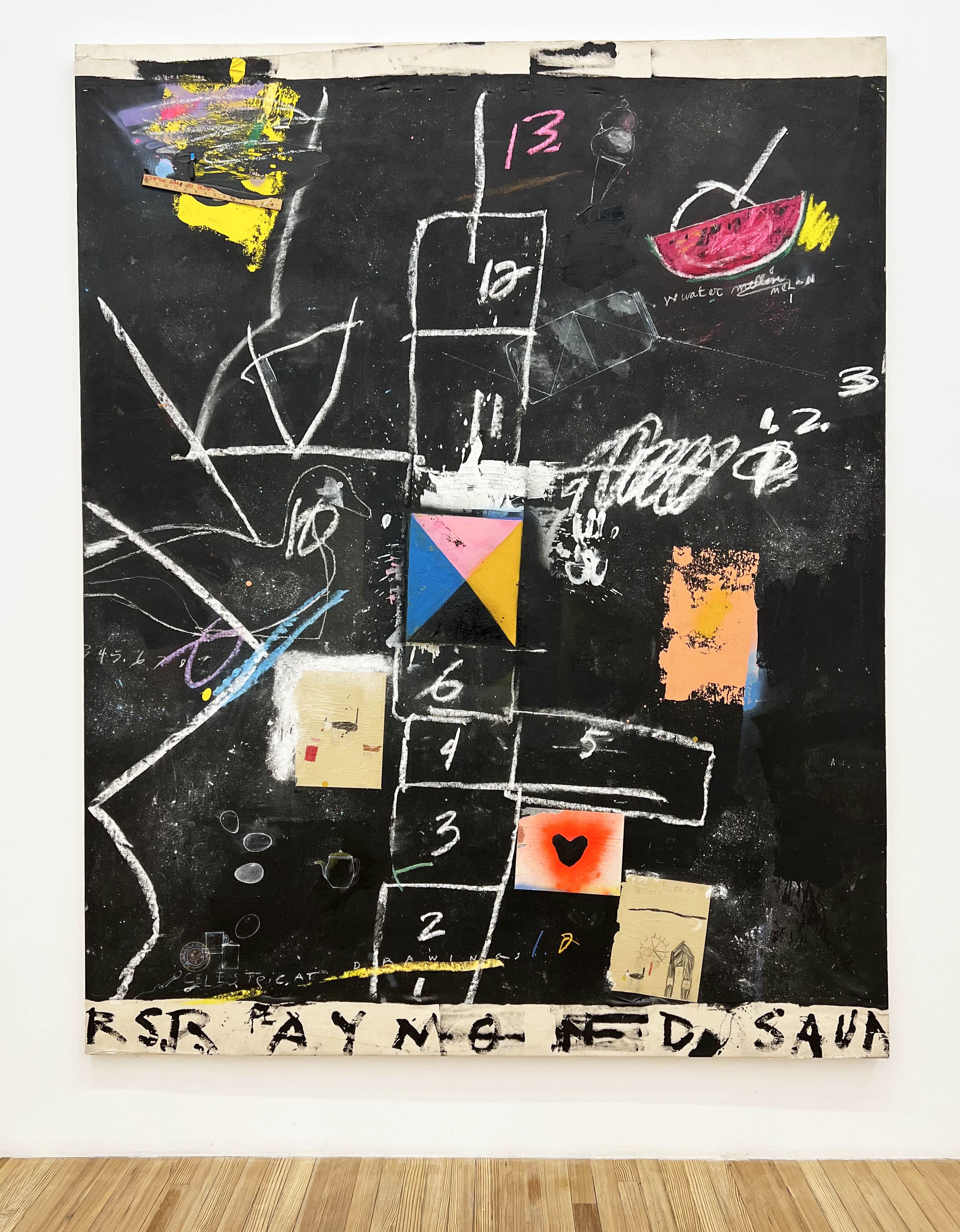
The hopscotch grid stands out in this painting by Raymond Saunders, now on view in the renowned Bay Area artist’s first New York solo show in 20 years at Andrew Kreps Gallery in Tribeca.  Evoking a childhood game drawn out on blacktop as well as marks on a chalkboard, references to growth, learning and play are reinforced by the work’s title, ‘Celeste Age 5 Invited Me To Tea.’  Two children’s drawings of a wayward cat and a reference to Carnegie Mellon alongside a watermelon (the artist attended Carnegie Institute of Technology) link to Saunders’ recurring themes relating to education and race.  (On view through Feb 12th).

Raymond Saunders, Celeste Age 5 Invited Me To Tea, mixed media on canvas, 104 x 83 1/8 inches, 1986.

Lucy Puls at Nicelle Beauchene Gallery

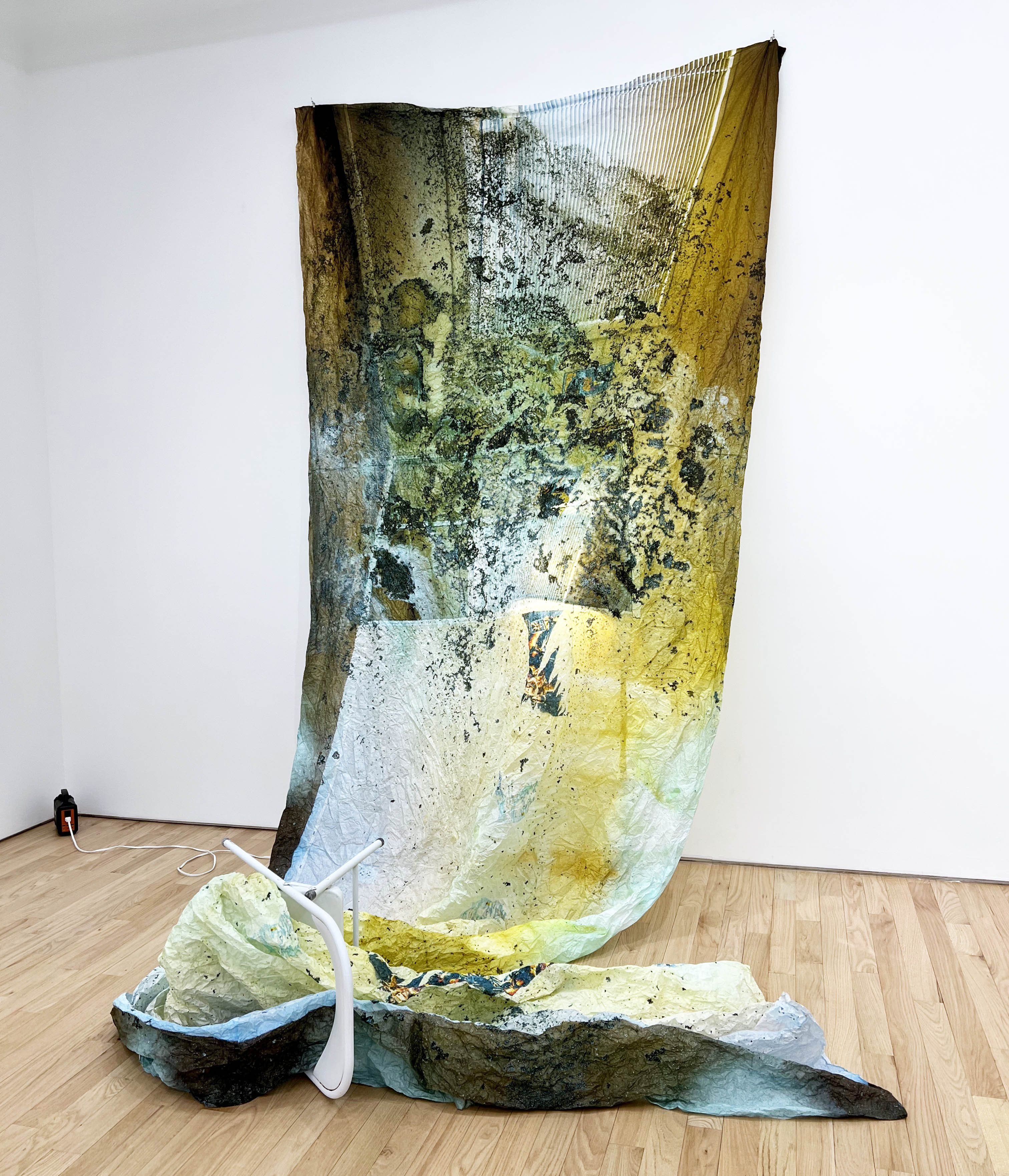
Bay Area artist Lucy Puls has returned over the course of her decades-long career to the question of what society values and what it discards.  Her photos of bank-owned homes, printed on huge sheets of fabric-like paper and hung high on the walls of Nicelle Beauchene Gallery feature images of places once personally meaningful and now neglected. Weighed down by discarded household items, in this case a metal folding chair, images and objects speak to the passing of time, to change and moving on.  (On view in Tribeca through Jan 22nd).

Lucy Puls, Delapsus (Bedroom, Mirrored Closet Door, Mini Blinds, Movie Poster), pigment ink on paper, floor standing lamp, metal folding chair, DVD movie, stickers, reflective glass beads, binder, steel hardware, 130 h x 85 w x 84 d inches, 2021.

Alexander Guy at Harper’s Gallery

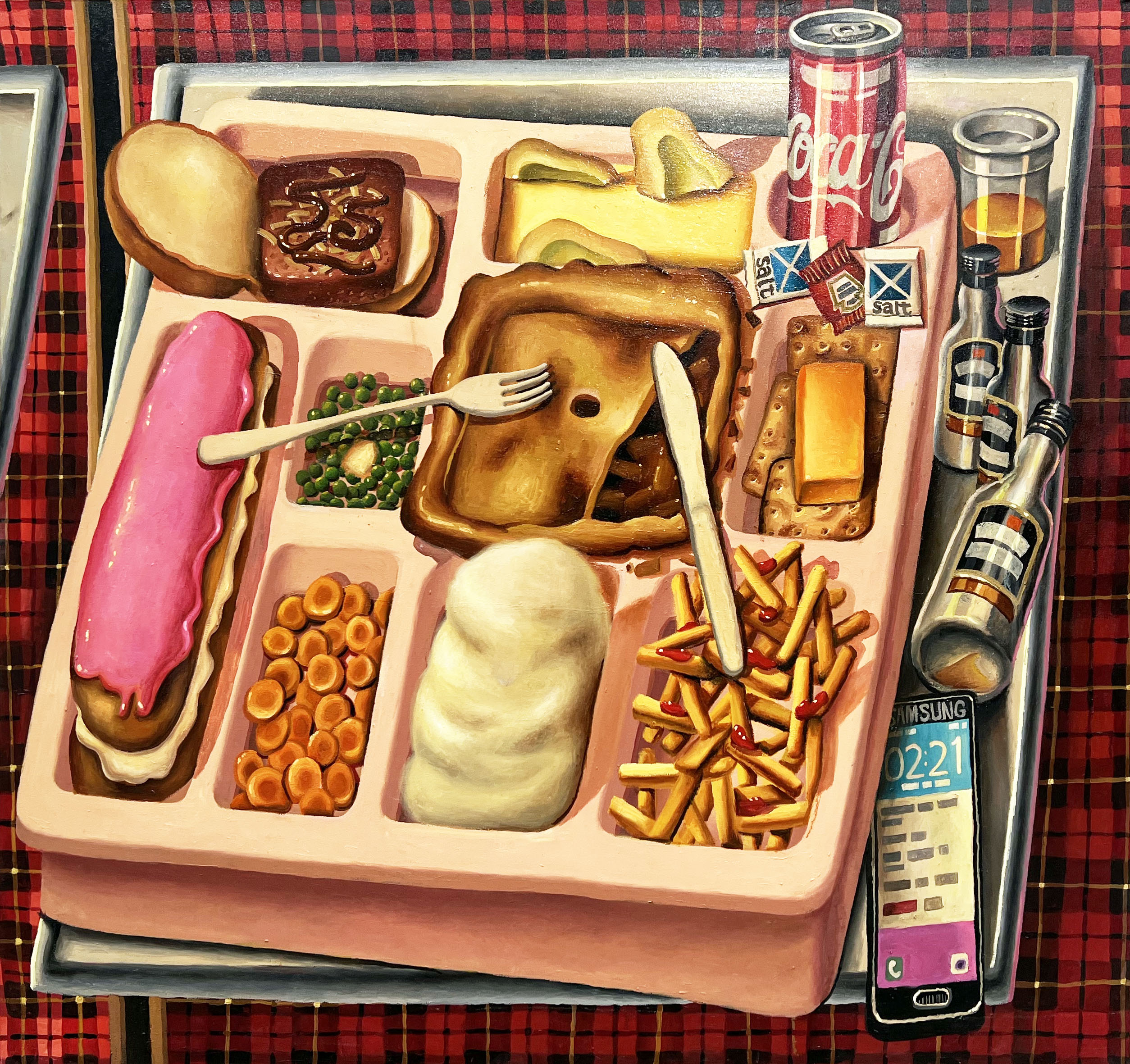
Scottish painter Alexander Guy made a hit on the ‘80s London art scene with his deadpan paintings, which ranged in subject from everyday objects to celebrity images.  In a career revival, Guy is now making his New York gallery debut at Harper’s Gallery in Chelsea with oil paintings showing an abundance of processed food, including a freezer stuffed with ice cream and pizza and a carefully arranged array of pink-colored foods from Tesco supermarket.  Here, a transatlantic in-flight meal overwhelms with its number of dishes and suggests that more is not necessarily more.  (On view through Jan 15th. Masks, social distancing and proof of vaccination required.)

Alexander Guy, GLA -> JFK (In flight meal), oil on canvas, 68h x 72.25w, 2021.

Suellen Rocca, Departure at Matthew Marks Gallery

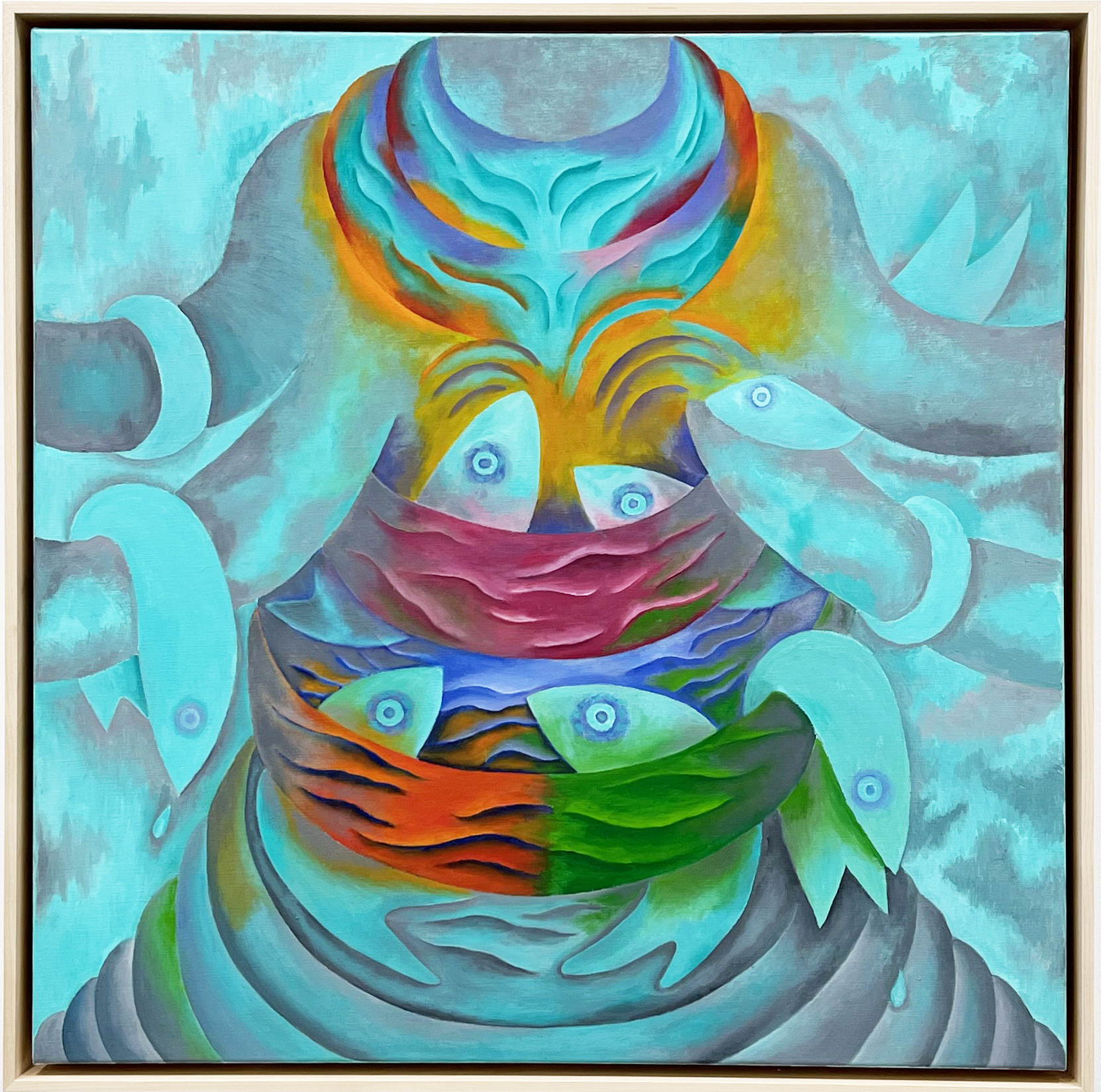
Suellen Rocca, a founding member of the short-lived but hugely influential group of Chicago artists known as ‘Hairy Who,’ adopted imagery from magazine ads, Sears Roebucks catalogues and other American pop culture sources, but her late-career work took on more personal meanings.  Several pieces in Matthew Marks Gallery’s exhibition of the late artist’s work in Chelsea include imagery relating to fish, which came to Rocca in a dream.  Fish seem to nurse like babies, breasts morph into fish and, in this painting, fish adorn the body of a deity-like multi-armed figure, picturing female power in terms of feeding, nurture and life.  (On view through Jan 29th.  Masks, social distancing and proof of vaccination required.)

Suellen Rocca, Departure, oil on canvas, 30 x 30 inches, 2012.

Cinga Samson at Flag Art Foundation

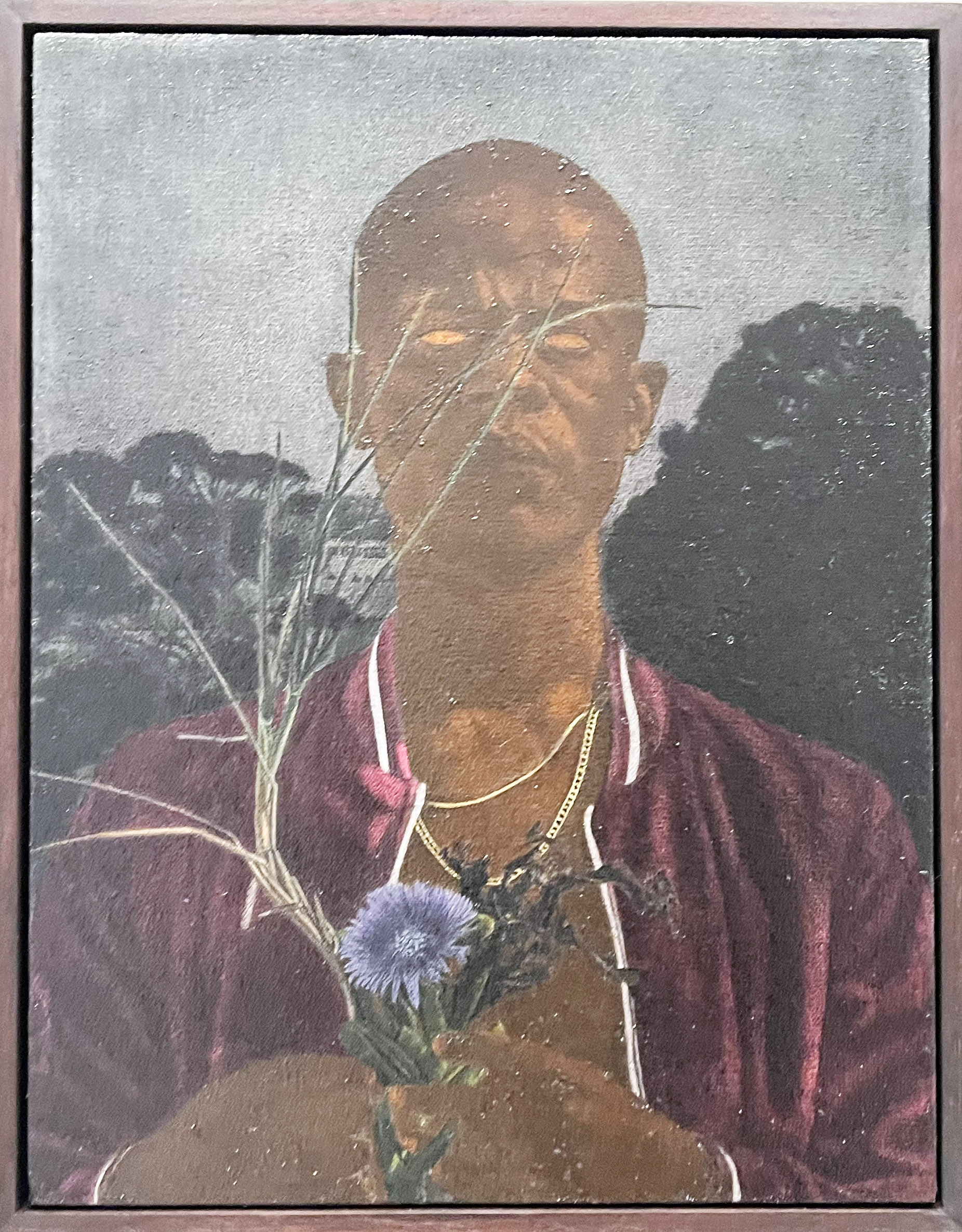
South African artist Cinga Samson complicates the act of looking in paintings that are challenging to see. The muted palettes and crepuscular lighting of his individual portraits and figure groups not only disguise his subjects, but aim to create a sense of having intruded on a private scene.  Samson’s recent body of work, on view at Flag Art Foundation in Chelsea, features young men like this figure, whose remarkable eyes disrupt easy engagement and suggest moments of looking inward.  Each painting is a meditation on mortality, the flower in this piece acting as a symbol of transience.  (On view through Jan 15th.   Masks, social distancing and proof of vaccination required).

Cinga Samson, Nontshonshi 1, oil on canvas, 18 x 13 ¾ x 1 inches, 2021.

Brie Ruais at Albertz Benda Gallery

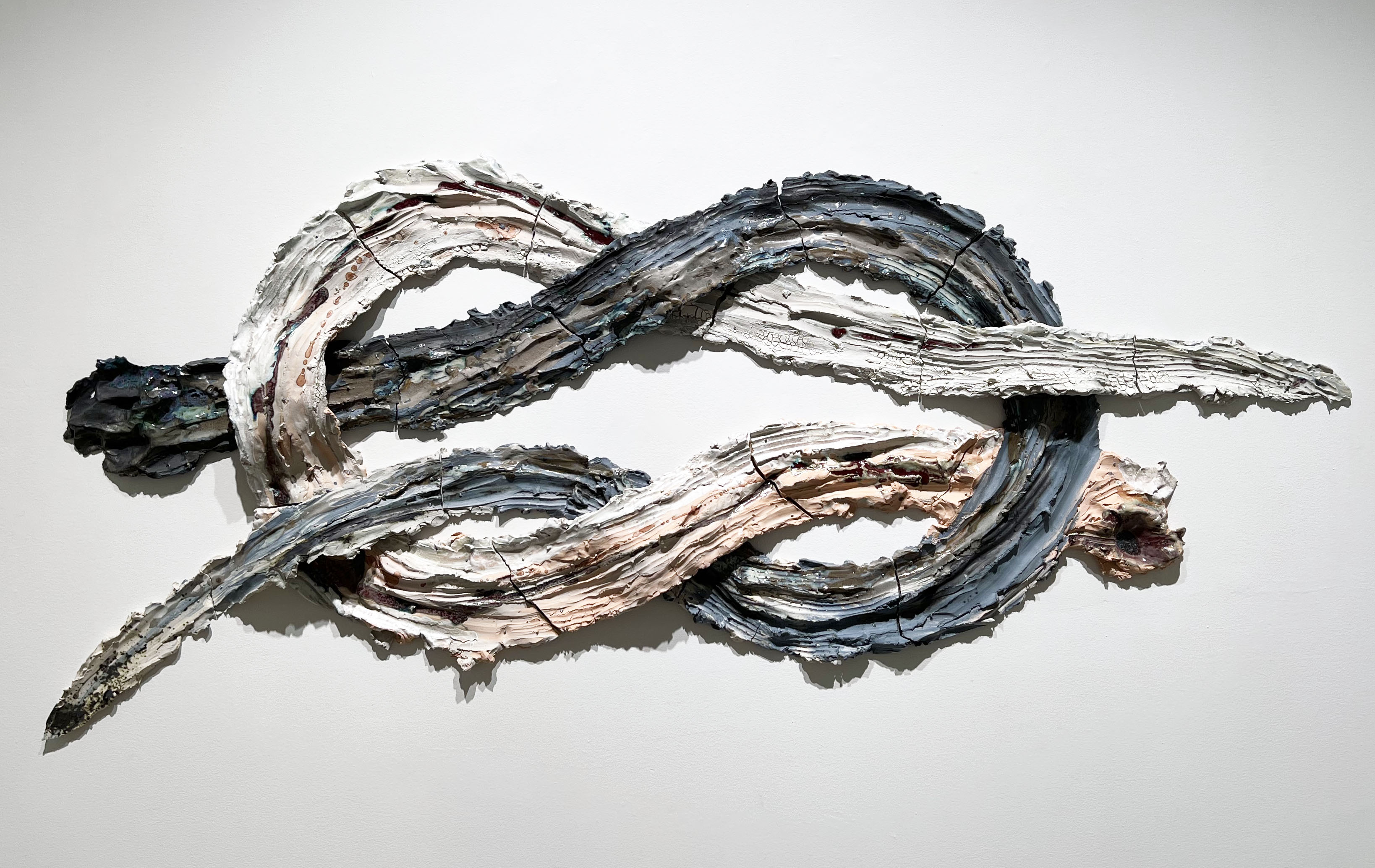
Brie Ruais’s signature approach to art involves manipulating a 130 lb pile (equivalent to the artist’s weight) of clay into flat rings of ceramic sculpture textured with finger and footprints.  Here, she varies her usual circular form with this knot-shaped piece in her current show at Albertz Benda Gallery.  The artist has called her work ‘Earth Art that takes place in the studio;’ in this sculpture, the relationship between the body and landscape speaks to interconnectedness.  (On view in Chelsea through Jan 22nd.)

Brie Ruais, Intertwining, 130lbs times two (Thief Knot), glazed and pigmented stoneware, hardware, 62 x 124 x 6 inches, 2021.

Tyler Ballon at Deitch Projects

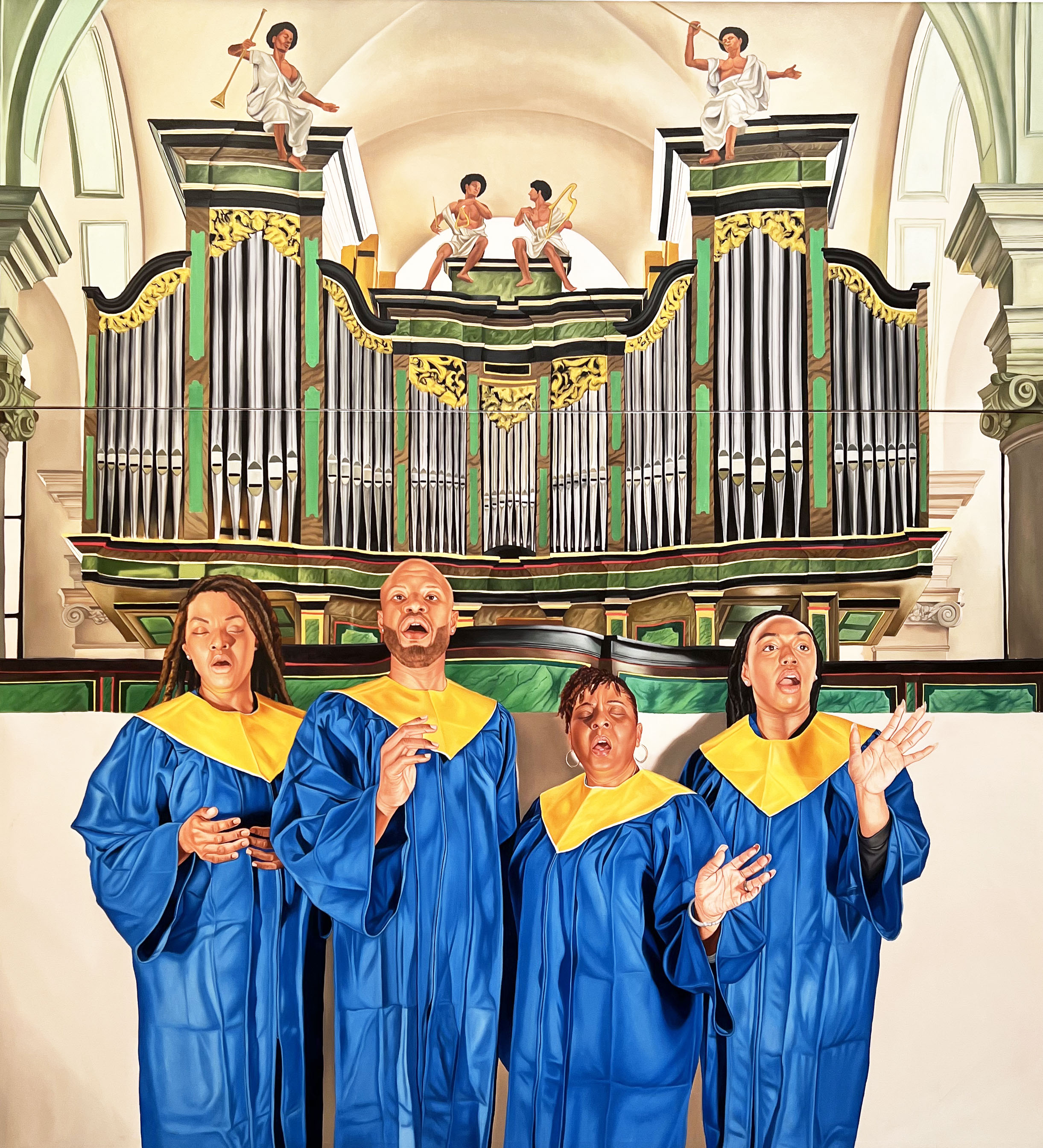
Below tiny members of a celestial choir, four earthly singers raise voices in praise in Tyler Ballon’s painting at Deitch Projects in SoHo.  Identifying ‘the Black church as a place of comfort and strength,’ Ballon also pictures scenes from the life of a pastor (a job both of his parents have filled) that honor this leadership role.  Other paintings feature loving relationships between friends and family and special moments including a graduation and a commemoration of Black lives lost.   (On view in SoHo through Jan 15th.  Note holiday hours and closures.)

Tyler Ballon, Songs Flung to Heaven, oil on canvas, 98 x 107 inches, 2021.


Gillian Wearing: Wearing Masks at the Guggenheim Museum

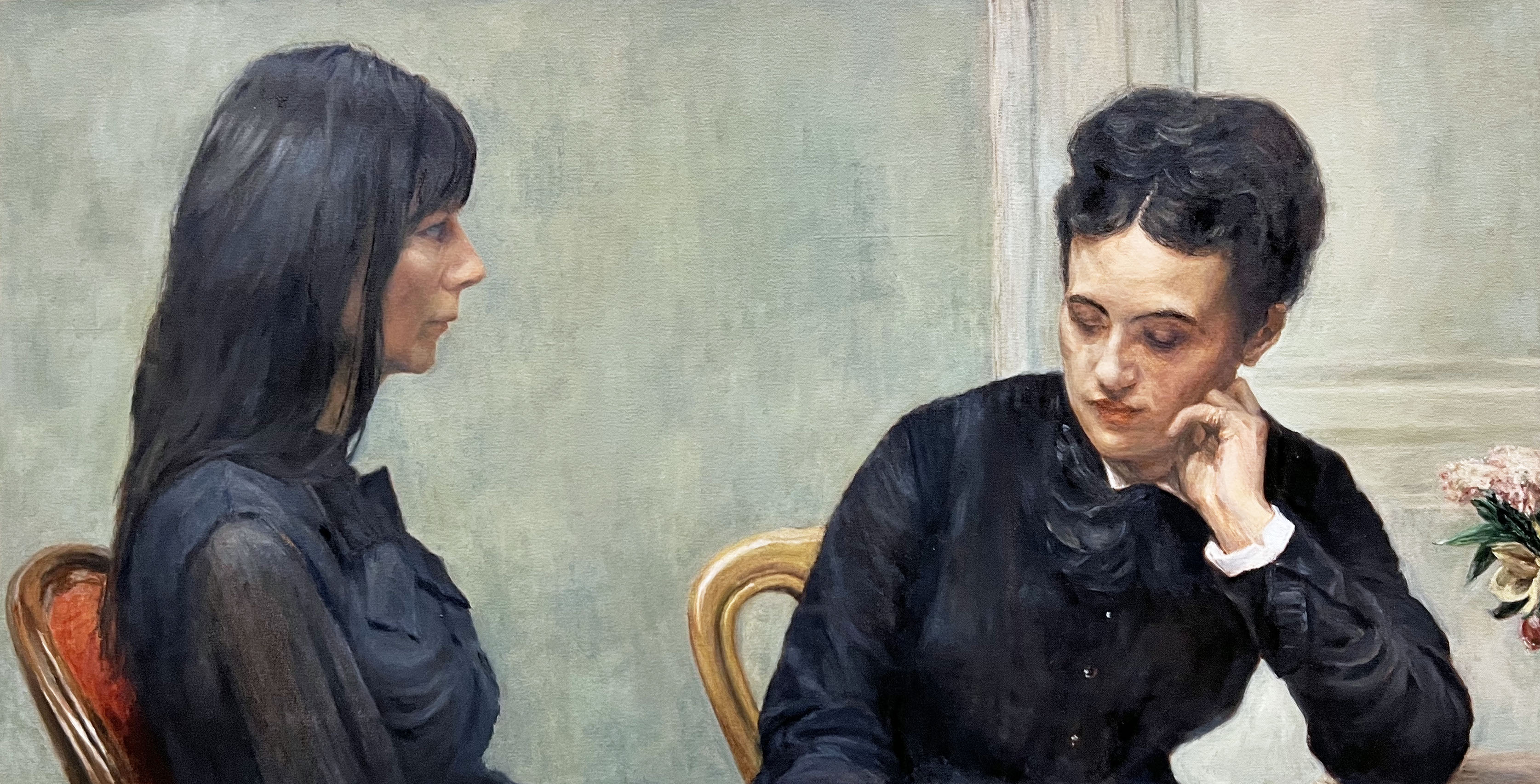
Known for bringing private lives into the public realm through projects like her iconic 1992-3 ‘Signs,’ for which strangers posed with signs sharing their personal thoughts, British conceptual artist Gillian Wearing continues to probe beyond the surface in recent work on view in her career retrospective at the Guggenheim Museum.  Based on mid-to late 19th century French artist Henri Fantin-Latour’s ‘La Lecture (The Reading),’ Wearing’s update includes herself on the left, not just listening to the reading, but gazing intently upon the reader.  Fantin-Latour’s characters famously exist in their private worlds, not always connecting with each other. Wearing, on the other hand, is absorbed by the world inhabited by her companion.  (On view on the Upper East Side through April, ’22).

Gillian Wearing, Me in History – A Conversation with the Work of Fantin-Latour, oil on canvas, 2021.

John Pai in ‘The Unseen Professors’ at Tina Kim Gallery

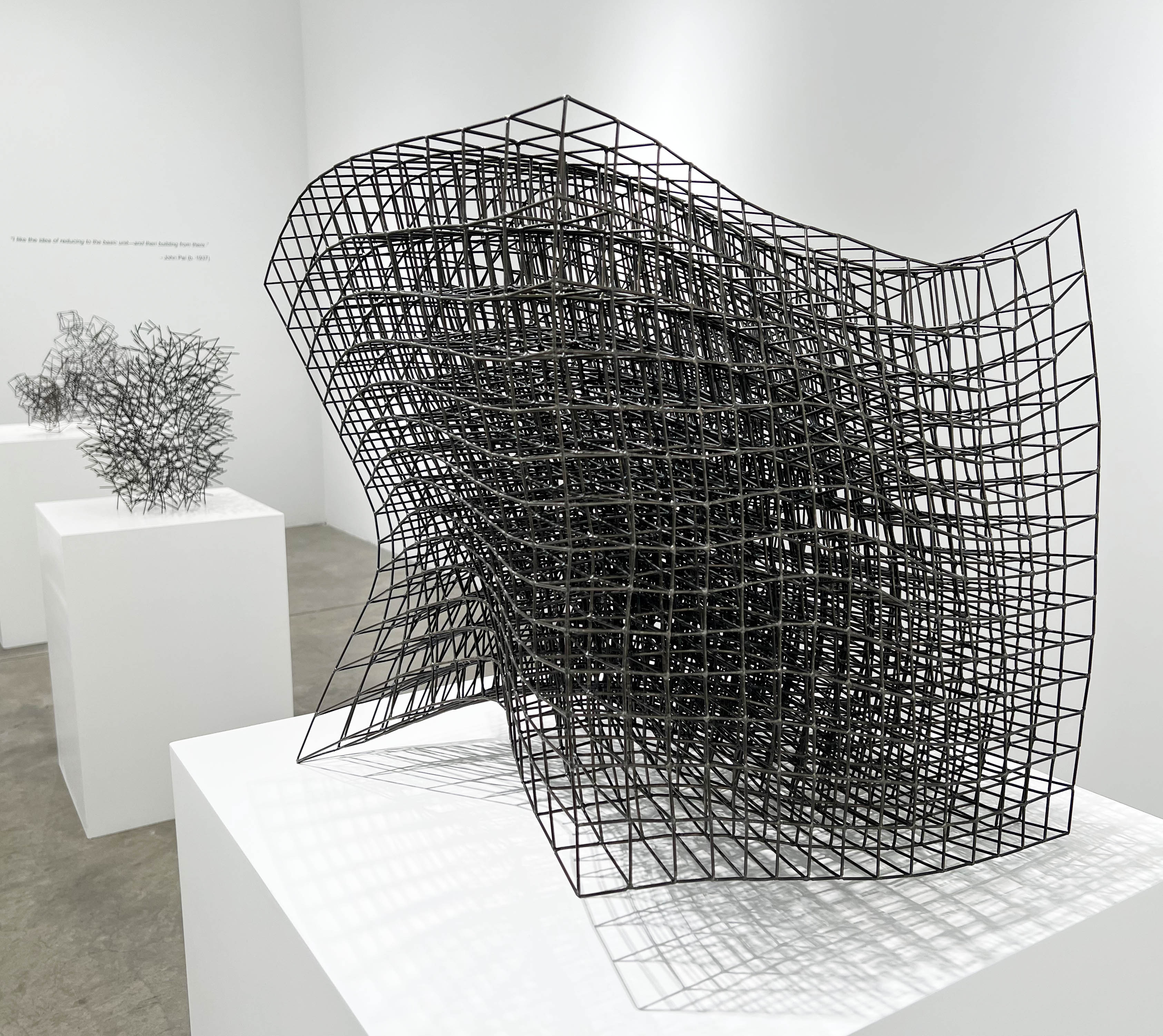
Dense and complex, this piece by octogenarian sculptor John Pai, now on view in a show of work by three 20th century Asian-American sculptors at Chelsea’s Tina Kim Gallery, evokes a scientific or mathematical model in flux.  Piece by piece, Pai welded short steel rods together in a hands-on practice he likened to drawing.  Reflecting subconscious activity and taking inspiration from music, science, architecture and more, Pai’s dynamic constructions elicit wonder at complex structures in our own thought processes and the world around us.  (On view through January 29th. Note holiday hours and closures.)

John Pai, Slice of Wave to Go, welded steel, 23.5 x 32 x 30.5 inches, 1980.

Olive Ayhens at Bookstein Projects

Olive Ayhens meets the abundance of people and buildings in New York with a profusion of recorded detail in her new series of ink and watercolor paintings at Bookstein Projects. Painted in a topsy turvy style combining multiple perspectives, Ayhens’ dynamic cityscapes look as if the buildings are in movement, perhaps shuffling down the sidewalk shoulder to shoulder like New York’s notably absent human residents. Painted in her new West Village neighborhood during the pandemic, Ayhens work reflects a sense of jittery nervousness via its architecture.  (On view on the Upper East Side through Jan 7th.  Note holiday hours and closures).

Olive Ayhens, Orange Luxury, watercolor and ink on paper, 23 x 30.5 inches, 2020.

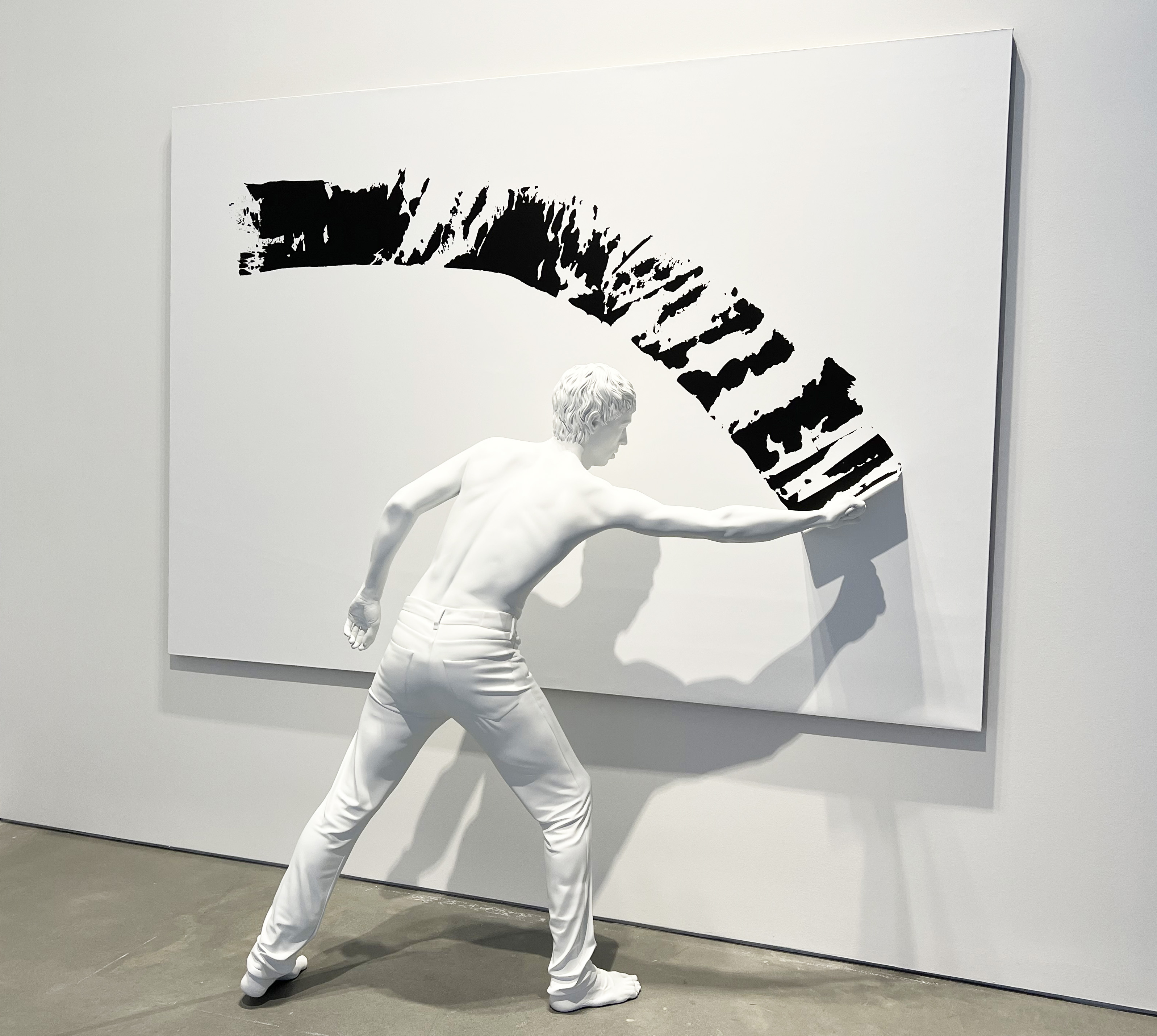
Elmgreen and Dragset at Pace Gallery

Titled ‘The Painter, Fig. 1,’ this lacquered bronze sculpture by Berlin-based duo Elmgreen and Dragset appears to be offered as an illustration of an artist in action and is prominently displayed in the window of Pace Gallery’s Chelsea building.  In the adjoining gallery, other sculptures hint at themes of regret, loneliness and the will to dominate; nearby, this artist responds.  It’s unclear if he’s laying down black paint or scraping off white paint to reveal the darkness beneath; either way, he appears to be putting a dramatic end to his monochrome existence.  (On view in Chelsea through Dec 18th).

Elmgreen and Dragset, The Painter, Fig. 1, bronze, lacquer, linen, paint, 98 7/16 x 100 3/8 x 23 5/8 inches, 2021.

Ken Price, Pluto Bowl at Matthew Marks Gallery

If images of factories, billowing smokestacks and oil-slicked water sound alien to traditional ceramic decoration, the title of Ken Price’s mid-90s series, ‘Plutoware,’ at Matthew Marks Gallery plays along.  Intended to be a pun on the word pollution, the iconic sculptor’s scenes of environmental damage set up a fundamental contrast between intimately scaled and beautifully colored plates, bowls and vessels and depictions of giant manufacturing and co-generation plants.  Though Price’s work would seem to project despair, his wife, Happy Price explains an alternative point of view, saying, ‘When you look at the Pluto Ware some people only see pollution, darkness, and grim and then other people—like myself—see a kind of strange dark beauty.’  (On view through Dec 18th in Chelsea).

Ken Price, Pluto Bowl (Green Sludge), glazed ceramic, 2 ½ x 7 ¼ x 7 ¼ inches, 1995.

Mira Dancy at Chapter NY

After a recent move from New York to Southern California, Mira Dancy presents new work at Chapter Gallery depicting female figures in her trademark glowing neon colors who now revel in the natural world.  This pregnant goddess holds a ball in her palm that resembles the earth, suggesting a female power on an epic scale.  (On view in Tribeca through Dec 18th).

Mira Dancy, Life Line, acrylic on canvas, 80 x 60 inches, 2021.

Arthur Simms at Martos Gallery

Known for sculptures made of materials wrapped in hemp rope, Arthur Simms makes a departure in this ’96 piece by encasing two bicycles in wire, allowing us to see the license plates, central structure and bucket-like portable toilet on this tricked out super vehicle.   On view in Simm’s select 30-year retrospective at Martos Gallery, this sculpture and other wrapped works were inspired by carts used by homeless New Yorkers as well as the carts used by market vendors in Simm’s home country of Jamaica.  (On view on the Lower East Side through Dec 23rd).

Arthur Simms, Bicycle, bicycles, wire, wood, bottles, plastic, metal and objects, 67 x 93 x 30 inches, 1996.

Portia Zvavahera at David Zwirner Gallery

Every morning, Zimbabwe-based artist Portia Zvavahera and her grandmother would recall and share their dreams, now, the artist paints imagery from her nocturnal subconscious to promote healing and reject negative energy.  In her first New York solo show at David Zwirner Gallery, spectral forms and owl-like figures surround the characters, representing both spiritual danger and deliverance.  (On view in Chelsea through Dec 18th).

Portia Zvavahera, Woman with owls, oil based printing ink and oil bar on canvas, 82 ½ x 68 ¼ inches, 2021.

Robert Gober at Matthew Marks Gallery

Drawings of barred windows contrast sculptural tableau depicting open windows in Robert Gober’s new work at Matthew Marks Gallery’s 22nd Street location. While the bars suggest imprisonment, a series of wooden windows offer varying degrees of access into personal space resembling – to judge by the weathered sash and can of lithium grease in this version – an aging farmhouse.  Titled ‘Help Me,’ the piece suggests urgent need as it offers objects that stand in for the house’s inhabitants and possibly allude to the body.  Despite the pretty hand-painted designs on a lively curtain that appears to catch the breeze, uncertainty, sentiment, nostalgia and even delight at Gober’s meticulously hand-crafted objects combine to leave a feeling of thought-provoking unease.  (On view through Dec 23rd).

Robert Gober, Help Me, pewter, glass, synthetic plastic polymer, epoxy putty, acrylic paint, wood, cotton, epoxy resin, 30 ¼ x 30 3/8 x 18 ¾ inches, 2018 – 2021.

Olga de Amaral at Lisson Gallery

‘For me, gold is the sun,’ explains octogenarian Columbian artist Olga de Amaral as she describes the importance and stunning impact of the material in her textiles.  Hanging assemblages of gold-covered linen positioned near the door of Chelsea’s Lisson Gallery catch the natural light and resemble ancient carved stones; further in the gallery, this piece adds palladium, another metal that reflects light and adds to the luxurious quality of this labor-intensive artwork.  (On view in Chelsea through Dec 18th.  Masks and proof of vaccination required.)

Olga de Amaral, Memorias 6, linen, gesso, acrylic, gold leaf and palladium, 78 5/8 x 74 ¾ inches, 2014.


Radcliffe Bailey, Nommo at Jack Shainman

Constructed from reclaimed wooden beams from a shipyard in Istanbul, Atlanta-based artist Radcliffe Bailey’s ‘Nommo’ suggests both boat and stage.  Now on view in Bailey’s solo show at Jack Shainman Gallery, the piece was originally commissioned for the 2019 Istanbul Biennial and situated on the site of an earlier performance by Sun Ra, a musician whose real and imagined travels inspired Bailey.  For the artist, the repeated character represented in series of plaster busts represents the ‘spirituality of people and their practices.’  (On view through Dec 18th. Masks required.)

Radcliffe Bailey, Nommo, mixed media and sound installation including a radio, found wood, steel metal structure and 8 plaster busts, approx. 10H’ x 21L’ x 13D,’ 2019.


Paulina Olowska at Metro Pictures Gallery

For the last exhibition of its forty-year history, Helene Winer’s and Janelle Reiring’s legendary Metro Pictures Gallery is showcasing new work by Polish artist Paulia Olowska that celebrates exhibition and educational spaces run by women.  This large painting checks in with Seurat’s 1880s scene of Paris leisure, La Grande Jatte, while having been directly inspired by a photo by fashion photographer Deborah Tuberville.  Harnessing imagery meant to encourage consumption, Olowska sells the idea of new creative communities while aiming to increase representation of women in art history.  (On view through Dec 11th in Chelsea.  Masks required).

Paulina Olowska, The School of Archery (after Deborah Tuberville), oil on canvas, 102 3/8 x 82 11/16 inches, 2021.

Matthew Brandt, Rooms at Yossi Milo Gallery

Selling off unwanted furniture and household decoration takes a new twist in one of Matthew Brandt’s latest series, ‘Rooms,’ at Yossi Milo Gallery, for which he acquired chandeliers, then hot-fused photos of the room in which the chandelier hung to the individual pieces of the chandelier.  Literally bearing witness to their past, the lights feature windows (as seen here), furnishings and other signs of life from the past owner.  In this piece, ‘May’s Living Room,’ pictures of the past environment recall a pointillist painting crossed with a geometric abstraction.  (On view in Chelsea through Dec 11th).

Matthew Brandt, from the series Rooms, May’s Living Room, photographic glass chandelier pieces with painted metal armature, 9 x 16 x 16 inches, 2021.